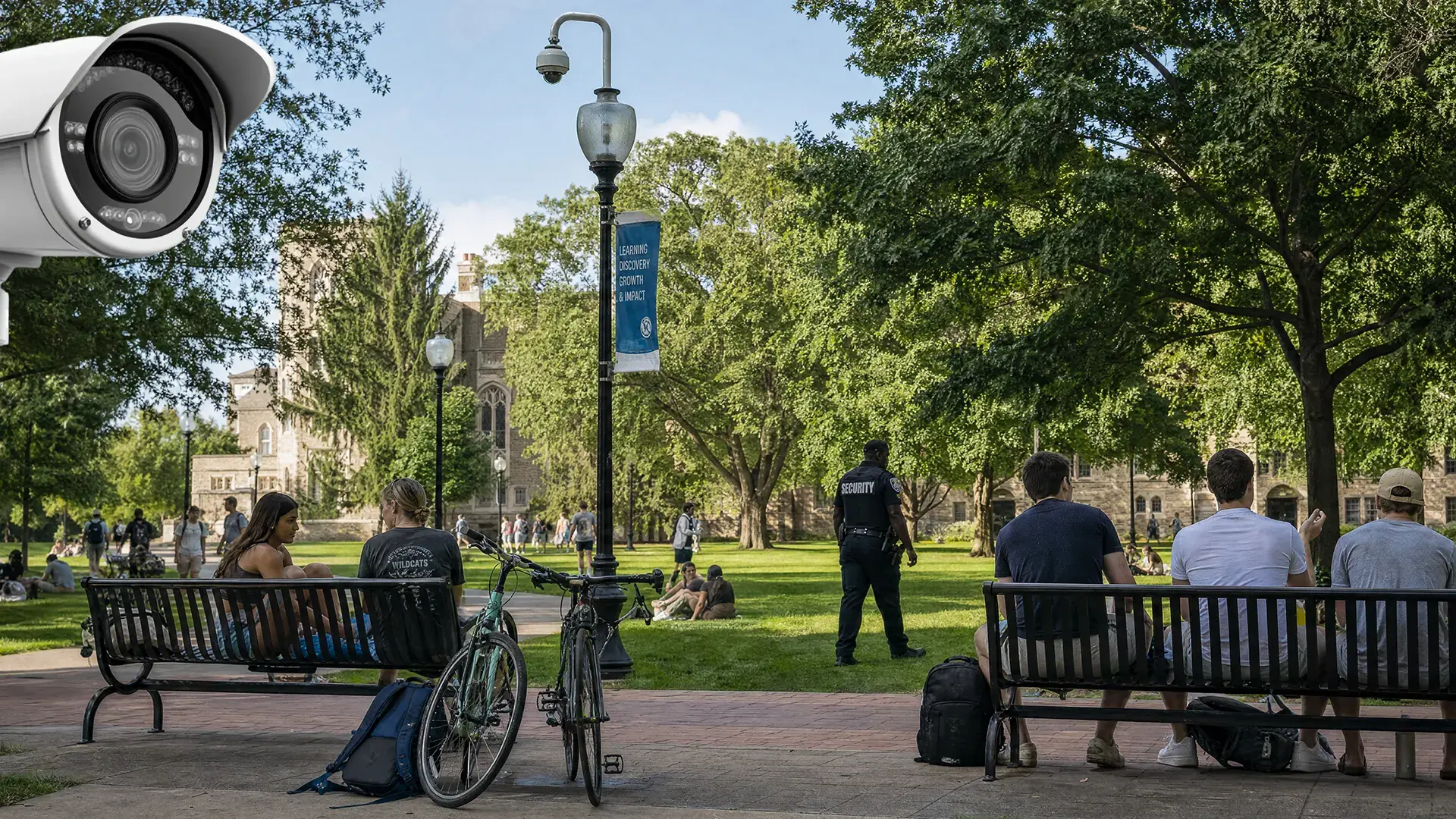
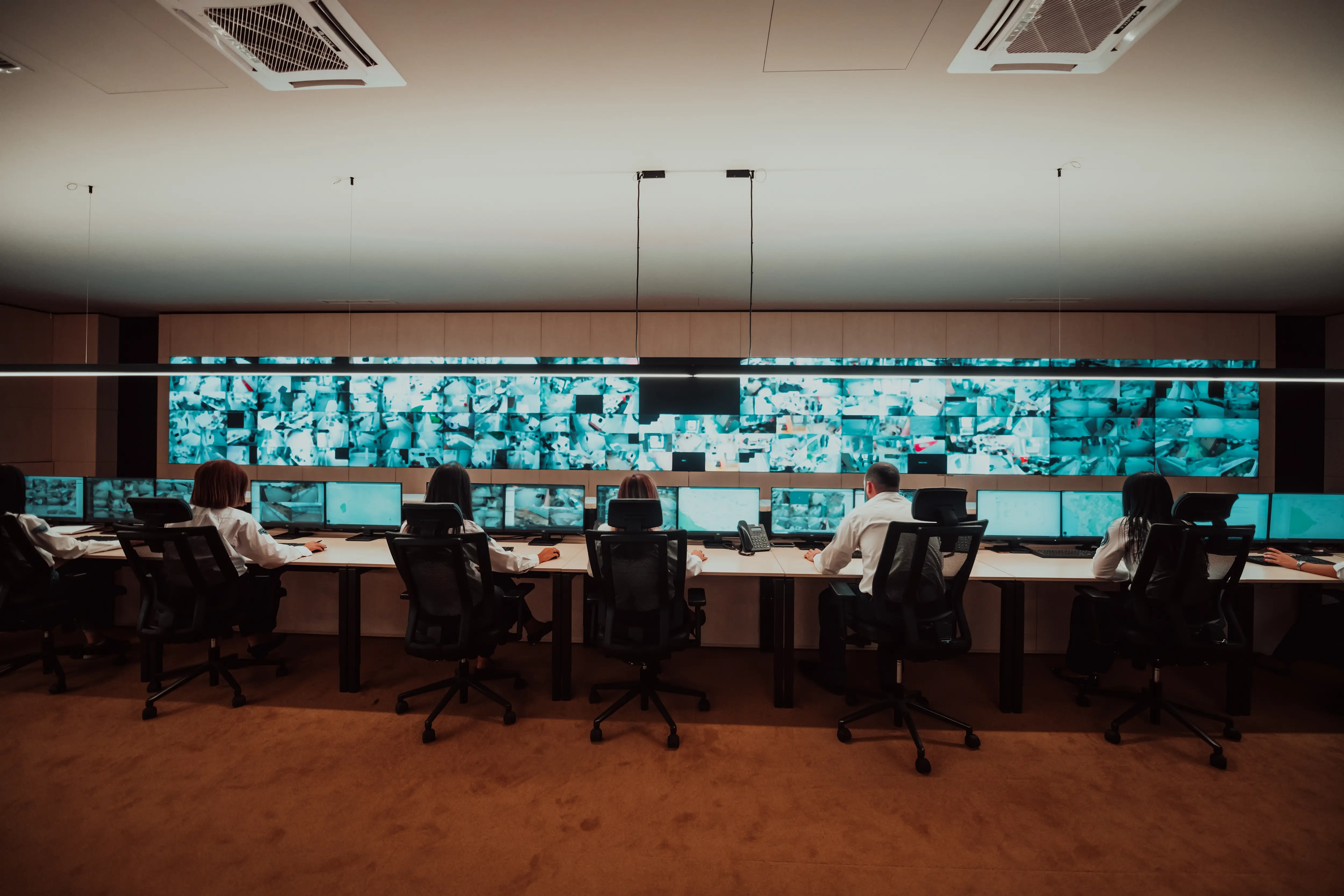
Walk into almost any American school district or university built out over the last fifteen years and you will find cameras, hundreds of them at a mid-size district, thousands at a large university, purchased in waves after each national tragedy, bolted to hallways and entrances and parking structures, all recording faithfully onto servers that overwrite themselves every few weeks. Now ask who is watching them. The honest answer at a typical district is nobody, or nearly nobody: a front-office monitor showing sixteen rotating tiles, a safety director who pulls footage after something happens, a campus police dispatcher with other duties. The cameras were bought to deter and to document, and they do both imperfectly, and the thing everyone quietly wanted them to do, notice trouble while there is still time to act, was never something a wall of unwatched monitors could deliver. This guide is about closing that gap with AI on the camera network a school already owns, what is genuinely detectable today, how detection becomes response without cutting humans out of decisions that must stay human, and how the same system serves the investigation and privacy obligations that make education different from every other setting where this technology runs.
Why districts are looking at this now
Three pressures have converged on school and campus safety leaders, and it is worth naming them because they shape what a defensible program looks like.
The first pressure is the simple arithmetic of attention. Districts kept adding cameras and never gained watchers, and the ratio is now absurd everywhere: one human cannot monitor forty feeds, let alone four hundred, and the research on vigilance says attention against a monitor wall decays in minutes. Every camera added without analytics widened the gap between what the district records and what it notices.
The second is the money, which for once is real. The federal School Violence Prevention Program makes up to $73 million available in FY26 for K-12 security improvements, with awards carrying a federal share of up to $500,000 over 36 months against a 25 percent local match, and reserved microgrants up to $100,000 for rural, tribal, and low-resourced districts. Its statutory purpose areas include coordination with law enforcement, physical security measures, and notification technology, which is precisely the territory this guide covers, and our companion article on school safety grants walks the funding landscape in detail.
The third pressure is the mandate environment that states keep tightening. States have moved from encouraging school safety technology to requiring elements of it, most visibly the panic-alert laws in the Alyssa's Law family, which require silent alarms linked to law enforcement in the states that have adopted them. Mandates of that shape assume something the camera wall never provided: that the school can know, quickly, that something is happening. Detection is how the knowing part becomes real.
What the cameras can already detect
The foundation layer is trained detection running continuously against the streams the camera network already produces, and for schools the detection types that matter are specific and worth stating plainly, alongside what each honestly requires.
Weapon detection watches for guns and knives in view of a camera and raises an alert with the frame attached, and it deserves its sober framing: it is a seconds-matter early-warning layer for the visible-weapon scenario, not a guarantee against concealment, which is why it complements rather than replaces every other measure a district runs. Our article on weapon detection in schools covers the verification and response chain that has to sit behind the detection for it to mean anything.
Intrusion and after-hours detection turns the perimeter and the schedule into rules: a person on the grounds at 2 a.m., entry through a door that should be closed, presence in a wing the school locked an hour ago. Zone rules drawn on each camera's view, with schedules attached, catch the difference between the community using the track on Saturday and someone working the doors on Sunday night, and our article on after-hours intrusion at school sites covers the tuning that keeps the difference clean.
Crowding and congestion rules watch density where schools actually have problems: the hallway crush between periods, the cafeteria line, dismissal, the event exit. A crowd rule fires when the count in a zone exceeds what the space should hold, which is operational information on an ordinary day and safety-critical information on a bad one, since fights draw crowds before staff hear about them, and sudden convergence is often the first visible signal that something is wrong. The dismissal-and-arrival window, when the entire student body and a fleet of buses and parent vehicles share the same edges of campus, gets its own treatment in our article on crowd and dismissal monitoring.
Person-down detection covers the medical half of school safety that the security conversation forgets: the student collapse in a stairwell, the staff member alone in a gym, the injury on a far field. Detection of a person down, held past a dwell threshold to separate the sitting from the stricken, dispatches help measured in seconds rather than in however long it takes someone to walk past, and our article on person-down and medical emergencies covers response design, which matters more than detection tuning.
Fire and smoke detection from cameras is a supplemental visual layer, and the word supplemental is doing regulatory work: certified alarm systems remain the systems of record, and the visual layer adds earlier sight of smoke in camera view and precise location context when the certified system activates. The boundary is drawn carefully in our article on fire and smoke as a second set of eyes.
Two properties run underneath every class on that list. Tracking keeps one person one object across frames, which is why one intruder is one alert rather than two hundred, and per-camera, per-detection-type confidence and severity settings are what keep the alert channel trusted, the same tuning discipline every deployment lives or dies by.
When fixed detectors are not enough
Some of what worries a school cannot be enumerated in advance, and honest vendors say so. A fight looks like a crowd until it does not. A person moving through three buildings checking doors is composed entirely of legitimate elements. The situations that make a safety director's instinct itch are contextual, and fixed detectors have no context.
The layer that addresses this puts a written question to footage: frames cached from the live pipeline are analyzed by a multimodal model against plain language, describe what this group near the gym entrance is doing, does anything about this person's movement through these hallways look unusual. The question is authored rather than picked from a menu, the analysis covers a sequence rather than a frame, and the answer arrives seconds later as a structured event with the clip attached. In the architecture that works, this is the second look in an escalation chain: the cheap continuous detectors flag what might matter and the model examines the moments flagged. Whether the model looks before anyone is paged or in parallel with the page is written policy rather than fixed plumbing, set per detection type and severity: ambiguous, low-stakes flags are screened first so only what survives interrupts a human, while the gravest detections page immediately and the model's reading catches up into the same alert seconds later. Either way the human receives the detection, the model's reading, and the footage together.
The guardrails here are not fine print, they are the difference between a defensible program and a scandal. This layer describes observable situations, aggressive physical interaction, unusual movement, a gathering crowd; it is not bullying detection, not emotion recognition, not a threat-assessment oracle. Software wearing those labels does exist, but what it measures is not what it claims to know: an expression classifier reads faces rather than feelings, the research maps expressions to actual emotional states far too loosely to act on, and the European Union's AI Act now prohibits emotion inference in schools altogether. A vendor using those phrases is selling inference dressed up as observation. Every answer depends on the question's wording, so questions live in a governed register with controlled authorship; no accuracy percentage exists for open-ended visual analysis, so trust is calibrated on the school's own footage during commissioning; and the analysis runs seconds behind the moment, which suits triage and disqualifies it from split-second autonomy, a boundary the response section below makes structural.
From detection to response
Detection that ends in a dashboard is a liability with a login. What a school needs is the path from validated event to coordinated response, and this is where positioning honesty matters most, so it gets stated flatly: this platform is the visual intelligence and orchestration layer. It does not replace access control, mass notification, dispatch, or certified fire systems, and a district should not want it to. What it does is detect, add context, and route validated events into the systems the school already operates, through integrations, under policy the institution defines.
Concretely, the orchestration layer means an event can notify the right people with the evidence attached, email and SMS to roles by zone and severity, the snapshot in the message; can invoke external systems through their APIs, the access-control platform that executes a door action, the notification system that sends the campus alert, the dispatch interface that reaches responders; and can follow institution-defined workflows in which severity, location, and schedule determine who approves what before anything irreversible happens. The lockdown case is the sharpest version and gets its own article, from detection to lockdown, whose one-sentence summary is the policy every district should demand: automation assembles and accelerates the decision, and a named human makes it, with fail-safe defaults for every component in the chain.
K-12 districts versus university campuses
The same platform serves a school district and a university, and pretending the deployments are identical serves neither, so the differences deserve a section of their own.
A K-12 district is a fleet of small perimeters: dozens of buildings, each with a front office that is the real security operations center, staffed by people whose job title is not security. Detection has to arrive as simple, pre-triaged, snapshot-attached alerts to named people, the principal, the School Resource Officer (SRO), the head custodian on evenings, because there is no dispatcher to interpret ambiguity. The schedule is the district's best tuning asset, since a school's rhythm is rigid enough that after-hours, class-change, and dismissal each get their own rule sets, and the camera network is centrally managed, which means a district can standardize configuration across forty buildings and monitor from the district office while alerts route locally. Parents, not students, hold the Family Educational Rights and Privacy Act (FERPA) rights, the works-council dynamics of the industrial world are replaced by school boards and community meetings, and the program that thrives is the one the superintendent can explain in two minutes at a podium.
A university is one large perimeter with a city inside it: open campus, 24-hour buildings, a sworn police department with an actual dispatch operation, tens of thousands of adults who are also rights-holders under FERPA themselves. Here the detection layer feeds a real security operations center, the escalation chain earns its keep against far higher event volume, and integration with dispatch and mass-notification systems is the difference between analytics and operations. Residence halls raise privacy stakes that detection typeroom corridors do not, campus police departments can maintain law-enforcement-unit records outside FERPA's education-record definition, a distinction our FERPA article treats carefully, and the governance conversation runs through faculty senates and student government as well as administration. Same detection types, same architecture, different owners, thresholds, and politics, and an experienced deployment plan writes them down separately.
Investigation and evidence
Every serious school incident becomes an investigation, disciplinary, legal, insurance, or all three, and the same platform that detected the event holds what the investigation needs: event-triggered clips with footage from before the trigger, cross-camera timelines assembled on one clock, search over described footage in plain language, and an audit trail over every view and export. Our article on investigating a school incident from footage walks the practice.
Education adds a legal layer nowhere else has. Under FERPA, per the Department of Education's guidance, a video becomes an education record when it is directly related to a student and maintained by the institution, and the Department's examples are exactly the footage this guide is about: the hallway fight used for discipline is directly related to both students, the health emergency becomes the focus of the video. Parents can inspect it, other students in the frame must be redacted or segregated where reasonably possible, and the school cannot charge parents for the redaction. That last clause deserves a beat of attention, because it converts redaction from an occasional courtesy into an operational capability a district needs on tap, and it is why redaction sits beside detection in this platform family rather than in a separate procurement. The full governance picture, including the law-enforcement-unit records exception and retention design, lives in our article on FERPA and camera AI.
Student privacy by architecture
A program watching minors answers to a higher standard, and the answers have to be structural. No identification by default: safety analytics needs to know that someone is in the science wing at midnight, not who, and face recognition stays off for safety use cases. Cameras stay out of every space with an expectation of privacy, which is also why the bathroom vaping problem belongs to air sensors, not to this technology. Access is role-based and every view and export is logged; retention is short and stated, with incident-linked clips preserved on documented holds; the scope of what is watched and asked lives in a written register the board and the community can see; and for institutions that want processing kept entirely inside their own walls, the whole stack runs on premises, which is also where a latency-sensitive live workload belongs on the engineering merits alone. Districts that lead community conversations with this architecture, before the first camera is enrolled, get programs the community defends; districts that lead with capability get board meetings they remember.
The first year, quarter by quarter
Sequencing determines whether this program compounds or stalls, and the year that works has a shape. The first quarter is one building or one zone of campus, silent: detection running, nobody paged, a baseline accumulating of what the camera network actually sees, which doors get tried, where crowds form, what the after-hours pattern truly is. The silent period also produces the artifact every later conversation needs, real events from the school's own cameras, which is what turns board presentations and community meetings from hypotheticals into footage. The second quarter turns on alerts for the highest-severity, best-tuned detection types, weapon detection and after-hours intrusion first, with the response drill run before the first real page, and the escalation chain's second look absorbing ambiguity so front offices are not flooded. The third quarter extends coverage and adds the operational classes, crowds, person-down, buses, and begins the monthly review discipline, alerts against dispositions, time-to-acknowledge, corrections closed. The fourth quarter adds the investigation and orchestration layers where the district is ready, and takes the results, measured response times, real events caught, the near-miss record nobody previously had, into the budget and grant cycle. Districts that attempt all of it at once buy a year of noise; districts that walk this sequence end the year with a system the staff trusts, which is the only kind that survives.
Where this is the wrong tool
Cameras cannot see what does not reach a lens: the concealed weapon, the bathroom, the threat that arrives through a screenshot at midnight. Detection does not replace threat assessment teams, counseling, and climate work, which remain the layers that prevent rather than intercept. Metal detection, certified fire alarm, access control hardware, and mass notification are systems this platform triggers and enriches, not systems it replaces. And a district whose real gap is that nobody currently answers alarms at all should fix the response chain before buying more detection, because unanswered alerts are worse than no alerts: they document what nobody acted on.
How VIDIZMO approaches it
VIDIZMO AI Live Insight runs the detection layer on the cameras a district or campus already owns, reading standard Real-Time Streaming Protocol (RTSP) and ONVIF (Open Network Video Interface Forum) streams from the cameras and its Video Management System (VMS), with processing on the institution's own hardware. Detection types, zone rules, schedules, confidence, and severity are configured per camera; events raise alerts, land on a timeline, and trigger event-based recording in the same motion; and clips inherit the access control, retention, and audit logging of the VIDIZMO Nexus portal the deployment works side by side with. AI Intelligence Hub adds the written-question analysis, the agentic workflows that orchestrate response through external systems, and the investigation assembly, licensed separately because plenty of districts run detection alone first. Redaction, when FERPA obligations demand it, is part of the same platform family rather than another vendor.
Where to go next
The articles beneath this guide go deep where a paragraph here had to summarize: after-hours intrusion, weapon detection, fights and aggression, crowds and dismissal, person-down events, fire and smoke, school buses, unusual activity, lockdown and response, incident investigation, FERPA, and grants. Read the ones that match this year's board priorities first; the architecture underneath them is one system, and it is the same system whichever door a district enters through.