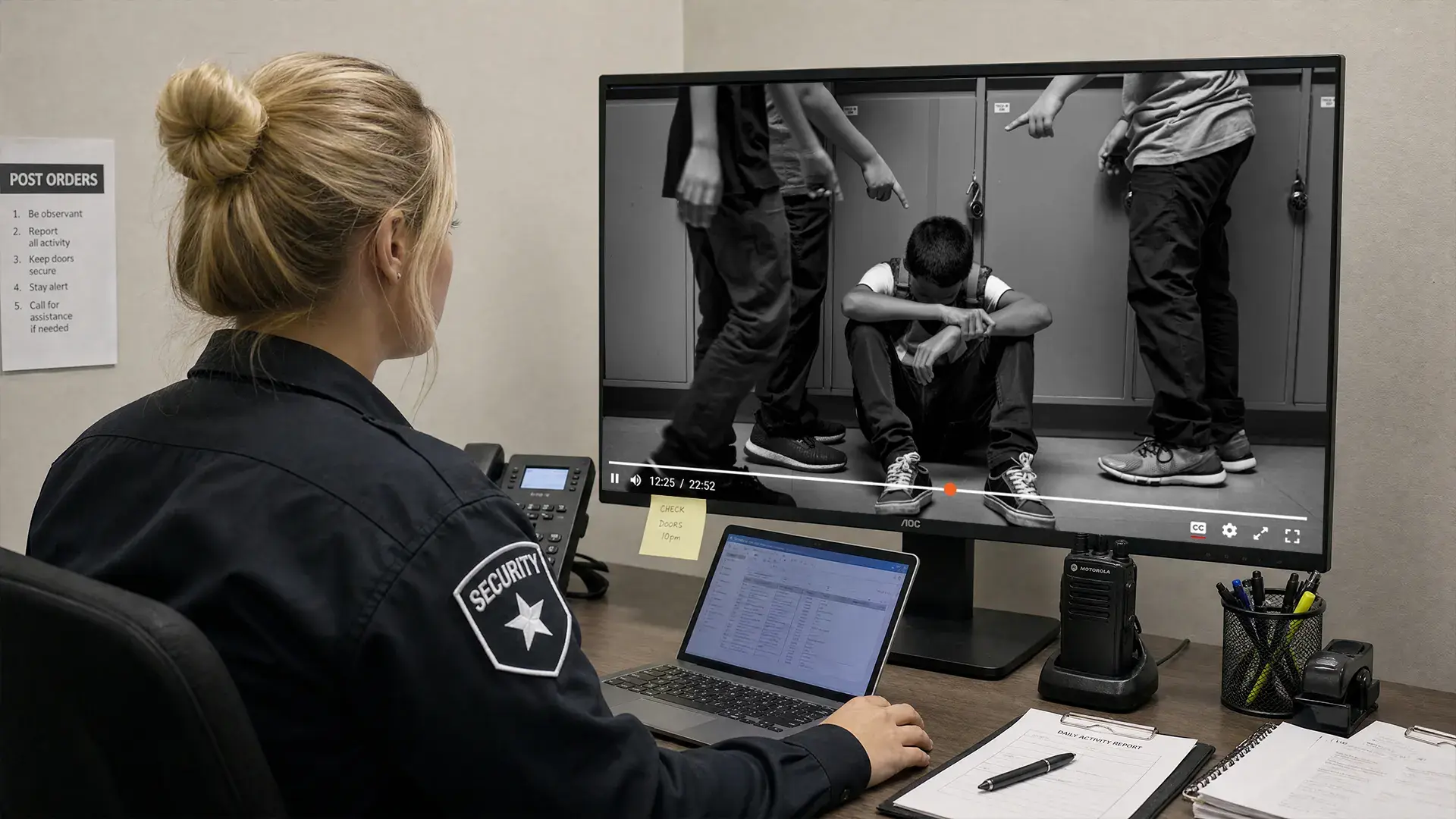
A school incident investigation has more audiences than any other kind this platform family serves, and each one changes what the record must be. The disciplinary process needs facts a hearing can rely on. Parents have inspection rights the law grants and emotions no process fully contains. Law enforcement may need evidence that survives prosecution. Insurers and plaintiffs' counsel will test the handling of every clip. Title IX and civil-rights processes carry their own procedural machinery. And the student body itself, phones out, is often circulating its own footage of the event before the administration has found the official version. Into that thicket walks an assistant principal with a Video Management System (VMS) login and an afternoon, scrubbing hallway cameras for the thirty seconds that matter. This article is about doing the whole job properly, from the first hour to the file that satisfies every audience, and it belongs to our full guide on AI video analytics for school and campus safety.
The first hour: hold everything, touch nothing
The investigation's fate is substantially decided before anyone reviews a frame, in the preservation decisions of the first hour, and the discipline transfers from every serious evidence practice.
The hold comes first and reaches wider than instinct: not just the camera that saw the fight or the fall, but the cameras on the routes to and from it, for a window reaching well before the event, because school incidents in particular have prologues, the argument at lunch, the group that followed, the door that was propped, and the prologue is routinely where responsibility actually lives. Where detection was running, the work is mostly done, event-triggered clips with pre-event footage already exist as discrete objects, and the hold is applied against routine retention the same day. Where only continuous recording exists, someone must find and export the spans before the recorder's cycle eats them, and school retention cycles are short enough that a slow week destroys the answer.
The touch-nothing half is cultural and it is where schools most often stumble: no phone recordings of the monitor, no clips emailed to whoever asked, no copies on the front-office desktop, because every uncontrolled copy is a future provenance problem and, in a school, a future privacy violation, given who is in the frame. The footage stays in the governed system, viewing happens through logged access, and the first hour's rule fits on a sticky note: preserve wide, share nothing yet.
Building the timeline
The analytical work is the same temporal assembly this platform family runs everywhere, with school-specific texture. Multi-camera synchronization turns the corridor camera, the stairwell camera, and the exterior door camera into one timeline, which is where school incidents give up their causation: who followed whom, which direction the group came from, what the third student did before the first push. Frame-by-frame advance resolves the disputed instant, who swung first being the eternal school question, and the difference between the accounts is usually a handful of frames.
Search is what changes the labor arithmetic of the whole exercise. Descriptions generated over the footage make it queryable in plain language, students gathering near the east stairwell, a person entering through the propped door, and the archive answers in moments rather than in an afternoon of scrubbing, which matters most for the questions that reach beyond the incident itself: had this happened before, was that door propped routinely, did the same group gather there last week. The event history answers in seconds what canvassing staff answers in days, and the written-question layer reads the ambiguous clip, describe the sequence of contact between these students, as a second reading beside the investigator's own, with the standing disciplines, the prompt preserved in the file, no accuracy pretensions, the reading informing judgment rather than replacing it.
The footage-first-then-interviews sequence works in schools exactly as it works everywhere: shown a timeline, students and staff stop defending recollections the video contradicts, the argument about what happened evaporates, and the conversation moves to what only they know, why, what was said, what preceded the cameras' view. Interviews get shorter, less adversarial, and fairer, and the wrongly accused, a population every school investigation risks producing, are cleared by evidence instead of exhausted by process.
Who will use the record
Now the thicket, audience by audience, because the record must be built for all of them at once.
The disciplinary process makes the footage an education record: under the Department of Education's the Family Educational Rights and Privacy Act (FERPA) guidance, video used for discipline is directly related to the students involved, parents may inspect it, and the other students in frame must be redacted or segregated where reasonably possible, at the district's expense, before that inspection. Our FERPA article covers the doctrine; the operational consequence belongs here: redaction is part of the investigation workflow, not an afterthought, and the file should assume from day one that parents of every involved student may lawfully see their child's portion.
Law enforcement's involvement introduces the parallel track of the record. Where a school's own police or School Resource Officer (SRO) maintains law-enforcement-unit records, FERPA treats those differently, and where an outside agency takes the case, the district's disclosure runs through its own counsel and policies, with the export controlled, logged, and redacted for uninvolved students as appropriate. The practical rule: one incident may lawfully produce two differently governed files, and the district's copy keeps its own integrity regardless of what the agency does with theirs.
Civil exposure tests the handling discipline above everything else. Slip-and-falls, transportation claims, supervision-failure allegations, all eventually ask the same questions of the record: is the footage complete, is the chain of custody clean, who has viewed and exported it, and was anything altered. The platform disciplines this series specifies everywhere, hash-verified integrity, view and export audit logs, holds that outlive routine retention, are the answers, and they cost nothing to run from the first day and everything to reconstruct afterward.
And the community audience, parents at a meeting, sometimes the press, gets served by the same record differently: the district that can say precisely what happened, when, and what it did, because its file is assembled and verified, holds the narrative; the district still scrubbing footage on day three is governed by whatever circulated on the students' phones on day one.
Title IX and formal processes
A subset of school investigations runs under procedural machinery with federal shape, Title IX matters most prominently, and the video record enters those processes on their terms, not the safety office's. The practical accommodations are worth naming. Access narrows further: the footage relevant to a Title IX matter is viewed by the roles the process designates, coordinators, investigators, decision-makers, and the audit log of who saw what becomes part of demonstrating the process's own integrity. Both parties' procedural rights reach the evidence, which in video terms means both sides may need to view the same clips under the same conditions, with the redaction of uninvolved students handled once, consistently, rather than negotiated per viewing. And timelines lengthen: these processes run months where discipline runs days, so the holds applied in the first hour must anticipate the longest process the incident could enter, not the shortest. None of this changes the platform disciplines, it consumes them, and the coordinator who discovers the safety office can produce a synchronized, redacted, access-logged evidence package in a day rather than a month tends to become the program's most unexpected advocate.
After the finding
School investigations end in findings and corrective actions, discipline, supervision changes, a physical fix, a procedure revision, and the loop this series closes everywhere closes here too: the zones keep watching, and the after picture is measurable. The corner that produced the fight gets its supervision repositioned, and the convergence record shows whether events actually fell; the propped door that admitted the intruder gets its alarm, and the after-hours record verifies the fix held. Aggregated and anonymized, the investigation record also feeds the annual safety review the way every measured program in this series does: incidents by type, location, and period, time-to-resolution, and the corrective actions with their verification, which is the difference between a district that has incidents and a district that learns from them.
The time this saves
The compressed version of this article is a labor story, and it deserves telling in those terms because investigation time is the district resource nobody budgets. Before: the assistant principal loses an afternoon to scrubbing, the SRO burns a morning copying files for the agency, the records office fields the parent request with dread, and the Title IX coordinator waits weeks for a package that arrives as a folder of unlabeled clips. After: the event history surfaces the relevant moments in minutes, the timeline assembles in the same system that holds the evidence, the redacted parent copy is a workflow product rather than a project, and every audience's copy carries its provenance with it. Multiply by a school year's incident volume and the capability pays for itself in administrator hours alone, before any weight is given to the cases where the quality of the record decided the outcome, which are precisely the cases nobody can afford to discover the gap in.
How VIDIZMO fits
VIDIZMO's platform runs this article end to end. AI Live Insight's event-triggered recording preserves the moments with their prologues; the Nexus portal holds them under role-based access, hash-verified integrity, audit-logged viewing and export, and retention holds applied per clip; search over described footage and the event history answers the assembly questions in minutes; the written-question layer reads the ambiguous sequences with the prompt preserved; multi-camera timelines and frame advance run in the same system the evidence lives in; and redaction for the FERPA and disclosure obligations is part of the same platform family, so bystander students are masked without the footage ever leaving governed custody. The student-phone problem deserves its own answer, because it now shadows every school investigation: by the time the official file is assembled, edited fragments have circulated, and the district is answering a narrative built from the worst thirty seconds shot from the worst angle. The official record's value in that environment is not speed of publication, footage of students is not for publishing, but authority in the rooms that matter: the hearing, the agency review, the parent meeting, where the complete, synchronized, provenance-clean timeline quietly outweighs any fragment. Districts that understand this stop racing the rumor and start outlasting it, and the investigation practice this article describes is what makes outlasting possible.
Universities scale every element of this article and add one: the sworn campus police department, whose cases run under criminal procedure while student-conduct processes run in parallel on the same footage. The two-file discipline becomes daily practice rather than an edge case, the evidence platform's role-based access is what keeps the conduct office out of the criminal file and vice versa until policy says otherwise, and the export log is what lets the general counsel answer, under oath if necessary, exactly who had what when. Large districts with their own police units inherit the same shape at smaller scale, and the design lesson is identical: build the two-track handling before the case that needs it, because the case that needs it will not wait for the configuration.
One boundary keeps the whole practice inside its lane: the investigation record describes events, not children. The no-identification default holds through the investigative layer, names attach through the school's human processes, the question register's education rules forbid targeting any student, and the pattern analytics that feed the safety review stay aggregate and anonymous. An investigation capability this strong stays trustworthy only inside that discipline, which is why it is architecture here rather than promise.
The readiness drill costs an afternoon and answers everything: take the school's last significant incident, and time how long the current setup takes to produce the synchronized footage, the ninety-day pattern for that location, the redacted parent-viewable copy, and the access log for who has seen the material. The gap between that afternoon's answer and this article is the project plan.