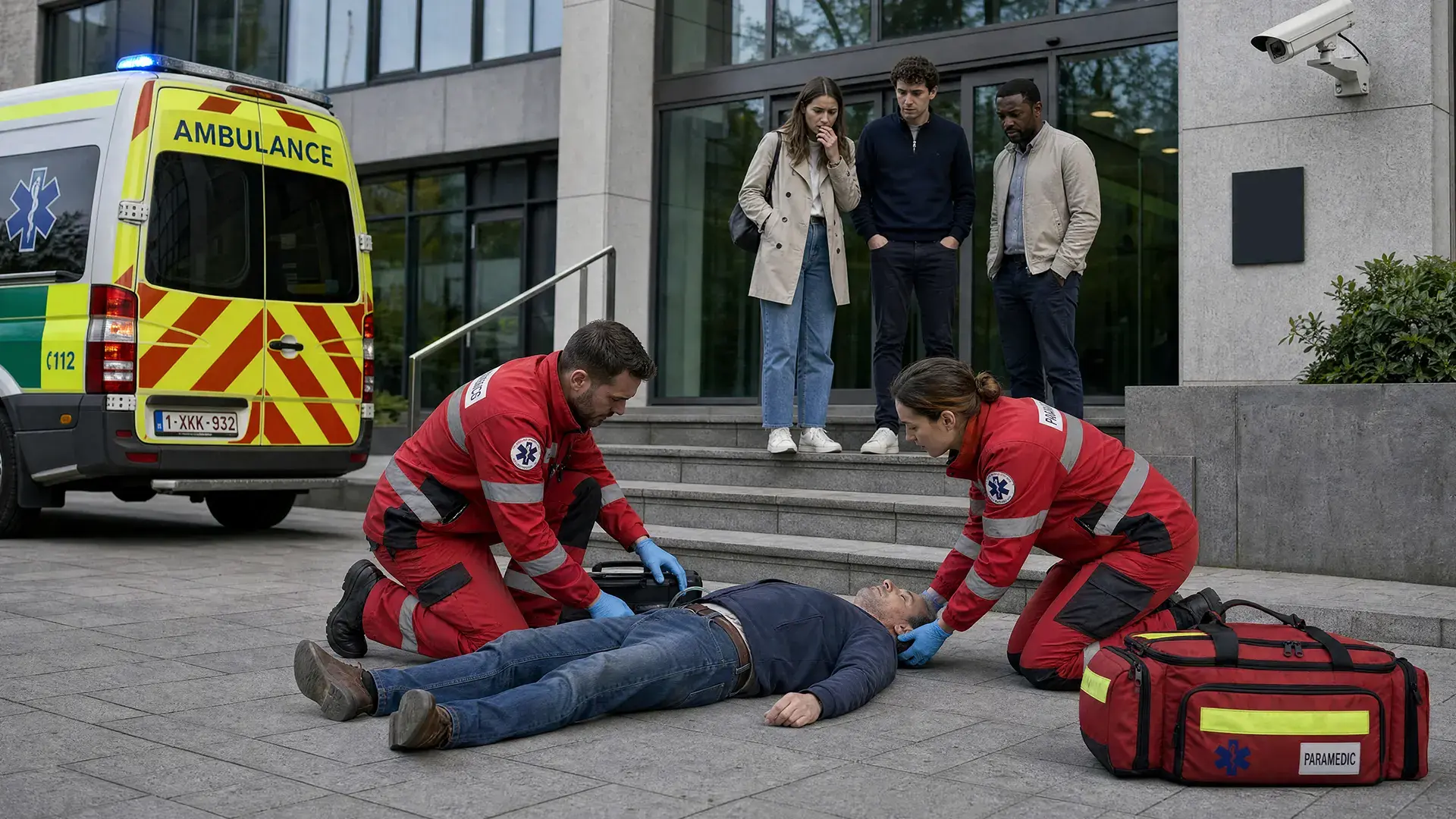
School safety planning orbits the catastrophic scenarios, and meanwhile the emergencies that actually arrive, year in and year out, are medical: the athlete down at practice on the far field, the staff member's cardiac event in an empty gym, the seizure in a stairwell between classes, the student with a severe allergic reaction in a corridor after the bell, the fall on the ice by the buses. Every one of those runs on the same clock, the interval between the event and the first trained responder, and on most campuses that clock is set by luck, by whether anyone happened to be walking past. A campus is a big place that is mostly empty most of the time, its population concentrates and disperses on a bell schedule, and the person who goes down two minutes after a corridor clears can lie there for the length of a class period. This article is about using the cameras already covering those spaces to cut that interval, and it belongs to our full guide on AI video analytics for school and campus safety.
How person-down detection works
Person-down detection watches for the visual signature of a person on the ground, and the engineering honesty this platform family maintains everywhere applies here with full force. A fallen person is a person in an unusual posture, not a distinct object, and postures vary with camera angle, distance, and what the person fell against or behind, which is why credible fall detection is delivered as a trained capability validated on the deployment's own cameras rather than a checkbox on a datasheet. Time is the second signal that makes the first one deployable: a person who goes down and gets up is a slip worth a log entry, a person who goes down and stays down is the emergency, and dwell logic over the tracked detection separates them, so the alert channel pages on the stricken rather than the stretching.
For the ambiguous residue, the escalation chain runs at its most humane here: the flagged clip goes to the written-question second look, does this person appear to be in distress or resting, and the answer arrives in seconds to decide the escalation, which matters on campuses precisely because campuses are full of people legitimately sitting and lying down, students sprawled in commons, athletes stretching, toddlers at the elementary playground doing whatever toddlers do. The second look is what lets coverage extend into those spaces without drowning the school nurse in false pages.
Where the capability changes outcomes is a coverage question, and the campus map that matters is the one nobody usually draws: the places a person could go down unseen. Stairwells between classes. The far athletic fields and the track at dawn. Parking structures and lots at the schedule's edges. Locker-room corridors, not the rooms themselves, which stay uncovered for privacy reasons stated in the program's register. The pool deck's approaches. Service corridors and mechanical spaces the custodial staff work alone. The elementary playground's blind corners. At a university, add the library stacks at 2 a.m., the residence-hall stair towers, the campus edges where town meets gown. That map, walked once with fresh eyes, is the deployment plan, and it is routinely the argument that funds it.
Treat every alert as a dispatch
Everything this platform family teaches about worker-down response in industrial settings transfers to campuses, with the school-specific twist that the responder population is richer than most plants enjoy: school nurses, athletic trainers, School Resource Officers (SROs), coaches with first-aid training, and at universities a dispatch operation with Emergency Medical Services (EMS) relationships. The design work is routing the alert to the right subset with the evidence attached.
The pattern that works routes by zone and schedule. The field alert goes to the athletic trainer and the nearest coach during practice hours, to security after them. The stairwell alert goes to the nurse and the nearest front office during the school day, to the on-call chain at night. Every alert carries the camera, the location, and the snapshot, so the responder moves toward a place with a picture rather than a guess, and acknowledgment with escalation ensures an unanswered page climbs rather than expires. Automated External Defibrillator (AED) locations deserve a line in the routing design: the responder message that includes the nearest AED cabinet for that zone costs one configuration field and pays for the whole system the day it matters.
Drills make it real, exactly as the industrial version of this article prescribes. The first month's false positives are free drills if the program treats them that way, each one timed from alert to arrival, and the gaps the timing exposes are almost never technological: the trainer's phone in a locker during practice, the after-hours path assuming a staffed office, the responder who did not know which stairwell camera 14 watches. Every one is fixable the week it is found, and invisible until timed.
Protecting lone workers and late hours
Schools carry a lone-worker population nobody calls by that name, and the industrial half of this platform family would recognize them instantly: the custodian working a wing alone at 9 p.m., the coach closing the field house, the kitchen staff in at 5 a.m., the librarian on the late shift, the maintenance tech on the roof. Every one of them works stretches where a collapse would be discovered by the morning, and every one of them has done the private arithmetic about it. Coverage of their routes and stations, the corridors, the mechanical rooms' approaches, the kitchen, the field house, paired with the after-hours duty chain, is the cheapest meaningful protection a district can extend to its own employees, and it tends to be the part of the camera-AI program the staff themselves champion, for the same reason industrial lone workers do: the system is unambiguously for them.
Universities multiply the pattern across a city's worth of territory and add the population that makes campus medical response genuinely distinctive, students alone at all hours, in stair towers, in stacks, on paths between buildings at 3 a.m. A campus safety operation that extends person-down coverage along the late-night routes, paired with its existing escort and blue-light infrastructure, is adding a watcher to exactly the hours and places its own incident history says the risk lives.
Learning from response times
Response-time data accumulates into the program's own report card, and it reads differently by zone in ways that drive real decisions. The stairwell events resolve in two minutes because the nurse's office is central; the far-field events resolve in nine because the trainer's radio was the only path; the parking-structure events resolve in twelve at night because the duty chain routed through a phone in an office. Each number is an argument: for an AED cabinet at the field house, for radios on the night custodial staff, for the routing change that pages the closest human rather than the designated one. The safety committee that reviews these timings quarterly is doing for medical response what the rest of this series does for every other program, replacing impressions with measurements and measurements with fixes, and the year-over-year curve, median time from event to responder on scene, is the single most defensible number the whole camera program produces.
What cameras will not catch
A program that oversells this capability injures its own credibility, so the boundaries belong in the plan. Cameras see the collapse; they do not see the quiet medical crisis in a seated person, the diabetic episode at a desk, the anaphylaxis that starts as flushing, and the human systems, teachers who know their students, buddy protocols, remain the detection layer for those. Coverage is what it is: the locker rooms, restrooms, and residence-hall interiors that privacy rightly excludes are exactly where some medical events happen, and the program's honest answer is fast response to the covered spaces plus unchanged vigilance in the uncovered ones, never a claim of a watched campus. And detection is not diagnosis: the system reports a person down and how long, the responder brings the judgment, and nothing in the chain should imply otherwise to a parent, a board, or a court.
Those boundaries stated, the coverage argument still lands, because the covered spaces are precisely the ones where nobody else would have seen: the empty stairwell, the far field, the 2 a.m. parking structure. The alternative in those places was not a better detector. It was the length of time until luck walked past.
Documentation and aftermath
Every person-down event preserves its clip with footage from before the trigger, and the aftermath uses are the ones education institutions discover they needed. The nurse's incident report and the athletic trainer's injury documentation gain an objective timeline, when the person went down, how long until response, what happened before, which matters enormously in the concussion-protocol era, where the mechanism of a head injury on a field is exactly what the clip shows and memory reconstructs badly. Insurance claims and the occasional lawsuit meet evidence handled under the platform's standing discipline, retention holds, logged access, controlled export, with student bystanders redacted per the obligations our the Family Educational Rights and Privacy Act (FERPA) article covers, since footage of a student's medical event used in official processes sits squarely in education-record territory, and the Department of Education's guidance names the health emergency as a case where the video becomes directly related to the student. And the aggregate record, response times by zone and shift, events by location, feeds the safety committee the way every measured program in this series does, including the slip-and-fall pattern data that turns the icy northeast entrance from an anecdote into a work order.
Athletics and emergency action plans
Athletic programs deserve a closing section because they are simultaneously the highest-risk territory and the best-organized responder community on any campus. Practices and conditioning sessions put young athletes under exertion at the schedule's edges, on fields far from the nurse's office, in weight rooms before dawn, and the athletic training profession has spent two decades building emergency action plans, venue-specific protocols with responder assignments and AED maps, for exactly these spaces. Person-down coverage of the venues plugs directly into those plans as the notification layer they always lacked: the EAP names who runs to whom with what, and the detection layer answers the question the plan could never answer, which is how anyone finds out at second thirty instead of minute six when the field is otherwise empty. Trainers, in deployment after deployment across settings like these, become the capability's most fluent users, because they already think in response times, and the heat-stress season, early fall practices in August heat, is the calendar window where the progressive-collapse pattern the industrial version of this article describes, the person slowing and steadying before going down, is most visible to a camera and most survivable when caught early.
How VIDIZMO fits
VIDIZMO AI Live Insight runs person-down detection as a trained, site-validated capability on the cameras a campus already owns, on the institution's own hardware, with dwell thresholds separating the slip from the emergency, the written-question second look ahead of ambiguous escalations, and per-zone, per-schedule routing that turns each alert into a dispatch with location, snapshot, and nearest-AED attached. Events preserve their clips in the Nexus portal under role-based access, audit logs, retention with incident holds, and redaction on export, and the response-time record accumulates into the program's evidence. Note on cadence for this detection type: because seconds are the whole point, this workload runs on the institution's own hardware, close to the cameras, and the cameras carrying person-down coverage deserve the tighter inference intervals in the campus's Graphics Processing Unit (GPU) budget, a per-camera decision the commissioning makes explicitly rather than inheriting from a global default.
The deployment conversation starts with the map this article described: one walk of the campus asking where a person could go down unseen, and the map has yet to fail to make the case.