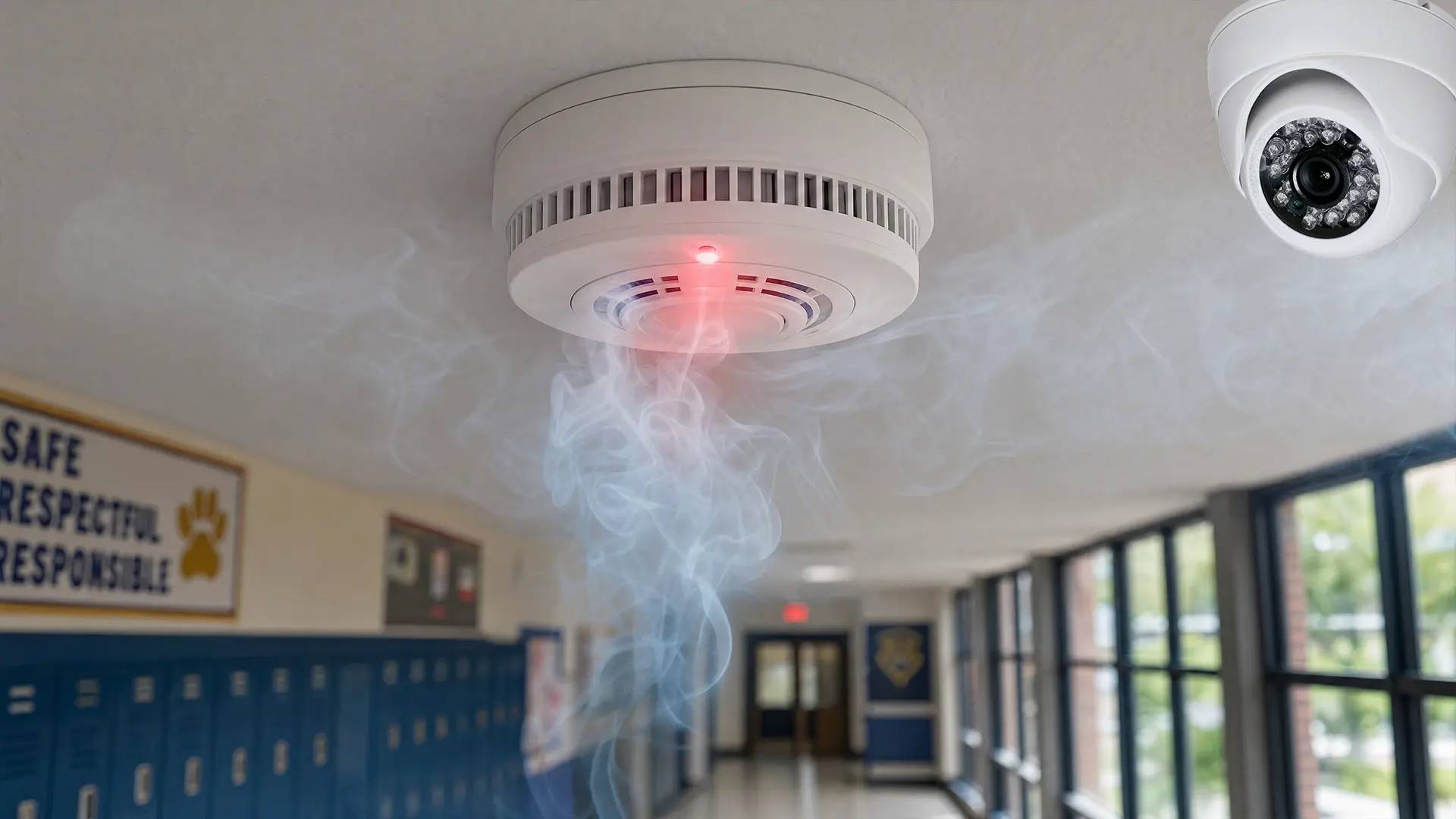
Let the first sentence of this article do the compliance work: nothing described here replaces, modifies, or competes with a certified fire alarm system, and no school should entertain a vendor who suggests otherwise. Fire detection in occupied buildings is governed territory, the certified systems are the systems of record, and their engineering, their testing regimes, and their direct lines to dispatch exist because the stakes earned them. What this article describes is a supplemental layer with a specific, honest contribution: cameras that are already watching a campus can see smoke and flame, software can now notice what they see, and the minutes and context that adds sit on top of the certified infrastructure, never beneath it. With that boundary set, the case is worth making, because the contribution is real. It belongs to our full guide on AI video analytics for school and campus safety.
Where cameras add real minutes
Certified detection is engineered around occupied interiors, and a campus has territory the code never asked it to cover. The dumpster against the back wall, where a remarkable fraction of school fires start. The roof, with its Heating, Ventilation and Air Conditioning (HVAC) units and its history of contractor hot work. The portable classrooms and storage buildings at the property's edge. The bus yard and its fuel. The athletic storage shed, the bleachers, the landscaping mulch in a drought August. Fires in those places burn openly, on camera, for however long it takes flame to reach something with a detector on it or a passerby to call, and the after-hours arson scenario, which is disproportionately a school scenario, is precisely a fire that starts outside, at night, with nobody there. A visual layer watching those cameras raises the alarm during the minutes when the fire is still a dumpster fire, and the difference between a dumpster fire and a structure fire is usually exactly those minutes.
Indoors, the visual layer's contribution shifts from first detection to context. When the certified system activates, the questions that follow are immediate and human: where exactly, how big, is it spreading, which routes are clear. A camera view of the alarmed zone answers them in seconds, for the administrator deciding on evacuation scope, for the incident commander arriving to a building they may not know, and for the fire officer who would otherwise learn the layout from a paper map on the wall. Districts that have integrated the two layers describe the same moment: the alarm sounds, and the safety office is already looking at the corridor in question, watching the smoke's actual behavior, while the panel says only zone six.
The detection types themselves are shipped rather than exotic, flame and smoke recognized in frame with per-camera confidence and severity, and the tuning realities are the honest ones: steam from kitchen vents, dust from a construction zone, fog on an exterior lens at dawn, all of them share pixels with smoke, which is why thresholds are set per camera against a silent baseline, why the written-question second look reads the ambiguous clip before anyone is paged, and why the program measures its false-positive rate the way every detection type in this series does. A visual fire alert that cries wolf weekly is worse than none, because it trains the exact people who must never hesitate.
Feeding the fire workflow, never bypassing it
Response design for visual fire events has one governing rule: the certified pathway is never bypassed, complicated, or raced. A confirmed visual fire event routes to the same humans and the same protocols the school's fire procedures already name, the facilities director, the front office, the School Resource Officer (SRO), the after-hours duty chain, with the clip attached so the confirm decision takes seconds, and the humans invoke the established emergency machinery exactly as they would for any discovered fire, including pulling the alarm when the building needs to move. Where the district's monitoring or dispatch arrangements accept video-verified events, the integration layer delivers the visual event into those channels as supporting information beside the certified system's signals, and the orchestration positioning this series maintains everywhere applies verbatim: this platform routes validated events into the school's existing emergency systems through integrations, under district policy, with humans on the irreversible calls, per the architecture our lockdown and response article details.
The drill discipline transfers unchanged: the visual layer's alerts get timed, its confirm decisions get logged, and its false positives feed the weekly tuning review, because the layer earns its place beside the certified system by behaving with the same seriousness, on a record the fire marshal could read.
After-hours arson and pre-fire conditions
Two school-specific patterns deserve their own attention, because they are where this layer pays most often.
After hours is the first, and it compounds with everything in our after-hours intrusion article: the empty-building fire and the empty-building intruder are watched by the same cameras on the same duty roster, and the arson scenario is frequently both at once, a person on the grounds at 1 a.m. and a glow behind them minutes later. A district running perimeter detection adds the fire and smoke detection types to the same exterior cameras at nearly zero marginal cost, and the combined record, who was there, when the first flame shows, which way they left, is the entire investigative file for a category of crime that historically produced nothing but ashes and a shrug.
The pre-fire condition is the second pattern, and the quieter of the two. Cameras watching for smoke also see the things that precede it: the scorch of an overloaded receptacle in a storage room, the smoke wisp from a machine in the shop wing, the barbecue someone lit under the bleachers. Treated as high-priority housekeeping events rather than fire alarms, routed to facilities with the clip, these small findings close the loop the way every early-warning layer in this platform family does, cheaply, before the consequence, with the event trail proving the program catches what it was bought to catch.
Commissioning fire and smoke detection
The tuning realities named above turn into a short commissioning discipline that keeps the layer credible. The silent baseline runs long enough to meet the campus's real steam, dust, and fog calendar, two weeks minimum, longer where kitchens and shops run seasonal schedules, and every exterior camera's dawn and dusk behavior gets reviewed, because low sun through haze is the classic false flame. Kitchen vents, wood shops, kilns in the art wing, and construction zones get named exclusions or raised thresholds, documented in the register like every scoping decision. Severity is tiered deliberately: open flame pages the full chain immediately, smoke signatures route to a fast human confirm with the clip, and the pre-fire housekeeping findings flow to facilities as tickets, three different urgencies for three different facts. And the monthly review reads the fire and smoke detection types' false-positive record with the same seriousness as the weapon program's, because both layers protect their credibility or lose their function.
The record has one more consumer worth naming: the annual insurance conversation. Property carriers underwriting school districts ask about fire protection, and a district that can show a monitored exterior grounds, logged response times to flame events, and a pre-fire findings trail with closed tickets is presenting exactly the kind of managed-risk evidence that the market rewards, the same posture shift every measured program in this series produces with its own underwriters.
What this layer is not
The boundary bears restating at the end as at the start, because procurement is where it gets tested. This layer does not satisfy any code requirement, does not replace detectors, pull stations, or notification appliances, does not shorten the certified system's path to dispatch, and does not belong in any conversation about reducing fire-protection scope. It is bought from the security and operations budget as an extension of a camera-AI program, its value case is the uncovered outdoor territory, the after-hours window, and the context it hands responders, and its governance runs through the same register, review, and audit discipline as every other detection type the campus runs. Framed exactly that way, fire officials tend to welcome it, because nobody appreciates earlier eyes on a fire more than the people who have to enter the building it is in.
Universities: labs and residence halls
Higher education stretches the case in both directions. The lab buildings, chemistry wings, maker spaces, battery storage in engineering buildings, concentrates exactly the ignition risks that reward earlier eyes, under the same certified-systems-first rule, with the visual layer watching the corridors, loading areas, and roofs around the specialized suppression the labs themselves run. Residence halls concentrate the human stakes and the false-positive challenges at once, since student life produces steam, haze, and the occasional ill-advised cooking experiment, and the halls' interior coverage follows the privacy register's rules before any fire detection type runs there; the exterior approaches, trash rooms' corridors, and rooftop views carry the load instead. And campus scale turns the context contribution into an operations-center capability: a university fire response that arrives with the affected floor already on screen, routes visible and smoke behavior watched, is running the incident on information its municipal partners rarely enjoy, which is why campus emergency managers, once shown the layer, tend to ask for more cameras rather than fewer classes.
Camera health carries fire-specific weight as well: a dead exterior camera in the arson season is a blind spot with the worst possible timing, so stream-health alerts ride the same after-hours duty roster, and the quarterly coverage audit walks the fire zones with the same standing question as everywhere else in the program, if this one failed on Friday night, when would anyone know.
Seasonal recalibration belongs on the fire and smoke detection types' calendar more than any other: wildfire smoke season, where a region has one, changes ambient haze for weeks and the thresholds with it; winter steam plumes appear at vents that ran invisible all summer; and the quarterly pass reviews the fire and smoke detection types against the current season's baseline the way it reviews everything else. The register records the seasonal profiles so next year's adjustment is a lookup rather than a rediscovery.
The record earns its keep between events too, in the fire-marshal relationship every institution manages: inspection findings about blocked egress and storage against panels are exactly the conditions the housekeeping classes already watch, and an institution that arrives at its inspection with the trend data and closed tickets is having a different conversation than one that arrives with a binder of last year's memos.
One integration note completes the picture: the visual fire layer inherits the whole response fabric this platform family builds, which means a confirmed flame event does not merely page, it can flow through the orchestration layer into the district's notification system for the affected building, land in the dispatch channel with the clip attached, and open the incident record that the after-action review will need, all under the same policy-controlled, human-approved architecture the lockdown article details. The fire drill's after-action gains the same measured character as everything else in the program, evacuation timings from the crowd layer, route usage from the flow data, and the visual record of the drill itself, which is how a safety office turns the semester's mandatory exercise into an actual engineering review of the building's worst ten minutes.
How VIDIZMO fits
VIDIZMO AI Live Insight ships fire and smoke detection types that run on the cameras a campus already owns, on the institution's own hardware, tuned per camera against a silent baseline, with the written-question second look ahead of ambiguous escalations and severity routing that treats a flame event with the urgency it deserves. Events land with clips in the Nexus portal under the standing access, retention, and audit discipline, alerts route through the duty chains the school's fire procedures already name, and the integration layer can deliver video-verified events into monitoring and dispatch channels as supporting context beside the certified systems that remain, in every sense, in charge. The natural starting scope is the exterior grounds, dumpsters, roofs, portables, yards, where the certified system was never asked to watch and the cameras already do.