The transportation department runs the district's most scattered operation and fields its most relentless stream of questions. A parent calls about something that happened on the afternoon run. A motorist reports a near miss at a stop. A driver reports damage discovered at morning check that was not there at night. A principal forwards a complaint about the loading zone. Every one of those questions has a video answer somewhere, on the bus cameras, on the yard cameras, on the school-side cameras covering the loops, and the transportation director knows exactly what answering costs: hours of pulling drives, scrubbing footage, and reconstructing which bus was where, multiplied by a fleet, multiplied by a school year. Transportation video is the district's least searched archive and its most interrogated one, and that mismatch is the subject of this article. It belongs to our full guide on AI video analytics for school and campus safety.
Yards, loops, and buses
School transportation video lives in three territories with different characters, and a sensible program treats them differently.
The yard is fixed-camera territory, and everything this platform family knows about perimeters applies directly: after-hours intrusion rules over the parking rows, vehicle and person detection with schedules, plate reads retained as searchable events, fuel-area coverage, and the vandalism-and-theft record that bus yards, sitting unstaffed at the property's edge, accumulate more reliably than any school building. A yard running the after-hours discipline stops donating catalytic converters to the night economy, and the before-and-after is a line item the fleet budget already tracks.
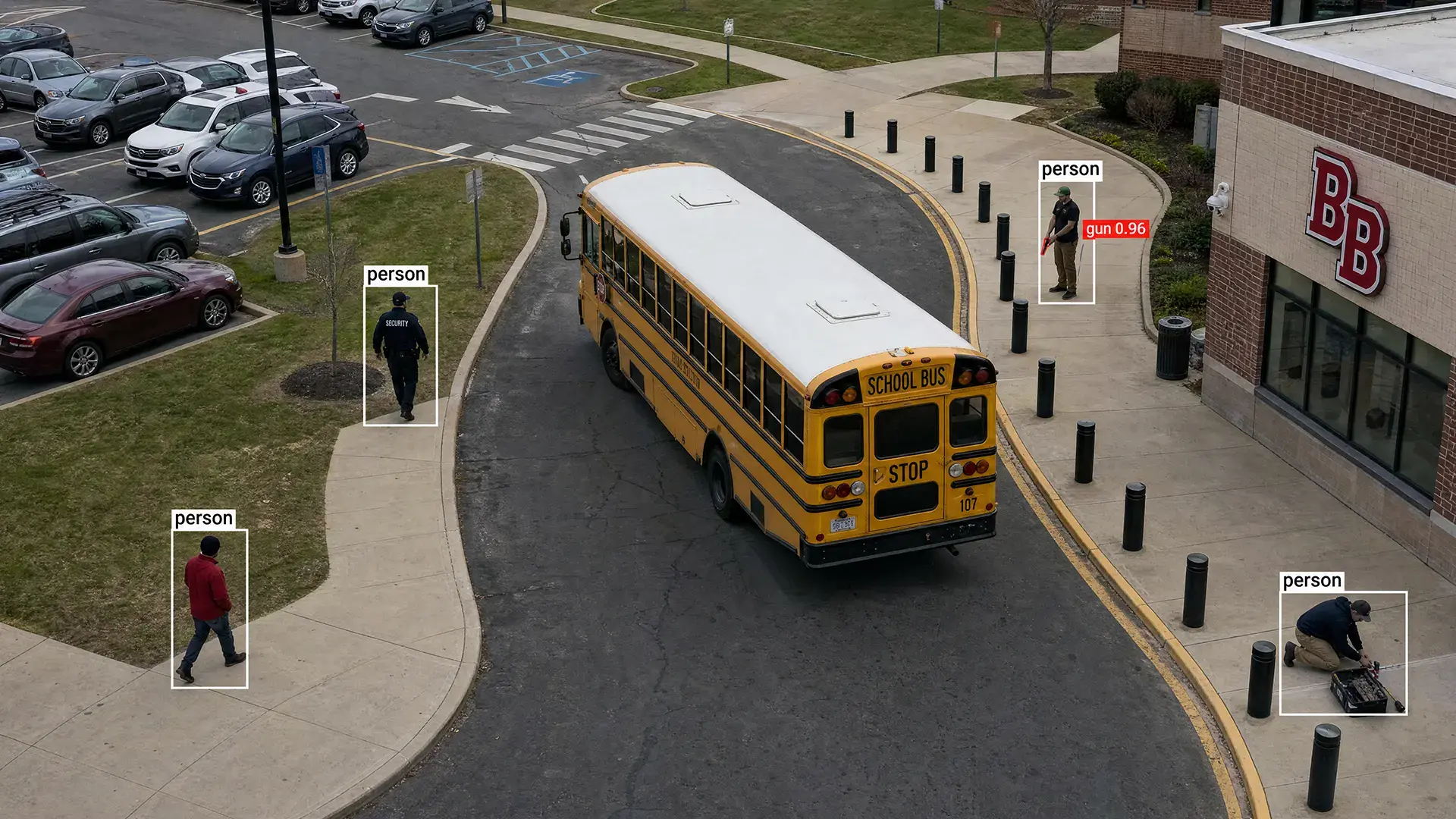
The loops and stops on school property are the shared territory with the dismissal program: the loading zones where buses and children concentrate twice daily, watched by school-side cameras running vehicle-pedestrian rules at the highest severities on campus, with the crossing events and near-miss record feeding the same physical-fix pipeline, the relocated crosswalk, the extended barrier, the repositioned aide.
The buses themselves are the third territory, and the honest scoping matters: onboard systems are their own procurement world, with stop-arm cameras and Digital Video Recorders (DVRs) the district may already run, and this platform's contribution there is not to replace them but to make their output usable, which is the next section, because the chronic problem with bus footage was never capturing it. It was finding anything in it afterward.
Answering complaints in minutes
Consider the Monday complaint in its canonical form: something happened on bus 41 Friday afternoon, a parent is certain, a student is upset, and the footage exists, somewhere in several hours across several cameras. The traditional workflow pulls the drive, copies the files, and assigns a person to watch, and the cost of that workflow is why so many transportation complaints resolve by weariness rather than evidence.
Ingested into the platform, the same footage becomes answerable. Visual descriptions generated across it make the silent interior and exterior video searchable in plain language, students standing near the rear door, an altercation near the third row, the stop where the crowd boarded. Detection events, where the district processes bus footage through the analytics layer, mark the moments worth reviewing, and the multi-camera timeline assembles interior and exterior views on one clock, so the reviewer watches the incident rather than hunting it. The written-question layer serves the ambiguous clip here as everywhere, describe what happens between the students in this sequence, with the standing cautions about recorded prompts and unquantifiable accuracy that our unusual-activity article details. What took an afternoon takes minutes, which changes not just the cost of answering but the district's whole posture: complaints get answered with evidence while they are still small, drivers get exonerated by footage as often as anything else, and the transportation office stops rationing its own willingness to look.
The Family Educational Rights and Privacy Act (FERPA) frame arrives with the territory, and transportation is where districts most often meet it: bus footage of an incident used for discipline is an education record under the Department of Education's directly-related test, parents can inspect it, and the other children in frame, which on a bus is all of them, must be redacted where reasonably possible, at the district's own expense. That obligation, unmeetable by hand at any scale, is why redaction capability sits beside search in the platform family, and our FERPA article covers the whole governance picture.
Stop-arm violations and collisions
The stop-arm problem deserves its own paragraph, because it is transportation's most public safety issue and its most evidence-hungry one. Illegal passes of stopped buses are chronic, enforcement depends entirely on capture quality and retrieval, and the dedicated stop-arm camera programs many districts run produce exactly the kind of high-volume footage that needs the plate-read retention and event search this platform provides. Where those programs feed their footage through, every read becomes a searchable record and every event a retrievable clip with the pass, the plate, and the timestamp assembled, which is what the enforcement conversation with the local agency actually requires, and which is covered by the same evidence-handling discipline every enforcement submission demands.
The same discipline serves the collision and the claim: a fleet accumulates fender benders, disputed backing incidents, and the occasional serious crash, and the district's position in each is decided by what the footage shows and whether its handling survives scrutiny. Event clips preserved with pre-event footage, held the day of the incident, viewed through logged access, exported through controlled channels with student passengers redacted, that chain, run identically every time, is the difference between footage the insurer and the court weigh and footage they argue about.
A record that protects drivers
No transportation program survives its own workforce's distrust, and drivers meet camera programs with the same reasonable wariness any monitored workforce does, so the governance this platform family runs everywhere applies with its usual force: conditions and events, not driver report cards; review focused on incidents, not fishing; the no-discipline commitment in writing with its narrow exceptions; and the record's exculpatory power stated plainly, because it is real. Drivers are the district employees most exposed to unverifiable accusations, the motorist's complaint, the parent's secondhand account, the incident that allegedly happened at a stop, and a searchable record settles those in minutes, overwhelmingly in the driver's favor. Departments that introduce the program through that lens, with the drivers' association in the room and the complaint-exoneration cases counted openly, convert the workforce from subjects to stakeholders, which is the same transformation every honest monitoring program in this series depends on.
Safety data for route planning
A season of loading-zone and stop events also accumulates into planning data the routing software never sees: which stops consistently produce crossing conflicts, which loops back up onto arterials, where the walk-to-stop routes cross traffic the maps undercount. Routing decisions that have always balanced time and distance gain a measured safety layer, and the annual route review, run against the event map, becomes the transportation version of the supervision-map conversation the fight-detection article describes, the same resources, aimed by evidence instead of memory.
One program across the district
The transportation deployment succeeds when it stops being special and becomes another territory of the district's one program: the same zones-schedules-severity configuration language as the buildings, the same silent-baseline commissioning, the same weekly false-positive review, the same duty rosters, the same portal holding the clips under the same access, retention, and audit rules, and the same scope register telling the community exactly what is watched and why. Transportation adds its own owners, the director, the yard supervisor, the dispatch desk, and its own review cadence with the fleet-safety committee, and it contributes its own metrics to the district's safety report: yard events trending down, loading-zone near-misses mapped and fixed, complaint-resolution time collapsed, stop-arm evidence packages delivered. Framed that way, the transportation program is usually the part of the district's camera-AI story the board understands fastest, because everyone on the board has waited behind a school bus, and nobody thinks the children around one deserve less than the buildings get.
Running the yard like a depot
One more territory rounds out the program, and it borrows directly from the industrial half of this platform family: the yard as a working depot. Morning pull-out and afternoon return are the yard's own rush hours, dozens of buses maneuvering among walking drivers and technicians in the half-light, and the vehicle-pedestrian rules that watch a plant's loading docks apply without modification, backing events near walking paths, pedestrians in travel lanes, the near-miss record by zone and hour. Fueling areas earn dwell and presence rules; maintenance bays earn the same person-down coverage the buildings get, because a technician alone under a bus at 5 a.m. is a lone worker by any definition; and the pre-trip inspection routine, drivers walking their vehicles before pull-out, leaves a visual record that answers the recurring damage dispute, was the mirror broken before the route or after, with a timestamp instead of an argument. Districts that run the yard this way describe the same shift every measured operation in this series reports: the annual conversation with the fleet insurer changes character, because the yard stops being a black box and becomes a documented operation.
How VIDIZMO fits
VIDIZMO AI Live Insight applies the standing kit to transportation's fixed-camera territories, yard perimeters, loops, and loading zones, on the cameras the district already owns, on district hardware, with schedules, plate reads, and vehicle-pedestrian rules at dismissal severities. Ingested bus footage gains visual descriptions, search, multi-camera timelines, and the written-question review, and the Nexus portal holds all of it under role-based access, audit logs, retention with holds, and redaction on export for the FERPA obligations bus incidents trigger. Events route to the transportation duty roster by SMS and email with snapshots, and flow onward to district systems through the standard webhook and API paths. Plate reads earn one more transportation-specific use before the close: vendor and visitor vehicles in the yard and loops, service trucks, fuel deliveries, the contractor grinding brakes on a Saturday, all leave a searchable arrival-and-departure record that answers the periodic question of who was on the property when something went wrong, and it costs nothing beyond the retention the reads already have.
Summer inverts the department the way it inverts the buildings: the fleet sits parked for ten weeks, the yard becomes pure after-hours territory, and the maintenance push that readies buses for fall fills the bays with lone technicians on quiet days. The seasonal profile flips accordingly, yard perimeter rules tightened, bay person-down coverage carrying the load, and the same end-of-summer configuration review the buildings get, because a summer of drift meets the fall's first pull-out otherwise.
Retention design for transportation deserves its own line in the program's register, because the questions arrive late: the parent complaint surfaces days after the ride, the claim months after the fender bender, and the routine cycle that suits building corridors will quietly destroy the answer to a question nobody has asked yet. The working pattern holds transportation event clips and ingested incident footage on longer schedules than routine streams, applies the hold the day any complaint or claim is opened, and lets the read-history and event indexes, which are tiny beside the video, persist longest of all, so the searchable record outlives the raw footage where policy requires the footage to go.
One scoping honesty completes the article: nothing here puts this platform inside the bus in real time. Onboard connectivity is its own engineering world, the dedicated onboard systems own the vehicle while it moves, and this platform's territory is the fixed estate plus the ingested archive, which is where the searchable record, the FERPA-grade handling, and the evidence discipline live. A vendor blurring that line is selling connectivity the fleet will pay for twice; the honest division of labor is capture on the vehicle, intelligence in the platform, and the district's questions answered wherever the footage lands.
The pilot that persuades is the one the department already wishes it had run: last month's three worst complaints, answered against a described archive, timed, beside what answering them actually cost.