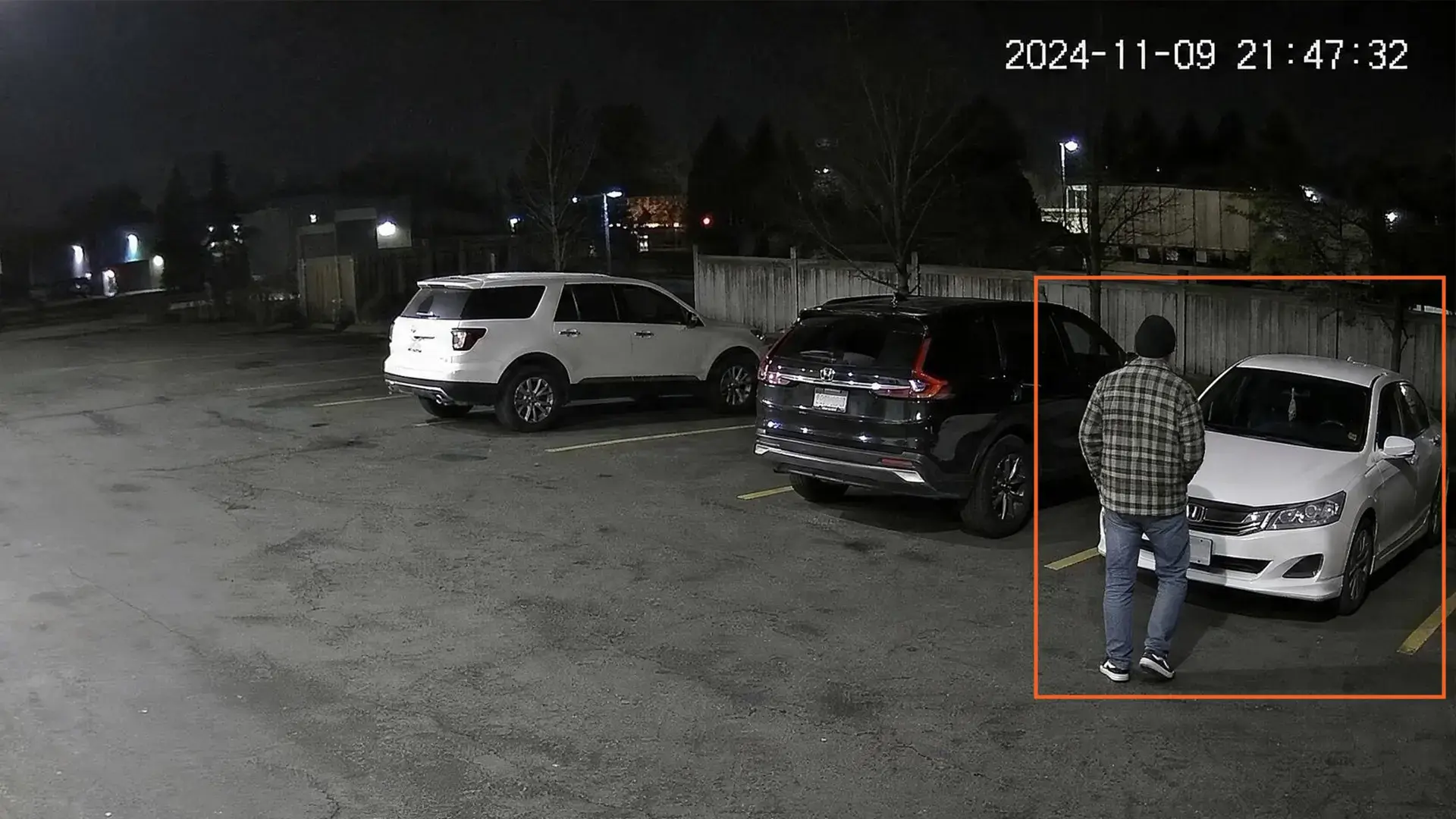
Veteran campus security officers develop an instinct that no training manual fully captures: the sense that something is off. The person moving through the parking structure checking door handles is walking, which is legal, near cars, which is normal, in a public place, at a plausible hour, and every element of the scene is individually unremarkable while the whole is unmistakably wrong. The visitor who has drifted through three buildings without arriving anywhere. The car that has circled the elementary school twice at dismissal. The group at the field's edge at midnight, doing nothing prosecutable, radiating intent. Campus safety runs on noticing these compositions, the instinct is scarce, it works only where the experienced eyes happen to be looking, and it retires with the people who have it. This article is about the technology that has begun to make that instinct expressible in software, what it honestly is, what it must never be sold as, and how a school governs it. It belongs to our full guide on AI video analytics for school and campus safety.
Two kinds of watching
Everything else in this series runs on enumeration: name the event, train the detection type, draw the zone, tune the threshold. Weapons, intrusions, crowds, falls, each is a known pattern watched by a detector built for it, and the built-in detection layer is rightly the foundation, cheap, continuous, and precise about what it knows. Its structural blindness is the unenumerated: a detector knows a person is present and cannot know the presence is strange, and the campus scenarios that make safety directors' instincts itch are strange compositions of legal elements, exactly the cases no preset list will ever contain.
The second kind of watching asks instead of matching. Frames cached from the live pipeline go to a multimodal model with a question written in plain language: describe what the person in this parking structure is doing; does anything about this visitor's movement through these buildings look unusual; what is happening at the field's edge in this sequence. The question is authored, the analysis reads a sequence rather than a frame, so drift and pattern are visible, and the answer returns in seconds as a structured event with the clip attached. In the deployable architecture, the two kinds of watching are chained, the escalation pattern this platform family runs everywhere: the built-in detection layer and simple rules flag the moments worth a second look, presence at an odd hour, dwell without purpose, movement across zones, and the question layer reads exactly those moments, which keeps the economics sane and the attention aimed.
What comes back is the instinct, transcribed: the person appears to be testing door handles along the row; the individual has looked into several classroom windows while moving away from the entrance; the group is gathered around the equipment shed and one member is working at the latch. An operator reading that line beside the clip makes the same call the veteran would have made, except the veteran was never going to be watching that camera at that hour, and this layer watches all of them.
The guardrails
Now the boundaries, stated with the weight the setting demands, because a capability that can be asked anything about footage of children is exactly as dangerous as it is useful, and the district's governance is what makes it the former.
This layer describes observable behavior, and only observable behavior. It is not suspicion detection, threat scoring, or intent prediction, it does not read minds, moods, or backpacks, and the education strategy this platform family maintains prohibits the phrases that pretend otherwise: no bullying detection, no emotion recognition, no aggression scores. A vendor using those phrases is selling a fiction, and a district repeating them is writing its own future retraction.
The questions themselves are governed instruments rather than free text. Every standing question lives in a written register with controlled authorship, board-visible scope, and versioned wording, per the discipline this series applies wherever the question layer runs, and the education register carries extra rules the industrial one does not need: questions describe situations, never named individuals; no question may target a specific student; and the answers feed safety response, never disciplinary files, under the same triage-not-discipline architecture our fight-detection article establishes. The no-identification default stands in full: the system reports that someone is checking door handles, and who is a human process with its own rules.
The honest limits of the method travel with every answer it produces. No accuracy percentage exists for open-ended visual questions, structurally, so the layer is validated on the campus's own footage during commissioning and trusted accordingly, as an operator's aid rather than an oracle. Answers vary with question wording, so the prompt is preserved beside any answer that will be relied on. And the analysis runs seconds behind the moment, on cached frames, which suits triage and disqualifies autonomy, the same cadence honesty this series states everywhere.
What campuses catch
Deployments that run this layer accumulate a distinctive catalog. The pre-incident patterns: door testing, window checking, the vehicle circling the pickup zone, the person pacing the fence line, each caught as a description while it is still a conversation rather than a crime. The drift that hardens into risk: the gate propped open every Thursday, the delivery route that has quietly become a public shortcut, the gathering spot migrating to the blind corner, conditions no threshold owned and every safety audit would want to know. The campus never-agains: every district carries a private list of one-off events that produced a corrective action and no way to watch for recurrence, and each entry becomes a standing question the day someone writes it down.
The register lives the healthy life cycle this platform family describes: findings get dispositions from the operators who adjudicate them, real, known condition, badly phrased; wording sharpens through review; recurring findings graduate into trained detection types or zone rules on the built-in detection layer, which is cheaper and more precise for anything that has stabilized into a pattern; and the register itself becomes the campus's codified watching knowledge, readable by the next safety director, reviewable by the board, and prunable on the same quarterly cadence as every threshold in the program. A register that only grows is scope drift; a register that discovers, industrializes, and moves on is the instinct, institutionalized.
What to expect in week one
The layer's daily life belongs to the people who read its findings, and setting their expectations is part of commissioning. Early findings run verbose, the model describing three unremarkable things on its way to the one that matters, and the first review cycles tighten wording and thresholds fast; a team told this in advance reads the early noise as calibration rather than failure. Dispositions are the flywheel: every finding marked real, known, or badly-phrased feeds the register's improvement, the operators who adjudicate become the layer's best question authors within a term, because they have spent careers knowing what did not look right with nowhere to write it down, and the sampling audit this platform family runs on every judgment layer, a weekly random slice of quiet periods reviewed by a human, prices what the questions are missing while the cost of a miss is still administrative.
Timing the pilot to the school calendar matters as much here as for the fight detection types: a baseline gathered across exam week, a home game, and ordinary Tuesdays teaches the questions the campus's full range of legitimate strangeness, while a quiet-month pilot calibrates normal too narrowly and floods the register the first Friday night. And the findings that surface known, tolerated conditions, the propped gate everyone uses, the sanctioned shortcut, deserve the decision this series always recommends: regularize or remove, decided by a named owner, never quietly prosecuted, because the layer's discoveries either improve the campus or sour it on the program, and the difference is entirely in the response.
Talking to the community early
A district deploying this layer owes its community the plain version before rumor supplies a worse one, and the plain version is tellable: the cameras have always watched, nobody could watch the cameras, and this layer notices the situations a good officer would notice, describes them to a human, and forgets no one, because it identifies no one. The register is showable, the exclusions, restrooms, locker rooms, anywhere with a privacy expectation, are absolute, the no-discipline architecture is in writing, and the parents' hardest question, is this profiling my child, has the only answer that survives: the system describes what is happening, never who someone is, and the humans it alerts are the same staff the district already trusts with their children. Districts that hold that meeting before go-live report it as the moment the program became the community's rather than the administration's, which is the only stable place for a program like this to live.
What it costs
The economics deserve one honest paragraph, because open-ended analysis prices differently from fixed detection. The enumerated layer's cost scales with cameras; the question layer's cost scales with how much footage gets asked about, since each reading is model inference over a clip, and the escalation-chain design is what keeps that spend proportionate: questions run against flagged moments and scheduled samples, never against every frame of every stream, and the register's size is the budget dial. A campus can run a meaningful program, the never-again watches, the drift questions on its critical zones, at modest inference cost on the same on-premises hardware the rest of the stack uses, and widen deliberately as findings justify. The failure mode to refuse is the inverted pyramid, open questions sprayed across the campus while the cheap enumerated layer sits untuned, which buys maximum cost for minimum precision, and the deployment sequence this series prescribes, detectors first, tuned and trusted, then the question layer where ambiguity concentrates, is as much a financial discipline as an operational one.
How VIDIZMO fits
VIDIZMO AI Live Insight supplies the built-in detection layer and the frame cache; AI Intelligence Hub supplies the written-question analysis and the event-driven workflows that trigger it; and the two run the escalation chain natively, flag, read, then human, with every finding landing as a structured event beside its clip in the Nexus portal, under role-based access, audit logs, and retention, and every prompt preserved with its answer. The question register, its authorship controls, and its education-specific rules live in the deployment's written terms, processing stays on the institution's own hardware, and the commissioning includes validation on the campus's own footage with the operators who will adjudicate. The register also deserves a named owner from day one, and in education the right owner is usually the safety director with the privacy officer as co-signer, because every question is simultaneously an operational choice and a privacy commitment. That pairing, unusual in industrial deployments, is natural in a school district, and it is the arrangement that lets the program answer the board's hardest questions with one document and two signatures.
A last word for the safety director weighing this against the rest of the program: this layer is the one that most rewards patience. The built-in detection types pay in their first month; the question layer pays across its first year, as the register fills with the campus's actual edge cases and the operators grow fluent, and the institutions that judge it by month one consistently underrate what they own by month twelve. Sequenced after the foundation and grown at the pace of its own findings, it becomes the part of the program nobody can imagine surrendering, because it is the part that watches for what nobody thought to ask.
The natural pilot is the never-again list: five entries, phrased as questions, run silent for a month against the zones where they happened, and the closing review asks what the layer saw that no preset list would have, which has yet to come back empty.