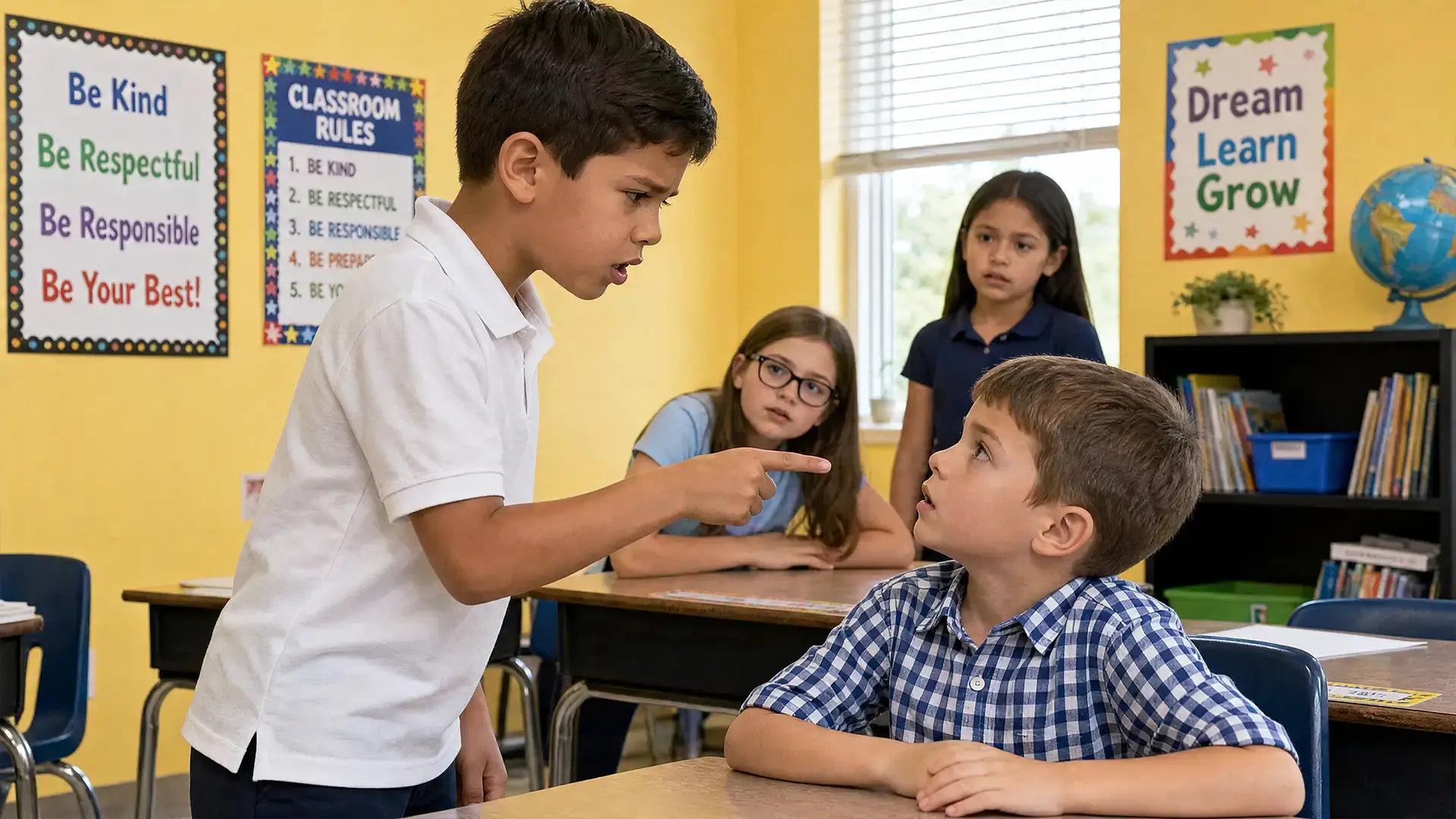
Ask any assistant principal how they learn about fights and the answer is always the same: the crowd. By the time an adult knows, a ring of students three deep has formed, phones are out, and the fight has been running for the longest minute of somebody's school year. The injuries that matter often happen in that minute, the footage that ends up everywhere is already recorded on a dozen phones, and the adults arrive to manage an aftermath they never had a chance to interrupt. Every school with cameras has recorded hundreds of these minutes. Almost none has ever shortened one. This article is about using detection to shorten that minute, and, just as much, about the framing decision that determines whether the technology helps a school or quietly corrodes it, because fight detection deployed as a disciplinary instrument fails in ways that fight detection deployed as a response accelerator does not. It belongs to our full guide on AI video analytics for school and campus safety.
What is actually detectable
The vendor language in this category runs ahead of the technology, so the careful version matters. What detection genuinely provides is a layered read on observable physical events, and each layer earns its place differently.
The first layer is the crowd signature, and it is the workhorse. Fights draw crowds with astonishing reliability, and they draw them fast, often faster than the fight itself becomes distinguishable on a wide camera. Crowd rules, the count of people in a zone exceeding its normal density, plus convergence, many tracks collapsing toward a point, fire on the pattern that precedes and surrounds a fight, and they fire on geometry rather than on interpretation, which makes them robust. A sudden ring of twenty students in a hallway corner is worth an adult's attention every single time, whatever is at its center, and that is precisely the right claim for the detection to make.
The second layer is activity detection for aggressive physical interaction, rapid, violent motion between people, and it works best exactly where the crowd signature works least: the two-person altercation in an empty stairwell, the corridor scuffle before an audience gathers. It is also the layer where honest vendors qualify hardest, because horseplay, sports, and drama rehearsal share motion signatures with the real thing, and the false-positive management this series describes everywhere applies at full strength.
The third layer is the second look, and it is what makes the first two deployable at school scale. The flagged clip goes to a multimodal model with a written question, describe what the students in this sequence are doing, and the answer that comes back in seconds separates the birthday mob from the fight, the dance-team practice from the assault, before any adult is interrupted. The guardrails are the ones this series states everywhere and education strategy demands in bold: this is observable-behavior description, not bullying detection, not emotion recognition, not a prediction about intent, and the questions live in a governed register the district controls.
What none of the layers do is see what happens out of view, which for fights means the bathroom, the locker room, and the bus stop beyond the fence, and a deployment plan should say so rather than let the board believe the blind spots are covered.
Getting an adult there faster
The entire operational value of fight detection is compressing the adult-arrival clock, so the response design is the deployment. The alert goes to the adults physically closest to the zone, the hall supervisor, the nearest administrator, the School Resource Officer (SRO), by radio-adjacent channels the school actually uses, with the location and snapshot attached, because the responder's first question is where, not what. Severity tiers distinguish the convergence alert, get eyes on this corner, from the confirmed-altercation alert, get bodies there now, and the second look's reading rides along so the responder knows which one they are walking into. The medical follow-through is part of the same chain: fights produce injuries, the person-down logic this series covers in the medical emergencies article stays armed in the same zones, and the event-triggered recording preserves the footage from before the first push through the aftermath, which the investigation will need.
Timing expectations deserve the same honesty as everywhere in this series: detection fires as the event is tracked, and whether the second look screens the clip before the page goes out or reads it in parallel while the page is already traveling is a per-zone policy choice, so a tuned high-confidence detection gives up nothing to verification latency while the ambiguous flag spends a few seconds being screened. Against the crowd-tells-an-adult baseline, which is measured in minutes, the chain is transformative; against the fantasy of prevention, it is not, and a district should buy the minute, because the minute is real and it is where injuries are averted.
Triage, not discipline
Now the part that determines whether this technology belongs in a school at all, stated as directly as this series knows how. A fight-detection system exists to get adults to trouble faster and to preserve an accurate record of what happened. It must not become an automated referral machine, and the difference is architectural, not rhetorical.
Discipline in schools runs on process: an incident, an investigation, statements, context, proportionality, and, under the Family Educational Rights and Privacy Act (FERPA) once footage is used for discipline, a records regime with parental access and redaction obligations our FERPA article covers in full. Detection contributes evidence to that process, the accurate timeline, the footage of who did what and in what order, which protects the wrongly accused at least as often as it identifies the instigator, and adults who watched the clip make every judgment that follows. What detection must not do is skip the process: no automated identification of participants, no auto-generated discipline lists, no quiet accumulation of a behavioral dossier per student, and the no-identification default this platform runs for safety analytics makes that boundary technical rather than aspirational. The system knows a fight happened at the C-wing stairs at 11:42; attaching names is human work inside the school's own process.
Districts should hold that line for self-interested reasons as much as principled ones. A student body that experiences the cameras as a dragnet adapts the way workforces do, moving trouble to the blind spots, and the community meeting where a parent asks whether an algorithm accused their child is a meeting no superintendent enjoys. The program that survives is the one described to families exactly as it works: the cameras get an adult there faster, the footage means the truth is knowable, and no algorithm ever writes a referral.
Aiming supervision with the data
There is a staffing argument hiding in the event history that deserves to be made explicit, because it is the most practical thing this capability does for a principal. Hallway supervision is allocated by tradition and instinct, the same adults at the same posts, and every administrator privately knows the coverage map is stale. A term of convergence and altercation events, plotted by location and period, is the first empirical supervision map a school has ever had, and it reliably surprises: the notorious corner turns out to be quiet since the schedule changed, the real cluster is at the gym corridor during fourth period, the after-lunch window generates more events than the after-school one everyone staffs for. Repositioning adults against the map costs nothing, and the verification loop, watching the zone's event rate respond, proves within weeks whether the move worked. This is also the honest answer to the budget question that shadows every safety technology purchase: the system does not replace supervision, it aims it, and aimed supervision is the cheapest intervention in the entire school safety conversation.
Fights that end up in court
A minority of school fights produce criminal charges, civil claims, or both, and the footage's handling decides what it is worth when they do. The chain this platform family maintains everywhere applies: the clip preserved from before the first contact, held under an incident retention hold the day of the event, viewed only through role-based access with every view and export logged, and released outward, to police, to counsel, to a parent exercising FERPA rights, through controlled channels with bystander students redacted per the obligations our FERPA article details. Districts that improvise this, the clip pulled to a thumb drive, emailed to whoever asked, discover in deposition what provenance means, and the discipline costs nothing to run from day one.
What the data shows between incidents
The event history earns quieter value across a semester. Fights cluster, by location, by period, by the friction points every administrator knows and can now count, and the pattern data moves the conversation upstream: supervision repositioned to the corner that produces the events, the bell schedule's worst crush relieved, the blind corner mirrored or covered. The verification loop this series runs everywhere applies, the intervention either moved the zone's event rate or it did not, and the aggregate numbers, never the individual clips, belong in the safety committee's review and the board's annual safety report, where they demonstrate a program that measures and improves rather than one that watches and punishes.
Timing the rollout to the school year matters more here than for any other detection type in the program: go-live in the first weeks of fall term meets the year's highest baseline of jostling and reunion energy, and a system tuned against September behaves badly by November. The silent baseline belongs in a representative mid-term stretch, and the thresholds it produces deserve a scheduled check after each break, because student behavior resets with the calendar in ways no other monitored population does.
Anonymous aggregate data also gives the district its first honest answer to the question every school climate survey asks and none can verify: is it getting better? The event trend by semester, measured identically across years, sits beside the survey data as the behavioral record, and a falling curve that matches rising climate scores is the strongest story a student-affairs office can bring to a board, because neither number alone is proof and together they are close.
The staff conversation deserves the same care as the community one. Teachers and aides will reasonably ask whether the cameras now grade their supervision, and the honest answer, delivered before go-live, is the same conditions-not-individuals commitment the rest of this platform family runs: the event map aims staffing, the review examines zones and periods, and no clip becomes a personnel exhibit outside the narrow exceptions every policy carries. Supervisors who trust that line become the system's best users, because they are the ones it pages.
A word on de-escalation, because the technology conversation can obscure what the minute is for. The point of faster adult arrival is not faster punishment, it is interruption before escalation and injury: the shove separated before it becomes the fight, the fight stopped before the head hits the floor, the crowd dispersed before three more join. Schools that brief their staff this way, the alert means go de-escalate, treat the system as an extension of the supervision they already believe in, and the response data reflects it, with most convergence alerts resolving as conversations rather than referrals. That outcome, invisible in any discipline log, is the program working exactly as intended.
How VIDIZMO fits
VIDIZMO AI Live Insight runs the crowd, convergence, and activity layers on the cameras a school already owns, on the district's own hardware, with zones, schedules, confidence, and severity per camera, and the written-question second look wired in by policy, screening ambiguous flags before any human is interrupted and reading high-severity clips in parallel with the alert. Alerts route by proximity and severity with snapshots attached; every event preserves its clip, with pre-event footage, in the Nexus portal under role-based access, audit-logged viewing, and retention with incident holds; and the no-identification default keeps the system a triage instrument. Redaction for the FERPA obligations that follow a disciplinary use is part of the same platform family, which matters the first time a parent exercises the access rights the law gives them.
The pilot that proves the value is one building's worst corridor for one term: the before picture is the office referral log and the crowd-tells-an-adult clock, the after picture is the event history with response times, and the difference is the minute this article promised, measured on the school's own footage.