No school safety technology carries more emotional weight than weapon detection, and no school safety technology is sold with less precision. Districts are asked to evaluate systems against the scenario every administrator carries in their mind, and vendors let that scenario do the selling, which is exactly backwards, because a district that buys on fear buys wrong. This article is the precise version: what visual weapon detection genuinely provides, the failure modes an honest deployment plans for, the verification step that separates a usable system from a dangerous one, and the response chain that must exist before the first alert ever fires. It belongs to our full guide on AI video analytics for school and campus safety, and it is written to be read before any vendor meeting, including one with us.
What weapon detection actually does
Visual weapon detection watches camera streams for guns and knives in view, continuously, across every enrolled camera, and raises an alert with the frame attached when it finds one. Stated that plainly, both the value and the boundary are visible.
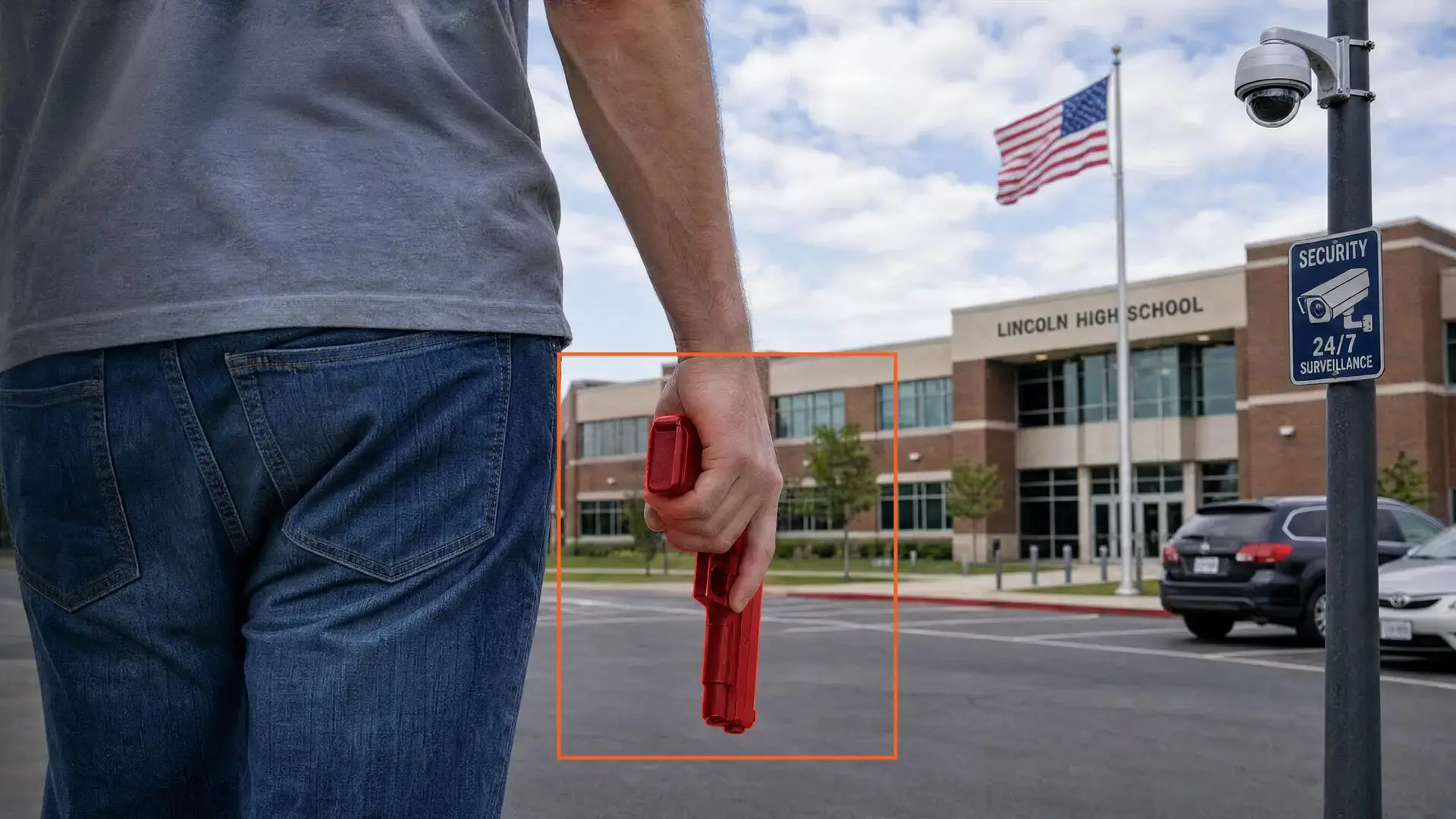
The value it genuinely delivers is seconds and simultaneity. In the visible-weapon scenario, the weapon drawn in a parking lot, carried across a field toward the building, brandished in a corridor, the difference between the first human knowing at second ten versus minute three is the difference around which every school response protocol is built, and a detector that never blinks watches all four hundred cameras at once, which no staffing plan has ever approached. The boundary is equally plain: a camera detects what a camera can see. A weapon in a backpack, under a coat, or inside a waistband does not exist for this technology until it is produced, which means visual detection is the layer that compresses response time when concealment ends, not a screening system, and any vendor letting a district believe otherwise is selling the scenario rather than the product. Screening at entries, where a district chooses to run it, is a different technology making a different promise; the camera layer is what covers everywhere the screening line is not, which is most of the campus, most of the time.
Detection quality has honest determinants worth hearing before procurement: camera coverage and angles, distance and resolution, lighting, and the physical size of what is being detected. A handgun at eighty feet on a wide lens is a few dozen pixels, and the feasibility conversation this series applies to every detection type applies here with the highest stakes, which is why commissioning includes validation on the district's own cameras, with training props, at the district's own distances and light, rather than acceptance of a number measured somewhere else.
Verification before response
Every conversation about weapon detection in schools eventually reaches the question that decides deployability, and it should be asked early: what happens on a false positive? Because there will be false positives, the umbrella held like a rifle, the phone in a dark case, the prop from the theater department, the toy on the elementary playground, and a system that turns each into a lockdown is not a safety system, it is a trauma generator with a network connection, and one bad activation will end the program and poison the district against the technology for a decade.
The deployable architecture therefore treats verification as something that races the alert rather than something the alert waits on. When the detector fires with high confidence, the page to the designated humans goes out immediately with the frame attached, and the second look, a multimodal model reading the surrounding clip against a written question, does this appear to be a firearm and what is the person doing, drops its reading into the same alert seconds later, usually while the verifier is still opening the clip. Ambiguous, lower-confidence detections run the other way: the second look screens first and only what survives interrupts anyone, which is where the umbrella and the phone case are absorbed. The ordering is not a fixed property of the system, it is written policy, set per detection type, per camera zone, and per schedule, and either way trained eyes make the confirm-or-clear call on evidence rather than on a thumbnail and adrenaline. The humans who make that call are named in advance, per building and per shift, they are trained on exactly this decision, and the protocol distinguishes confirmed from unverified at every step, because the response to each is different and pre-written.
Two design rules keep the verification step honest under pressure. The bias runs toward the human look: a false escalation costs a trained person thirty seconds, a false suppression is unthinkable, so thresholds err toward showing the ambiguous frame to the verifier rather than resolving it silently. And verification never becomes a bottleneck the emergency waits on: the protocol's clock runs in seconds, the verifier role is always staffed during occupied hours, and the unverified-but-credible case has its own pre-agreed path rather than dying in a queue.
Build the response chain first
A confirmed weapon event triggers the most consequential workflow a school operates, and none of it should be improvised on the day. This is where the positioning honesty this series maintains matters most: the detection platform is the visual intelligence and orchestration layer, and the systems that act, the access control that secures doors, the mass-notification system that alerts the campus, the 911 and dispatch channels that bring law enforcement, remain the district's existing systems, invoked through integrations, under policies the district wrote. What the platform contributes is speed and evidence: the validated event, with location, snapshot, and clip, delivered simultaneously into the notification chain and the dispatch channel, so the first responding officer is looking at the person and the place rather than at a text description relayed twice.
The policy architecture around automation deserves its own plain statement, and our article on lockdown automation and the human in the loop gives it full treatment: irreversible campus-wide actions carry named human approval, the automation assembles the decision, pre-stages the notifications, and starts the clock, and the district defines in writing which steps run automatically at which confidence and which wait for the designated human. State panic-alert mandates in the Alyssa's Law family, where they apply, slot into this chain as a notification target the orchestration reaches, not as a system this platform replaces.
Drills are where the whole chain becomes real instead of theoretical. The district that runs its weapon-detection protocol quarterly, with staged props, timed from detection through verification to notification, owns its response; the district that installs and waits owns a hope. The drill timings themselves become program metrics, and they are the numbers a board and a community actually understand.
What to ask every vendor, including us
The procurement conversation in this category rewards a short, hard question list, and a district should run it identically past every bidder. Where does processing run, and does any frame of school footage leave the district's infrastructure? What are the shipped detection types, and what does validation on our cameras, at our distances, with props, look like in the statement of work? What sits between detection and alert, and can the verification step be shown live, with the reading and the clip, in seconds? What exactly happens on a false positive, walked through as a timeline, and what does the system log about it afterward? Which of our existing systems, notification, access control, dispatch, does the platform invoke, through what integration, and which actions require named human approval? And what does the monthly review look like, what numbers does the district see about its own system's performance? A vendor fluent in those answers is describing an operational system; a vendor who answers with the scenario is describing a brochure, and the difference is audible within ten minutes.
Governance, records, and the community
A weapon-detection program watches students, which means every governance instrument this series describes applies at full strength: the written scope register, role-based access with audit-logged viewing, short stated retention with incident holds, no identification by default, and the community conversation held before go-live rather than after the first headline. Two education-specific notes complete the picture. Detection events involving students become part of incident records that may meet the Family Educational Rights and Privacy Act's (FERPA) definition of education records once used for discipline, with everything our FERPA article covers about access and redaction following, so the evidence handling runs through the governed portal from the first second. And the false-positive record deserves the same disciplined review as every other alert type in this series, read monthly, fed back into thresholds and prompts, because the program's credibility compounds from a boring, well-run review far more than from any single dramatic catch.
There is also a quieter dividend districts rarely anticipate: the system's record of what did not happen. A year of monitoring with zero confirmed events and a documented, drilled response chain is not a wasted year, it is the evidence file for the insurance renewal, the grant report, and the board's annual safety review, demonstrating a control that was live, tested, and ready, which is what due diligence looks like written down.
Elementary, middle, and high schools also deserve different threshold conversations, not because the technology differs but because the false-positive population does: toy weapons are an elementary reality, theater props live in high schools, and the verification protocol's context line, which building, which age band, which time of day, is part of what the trained verifier weighs. Districts that tune per building rather than per district get both fewer nuisance escalations and faster confident confirmations.
One number the district controls deserves attention before any vendor is chosen: coverage of the approach paths. Most visible-weapon scenarios begin outside, in lots and at perimeters, and the cameras that buy the most seconds are the ones watching the walk toward the doors, not the corridor after entry. An approach-path audit, which routes to each entrance are actually in view, at what distance, in what light, tells the district where its real early-warning window is, and it frequently redirects budget from more analytics to two better-placed exterior cameras, which is the kind of finding an honest vendor should be pleased to deliver.
The honest summary a superintendent can carry into a board meeting runs three sentences. Visual weapon detection compresses the time between a weapon becoming visible and trained people knowing, from minutes to seconds, across every camera at once. It does not see through backpacks, and anyone who implies it does is selling. It is deployable only as a chain, detection, human verification in seconds, and a pre-written response that uses the systems the district already trusts, and the district that builds the chain gets the seconds, which are the entire point.
The aftermath obligations complete the picture a district must plan for. A confirmed event, and equally a false alarm that triggered any response, produces records: the detection, the verification decision with its timestamp, the notifications sent, the footage. Those records feed the after-action review, the law-enforcement file, the parent communications, and sometimes litigation, and they do so credibly only under the handling discipline this platform family applies everywhere, retention holds applied the day of the event, access logged, exports controlled, bystander students redacted before anything leaves the district. The verification decision itself deserves logging as policy: who saw the frame, what they decided, how long it took, because the district that can reconstruct its own response owns its story, in the debrief and in public.
How VIDIZMO fits
VIDIZMO AI Live Insight runs weapon detection as shipped gun and knife detection types on the cameras a district already owns, on the district's own hardware, with per-camera confidence and severity and the frame attached to every alert. The escalation chain is native and its ordering is policy rather than plumbing: a high-confidence detection pages the verifier immediately while the written-question second look reads the clip in parallel and lands its reading in the same alert, ambiguous detections are screened by the second look before anyone is interrupted, and every step is audit-logged either way. Orchestration through AI Intelligence Hub routes confirmed events into the district's notification, access-control, and dispatch channels by webhook and API under district-written policy with human-approval gates, and every clip lands in the Nexus portal under the access, retention, and audit discipline the aftermath will require. Commissioning includes validation on the district's own cameras with props at real distances, and the protocol drill belongs in the statement of work, not the wish list.