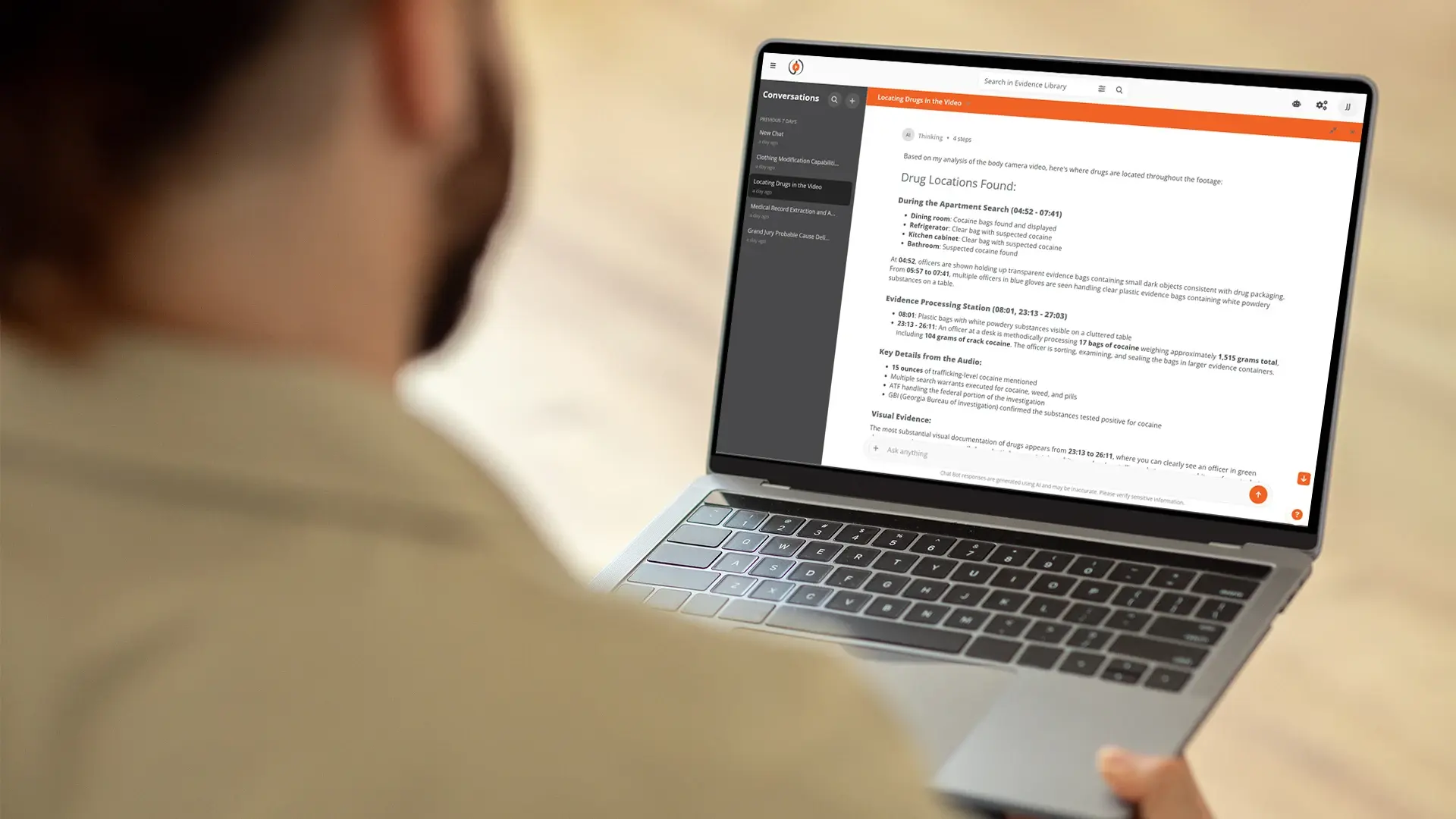
Almost every interview and interrogation is recorded now, which means the substance of a case increasingly sits inside hours of audio and video that someone still has to watch. A detective with a full caseload cannot rewatch a six-hour custodial interview to find the two minutes that matter, and a prosecutor preparing for a hearing cannot scrub every recording in discovery by hand.
AI interview andinterrogation analysis is how that recorded material becomes searchable evidence: transcribed, queryable, and tied back to the exact moment each answer came from. It is worth being precise about what that means, because the phrase gets used for two very different things.
This piece is about analyzing what was said, finding admissions, contradictions, and the sequence of events, and citing each one to the recording. It is not about machines deciding who is telling the truth, which is a separate and far more troubled idea that we will come back to.
What AI Interview and Interrogation Analysis Actually Does
The useful version of this technology does a handful of concrete things to a recording. It transcribes the audio with the speakers separated, so the interviewer and the subject are distinguishable. It makes the whole recording searchable, so a question like "where does the subject mention the second location" returns the exact timestamp instead of a hunch about where it was.
From there, the analysis goes past transcription. It can surface admissions and statements relevant to the case, flag where an account contradicts an earlier statement or another piece of evidence, assemble a timeline of what was said and when, and summarize a long session into something a reviewer can scan. Every one of those outputs points back to the moment in the recording it came from, so a person can verify it rather than take the system's word.
The thread through all of it is that the recording is the source of truth, and the analysis just makes the recording navigable. The investigator still does the investigating.
What It Does Not Do: Deception and Emotion Detection
There is a second category of tool that claims to read faces, voices, or word choice and tell you whether someone is lying. It is important to separate the two, because they are not the same product and they do not carry the same risk.
Methods that claim to detect deception from voice stress or facial micro-expressions are scientifically contested and legally fraught. Leaning on them invites exactly the problems the justice system already worries about with interrogations, including false confessions and bias, and a confidence score on a person's honesty is not something a court should be asked to weigh.
Useful interview analysis stays on firmer ground. It tells you what was said, by whom, and when, and it leaves the judgment about what that means to the people whose job it is to make it. That line is not a limitation to apologize for. It is what keeps the analysis defensible.
What Investigators and Attorneys Look For in a Recording
The reason analysis matters is that a recorded interview is dense with things people need to find later. Investigators and attorneys reviewing an interrogation are usually after the same handful of things, and they are rarely on the surface.
They want the substance of what was said, the admissions and the exculpatory statements both. They look at how questions were asked and whether procedure was followed, since the manner of questioning can bear on the voluntariness of a statement and on issues like Miranda warnings. And they look for contradictions, the place where the account in the room does not match an earlier statement, the body camera footage, or the documents in the file.
Finding those moments by hand is the work that eats days. Analysis that can search across the recording, and across the rest of the case, is what turns that review from a week into an afternoon, which is the same shift attorneys describe when they use AI to analyze body-worn camera footage alongside interview recordings.
How AI Analyzes an Interview Recording
The workflow behind this is straightforward once the recording is in the system. First the audio is transcribed and the speakers are separated, with translation where the interview was conducted in another language, so a non-native transcript becomes usable in a filing. Multilingual interviews are common, and a transcript tied to the original audio is what makes a translated statement verifiable rather than a second-hand claim.
Next the transcript and the recording become queryable together. An investigator can ask for a topic, a name, or an event in plain language and land on the exact passage, then pull every related moment across the other recordings and documents in the case. The system can assemble those moments into a timeline and summarize a long session, again with each point cited to its source.
What makes this analysis rather than a fancy transcript is the cross-referencing. The value is not that the recording is now text, it is that a question can be answered against everything in the case at once, with the evidence behind the answer one click away.
Why Transcription Alone Is Not Analysis
Plenty of tools will transcribe an interrogation, and transcription is a real and necessary first step. It is not the same as analysis, and the difference matters when an agency is choosing where to spend.
A transcript gives you a searchable document. Analysis answers a question across many documents and recordings, finds the contradiction you did not know to look for, and ties the result to the moment it came from. Transcription turns one recording into text; analysis turns an entire case file into something you can interrogate. An agency that buys transcription alone still has the review problem, just with a search box bolted on.
Keeping the Analysis Defensible and Compliant
Interview and interrogation recordings are among the most sensitive evidence an agency holds, and they are criminal justice information, so the analysis has to clear two bars beyond simply working.
The first is compliance. Recordings of custodial interviews cannot be shipped to a public AI service for processing, which is why the analysis has to run on infrastructure the agency controls, on-premises, in a government cloud, or air-gapped, in line with the FBI CJIS Security Policy. The full picture of running this kind of analysis on criminal justice data is covered in our guide to CJIS-compliant AI analysis.
The second is defensibility. Every answer needs to cite its source in the recording, a person needs to review what the analysis surfaces because a summary is a lead and not a finding, and the whole process needs an audit trail, the discipline we cover in audit-ready, sourced AI answers. The recording itself stays in the agency's evidence system of record, the way an interrogation-room evidence workflow already handles custody, retention, and access, while the analysis layer reads from it without breaking that custody.
How VIDIZMO Intelligence Hub Analyzes Interview and Interrogation Recordings
VIDIZMO Intelligence Hub is the AI analysis layer for interview and interrogation evidence. It transcribes across 82 languages with speaker separation, makes the recording and the rest of the case queryable in plain language, and returns answers with the relevant clip, a timestamp, and a confidence score, so every result can be checked against the source.
It runs where criminal justice information has to stay, on-premises, in a private or government cloud, or fully air-gapped, and it supports self-hosted models through Ollama and vLLM so the recordings and the inference never leave the agency's perimeter. No data goes to public model providers, and no customer data trains a model. Human-in-the-loop checkpoints sit wherever the agency needs them, and every prompt, output, and review step is logged inside the agency's own environment.
The recording stays in the agency's evidence system of record while the Hub analyzes it, with chain of custody preserved end to end. Agencies use the platform to analyze interview and interrogation recordings alongside other case evidence. Run a real interview recording through it and see what surfaces: explore VIDIZMO Intelligence Hub.
Find what was said without watching every hour. See how Intelligence Hub analyzes interview and interrogation recordings.

FAQ
Frequently Asked Questions
What is AI interview and interrogation analysis?
It is the use of AI to turn recorded interviews and interrogations into searchable, sourced evidence. The recording is transcribed with speakers separated, made queryable in plain language, and analyzed to surface admissions, contradictions, and a timeline, with every result tied to the timestamp it came from so a person can verify it.
Does AI interrogation analysis detect lies or deception?
The responsible version does not. Methods that claim to detect deception from voice stress or facial cues are scientifically contested and legally risky, and they invite problems like false confessions and bias. Sound analysis stays on what was said and when, and leaves judgments about credibility to the people whose job that is.
How is this different from interrogation transcription software?
Transcription turns one recording into a searchable document. Analysis answers questions across the whole case, finds contradictions between the interview and other evidence, builds a timeline, and cites each result to its source. Transcription is a necessary first step, not the finished capability.
Can AI find admissions or contradictions in an interview recording?
Yes, as leads for a person to verify. The analysis can surface statements relevant to the case and flag where an account conflicts with an earlier statement, body camera footage, or documents in the file, then point to the exact moment in the recording so a reviewer can confirm it.
Does analyzing interrogation recordings preserve chain of custody?
It should. The original recording stays in the agency's evidence system of record, and the analysis layer reads from it without altering the source. A defensible setup logs every analysis step and ties each output to the original file, so custody and the audit trail stay intact.
Can interrogation analysis run on CJIS data or on-premises?
Yes, and for custodial recordings it usually must. Because the recordings are criminal justice information, the analysis should run on-premises, in a government cloud, or air-gapped, with self-hosted models so the data and the processing stay inside the agency's perimeter rather than going to a public AI service.
Can it handle interviews in other languages?
Yes. Strong platforms transcribe and translate across dozens of languages while keeping the transcript tied to the original audio, so a translated statement can be verified against the recording rather than trusted on its own.
TopicsAI Intelligence HubLegal and Privacy

About the author
Ali Rind is a Product Marketing Executive at VIDIZMO, where he focuses on digital evidence management, AI redaction, and enterprise video technology. He closely follows how law enforcement agencies, public safety organizations, and government bodies manage and act on video evidence, translating those insights into clear, practical content. Ali writes across Digital Evidence Management System, Redactor, and Intelligence Hub products, covering everything from compliance challenges to real-world deployment across federal, state, and commercial markets.
You may also like
Fire and Smoke Detection as a Second Set of Eyes in Schools
Let the first sentence of this article do the compliance work: nothing described here replaces, modifies, or competes ...
Weapon Detection in Schools: Detection, Verification, Response
No school safety technology carries more emotional weight than weapon detection, and no school safety technology is ...

School Safety Grants: What the Money Can Buy
School safety improvements have a funding problem that is really a sequencing problem: the need is continuous, the ...