
Law enforcement agencies generate thousands of hours of interrogation room and interview recordings every year. These recordings are not just documentation. They are high-stakes digital evidence that can determine whether a confession is admissible, whether a case proceeds to trial, and whether an agency withstands legal scrutiny.
Effective interrogation room video evidence management requires more than simple storage. Recordings must be automatically ingested, securely preserved, hash-verified, access-controlled, searchable, and defensibly shared with prosecutors, defense counsel, and courts. Any breakdown in chain of custody, retention policy, access controls, or redaction workflows can create admissibility challenges, discovery delays, or compliance risks.
This guide outlines the essential best practices for managing interview room recordings from the moment capture ends through courtroom presentation. You will learn how to strengthen chain of custody, accelerate review with AI transcription, streamline secure evidence sharing, and align retention with legal requirements.
Why Interrogation Room Recordings Demand Dedicated Management
Interview room and interrogation recordings are among the most sensitive evidence categories an agency produces. Unlike body-worn camera footage captured in dynamic field conditions, interrogation recordings are made in a controlled setting. This means courts, defense attorneys, and oversight bodies hold them to a higher standard of integrity.
Agencies that manage these recordings in shared file drives, generic cloud storage, or standalone recording systems encounter predictable operational and legal problems:
- Chain-of-custody gaps: Recordings copied or moved outside a controlled system create questions about tampering, even when no tampering occurred.
- Inconsistent retention: Without automated policies, some recordings are deleted prematurely while others are stored indefinitely beyond required periods.
- Slow prosecutor access: Burning DVDs or emailing compressed files introduces delays and creates additional copies with no audit trail.
- Redaction burden: Public records requests require face, identity, and audio redaction before release, and manual workflows cannot scale to meet demand.
A purpose-built Digital Evidence Management System, addresses each of these challenges systematically.
1. Automate Ingestion at the Source
The chain of custody begins the moment a recording ends. Any manual step between recording completion and evidence storage creates an opportunity for documentation failure. Manual transfers also introduce the risk of file name changes, compression, or metadata loss before the recording reaches a controlled environment.
Best practice is to configure automated ingestion directly from interview room recording systems into your DEMS through:
- Watch folder monitoring: The DEMS monitors a designated local or network directory and automatically ingests new recordings as they are created, with no manual intervention required.
- Direct API integration: API-based connections between your interview room recording system and the DEMS trigger ingestion without staff involvement.
- Bulk upload with structured metadata: For agencies migrating legacy recordings, bulk upload tools allow batch ingestion with case-linked metadata.
At ingestion, each recording should be automatically assigned a unique identifier, linked to a case or incident number, and timestamped. This creates an unbroken record from recording creation to secure storage.
2. Establish Verifiable Chain of Custody from Day One
For interrogation recordings, demonstrating that a recording has not been altered from the moment of capture to the moment it is presented in court is foundational to admissibility. Chain-of-custody integrity must be built into the system, not reconstructed after the fact.
Key controls include:
- SHA-256 hash verification: A cryptographic hash is generated at ingest and verified at every subsequent access point. Any modification to the original file changes the hash and is immediately detectable.
- Comprehensive audit logging: Every interaction with a recording, including view, download, share, export, or access attempt, is logged with username, IP address, timestamp, and event type.
- Exportable chain-of-custody reports: Prosecutors and defense attorneys may request full activity logs. These should be exportable as PDF or CSV directly from the system without manual compilation.
- WORM-enabled storage: Write-once, read-many storage prevents post-ingestion modification of original recordings.
- Legal hold: When a case is active, legal holds prevent scheduled retention policies from deleting or archiving recordings prematurely.
Without these controls, interrogation recordings are vulnerable to admissibility challenges even when no actual tampering occurred.
3. Apply Role-Based Access Controls
Implementing structured role-based access controls ensures that access to interrogation recordings is restricted by role, case assignment, and responsibility. This reduces exposure risk while maintaining operational efficiency.
A well-structured access model for interrogation room recordings typically maps as follows:
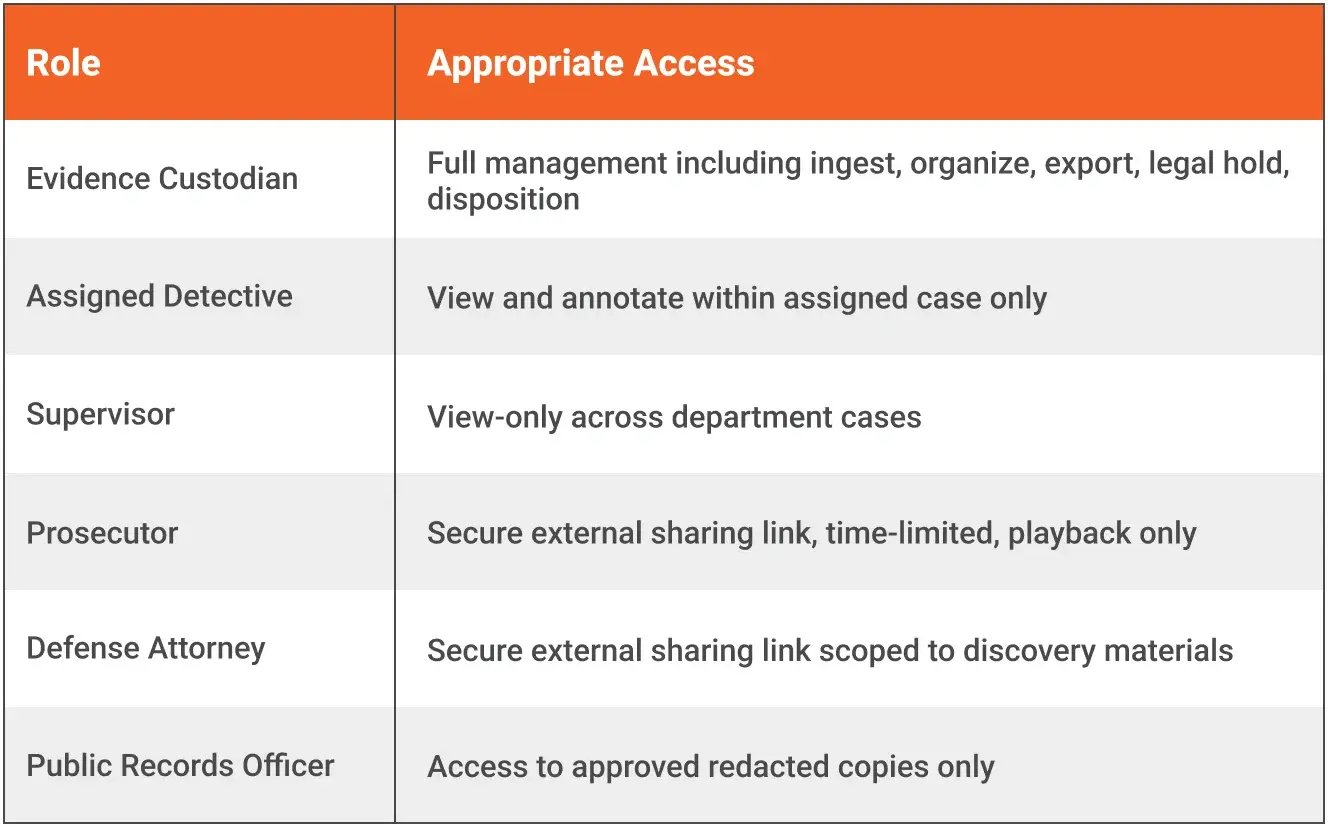
Access should be scoped to case, not just role. A detective assigned to one case should not be able to browse unrelated interrogation recordings through the same interface. Configure access reason provisioning that requires users to state why they are accessing a recording before it opens. This creates an accountability layer that deters casual or unauthorized access.
4. Use AI Transcription to Accelerate Review
Hours of interrogation video cannot be reviewed at normal playback speed for every case review, prosecution preparation session, or internal affairs inquiry. AI transcription converts audio content into searchable text, enabling investigators and attorneys to work more efficiently:
- Search for specific statements, subject names, or admissions without manually scrubbing through footage.
- Use speaker diarization to distinguish between detective and subject statements in the transcript.
- Generate automatic summaries of lengthy interrogations, highlighting key content segments.
- Translate transcripts into additional languages for non-English-speaking subjects or review teams.
When evaluating AI transcription accuracy, look for platforms that publish Word Error Rate benchmarks across languages and accent profiles rather than making vague accuracy claims. Accuracy varies significantly based on audio quality, recording environment, and language. Agencies should test against their actual conditions before committing to a platform.
AI transcription assists human review. It does not replace it. Treat transcripts as a navigation and discovery tool, not as a definitive evidentiary record.
5. Streamline Secure Sharing with Prosecutors and Courts
Evidence production for prosecution is one of the most operationally disruptive aspects of interrogation recording management under traditional workflows. Burning DVDs, uploading to consumer file-sharing services, or emailing compressed files creates uncontrolled copies with no access tracking and no guarantee of integrity.
Best practices for secure external sharing include:
- Per-recipient tokenized URLs: Each prosecutor or attorney receives a unique, trackable link. The recording is not copied. The link provides controlled access to the original, with all views logged per recipient.
- Time-limited access: Links expire after a configurable window, preventing perpetual external access to sensitive recordings.
- Access count restrictions: Limit how many times a shared link can be opened.
- Playback-only options: Configure viewer access that prevents downloading or saving copies locally.
- Automatic access notifications: Alert evidence custodians when external parties view shared recordings.
These controls satisfy discovery obligations while maintaining chain-of-custody integrity and reducing the administrative overhead of evidence production.
6. Align Retention Policies to Case Disposition
Interrogation recordings should not be retained indefinitely, nor should they be deleted before legal hold requirements and applicable retention schedules are satisfied. Both failure modes carry risk:
- Premature deletion: Recordings destroyed while litigation holds are active can result in sanctions, adverse inference instructions at trial, or civil liability.
- Indefinite retention: Keeping recordings beyond required periods creates unnecessary storage cost and data privacy exposure.
A well-designed DEMS supports configurable retention policies set by case status such as active, closed, or adjudicated, evidence type, regulatory requirements, and legal hold status. When a case closes and holds are released, automated disposition workflows can move recordings to archival storage or schedule destruction, with each step fully documented in the audit log.
Agencies should consult legal counsel when configuring retention schedules and align policies to applicable state statutes, NARA standards, and department policy.
7. Automate Redaction for Public Records Compliance
Interrogation recordings are frequently subject to public records and FOIA requests. Before any recording is released, sensitive content such as officer identities, witness faces, juvenile subjects, irrelevant third parties, and spoken personally identifiable information must be redacted. As explained in our guide on the critical role of automated redaction in law enforcement and justice, manual redaction workflows are slow, inconsistent, and difficult to scale.
AI-powered redaction tools can:
- Automatically detect and blur faces, license plates, and other sensitive objects in video frames.
- Mute or bleep spoken personally identifiable information including names, addresses, social security numbers, and other configurable patterns.
- Generate redacted copies while preserving unmodified originals for evidentiary use.
- Track which version was released, to whom, and when.
For agencies managing substantial public records volume, automated redaction is an operational requirement, not a convenience. Manual-only workflows are not sustainable at scale.
How VIDIZMO DEMS Supports Interrogation Room Video Evidence Management
VIDIZMO Digital Evidence Management System is purpose-built to manage interrogation room recordings with defensible chain of custody and secure collaboration. Recordings are automatically ingested from interview room systems through watch folder monitoring or API integration, SHA-256 hash-verified at ingest, and protected with AES-256 encryption at rest and TLS 1.3 in transit.
Comprehensive audit logs capture every access event, including user, IP address, timestamp, and action, while automated chain-of-custody reports are exportable for court. WORM-enabled storage and legal holds ensure original recordings remain unaltered and protected throughout the case lifecycle.
Role-based access controls restrict visibility by case, and per-recipient tokenized links allow secure, trackable sharing with prosecutors and defense counsel without creating uncontrolled copies. Built-in AI transcription, speaker diarization, and summarization accelerate review, while AI-powered redaction automates face, object, and spoken PII removal for public records compliance.
VIDIZMO DEMS supports CJIS-compliant deployments in Azure Government Cloud, as well as on-premises and hybrid environments to meet agency security and data sovereignty requirements.
Ready to modernize your interrogation room with VIDIZMO Digital Evidence Management System?

FAQ
Frequently Asked Questions
How do agencies prove an interrogation video has not been altered?
Agencies prove video integrity by generating a SHA-256 hash at the time of ingestion and verifying it throughout the evidence lifecycle. If the file is altered in any way, the hash value changes immediately. Combined with immutable audit logs and WORM-enabled storage, this provides defensible proof that the recording remained unmodified from capture to courtroom presentation.
Is it risky to store interrogation recordings on shared drives?
Yes. Shared drives and generic cloud storage do not provide built-in chain-of-custody controls, hash verification, or immutable audit trails. Without these safeguards, agencies cannot easily demonstrate controlled handling of evidence, which can create admissibility challenges even if no tampering occurred.
Can prosecutors review interrogation videos without downloading copies?
Yes. A properly configured Digital Evidence Management System allows prosecutors to access interrogation recordings through secure, tokenized streaming links. Access can be time-limited, playback-only, and fully logged, ensuring discovery compliance while the agency retains custody of the original file.
How accurate is AI transcription for interrogation recordings?
AI transcription accuracy depends on audio quality, speaker clarity, and recording conditions. High-quality interrogation room recordings typically yield strong results, but transcripts should always be reviewed against the original audio. AI transcription is best used to accelerate search and review, not as a substitute for formal validation.
What retention policy should apply to interrogation room recordings?
Retention requirements vary by jurisdiction and case type, and must align with state statutes, litigation hold obligations, and department policy. Best practice is to use automated, case status based retention rules with legal hold overrides to prevent premature deletion while avoiding unnecessary long-term storage.
How can agencies speed up redaction for public records requests?
Agencies can reduce redaction workload by using AI-powered tools that automatically detect faces and spoken personally identifiable information. These tools generate redacted copies while preserving originals and logging release activity, significantly reducing turnaround time compared to manual frame-by-frame editing.
What should agencies look for in a DEMS for interrogation recordings?
Agencies should prioritize systems that provide automated ingestion, SHA-256 hash verification, comprehensive audit logging, case-scoped access controls, secure external sharing, and configurable retention policies. A defensible chain-of-custody framework is essential to withstand legal scrutiny and support courtroom admissibility.
TopicsDigital Evidence ManagementCIO and IT Leadership

About the author
Ali Rind is a Product Marketing Executive at VIDIZMO, where he focuses on digital evidence management, AI redaction, and enterprise video technology. He closely follows how law enforcement agencies, public safety organizations, and government bodies manage and act on video evidence, translating those insights into clear, practical content. Ali writes across Digital Evidence Management System, Redactor, and Intelligence Hub products, covering everything from compliance challenges to real-world deployment across federal, state, and commercial markets.
You may also like

What Is a Real-Time Crime Center? A Guide for Cities and Counties
Somewhere in the last two years, someone probably asked your department whether it should have a real-time crime ...

Staffing a Real-Time Crime Center When Software Does the Watching
Most chiefs who hear a pitch for a real-time crime center ask the same question before any other, which is whether they ...

RTCC, EOC or Situational Awareness Center: What Each Room Is For
Walk into a real-time crime center, then into a city's emergency operations center, and you will see much the same ...