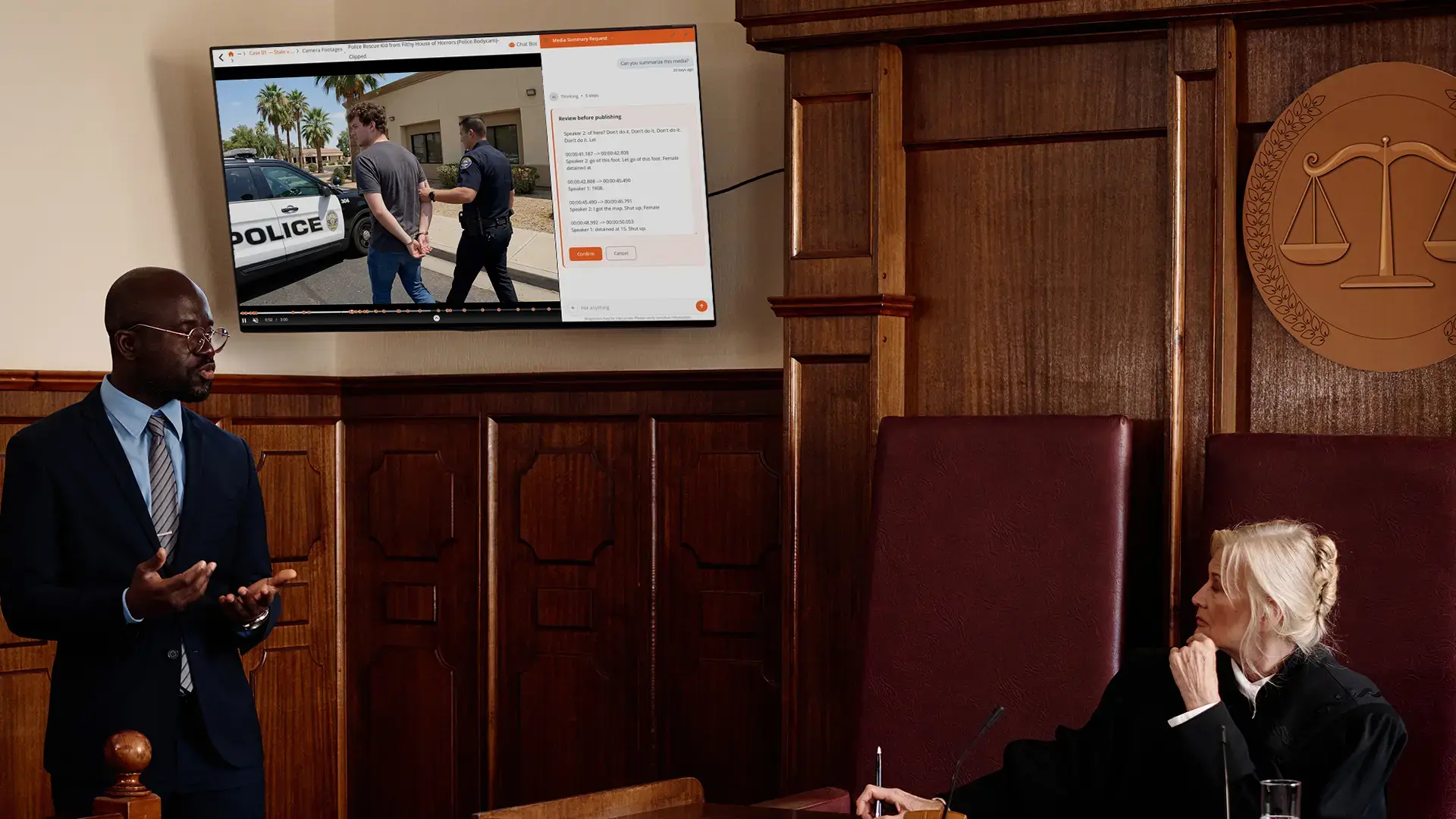
A single arrest can generate hours of body-worn camera video across multiple officers, and a case can pull in dozens of hours more from cruisers, interview rooms, and bystander phones. Somewhere in that footage are the three minutes that decide a motion or a plea.
Body-worn camera AI analysis is how attorneys and investigators find, summarize, and cite those minutes without watching every hour of recording. For the wider picture of how legal teams handle video, audio, and image evidence together, see our guide to AI-powered legal evidence analysis across every format.
Why Body-Worn Camera Footage Review Is So Time-Consuming
Body-worn camera programs have expanded steadily across US law enforcement, supported by federal funding and policy guidance from the Bureau of Justice Assistance and the Department of Justice. More cameras mean more footage, and the footage lands on prosecutors and investigators who already have full caseloads. A case that involves five devices is routine, and review is still mostly manual: someone scrubs the timeline, takes notes, and hopes they did not miss anything.
The cost of that manual reality is real. Cellebrite's 2025 Industry Trends Survey reported investigators spend an average of 69 hours per case reviewing digital evidence, much of it watching recordings in real time because there has been no faster way to know what a file contains. Body-worn footage is a large and growing share of that load. The footage that never gets watched is a blind spot, and in a discovery context a blind spot is a risk.
What Is Body-Worn Camera AI Analysis?
AI analysis of body camera footage means running the recording through models that produce a searchable, summarized, time-stamped account of what it contains. In practice that includes speech transcription with speaker separation, summarization of long segments, key-event extraction with timestamps, detection of people, vehicles, and objects, and optical character recognition of on-screen text such as license plates or street signs.
The point is to tell an attorney what is in the footage and where, so they can decide which moments matter before anyone watches a full recording. That is the difference between starting trial prep from a searchable account of the evidence and starting it from a stack of raw files.
How to Search Inside Body Camera Footage with AI
The capability that changes an attorney's day is searching inside the video rather than across a folder of file names. With analysis applied, footage becomes queryable in plain language. An investigator can ask for every clip showing a red sedan near a given intersection within a time window, or jump straight to the timestamp where a specific person enters the frame, instead of opening files one by one.
This matters most on long recordings. Finding a person or a vehicle by description across many hours is exactly the work that manual review does slowly and inconsistently. Natural-language search with jump-to-timestamp results turns that into a question and an answer, with the underlying clip attached so the attorney verifies it directly.
Analyzing Non-English Body Camera Audio
Body-worn camera audio is not always in English. Encounters happen in Spanish, in mixed dialogue, and in dozens of other languages depending on the community. When footage is multilingual, analysis has to transcribe the spoken language accurately, translate it, and produce English captions and transcripts that a juror or a judge can rely on.
This is a practical admissibility and accessibility issue, not a convenience. A transcript that a non-specialist can read, tied to the original audio, is what makes foreign-language footage usable in a filing or at trial. Capable analysis platforms transcribe across dozens of languages, enough to cover the range most US prosecution offices encounter.
Is AI Body Camera Analysis Admissible in Court?
The first question a careful attorney asks about any AI output is whether it will hold up. Defensibility comes from a few disciplines. Every machine-generated claim should trace back to a source: the exact timestamp and the clip it came from, so a human can confirm it. Summaries and detections are leads for review, not findings of fact, and the human review of the record stays in the loop. Hallucination risk is managed by grounding answers in the footage itself and citing the offset rather than letting a model narrate freely.
The governing standards are well established. Authentication of video evidence runs through Federal Rule of Evidence 901, expert and methodology questions through the Daubert standard, and forensic handling practices align with NIST Special Publication 800-86. Chain of custody is preserved throughout, because analysis that breaks custody is analysis a court can exclude. None of this is exotic; it is the same evidentiary discipline applied to a new processing step.
CJIS-Compliant Deployment for Body Camera AI
Criminal justice data carries handling requirements that rule out most general-purpose AI tools. The FBI CJIS Security Policy sets the controls for criminal justice information, covering access control, auditing, and where data may be processed. Footage of victims, minors, and undercover work cannot be shipped to an undisclosed cloud for processing.
This is why deployment flexibility decides whether a tool is usable at all. Analysis that can run in a government cloud, on-premises, or in a fully air-gapped environment lets an office keep evidence inside its own boundary while still applying AI. The right tool aligns with CJIS Security Policy requirements rather than working around them.
Body-Worn Camera AI Analysis with VIDIZMO Intelligence Hub
VIDIZMO Intelligence Hub is the AI analysis layer for body-worn camera and other video evidence. It applies computer vision to the footage, detecting and tracking people, vehicles, weapons, and license plates, recognizing activities, and generating scene descriptions, alongside 82-language transcription with speaker separation. Those results feed an agentic retrieval layer that lets attorneys query all processed evidence in natural language and receive answers with source citations, the relevant clips, and confidence scores. Workflows route footage from intake through processing to human review, with checkpoints where a person signs off.
It runs where criminal justice data has to stay: government cloud, on-premises, or air-gapped, with self-hosted models so processing aligns with CJIS Security Policy requirements. You can see the full platform on the Intelligence Hub product page, and review how it connects to evidence systems on the VIDIZMO Digital Evidence Management platform.
The honest way to evaluate this is not a scripted demo. Pick a real closed case with messy body-worn footage, and run it through analysis to see what surfaces that manual review missed. Contact our team to set up a pilot on a case you already know the answer to.

FAQ
Frequently Asked Questions
Can AI summarize body camera footage?
Yes. AI analysis can transcribe the audio, separate speakers, and produce timestamped summaries and key-event extractions for long recordings. Treat the summary as a lead for human review rather than a finding, and confirm each point against the cited clip. The value is triage: knowing what hours of footage contain before deciding which minutes to watch in full.
How accurate is AI body camera analysis?
Accuracy varies by audio quality, language, camera angle, and the specific task. Transcription and object detection are strong but not perfect, which is why defensible systems attach confidence scores and cite the exact source. The standard is not zero error; it is traceability. Every claim should point back to a timestamp a human can verify, so accuracy is checked rather than assumed.
Is AI analysis of body-worn camera footage admissible in court?
The analysis itself is a tool that helps you find and authenticate evidence; the footage is what gets admitted. Authentication runs through Federal Rule of Evidence 901, methodology questions through the Daubert standard, and forensic handling through NIST Special Publication 800-86. Preserving chain of custody and keeping a human in the loop are what keep the underlying evidence admissible.
Can AI search inside body camera video?
Yes. Once footage is analyzed, it becomes searchable in plain language. You can ask for every clip containing a described person, vehicle, or object, or jump directly to the timestamp where something appears, instead of scrubbing the timeline. This is the capability that makes long recordings practical to review across an entire case.
Does it handle non-English audio?
Yes. Multilingual footage is transcribed in the spoken language, translated, and rendered as English captions and transcripts suitable for jurors and filings. Strong analysis platforms support dozens of languages, covering the range most US prosecution offices encounter. The transcript stays tied to the original audio so the translation can be verified.
Is body camera AI analysis CJIS-compliant?
CJIS compliance depends on how and where the data is processed, not on the software alone. The FBI CJIS Security Policy governs access control, auditing, and data location for criminal justice information. Analysis that deploys on-premises, in a government cloud, or air-gapped lets an office keep evidence inside its own boundary and align processing with those controls.
TopicsAI Intelligence HubLegal and Privacy

About the author
Ali Rind is a Product Marketing Executive at VIDIZMO, where he focuses on digital evidence management, AI redaction, and enterprise video technology. He closely follows how law enforcement agencies, public safety organizations, and government bodies manage and act on video evidence, translating those insights into clear, practical content. Ali writes across Digital Evidence Management System, Redactor, and Intelligence Hub products, covering everything from compliance challenges to real-world deployment across federal, state, and commercial markets.
You may also like
What Is a Real-Time Crime Center? A Guide for Cities and Counties
Somewhere in the last two years, someone probably asked your department whether it should have a real-time crime ...
Staffing a Real-Time Crime Center When Software Does the Watching
Most chiefs who hear a pitch for a real-time crime center ask the same question before any other, which is whether they ...
RTCC, EOC or Situational Awareness Center: What Each Room Is For
Walk into a real-time crime center, then into a city's emergency operations center, and you will see much the same ...