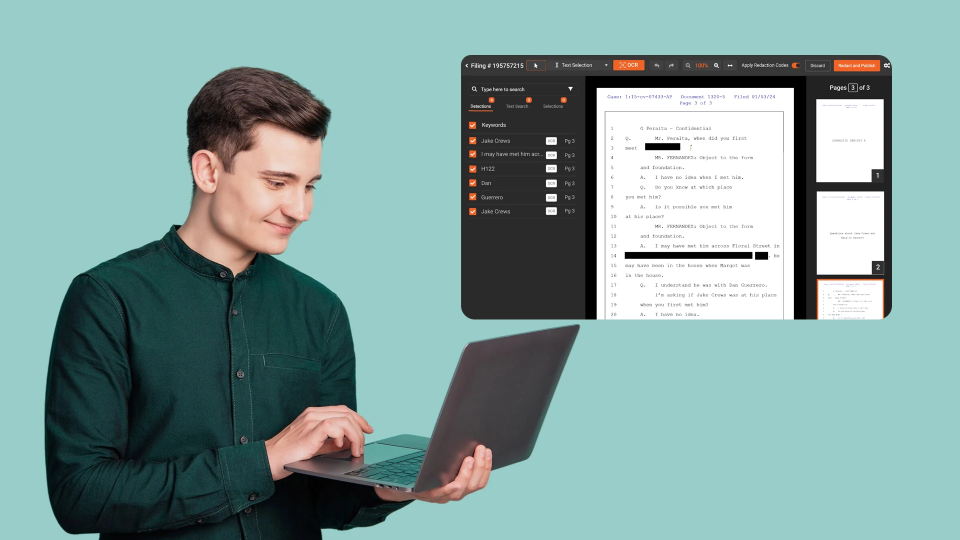
Redaction software permanently removes or obscures personally identifiable information (PII), protected health information (PHI), and other sensitive data from videos, audio recordings, images, and documents. Organizations across government, healthcare, legal, and finance rely on it to fulfill disclosure obligations without exposing confidential details. VIDIZMO Redactor applies AI-powered detection across 255+ file formats, covering faces, license plates, spoken PII, and 40+ data categories in a single platform. If your organization handles public records requests, compliance audits, or litigation holds, the redaction software you choose determines whether you meet deadlines or face penalties.
What Does Redaction Software Actually Do?
Redaction software identifies and permanently removes sensitive information from files before they're shared, published, or archived. That sounds simple. It isn't.
A government agency responding to a Freedom of Information Act (FOIA) request might need to process 200 pages of documents, 15 hours of body camera footage, and dozens of audio recordings from a single case. Each file could contain faces of minors, Social Security numbers spoken aloud, license plates caught on camera, and handwritten notes with addresses. Manual review of that volume takes weeks.
Effective redaction software handles this by combining several capabilities:
- Visual detection for faces, license plates, screens, and custom objects in video and images
- Audio analysis that identifies spoken names, phone numbers, SSNs, and other PII categories
- Text pattern matching with OCR for scanned documents, including handwritten content
- Batch processing so hundreds or thousands of files run through the pipeline without manual intervention
- Audit trails documenting every redaction decision for legal defensibility
VIDIZMO Redactor covers all five of these areas across video, audio, images, documents, and PDFs. It supports 82 languages for transcription-based audio redaction and includes configurable confidence thresholds (25% to 90%) so teams can balance speed with accuracy for their specific compliance requirements.
Why Do Organizations Need AI-Powered Redaction in 2026?
The volume problem is real. Law enforcement agencies generate terabytes of body camera footage monthly. Healthcare systems record telehealth sessions containing PHI. Financial institutions store call center recordings where customers read credit card numbers and account details out loud.
Manual redaction of a single hour of video takes 4 to 8 analyst hours. Multiply that across hundreds of FOIA requests per month, and staffing can't keep up.
AI changes the equation. Modern redaction software uses computer vision to detect and track objects across video frames, natural language processing to identify spoken PII, and OCR to find sensitive text in scanned documents. The National Institute of Standards and Technology (NIST) has published benchmarks for face recognition and text detection that show AI systems meeting or exceeding human reviewer accuracy when properly configured.
Three trends are accelerating demand:
- Expanding privacy regulations. GDPR, CCPA, HIPAA, and state-level open records laws all carry penalties for improper disclosure. GDPR alone can impose fines up to 4% of annual global revenue.
- Growing request volumes. Public records offices face rising request backlogs while their headcount stays flat. Many agencies now report multi-month response delays.
- Multi-format complexity. Agencies don't just redact documents anymore. They handle video, audio, images, drone footage, and CCTV recordings, often in proprietary formats that consumer software can't open.
How Should You Evaluate Redaction Software?
Not every redaction tool fits every use case. A law firm processing eDiscovery documents has different needs than a police department handling body camera footage. Here's what to assess.
Format coverage
Some tools only handle PDFs and Word documents. Others focus on video. If your organization deals with multiple media types, you need a platform that covers all of them without forcing you to buy separate tools for each format. VIDIZMO Redactor supports 255+ formats in a single platform, including proprietary CCTV files that it automatically rewraps from H.264 to standard MP4.
AI detection breadth
Count the PII categories a tool can detect. Pattern matching alone catches SSNs and credit card numbers, but it won't find a face in a surveillance video or a name spoken during a recorded interview. The most capable tools combine visual AI, audio AI, and text-based detection in one workflow. VIDIZMO Redactor detects 40+ PII types across all three modalities, including 33+ spoken PII categories in audio.
Deployment options
Cloud-only tools won't work for agencies with strict data residency requirements or air-gapped networks. Look for on-premises and government cloud options if your organization falls under federal, state, or defense data handling rules. VIDIZMO offers SaaS, Azure Government Cloud, on-premises, and hybrid configurations.
Compliance workflows
Redaction without documentation isn't defensible. Any tool you choose should generate audit trails showing who redacted what, when, and under which legal authority. Exemption codes for FOIA, CPRA, and state-specific laws should map directly to redaction decisions so reviewers can trace every obscured element back to a specific legal basis.
Scale and automation
Can the tool process files unattended? Overnight batch runs matter for high-volume environments. Ask vendors for specific scale benchmarks. VIDIZMO's queue-based automation has been tested with 1.1 million+ recordings, and its fully automated mode lets administrators configure auto-redaction policies with custom PII patterns for zero-touch processing.
Key Industries That Rely on Redaction Software
Redaction software isn't a niche tool. It touches nearly every sector that handles sensitive records.
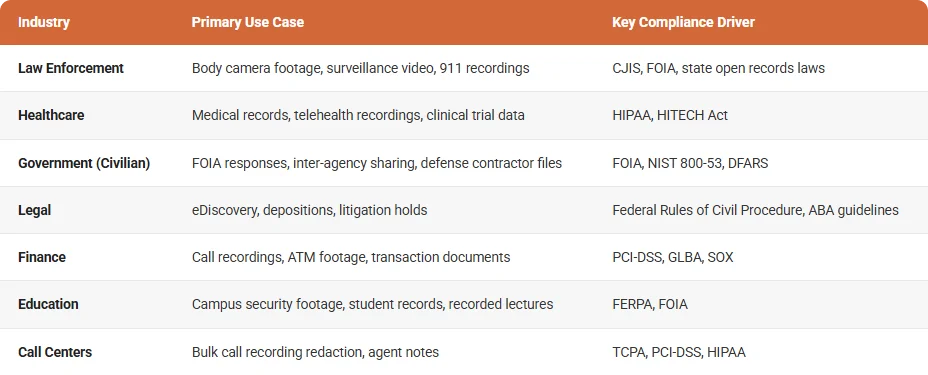
Each industry has distinct requirements. A hospital needs HIPAA-compliant PHI removal from consultation videos. A police department needs chain-of-custody tracking on every redacted file that meets CJIS requirements. The right redaction software adapts to these differences rather than forcing a one-size-fits-all workflow.
Automated vs. Manual Redaction: When Each Approach Fits
Full automation isn't always the answer. Sometimes it is.
Fully automated redaction works best for high-volume, repeatable tasks: thousands of call center recordings where the same PII categories (credit card numbers, SSNs, account numbers) appear in predictable patterns. Administrators configure auto-redaction policies once, and files process overnight without human touch.
Semi-automated redaction pairs AI detection with human review. The software identifies likely PII, and an analyst confirms or adjusts before finalizing. This is the right fit for FOIA responses and legal discovery where a missed redaction could expose a minor's identity or compromise an ongoing investigation.
Manual redaction still has its place for edge cases: unusual file types, contested redactions, or one-off requests where setting up automation isn't worth the effort.
VIDIZMO Redactor supports all three modes. Organizations can mix approaches depending on the file, the regulation, and the stakes involved.
What Sets VIDIZMO Redactor Apart from Other Tools
Several factors separate Redactor from competing products:
- True multi-format coverage. Most competitors specialize in one media type. Veritone handles video and audio only. Redactable and iDox focus on documents. CaseGuard covers multiple formats but runs as a desktop application without cloud or server-based deployment. Redactor covers video, audio, images, documents, and PDFs in one platform with SaaS, on-premises, and hybrid options.
- Objects inside PDFs. Text-only tools can't detect a face or license plate embedded as an image in a PDF. Redactor can.
- Multi-layer redaction. Each layer is independently manageable with its own visibility controls, naming, permissions, and export settings. This matters for FOIA exemption code management where different redaction reasons apply to different elements in the same file.
- 82-language audio redaction. Spoken PII detection and transcription in 82 languages, with translation into 74 languages.
- Deployment flexibility. SaaS, Azure Government Cloud, on-premises, and hybrid. Veritone and iDox are cloud-only. CaseGuard is desktop-only with no cloud option.
In a competitive evaluation for the UK's Department for Work and Pensions (DWP), VIDIZMO scored 86.1% compared to iDox at 32.8% and ReadyRedact at 30.7% across a deployment scoped for 5,000 users processing 4 million pages per year.
Getting Started with Redaction Software
Choosing redaction software comes down to four questions: What file types do you need to redact? What PII categories matter for your regulations? Do you need on-premises or cloud deployment? And how much volume do you process monthly?
Start by mapping your compliance obligations to the features you actually need. A healthcare organization redacting medical records has different priorities than a city clerk processing FOIA requests for police body camera video.
If you're evaluating options, look at total cost of ownership, not just license price. Factor in the labor hours saved by automation, the risk reduction from consistent AI detection, and the compliance value of defensible audit trails.
See VIDIZMO Redactor in action to compare its multi-format AI redaction capabilities against your organization's requirements.

FAQ
Frequently Asked Questions
What is redaction software?
Redaction software permanently removes or obscures sensitive information (PII, PHI, classified data) from files before public release or sharing. Modern tools like VIDIZMO Redactor use AI to automatically detect faces, license plates, spoken names, and 40+ PII categories across video, audio, images, and documents.
How does AI-powered redaction differ from manual redaction?
Manual redaction requires an analyst to review every frame of video, every page of a document, and every second of audio to find and remove sensitive content. AI-powered redaction automates detection using computer vision, speech recognition, and OCR. VIDIZMO Redactor can process files in fully automated, semi-automated (AI plus human review), or manual mode depending on the sensitivity of the task.
What file formats can redaction software handle?
Coverage varies widely by vendor. Some tools only handle PDFs and documents, while others focus on video. VIDIZMO Redactor supports 255+ file formats including video (MP4, AVI, MOV, proprietary CCTV), audio (WAV, MP3, AAC), documents (PDF, DOCX, XLSX, PPTX), and images (JPG, PNG, TIFF). It also handles DICOM medical imaging files and automatically rewraps proprietary CCTV recordings to standard MP4.
How does VIDIZMO Redactor compare to CaseGuard and Veritone?
CaseGuard is a desktop-only application covering video, audio, images, and documents, with flat-rate pricing starting at $99 per month per user (at time of research). Veritone is a cloud-only platform focused on video and audio redaction, with licenses starting at approximately $600 per month. VIDIZMO Redactor offers broader format coverage (255+ formats including proprietary CCTV and DICOM), flexible deployment (SaaS, on-premises, Azure Government Cloud, hybrid), and multi-layer redaction architecture with FOIA exemption code support.
Does redaction software support FOIA and HIPAA compliance?
Redaction software itself isn't "certified" for FOIA or HIPAA. Rather, it provides features that help organizations comply with these regulations. VIDIZMO Redactor includes chain-of-custody audit trails, exemption code annotation, configurable retention policies, and AES-256 encryption at rest. For government deployments, it supports CJIS-compliant configurations via Azure Government Cloud.
Can redaction software process files in bulk?
Bulk processing capability varies by tool. VIDIZMO Redactor's queue-based automation has been tested with over 1.1 million recordings. Administrators can set up auto-redaction policies with custom PII patterns, submit files to the processing queue, and run them unattended during overnight or off-hours windows. That's particularly relevant for agencies handling large FOIA backlogs or call centers with thousands of daily recordings.
What PII categories can redaction software detect?
Basic tools detect text patterns like SSNs and credit card numbers. VIDIZMO Redactor detects 40+ PII categories across visual, audio, and text content: faces, license plates, vehicles, weapons, and custom objects in video; spoken names, addresses, phone numbers, and 33+ categories in audio; and text-based PII patterns in documents with OCR support for scanned files and handwritten content.

About the author
Ali Rind is a Product Marketing Executive at VIDIZMO, where he focuses on digital evidence management, AI redaction, and enterprise video technology. He closely follows how law enforcement agencies, public safety organizations, and government bodies manage and act on video evidence, translating those insights into clear, practical content. Ali writes across Digital Evidence Management System, Redactor, and Intelligence Hub products, covering everything from compliance challenges to real-world deployment across federal, state, and commercial markets.
You may also like

Deploying a Low-Latency Surveillance Pipeline: An Architecture Guide
"Real-time" is one of those phrases that gets used loosely, and in a video analytics pipeline it hides a lot of ...
Choosing a GPU for Real-Time Video Analytics
Capacity planning tells you how many GPUs a deployment needs. This is the other half of the question: which GPU to ...
GPU Capacity Planning for Real-Time AI Video Analytics
Ask a vendor how many cameras their AI runs on one GPU and you will usually get a single confident number with no ...
On-prem vs Cloud for Real-Time AI Video Analytics
For most software written this decade, the cloud is the default and running your own hardware needs a justification. ...