For most software written this decade, the cloud is the default and running your own hardware needs a justification. Real-time video analytics quietly reverses that, and the reversal is not about preference or caution, it is about two hard facts, bandwidth and sovereignty, that push the sensible default toward on-premises as the fleet grows. This is about why that is, when the cloud is nonetheless the right call, and how to think about the hybrid arrangements that sit between them.
The bandwidth argument, which is just arithmetic
Processing video in the cloud means continuously shipping every camera's stream out of your building and across an internet link, around the clock, indefinitely. For a handful of cameras that is fine. For several hundred it is a permanent and expensive torrent, and one your uplink may not physically have the capacity to carry in the first place. A few hundred 1080p streams is on the order of a gigabit or more of sustained outbound traffic that never stops, and every gigabyte of it is metered.
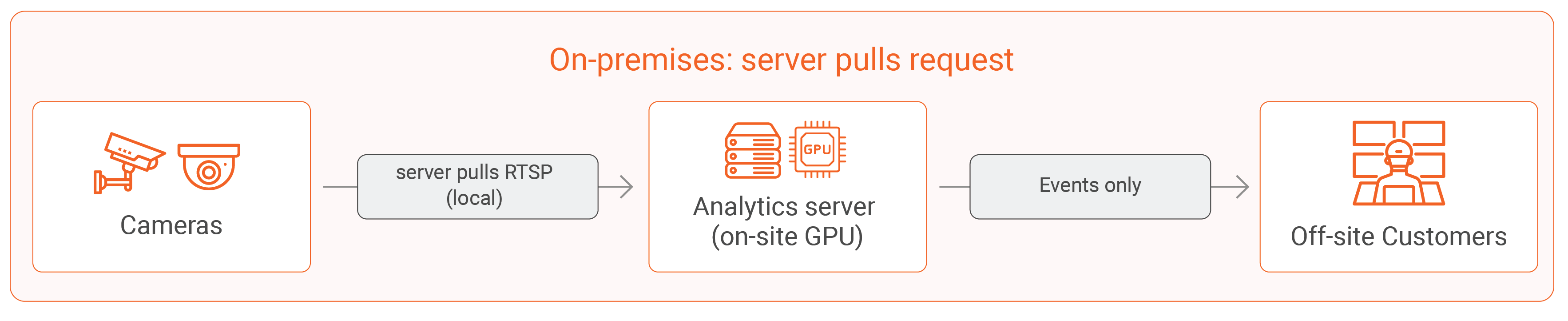
Keeping the analytics on-premises, right next to the cameras, means the heavy video never leaves the local network at all. Only the small things, the detections and the alerts, travel anywhere, and those are a rounding error next to the video. At fleet scale this single fact usually settles the question before anyone has even mentioned security, because the network arithmetic of continuously streaming a large fleet to the cloud simply does not close.
The sovereignty argument, which is often non-negotiable
The second reason is where the video is allowed to live. Surveillance footage is among the most sensitive data an organization holds, and for a government agency, a hospital, a school, or anyone operating under a regime like CJIS, the question of where the video physically resides and who could conceivably access it is not a philosophical one. It is a hard compliance requirement, and the answer often has to be "inside our own walls, and nowhere else."
On-premises deployment answers that cleanly, because the video stays inside your own infrastructure and never leaves. For the most sensitive environments the system can run fully air-gapped, with no external connection at all, which is a posture the cloud cannot offer by definition. This is exactly why on-premises is the primary deployment model for a serious real-time analytics platform, rather than an option bolted onto a cloud-first product as an afterthought.
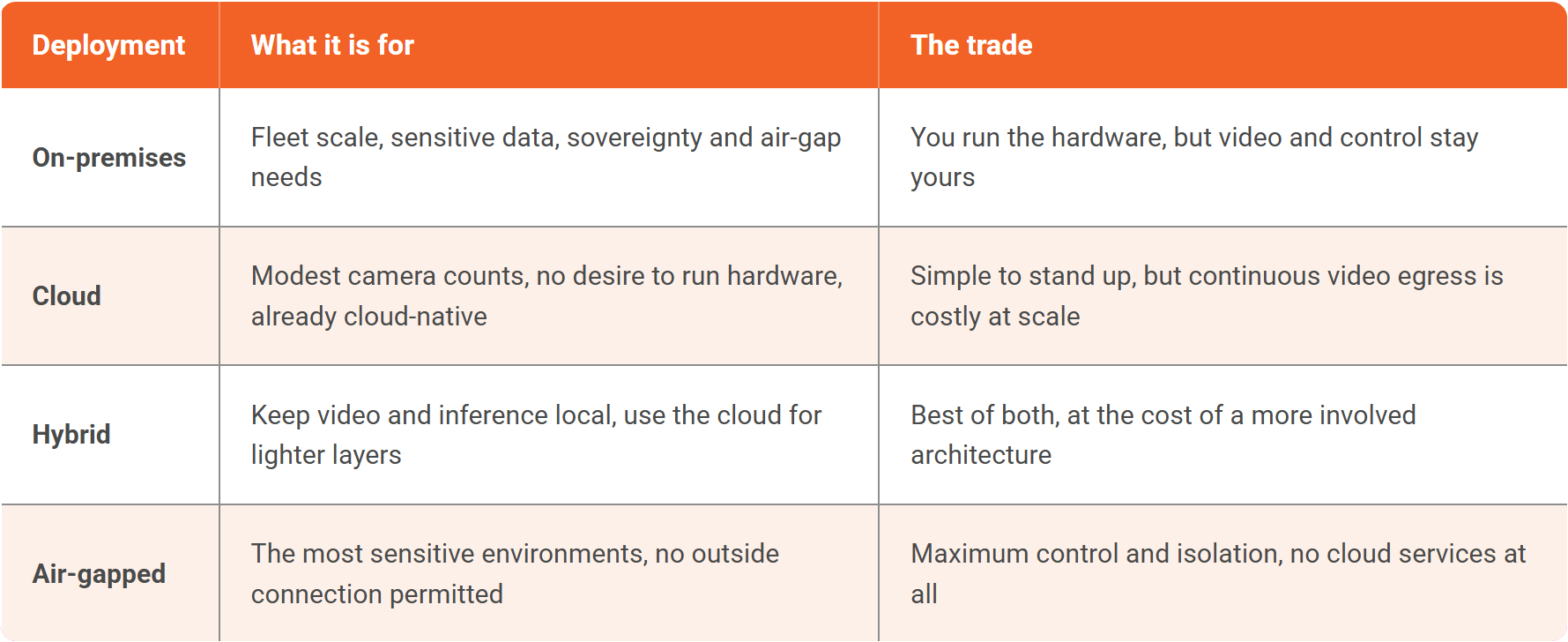
The options, and what each is for
When the cloud is the right call
None of this makes the cloud wrong, and pretending it does would be its own kind of dishonesty. Cloud deployment is genuinely the better choice when the camera count is modest enough that egress is not a problem, when you would rather not own and operate hardware, when you are already running everything else in the cloud and want one operational model, or when you need to spin capacity up and down rather than size for a fixed fleet.
For a small or bursty deployment without heavy sovereignty constraints, the cloud's simplicity is a real advantage, not a compromise. And there are situations where on-premises simply is not an option, no room for hardware, no local IT to run it, a site that is little more than cameras and a connection, and for those the cloud is not a compromise at all, it is the only thing that works.
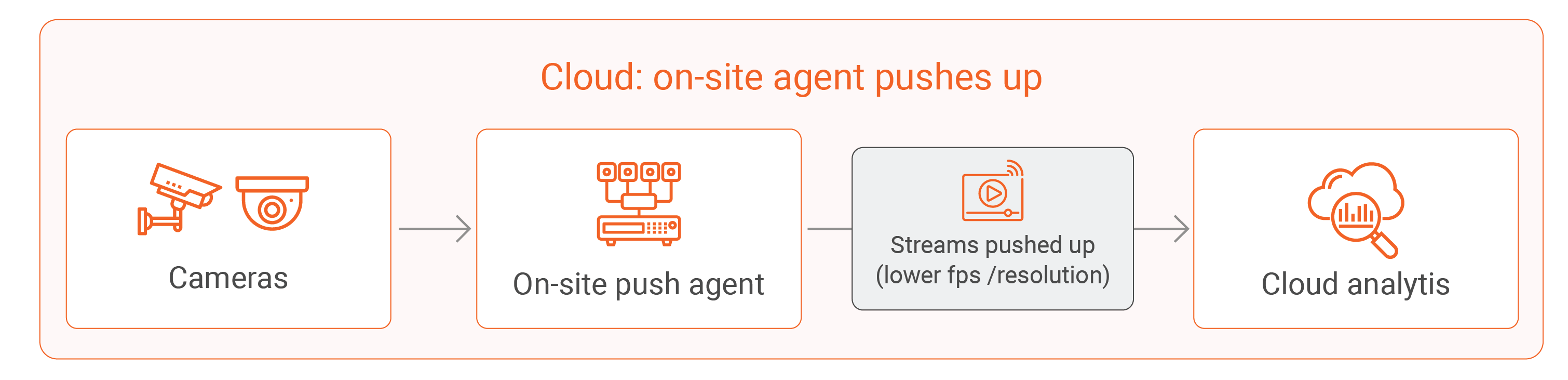
Cloud does change the shape of the deployment, though, and it is worth being concrete about how. On-premises, the analytics server sits on the same network as the cameras and pulls each stream directly. In the cloud it usually cannot, because it has no route into the private camera network and no line of sight to the devices, so the model inverts: something on-site pushes the streams up to the cloud rather than the cloud reaching in to pull them.
That upstream push is the thing you are paying for and sizing around, which is why making the cloud work at anything beyond a modest camera count often means deliberately sending less, a lower frame rate and a smaller frame size than you would run on-premises, trading some detection fidelity for a stream that actually fits the uplink and the budget. It is a sensible trade for the right deployment, and a quietly expensive one if you forget you are making it.
Hybrid: keeping the video home, using the cloud for the rest
The most common answer at the boundary is not a pure choice but a split. Hybrid arrangements keep the two heavy, sensitive things, the video and the inference, on-premises where the bandwidth and sovereignty arguments demand, while using the cloud for the lighter layers where it genuinely helps: management, dashboards, longer-term search over the small structured event data, or access to specialized models. The heavy video never crosses the boundary, and the cloud does the work it is actually good at. For many organizations this is the arrangement that satisfies the compliance people and the finance people at the same time.
How to decide
Strip it down and the decision follows a short path:
-
Is the fleet large enough that continuously streaming it to the cloud is impractical or unaffordable? That points on-premises.
-
Does regulation or policy dictate where the video may physically reside, or demand an air gap? That points on-premises, often without an alternative.
-
Is the deployment small, bursty, or already cloud-native, without heavy sovereignty constraints? The cloud is a fine and simpler answer.
And if the honest answer is "the video has to stay home but we would love the cloud's convenience for everything else," that is precisely what hybrid is for. The point is not that one is universally right, it is that real-time video at scale changes the default, and the default it changes to is on-premises.
Where this deployment decision sits alongside the network design that drives it, and the GPU sizing and everything else, is in Real-Time AI Video Analytics at Scale: The Systems Engineering Guide. The bandwidth math behind the on-premises argument is worked through in network and bandwidth design for large camera fleets.
Talk to us about deploying fully on-premises or air-gapped. See how AI Live Insight meets CJIS and sovereignty requirements without touching the cloud.

FAQ
Frequently Asked Questions
Should real-time video analytics run on-premises or in the cloud?
On-premises is the default for most fleet-scale deployments, mainly because continuously streaming hundreds of camera feeds to the cloud is a bandwidth problem, and many industries such as CJIS, healthcare, and government require the video to stay on-site. Cloud works well for modest camera counts without heavy sovereignty constraints.
Why does video analytics favor on-premises deployment more than most software?
Processing video in the cloud means shipping every camera's stream out of the building continuously, which for a few hundred 1080p cameras is a gigabit or more of sustained, metered outbound traffic. Keeping the analytics on-premises means only small detections and alerts travel off-site, not the heavy video itself.
When is cloud deployment the right choice for video analytics?
Cloud makes sense for a modest camera count where egress isn't a problem, when you'd rather not operate your own hardware, when you're already cloud-native, or when you need to scale capacity up and down rather than size for a fixed fleet.
What is a hybrid deployment for video analytics?
Hybrid keeps the video and inference on-premises, where bandwidth and sovereignty require it, while using the cloud for lighter layers like management dashboards, long-term event search, or specialized models. The heavy video never crosses the boundary.
How does cloud-based video analytics architecture differ from on-premises?
On-premises, the analytics server sits on the camera network and pulls each stream directly. In the cloud, the server usually can't reach into the private camera network, so an on-site agent pushes the streams up instead, often at a lower frame rate and resolution to fit the available bandwidth.
TopicsAI Live Insight

About the author
Farooq Khan is the co-founder and CTO of VIDIZMO, where he leads the engineering, product, and AI strategy behind its platform for making sense of unstructured media. He builds applied and generative AI that turns organizations' video, audio, images, and documents into searchable, governed, and usable intelligence at enterprise scale. Over the past 20 years, he has built systems that capture, scale, and now understand media, from voice logging platforms to large scale commerce to VIDIZMO's AI platform. He leads the product team that builds every VIDIZMO product, including Redactor, AI Intelligence Hub, AI Live Insight and the platform they all run on.
You may also like

What Is a Real-Time Crime Center? A Guide for Cities and Counties
Somewhere in the last two years, someone probably asked your department whether it should have a real-time crime ...

Staffing a Real-Time Crime Center When Software Does the Watching
Most chiefs who hear a pitch for a real-time crime center ask the same question before any other, which is whether they ...

RTCC, EOC or Situational Awareness Center: What Each Room Is For
Walk into a real-time crime center, then into a city's emergency operations center, and you will see much the same ...