Most of the AI use inside your organization is happening where you cannot see it. Microsoft's 2024 Work Trend Index found that 75% of knowledge workers already use AI at work, and 78% of them bring their own tools rather than wait for an approved option. At small and mid-sized companies that figure climbs to 80%. Half of these users (52%) say they are reluctant to admit they use AI for their most important tasks.
For a marketing team, that is a productivity story. For a hospital, a law enforcement agency, a bank, or a law firm, it is a compliance exposure that nobody has signed off on. An analyst pasting a transcript into a consumer chatbot to summarize it has just moved regulated data onto infrastructure the organization does not control, with no record that it happened.
This is the problem enterprise AI governance exists to solve. Not by pretending the tools will go away, and not by banning them and hoping people comply, but by giving the organization a sanctioned way to do the same work inside its own boundary. The rest of this piece covers what that governance actually contains, why the financial case for it is stronger than most leaders assume, and where it tends to break down in regulated settings.
Shadow AI risks and the cost of ungoverned adoption
The clearest number on this comes from IBM's 2025 Cost of a Data Breach Report, which studied 600 breached organizations across 17 industries with the Ponemon Institute. One in five (20%) of those organizations had a breach that involved shadow AI, meaning unsanctioned AI tools used without IT or security oversight. Those breaches cost an average of $670,000 more than incidents without shadow AI involved, which moved shadow AI into the top three costliest breach factors for the year.
The reason the cost lands harder in these sectors is what gets exposed. Shadow AI breaches were more likely to compromise personally identifiable information (65%) and intellectual property (40%) than other breaches. That is precisely the data a HIPAA, CJIS, or legal disclosure obligation is written to protect.
Two more findings explain why this keeps happening. Among breached organizations, 63% had no AI governance policy at all or were still drafting one, and 97% that suffered an AI-related security incident lacked proper access controls on their AI systems. IBM's own summary of the year is blunt: AI adoption is outpacing both security and governance. The gap is not a technology problem. It is an oversight problem.
There is a flip side worth noting, because it shapes the right response. The same report found that global breach costs fell for the first time in five years, to $4.44 million, largely because organizations used AI in their own security and detection. So the lesson is not that AI is the enemy. The lesson is that ungoverned AI is expensive and governed AI pays off, and the difference between the two is policy, controls, and visibility.
Why banning AI backfires in regulated industries
When leaders see those numbers, the reflex is often to prohibit AI outright. In a regulated environment that reflex backfires. A ban does not remove the tools. It removes your visibility into them. The 78% who already brought their own AI do not stop; they just stop telling anyone, and the data exposure moves further underground where no audit can find it.
The more durable answer is to make the sanctioned path the easy path. That is the core idea behind frameworks like the NIST AI Risk Management Framework, the voluntary, sector-agnostic standard NIST released in 2023 and built with more than 240 organizations. Its four functions, Govern, Map, Measure, and Manage, start from the same premise: you cannot manage what you have not inventoried, and you cannot inventory what you have driven into hiding. Governance and prohibition pull in opposite directions.
What an enterprise AI governance policy should include
A governance policy that holds up under regulatory scrutiny tends to do five things well. The order matters less than the fact that none of them can be skipped.
It defines what counts as AI and which tools are in scope. A policy that says "use AI responsibly" without naming the systems it covers gives employees nothing to act on. The definition has to be concrete enough that a paralegal and a CISO would classify the same tool the same way.
It maintains an approved list of vetted platforms, with a path to request new ones. This is the single highest-leverage control, because it converts a vague prohibition into a clear choice. People reach for unapproved tools when the approved set is empty or painful to use. The vetting itself is not trivial in regulated work, which is why a structured enterprise AI vendor evaluation that scores deployment model, compliance alignment, and data residency before anything gets signed is worth building once and reusing.
It specifies when AI must not be used, not only when it may. The harder line to draw is the negative one. A policy should name the categories of data and decision where a model is not permitted to touch the work, or where its output cannot stand without a documented human review.
It requires an audit trail. Every prompt, output, review step, and decision needs to be reconstructable after the fact, because that record is what you hand a regulator or opposing counsel when they ask how an AI-assisted conclusion was reached. The goal is sourced, defensible AI answers rather than confident text with no provenance. An answer that merely sounds right is not the same as one you can back up.
It funds training and revisits the policy on a schedule. Microsoft's data found that only 39% of people using AI at work had received any company training on it. A policy nobody understands is not a control. And because the tools change monthly, a document written once and shelved stops being accurate almost immediately.
AI governance challenges in regulated industries
The general framework above applies anywhere. What separates public safety, law enforcement, legal, and healthcare work is that the consequences of getting it wrong are written into law, and the data usually cannot leave the building.
In law enforcement, the report-writing case is the cautionary tale everyone now cites. Agencies adopting consumer AI to draft narratives ran into a problem when an AI report-writing system inserted the name of an officer who was not at the scene, which is the kind of fabrication that can compromise a case and an officer's credibility. The deeper issue is that sending criminal justice information to a public model processes it on servers the agency does not control, which the CJIS Security Policy does not permit. The practical fix is CJIS-compliant AI analysis that runs where the data already lives, so criminal justice information never crosses the boundary.
The same logic carries across the wider public safety mission, where the record is increasingly body-worn camera footage, dispatch audio, and surveillance video rather than text. Agencies modernizing with AI in public administration have to treat the location of the model as a compliance decision, because a 911 recording or an investigative file sent to a public endpoint has left the agency's control whether or not anyone intended it to.
In legal work, the exposure is privilege. A case file analyzed by a third-party model can lose attorney-client protection, and a conclusion an AI tool influenced has to be defensible if it is ever challenged. Federal courts have started describing what defensible AI use requires, and VIDIZMO's reading of the court oversight standard lands on three things: genuine human involvement, documented validation, and a re-constructable audit trail. A firm cannot produce any of those if the AI ran on infrastructure it does not control.
In healthcare, the exposure is patient data under HIPAA, and the breach math is unforgiving. IBM put healthcare at the top of the cost table again in 2025, at an average of $7.42 million per breach. A clinician pasting notes into a consumer chatbot is a HIPAA event waiting to be discovered.
There is a second blind spot that most governance conversations miss entirely. Almost all of the discussion about AI governance assumes the AI in question reads text. But the regulated record is rarely just text. It is body-worn camera footage, recorded interviews, surveillance video, scanned case files, medical imaging, and clinical recordings, and an analyst who needs to summarize a three-hour recording will find a consumer tool to do it whether or not your policy contemplated video. A governance program that only covers text-based chatbots leaves the highest-volume, highest-sensitivity evidence outside its scope. The approved path has to analyze the same multimodal evidence employees are already feeding into unapproved tools, or the gap simply reopens.
The thread connecting all of this is data residency. In regulated work, where the model runs is often the whole compliance question. A tool can be perfectly compliant in an on-premises deployment and non-compliant the moment the same data is sent to a public endpoint.
On-premise AI with VIDIZMO AI Intelligence Hub
Policy sets the rules. Architecture is what enforces them. Consumer AI keeps creating exposure for one structural reason: the data leaves your boundary and you lose the record of what happened to it. A governed platform closes that gap by keeping the model and the data inside infrastructure you control, and the real test is whether it does so without making people give up capability to stay compliant.
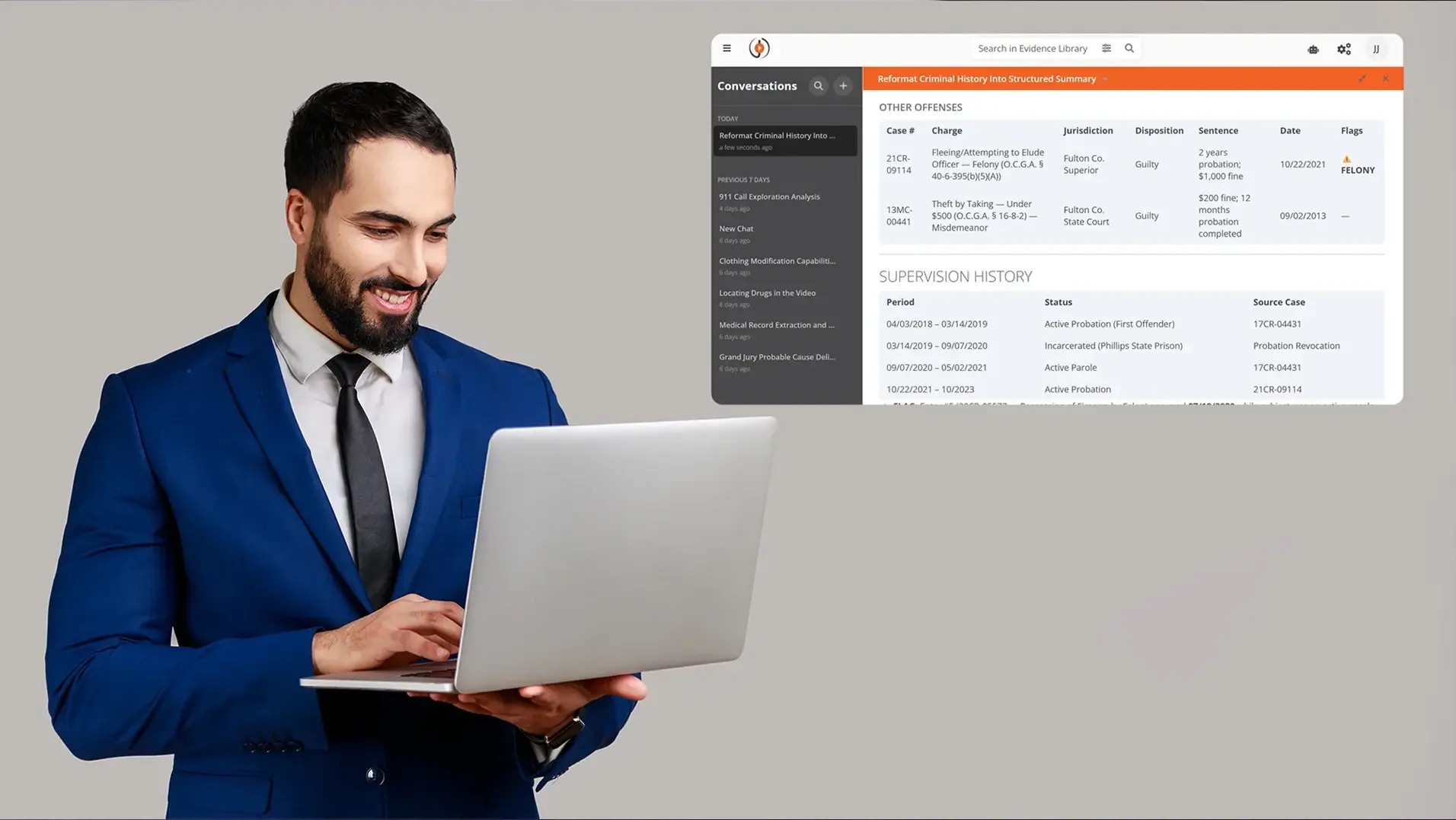
VIDIZMO AI Intelligence Hub is built for that test. It analyzes video, audio, documents, and images together, which covers the full regulated record rather than just the text portion most governance tools stop at. And it maps directly to the policy framework above. It is the sanctioned platform that does the work people would otherwise take to a chatbot. It deploys on your own private cloud, on-premises, or a fully air-gapped network, with self-hosted models through Ollama and vLLM, so criminal justice information, privileged case files, and patient records never leave the perimeter. Every answer it returns is sourced to the original material by timestamp, page, or frame, with a confidence score, and every prompt, output, and review step is logged in your environment.
That last point is what makes AI-assisted work defensible. If a regulator, auditor, or opposing counsel asks how a conclusion was reached, you can reconstruct it without asking a vendor first. The same platform runs in a commercial cloud, a government cloud, or an air-gapped facility, which is why it fits law enforcement, public safety, legal, and healthcare teams operating under CJIS, HIPAA, FedRAMP, and the oversight standards courts now expect.

FAQ
Frequently Asked Questions
What is enterprise AI governance?
Enterprise AI governance is the set of policies, controls, and oversight an organization uses to manage how AI is selected, deployed, and used across the business. It defines approved tools, sets rules for where AI may and may not be used, requires audit trails for AI-assisted decisions, and assigns accountability to a named owner so AI adoption stays compliant and defensible.
What is an example of shadow AI?
A common example is an employee pasting a confidential document, customer record, or call transcript into a public chatbot to summarize or rewrite it, without IT approval. The work gets done faster, but regulated data has now been processed on servers the organization does not control, with no log that it happened. IBM defines shadow AI as unsanctioned AI use without IT or security oversight.
Why is shadow AI a problem for regulated industries?
Shadow AI moves protected data outside the organization's control, which can breach HIPAA, CJIS, GDPR, or legal disclosure obligations the moment it occurs. IBM's 2025 research found shadow AI involved in 20% of breaches, adding $670,000 to the average cost and disproportionately exposing personal data and intellectual property. In law enforcement, legal, and healthcare work, that exposure can also invalidate evidence, waive privilege, or trigger regulatory fines.
What are the legal risks of using unapproved AI tools?
The legal risks include regulatory penalties for exposing protected data, loss of attorney-client privilege when case material is sent to a third-party model, and challenges to evidence or decisions that an AI tool influenced without a documented human review. In litigation or audits, an organization that cannot show how an AI-assisted conclusion was reached may be unable to defend it.
How do you detect shadow AI in an organization?
You detect shadow AI by combining a usage inventory with ongoing monitoring. Start by surveying teams and reviewing network and SaaS access logs to find which AI tools are in use, then add controls that flag data leaving the environment for AI endpoints. IBM found only 34% of organizations with AI policies run regular audits for unsanctioned AI, which is the gap most detection efforts need to close.
Does on-premises AI solve the governance problem?
On-premises or air-gapped AI solves the data residency part of the problem by keeping data and the model inside infrastructure you control, which removes the third-party exposure regulators scrutinize. It does not replace policy. You still need an approved-tool list, defined limits on use, audit logging, and training. The deployment makes those controls enforceable rather than aspirational.
TopicsAI Intelligence HubSecurity and Compliance

About the author
Ali Rind is a Product Marketing Executive at VIDIZMO, where he focuses on digital evidence management, AI redaction, and enterprise video technology. He closely follows how law enforcement agencies, public safety organizations, and government bodies manage and act on video evidence, translating those insights into clear, practical content. Ali writes across Digital Evidence Management System, Redactor, and Intelligence Hub products, covering everything from compliance challenges to real-world deployment across federal, state, and commercial markets.
You may also like
Finding Every Recording a Person Appears In
Some investigations open with the answer already in hand. There is a name, and there is a photograph, taken from a ...
What Analysis Can Still Do With an Incident Already Recorded
A person came to attention on one of your cameras today, and the next question is whether they have been here before. ...
How an Incident on Camera Becomes Known
A camera estate runs unwatched. That is arithmetic rather than a failure of discipline, because a site with a few ...