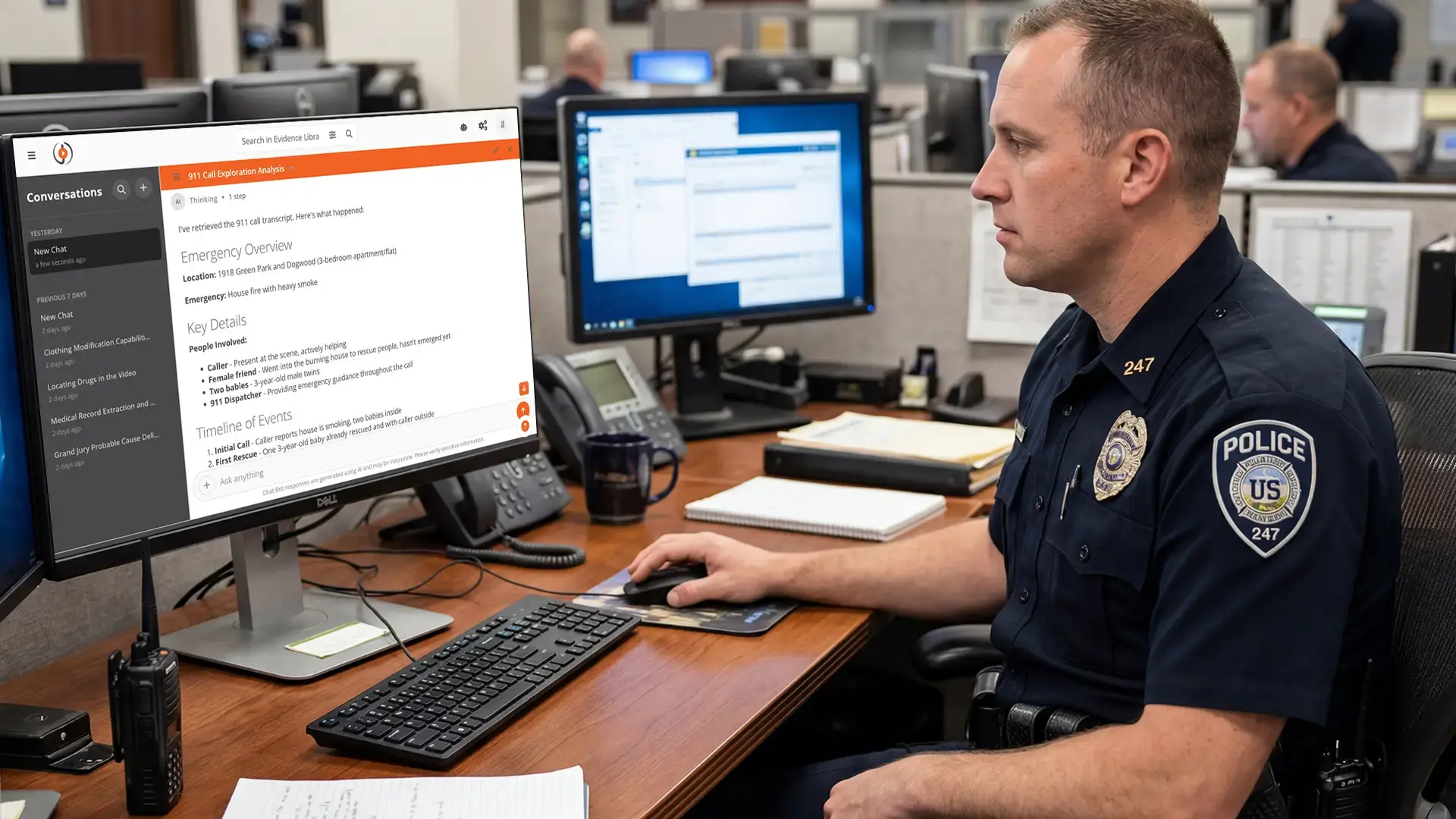
A single serious incident can generate a 911 call, a stream of radio traffic between dispatch and responding units, and follow-on calls from witnesses, all of it captured, and most of it never listened to again unless something goes wrong. When it does get pulled, someone scrubs through hours of audio in real time looking for the thirty seconds that matter.
Transcription solved part of this by turning the audio into text. Analysis is the part that comes after: searching across every call, summarizing what was said, pulling out the facts that matter, and connecting one call to the rest of the evidence. That is what AI 911 and dispatch audio analysis means, and it is a different capability than transcription alone.
One thing to set aside at the start. This is about analyzing what was said and when, cited back to the recording. It is not about inferring a caller's emotional state or judging panic, which is a tempting feature and a poor foundation for any decision.
What Is 911 and Dispatch Audio Analysis?
911 and dispatch audio analysis is the practice of making emergency call and radio traffic usable as evidence and intelligence, rather than as a stack of recordings. It covers the 911 calls themselves, the radio communications between dispatch and units, and related calls tied to an incident.
The distinction from transcription matters because the two get conflated. Transcription produces the text of what was said. Analysis works on that text and audio together to answer questions: what was reported, by whom, at what time, where, and how it connects to everything else in the case. Transcription is the input. Analysis is what turns the input into something an investigator or a reviewer can actually work with at scale.
Why 911 and Dispatch Audio Is Hard to Analyze
Emergency audio is some of the most difficult speech there is to work with, and that is the reason generic transcription struggles with it. A radio channel carries a dispatcher and many units at once, transmissions step on each other, and push-to-talk traffic arrives clipped and partial. The audio itself competes with sirens, wind, crowds, and the sound of the emergency in progress, while callers shout, whisper, cry, or drop in and out on a failing cell connection.
Then there is the language of the channel. Dispatch runs on codes, ten-codes, signal codes, and local shorthand that differ from one agency to the next, so a literal transcript of "signal four" or "ten fifty" means nothing without the context to read it. Calls arrive in many languages, sometimes with an interpreter joining mid-call, and a busy answering point handles a constant stream that turns into a flood the moment a major incident breaks.
All of this is why transcription accuracy and analysis quality depend on handling the medium, separating speakers on a shared channel, holding up against noise, and working across languages, rather than assuming clean, single-speaker speech. It is also why the output is treated as a lead to verify against the recording rather than a finished record. A tool that was not built for this drops exactly the words that matter.
What Can AI Do With 911 and Dispatch Audio?
The useful capabilities are concrete. The first is search. Once a body of calls is analyzed, an investigator can ask for every call that mentions an address, a name, or a weapon within a time window, and get the exact call and timestamp rather than a directory of audio files. On a major incident with dozens of calls and hours of radio traffic, that is the difference between minutes and days.
The second is summarization and extraction. A long call or a stretch of radio traffic can be condensed to what was said and when, with the key facts, the location given, the description of a suspect, the details a caller reported, pulled out with timestamps and tied back to the audio. A reviewer sees the shape of a call before deciding to listen to the whole thing.
The third is connection. A 911 call is rarely the only record of an incident. The same call lines up with the computer-aided dispatch entry and the body camera activation on a reconciled timeline, and it is one of the multi-source inputs an automated incident report reads from. The analysis of the call audio is the piece that makes its content available to all of that, rather than locked in a recording.
Analysis vs Transcription: Where the Line Is
Transcription is necessary and not sufficient. Turning a 911 call into an accurate, searchable, speaker-separated transcript is genuinely valuable, and it is the foundation everything else is built on.
Analysis is what you do once the transcript exists. Transcription answers what words were spoken. Analysis answers questions across many calls at once, surfaces the facts inside them, and connects them to the rest of the evidence. An agency that only transcribes has a searchable record of each call. An agency that analyzes can ask questions of all of them together. The first is record-keeping. The second is investigation.
Where 911 and Dispatch Audio Analysis Gets Used
The clearest use is investigative. A 911 call is often the earliest account of an incident, made before anyone had time to shape a story, and the radio traffic that follows is the real-time record of what responders were told and when. Analysis surfaces what the caller reported, the location and descriptions given, the names and details mentioned, and lets an investigator compare that first account against the later written report and the rest of the evidence.
Calls also become evidence in their own right. A 911 recording is frequently introduced in court, and analysis pulls the exact statements that matter and ties each one to the point in the audio it came from, so the record an attorney relies on is verifiable rather than paraphrased from memory.
There is a records dimension too. Agencies have to produce 911 audio in response to public records requests, and on a large volume of calls the first problem is simply finding the ones that respond to the request. Searching analyzed audio locates the relevant calls quickly, before the separate step of redacting them for release.
Reconstructing a Major Incident After the Fact
The use case where analysis earns its place fastest is the after-action review of a major incident. An active shooter, a natural disaster, a mass-casualty event, or a long pursuit generates a flood of 911 calls and hours of radio traffic across multiple channels, and that audio is the primary record of who reported what, what dispatch relayed, and how the response unfolded. Reconstructing it by hand, call by call and transmission by transmission, is the kind of work that takes a team weeks.
Analysis makes the whole body of audio workable at once. It transcribes and aligns the calls and radio traffic, lets a reviewer search for when a specific location, report, or unit first came up, and summarizes the sequence of what was communicated, each point cited to the recording. The cross-source chronology this supports is the same one behind a reconciled incident timeline.
The discipline matters here as much as anywhere. The analysis establishes what was said and when, and surfaces gaps such as a report that was made but never relayed. It does not grade the response or assign fault. That judgment belongs to the people conducting the review, working from a record they can verify.
Can AI Detect Panic or Stress in a 911 Call?
It can estimate acoustic features that correlate with stress, and some tools market exactly that. It should not be treated as fact or used as a basis for action, and that is a line worth holding.
Emotional state is an inference, not evidence. A caller may sound calm in a genuine emergency or frantic over something minor, and a model's read of tone tells you nothing reliable about what is true. Building a dispatch or investigative decision on a machine's guess about someone's feelings imports a soft signal into a place that needs hard ones, and it invites the same problems as using AI to judge whether a suspect is lying.
The dependable analysis is of content, what the caller actually said, what was reported, what details were given, all of it cited to the recording so a person can verify it. That is the part that holds up in an after-action review or a courtroom. What someone's voice supposedly revealed about their inner state does not.
Keeping 911 Audio Analysis Admissible and CJIS-Compliant
911 audio is sensitive on two fronts, and both shape how the analysis has to run. It is criminal justice information, and it routinely captures victims, minors, bystanders, and callers who never consented to anything beyond reaching help.
That rules out sending it to a public AI service for processing, because the audio would be handled on servers the agency does not control, which CJIS does not permit. The analysis has to run on infrastructure the agency controls, the subject of our guide to CJIS-compliant AI analysis. And because a 911 call can become evidence, an excited utterance has been treated as admissible precisely because of the circumstances it was made in, the analysis has to be defensible: each extracted fact cited to the point in the recording it came from, a person accountable for what gets acted on, and a process that can be reconstructed later, the standard recent rulings point to in defining sufficient human oversight of AI. The original recording stays in the agency's system of record with chain of custody intact, while the analysis reads from it.
How VIDIZMO AI Intelligence Hub Analyzes 911 and Dispatch Audio
Emergency audio is some of the hardest material there is to work with: overlapping units on a single radio channel, background noise and clipped transmissions, callers in distress, radio codes, and callers who are not speaking English. VIDIZMO AI Intelligence Hub transcribes through that, separating the dispatcher from the units on a channel and the parties on a call, and handling non-English callers across 82 languages, which on 911 lines is a routine need rather than an edge case.
With the calls and radio traffic transcribed, the Hub makes an entire incident's audio queryable in plain language. An investigator can pull every transmission that names a location, a suspect description, or a weapon within a time window, condense a long call or a stretch of radio traffic to what was reported and when, and get each fact tied back to the exact point in the recording, with a confidence score, so it can be checked against the audio. It analyzes what was said; it does not infer a caller's emotional state or treat tone as a finding. Those results feed the same workflows that reconcile an incident timeline and draft a multi-source report, so a call's content reaches the rest of the case instead of staying stranded in an audio file.
Because 911 and dispatch audio is criminal justice information that routinely captures victims, minors, and bystanders, the Hub keeps that audio inside the agency's own environment, on-premises, in a government cloud, or air-gapped, with the recording staying in the system of record and chain of custody intact while the analysis reads from it. Take a closed major incident and run its calls and radio traffic through to see what surfaces: explore VIDIZMO AI Intelligence Hub.
See it on your own evidence. Book a call to walk VIDIZMO AI Intelligence Hub through a real incident's 911 and dispatch audio.

FAQ
Frequently Asked Questions
What is 911 and dispatch audio analysis?
It is the practice of making emergency call and radio traffic usable as evidence, going past transcription to search across calls, summarize them, extract the facts inside them, and connect them to the rest of a case. Transcription produces the text of a call; analysis answers questions across many calls and ties the answers to the recordings.
How is analysis different from 911 call transcription?
Transcription converts a call into searchable, speaker-separated text and is the necessary first step. Analysis works on that text and audio to answer questions across an entire body of calls, surface the facts within them, and link them to other evidence. Transcription is record-keeping; analysis is investigation.
Can AI detect panic or stress in a 911 call?
It can estimate acoustic features associated with stress, but emotional state is an inference, not evidence, and should not drive a decision. A caller's tone is an unreliable guide to what is true. Sound analysis focuses on what was actually said, cited to the recording, not on a machine's read of feelings.
Can AI search across many 911 calls at once?
Yes. Once a body of calls is analyzed, an investigator can query all of them in plain language, asking for every call that mentions an address, name, or detail within a time window, and get the exact call and timestamp rather than a folder of files. This matters most on major incidents with many calls and hours of radio traffic.
Is an AI-analyzed 911 call admissible in court?
The analysis surfaces facts and leads, not findings, and admissibility depends on how the recording is handled. A defensible setup cites each extracted fact to the point in the audio it came from, keeps the original recording in the agency's system of record with chain of custody intact, and logs the process, so the work holds up to scrutiny.
Can 911 audio analysis run on CJIS data or on-premises?
Yes, and it generally must. Because 911 and dispatch audio is criminal justice information and often captures victims and minors, the analysis should run on-premises, in a government cloud, or air-gapped, with self-hosted models so the recordings and the processing stay inside the agency's perimeter rather than going to a public AI service.
Does this replace dispatcher quality assurance?
No. QA review of dispatcher performance is its own discipline, supported by accurate transcripts. Analysis adds the ability to search and summarize across calls and connect them to a case, which supports investigations and after-action review rather than replacing the QA process a call center already runs.
TopicsAI Intelligence Hub

About the author
Ali Rind is a Product Marketing Executive at VIDIZMO, where he focuses on digital evidence management, AI redaction, and enterprise video technology. He closely follows how law enforcement agencies, public safety organizations, and government bodies manage and act on video evidence, translating those insights into clear, practical content. Ali writes across Digital Evidence Management System, Redactor, and Intelligence Hub products, covering everything from compliance challenges to real-world deployment across federal, state, and commercial markets.
You may also like
Fire and Smoke Detection as a Second Set of Eyes in Schools
Let the first sentence of this article do the compliance work: nothing described here replaces, modifies, or competes ...
Weapon Detection in Schools: Detection, Verification, Response
No school safety technology carries more emotional weight than weapon detection, and no school safety technology is ...

School Safety Grants: What the Money Can Buy
School safety improvements have a funding problem that is really a sequencing problem: the need is continuous, the ...