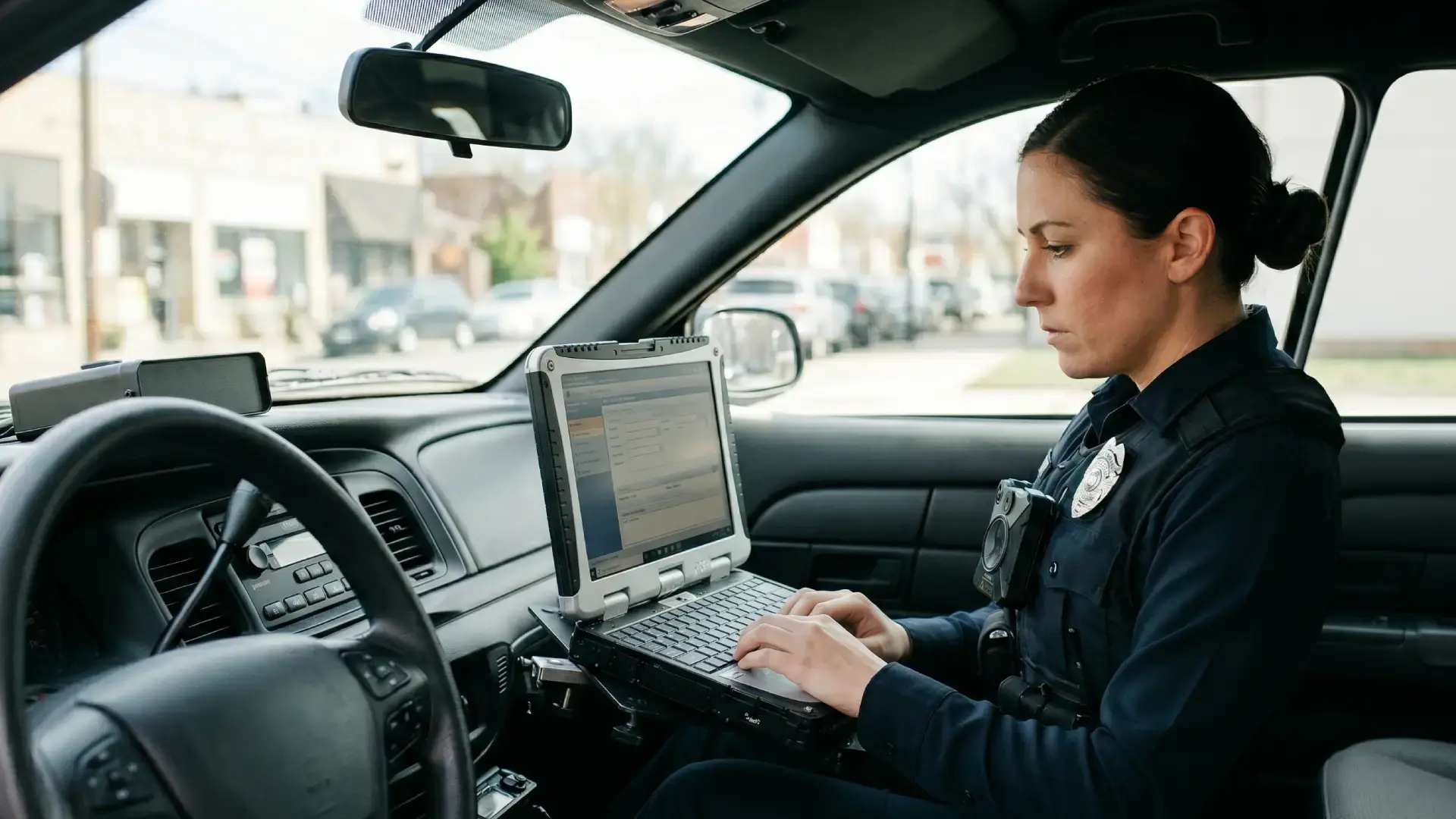
Automated police report generation from multi-source evidence is a new class of AI software that drafts narrative incident reports by reading the digital trail an officer leaves behind: body-worn camera (BWC) video, dashcam audio, interview recordings, computer-aided dispatch (CAD) entries, 911 transcripts, records management system (RMS) data, and any photos or sensor feeds tied to the incident. It compresses a paperwork process that has barely changed in fifty years.
The category emerged publicly in 2024, when the first AI report-writing tools went into U.S. patrol cars. By the close of 2025, dozens of agencies had piloted some form of AI-assisted report drafting, and the International Association of Chiefs of Police issued its first formal guidance on the practice. The 2026 conversation isn't whether AI can draft a police report. It's about which evidence the AI should be allowed to read, and how the officer signs off on what it writes.
Patrol officers spend a significant share of every shift on paperwork, according to time-and-motion studies from the Police Executive Research Forum. That number hasn't moved in over a decade. Multi-source models offer a credible path to changing it, but the category raises new questions about chain of custody, evidentiary admissibility, and what counts as the officer's own observations in a hybrid AI-human document.
Key Takeaways
- Automated police report generation from multi-source evidence is a 2024-emergent AI category that drafts narrative reports from BWC, dashcam, CAD, audio, and document evidence in one pipeline.
- Manual report writing consumes 30 to 40 percent of patrol time. AI-generated drafts cut this to under one hour per incident in published 2025 pilots.
- Multi-source models outperform single-input tools because they reconcile what the officer said, what the camera saw, and what dispatch logged.
- Agencies need three guardrails before adopting: officer review of every draft, full chain-of-custody logging, and prosecutor sign-off on disclosure language.
- Compliance hinges on CJIS Security Policy v6.0, state e-discovery rules, and the agency's own Brady disclosure posture.
What Is Automated Police Report Generation from Multi-Source Evidence?
Automated police report generation from multi-source evidence is software that ingests digital artifacts created during a call for service, then produces a draft narrative report in the agency's preferred format. The AI doesn't replace the officer. It assembles a first draft the officer can edit, sign, and submit.
The "multi-source" qualifier matters. Single-source tools that transcribe BWC audio and reformat it as a report were the first wave in 2023 and 2024. They missed half the picture. A complete incident record includes the dashcam angle, the CAD dispatch entry, the 911 audio, any photographs from the scene, and the suspect's RMS history. Multi-source systems pull all of these into one timeline and let the AI cross-reference them.
The category sits at the intersection of three older tools: speech-to-text transcription, evidence management systems, and large language models. What's new is the orchestration layer that decides which evidence to read, in what order, and how to reconcile contradictions between sources. From what we have seen working with prosecutors and patrol commanders, that reconciliation step is the difference between a useful draft and a liability.
For a broader view of where this fits in the AI-in-policing landscape, our overview of artificial intelligence in law enforcement covers the adjacent capabilities (transcription, redaction, object detection) that feed the report-drafting pipeline.
Does AI Report Writing Actually Save Officers Time?
The honest answer is: the evidence is mixed and the category is too new for confident claims.
The strongest counter-evidence to date is a peer-reviewed study by Adams et al. published in 2024 titled "No Man's Hand: Artificial Intelligence Does Not Improve Police Report Writing Speed," which found that current AI-enabled report-writing software did not improve the time it took officers to complete reports in the study population. IACP President Ken Walker cited this finding directly in his 2025 Police Chief Magazine column on AI adoption, noting that more research is needed before treating time savings as settled.
That doesn't mean the category fails. It means the time savings depend heavily on workflow design, integration with existing CAD and RMS systems, and the type of incident being documented. Vendor demos that promise hours saved per shift should be tested against a controlled pilot, not taken at face value.
What Counts as Multi-Source Evidence in Modern Police Work?
"Multi-source" refers to a specific set of digital artifacts that AI report systems must be able to ingest and align on a single incident timeline.
.png?width=3300&height=1908&name=evidence-types-table%20(1).png)
The hard problem isn't extracting any one of these. Off-the-shelf vendors have been doing speech-to-text and license plate recognition for years. The hard problem is fusing them onto one timeline that survives a defense motion to suppress. Platforms that already integrate with RMS, CAD, body-worn cameras, dashcams, and surveillance feeds have a head start, since the ingestion plumbing is already in place.
How Does AI Actually Generate a Report from Raw Evidence?
The pipeline has four steps, and understanding them helps agencies ask better evaluation questions during procurement.
Ingestion and normalization
The system pulls files from BWC, dashcam, CAD, RMS, and any third-party storage. It transcribes audio in the language spoken at the scene. It runs computer vision on video to detect objects, people, weapons, and movement patterns. It performs cryptographic hashing on every file to lock chain of custody.
Timeline reconciliation
A 911 call timestamped 14:02:18 lines up with a CAD dispatch at 14:02:23, a BWC activation at 14:08:44, and a dashcam clip from 14:08:30 to 14:32:11. The system aligns these on a shared timeline and flags gaps, such as a BWC that activated three minutes late.
Narrative generation
A large language model drafts the report in the agency's report format, citing each claim back to the source evidence. The best systems use retrieval-augmented generation (RAG) so the AI is constrained to facts that appear in the evidence. Every sentence has a pointer to the BWC timestamp or the CAD entry that supports it. This is the same grounding pattern that makes AI-driven evidence analysis defensible at the review stage.
Officer review and sign-off
The officer reads the draft, edits anything inaccurate, adds first-hand observations the cameras missed, and signs. The signed report should carry an audit trail of every AI suggestion and every human edit. That audit trail is the legal foundation for admissibility.
Five Capabilities That Define a Credible Report Generation Platform
The market is crowded with vendors claiming AI report generation. Five capabilities separate production-grade platforms from demoware. Use this as an evaluation checklist before any pilot.
- Source citations on every sentence. The draft must point each claim back to the BWC clip, CAD entry, or interview line that supports it. No citation, no admissibility.
- Confidence scoring with thresholds. The AI flags low-confidence claims for officer review. A blanket "all green" output is a red flag.
- Multi-language transcription with published benchmarks. Single-language systems fail in any city with significant non-English populations. Look for published Word Error Rates per language, not a vague "supports 100+ languages" claim.
- Air-gapped or sovereign deployment options. Agencies in CJIS-restricted contexts cannot send evidence to a public-cloud third-party LLM. The platform must run on-premises or in Azure Government Cloud.
- Full chain-of-custody logging. Every AI inference, every officer edit, every download, with cryptographic hashes. Without this, defense counsel will move to exclude.
What Compliance Standards Apply to AI-Generated Police Reports?
Automated police report generation from multi-source evidence touches every major criminal justice compliance regime. Three frameworks deserve specific attention.
CJIS Security Policy v6.0 requires FIPS 140-3 validated encryption, multi-factor authentication, and customer-managed keys for criminal justice information. Any AI platform that processes BWC or RMS data must meet this standard. Most consumer-facing LLM APIs do not. Agencies using a public LLM API through a wrapper may be out of compliance without realizing it. Our guide to CJIS-compliant cloud evidence software covers what to look for in a deployment that meets v6.0.
NIST SP 800-86 sets the chain-of-custody standard for digital forensics. AI-generated content should be treated as derivative evidence with its own provenance log. The original BWC file, the AI's transcription, the AI's narrative draft, and the officer's edited final each need separate hashes and timestamps.
Brady disclosure rules apply downstream. If the AI's draft made a claim the officer's final report removed, the defense may be entitled to both versions in discovery. A common mistake is treating the AI draft as a working document that doesn't need preservation. It does.
The IACP's AI Resource Hub recommends written agency policy on AI use covering: who can use the tool, mandatory human review, prosecutor consultation on disclosure, and ongoing accuracy review. Departments that adopt without policy are gambling on the first defense motion.
What to Ask Vendors Before Signing a Contract
Vendor demos always show a tidy traffic stop with crystal-clear audio. Real patrol work isn't that clean. Use these questions to surface the gaps.
How does the system handle low-quality audio from a windy scene or a domestic call with three people shouting? How does it disambiguate when the BWC says one thing and the officer's spoken narration says another? What happens when the suspect speaks a language the model wasn't trained on? Can the agency self-host the model, or does evidence always leave the building?
The part most teams overlook is the integration question. A standalone AI tool that requires officers to manually upload BWC clips will struggle to see real adoption. The platform needs to plug into the existing evidence management system, CAD, and RMS without forcing officers into a new workflow. If procurement skips the integration question, the pilot will fail and the agency will conclude AI doesn't work, when really the workflow killed it.
Another question worth pressing: who owns the data the AI trains on? Some vendors have included training rights in their terms of service. Agencies sending evidence to those systems may be donating their case files to improve a private company's model. Insist on contractual language that prohibits training on customer data.
How Intelligence Hub Approaches Automated Report Generation
VIDIZMO Intelligence Hub is the AI analysis layer that handles the ingestion, computer vision, transcription, and retrieval steps described above. Drafting workflows sit on top, configured to each agency's report format and policy.
Two things matter for multi-source report generation. First, Intelligence Hub analyzes the video itself, frame by frame, not just the transcript, so drafts can cite visual evidence officers never narrated aloud. Second, all processing runs on-premises inside the agency's network, which resolves the CJIS problem most public-cloud LLM APIs create. Every output carries a timestamp and source citation back to the original evidence, which is the foundation for admissibility downstream.
Agencies including the Georgia Attorney General's Office and DuPage County Sheriff's Office use the platform across law enforcement and prosecution workflows. For where this fits in an evidence stack, see the Intelligence Hub for law enforcement walkthrough.
Talk to the VIDIZMO team about where multi-source AI fits in your evidence stack and what a pilot would look like for your agency.

Where Multi-Source Report Generation Goes from Here
The category will look different by 2027. Early-mover platforms focused on BWC-only transcription will either expand into multi-source or get displaced. Prosecutors will start to demand AI provenance logs as standard disclosure, and state legislatures are already moving on AI-in-policing statutes.
The agencies that win this transition will treat AI report generation as a workflow project, not a software purchase. The platform matters. The policy matters more. And the officer's judgment, augmented but not replaced, remains the legal core of every report that goes to court.
Talk to the VIDIZMO team about how Digital Evidence Management and Intelligence Hub fit together in your agency's evidence stack.
FAQ
Frequently Asked Questions
Is automated police report generation legal?
Yes, when paired with mandatory officer review and proper disclosure. The IACP's 2024 guidance and most state attorney general opinions treat AI drafts as a working tool, similar to a dictation service. The officer remains the author of record and is responsible for accuracy. Agencies should consult their prosecutor's office before adoption.
How accurate are AI-generated police reports?
Published 2025 pilots report 85 to 95 percent factual accuracy on first drafts before officer review, with most errors concentrated in name spellings, address details, and the chronology of events. Officer review and editing closes that gap, but the drafts aren't court-ready without human sign-off. Accuracy is highest on routine calls (traffic stops, theft reports) and lowest on chaotic scenes with multiple voices.
How does multi-source evidence compare to BWC-only transcription tools?
BWC-only tools transcribe what was said but miss everything outside the audio channel: the dispatcher's call type, the suspect's prior history, the time the unit arrived, the dashcam plate read. Multi-source platforms reconcile all of these onto one timeline. The accuracy gap between the two approaches is significant on any incident with more than one officer or more than one camera.
Does AI report generation create new Brady disclosure obligations?
Probably. If the AI draft contained material the officer removed in the final, defense counsel may argue the draft is discoverable under Brady v. Maryland. Agencies should preserve every AI draft, every edit, and every audit log. Treat the AI's working document the same way you'd treat a witness's first statement to an officer.
Can AI hallucinate facts in a police report?
It can, which is exactly why retrieval-augmented generation with source citations is non-negotiable. A properly configured platform refuses to assert any claim that isn't backed by an evidence citation. Systems that use a general-purpose LLM without retrieval grounding have produced fabricated facts in early pilots, including invented witness names and incorrect timestamps.
Does the AI replace the patrol officer or report writer?
No. The AI drafts. The officer reviews, edits, and signs. Every state we have surveyed in 2025 treats the AI as a tool similar to dictation software, with the officer as the legal author. Departments that pitch AI as a replacement for sworn personnel will face union challenges and likely legal exposure when defense counsel argues the report wasn't actually written by the officer who signed it.
What evidence types should the system ingest beyond BWC and dashcam?
At minimum: BWC, dashcam, CAD entries, 911 audio, interview recordings, scene and booking photos, RMS subject history, and any in-field tablet notes. Forward-leaning agencies are adding ALPR feeds, drone footage, and gunshot detection data. The more sources, the more accurate the timeline reconciliation.
How does VIDIZMO compare to other automated report generation vendors?
Solutions like Axon Draft One, Truleo, Policereports.ai, and VIDIZMO Intelligence Hub address overlapping pieces of this category. The differences cluster around three axes: how many evidence sources the platform ingests natively, whether the AI runs on-prem or only in a single public cloud, and whether the platform is opinionated about which LLM does the drafting. Agencies in CJIS-restricted contexts should weigh deployment flexibility most heavily.
What's the first step for an agency considering this category?
Start with a written policy and a prosecutor consultation, not a pilot. Decide which call types are in scope, who reviews drafts, how AI versions are preserved, and how disclosure will be handled. Then run a 60-day pilot on a narrow call type (traffic stops or theft reports) with a single shift, and measure accuracy and time savings against a manual control group. Skip the policy step and the pilot will fail for procedural reasons regardless of how good the AI is.
TopicsAI Intelligence HubSecurity and Compliance

About the author
Nadeem Khan is the CEO and co-founder of VIDIZMO, where he has led the company's growth from a video management startup into an AI-powered platform trusted by federal law enforcement, defense agencies, and Fortune 500 enterprises. He spearheaded the development of VIDIZMO's Digital Evidence Management System, now used by leading public safety agencies across North America. With over 25 years in enterprise software architecture and cloud infrastructure, Nadeem brings hands-on technical depth to every product decision. Before taking the CEO role, he served as CTO and Chief Architect at VIDIZMO and spent 17 years as Principal Consultant at Softech Worldwide, a Microsoft Gold Partner.
You may also like
Finding Every Recording a Person Appears In
Some investigations open with the answer already in hand. There is a name, and there is a photograph, taken from a ...
What Analysis Can Still Do With an Incident Already Recorded
A person came to attention on one of your cameras today, and the next question is whether they have been here before. ...
How an Incident on Camera Becomes Known
A camera estate runs unwatched. That is arithmetic rather than a failure of discipline, because a site with a few ...