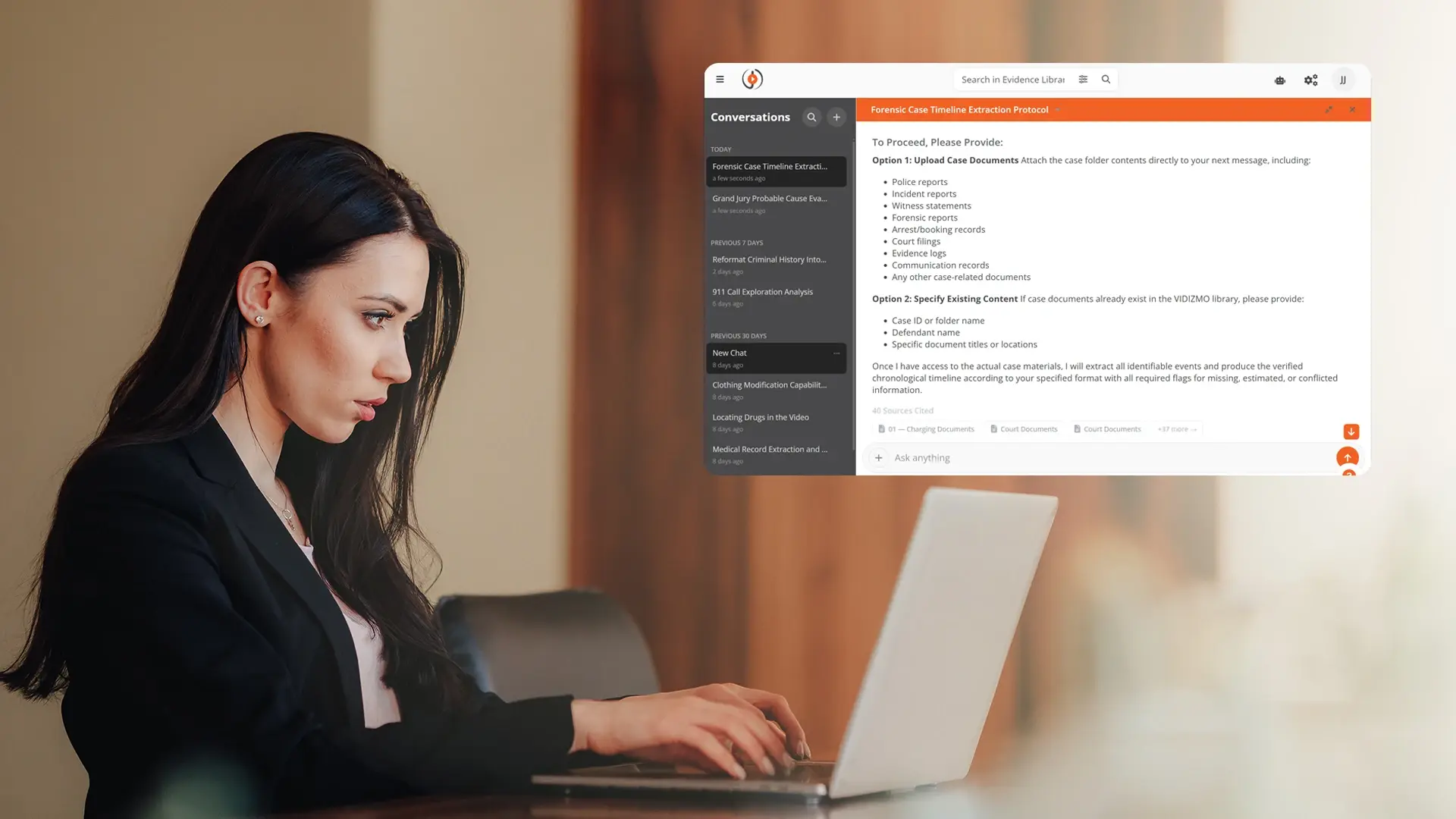
On most days, a large share of a lawyer's time goes to work that does not need a lawyer. Chasing records, sitting through a recording to find one exchange, reading a thousand-page production to locate a handful of facts, tracking down the current status of a matter. The firms that pull ahead have found ways to give that time back, by changing how the work gets done rather than asking anyone to work longer.
Firm productivity, in practical terms, is matters moving faster from intake to resolution, lawyers freed to spend their day on judgment and client work, and a practice that serves more clients well without burning out its team. Plenty of that comes down to workflow and habits. But the single largest block of recoverable time in most litigation and claims-heavy practices sits in one place that the usual productivity advice skips, and that is where this guide spends most of its attention.
What Law Firm Productivity Means in 2026
Productivity is easy to confuse with effort, and the two are not the same. A firm where everyone works late is not productive if matters still stall and clients still wait. The better measure is how smoothly the firm turns its lawyers' time, its technology, and its processes into finished work and satisfied clients.
What changed recently is the size of the lever technology now offers on one specific part of the work. Reviewing a large record, finding the relevant moment in hours of footage, summarizing a stack of documents, all of it used to set the pace of a matter, and all of it can now move in a fraction of the time. That resets what a given team can take on, which is why this is the part of the productivity question worth the most attention.
The Productivity Lever Most Firms Overlook
Walk through where a paralegal or associate actually spends the day on a busy matter and the same pattern appears. A four-hour body camera clip gets watched in real time to find one interaction. A box of scanned medical records gets read page by page. A set of recorded interviews gets transcribed by hand, or worse, summarized from memory. Depositions get cross-checked against statements one document at a time.
This is the work that quietly sets a matter's timeline, and it is invisible on most productivity plans because it does not show up as a billable bottleneck or a missed deadline. It shows up as people working long hours to keep up. The reason it persists is that the record is no longer mostly text, and the tools built to speed up legal work were built for text. Video, audio, and scanned material make up much of a modern file, and a platform that can only read clean documents leaves that volume for a person to handle by hand. Fix that, and you recover more time than any other single change a firm can make.
The Rest of the Picture, in Brief
Firm productivity does depend on more than this. Intake systems that pull information in cleanly, clear delegation so partners spend their time on partner-level work, a single shared system for deadlines and statutes, a client portal that cuts down status chasing, and a culture that protects focus time all matter, and there is good guidance on each.
They are also, for the most part, already well served by practice management and billing software most firms run. The point of this guide is not that those do not count. It is that the record and evidence work is the lever most firms have not pulled yet, and it is the one with the most time behind it. The sections below stay there.
Where AI Gives the Most Time Back
Make the Record Searchable on Day One
The recovery starts the moment material arrives. Transcribing audio and video into attributed text, reading scanned and handwritten documents, detecting people and objects across footage, and indexing all of it turns a pile of files no one can search into a record a reviewer can query immediately. Instead of a four-hour clip that someone has to watch, the team has text and timestamps they can scan. VIDIZMO AI Intelligence Hub does this across formats on one platform, which is what our guide to multimodal evidence analysis covers in depth, and the same processing applied to scanned and mixed documents is the subject of our intelligent document processing guide.
Ask the Record Questions Instead of Scrubbing It
Once the record is indexed, a reviewer asks a plain question and gets a sourced answer rather than searching by hand. The real questions are not keyword shaped. Every reference to a name across the interviews and the personnel file, or every contradiction between a deposition and the surveillance footage, is a sentence, not a search term. Answering it in seconds rather than across an afternoon is where the day-to-day hours come back, a workflow we cover in searching across the full case file.
Run First-Pass Review at Volume
Most documents in a large production do not need a senior lawyer's full attention, and the work is deciding which few do. AI handles the breadth, surfacing relevant terms, risks, and inconsistencies consistently across thousands of files, and the reviewer decides what matters. That first pass is where the largest reading burden lives, and compressing it is the difference between a review that gates a matter and one that keeps pace with it. Our piece on AI document review goes into what separates a tool built for this from one that only looks the part.
Summarize Before Anyone Reads in Full
A reliable summary of a file or a set of files lets an attorney decide what deserves a close read before committing to one. The time saved is not only in the reading, it is in the triage decision that keeps high-value reviewers off low-value material. Applied across a large record, the ability to summarize large document sets turns a multi-day orientation into a starting overview the team refines.
Automate Redaction Before Disclosure
Redaction is the step that turns review into disclosure, and by hand it is slow and risky, since a single missed name or face can waive privilege or draw a sanction. Detecting and removing sensitive content across documents, video, and audio compresses a task measured in hours into minutes, with a review step so a second person approves the result before it leaves the building. This runs through VIDIZMO Redactor, the sister product to the Intelligence Hub, and the ability to automate redaction is often where the productivity case first pays for itself.
Standardize the Processing Workflow
The gains hold when the processing is consistent rather than improvised per matter. Routing each file through the same steps, transcription, detection, redaction where needed, and review gates for anything that fails a confidence threshold, means a paralegal only touches the files that actually need a human. Setting that up once, rather than rebuilding it for every case, is the orchestration side of the same problem.
Why the Tool Has to Be Built for Legal Work
Speed is worthless if the output cannot be trusted, and the profession has already seen lawyers sanctioned for filing fabricated citations from general-purpose chatbots. The dependable approach grounds every answer in a passage retrieved from the firm's own record and shows the citation beside it, so the reviewer verifies in one click and the tool does not invent a fact.
It also keeps the work inside the firm's own environment rather than a third party's servers, and it produces an audit trail, both of which matter as privilege and confidentiality questions around AI use reach the courts. A platform built for the legal domain treats these as the starting point, not as features to add later.
Freeing Lawyers for Higher-Value Work
Every hour recovered from the record is an hour for the work only a lawyer can do. When review and triage take less time, lawyers go deeper on strategy, give clients the counsel they remember, and take on the complex matters that build a firm's reputation.
The same shift helps junior staff, who spend less of the day scrubbing footage and more of it on substantive work alongside the partners they learn from. For the firm, the payoff compounds, since a team that spends more of its time on high-value work can serve more clients and take on harder matters without constantly adding headcount.
The Path to a More Productive Firm
Higher productivity rarely comes from one large move, but this is the closest thing to it, because the record and evidence work holds more recoverable time than any other single stage. Start there. Pick one matter type that runs heavy on video, audio, or scanned records, make that record searchable and reviewable on day one, and let the result make the case for the next step.
VIDIZMO AI Intelligence Hub was built for exactly this part of the problem, turning video, audio, documents, and images into one searchable, cited record inside the firm's own environment, so the hours that used to go to scrubbing and reading go back to the work that needs a lawyer. Book a demo to see what that looks like on a matter from your own caseload.

FAQ
Frequently Asked Questions
Where does AI save the most time in a law firm?
The largest recoverable block of time is first-pass review of large or mixed records, because that is where lawyers and paralegals spend hours by hand. Transcription, search, and summarization compress the finding while the attorney keeps the judgment. For practices heavy in video, audio, and scanned files, the savings are larger, since text-based tools cannot read that material at all and leave it for a person.
How quickly can a firm see productivity gains?
Most firms see visible improvement within 30 to 60 days when they start with a single records-heavy matter type and make that record searchable on day one. Deeper gains build over three to six months as the processing workflow settles in. Pilot the change with one practice group and note where things stand before you begin, so the recovered time is easy to measure against the old process.
Does improving productivity this way mean replacing staff?
No. The aim is to move existing time toward higher-value work, not to cut the team. When review and triage take less time, the same people serve more clients and take on harder matters, and junior staff spend more of the day on substantive work that builds their careers. Most firms use the recovered capacity to grow rather than to reduce headcount.
What should a firm consider before using AI on client records?
Confirm the tool grounds its answers in sources you can verify, keeps data inside your own environment rather than a third party's servers, and produces an audit trail. Keep confidential material out of consumer chatbots, have a lawyer review anything AI produces, and start with low-risk internal uses before client-facing work. These controls are what keep the work both defensible and consistent with professional responsibility.
Can one platform handle documents, video, and audio together?
Yes. A multimodal platform transcribes audio, indexes video frame by frame, reads scanned and handwritten documents, and makes all of it searchable in one place, with answers cited to the exact source. This is the difference that matters for productivity, because the records that consume the most manual hours are precisely the ones document-only tools cannot read.
TopicsAI Intelligence HubLegal and Privacy

About the author
Ali Rind is a Product Marketing Executive at VIDIZMO, where he focuses on digital evidence management, AI redaction, and enterprise video technology. He closely follows how law enforcement agencies, public safety organizations, and government bodies manage and act on video evidence, translating those insights into clear, practical content. Ali writes across Digital Evidence Management System, Redactor, and Intelligence Hub products, covering everything from compliance challenges to real-world deployment across federal, state, and commercial markets.
You may also like
Finding Every Recording a Person Appears In
Some investigations open with the answer already in hand. There is a name, and there is a photograph, taken from a ...
What Analysis Can Still Do With an Incident Already Recorded
A person came to attention on one of your cameras today, and the next question is whether they have been here before. ...
How an Incident on Camera Becomes Known
A camera estate runs unwatched. That is arithmetic rather than a failure of discipline, because a site with a few ...