The answer is usually in the file. The problem is that the file is two hundred hours of body camera video, eleven recorded interviews, four months of surveillance, three banker boxes of scanned reports, and a deposition transcript that runs to four hundred pages. The question, "have we ever seen this pattern before," is reasonable. Sitting down to scrub it out by hand is not. Keyword search across the documents misses everything that lives inside the video and audio. The recordings might as well be opaque.
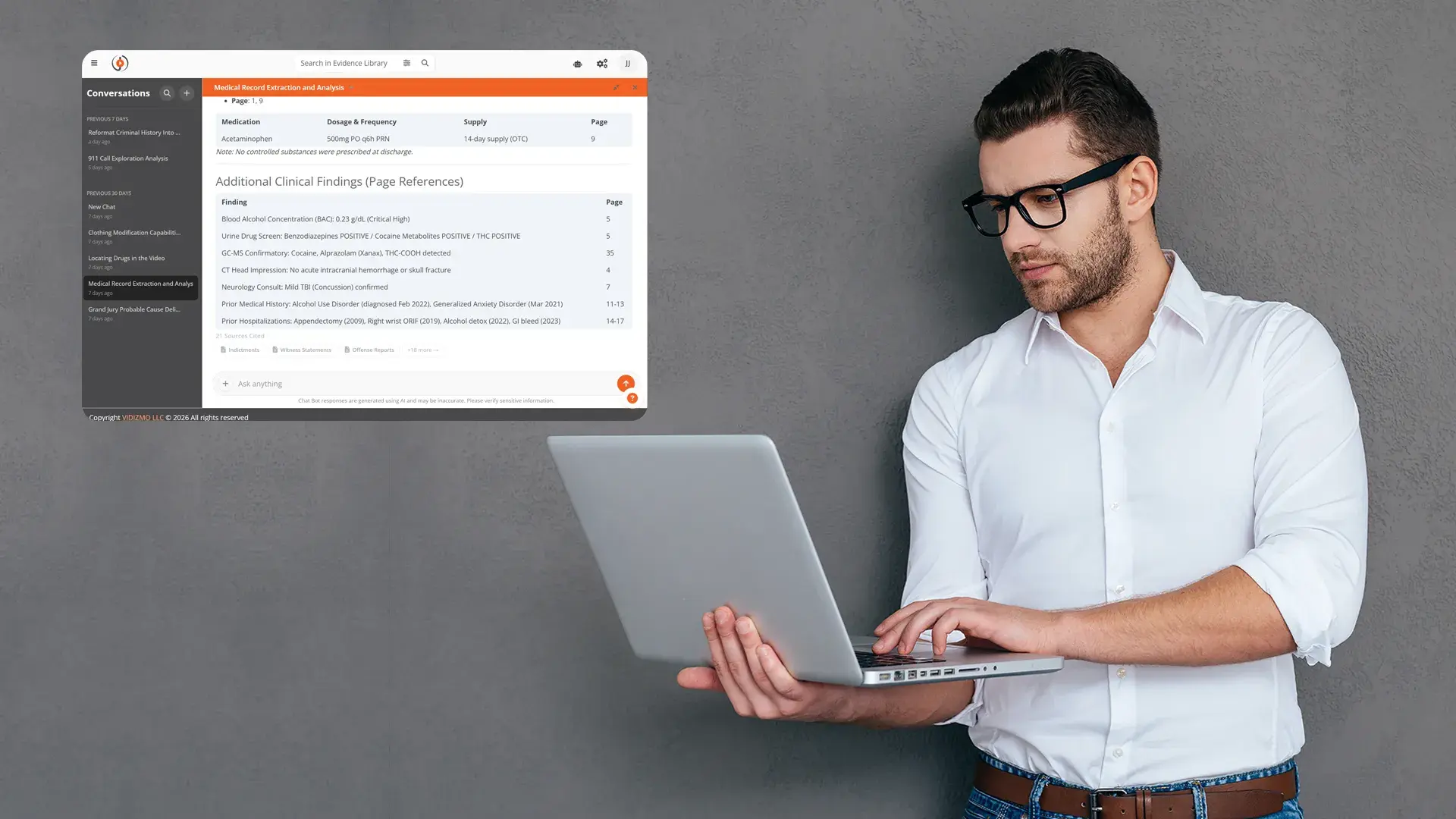
A conversational AI agent for legal evidence is a different shape of tool. Instead of opening files and searching one at a time, the legal team asks plain-language questions across the entire evidence set, and the agent returns a written answer with citations back to the exact page, timestamp, or frame. The agent does not browse the open internet for an answer. It does not draw on training data to invent one. It answers from the team's own indexed evidence, and only from there.
What a conversational agent for legal evidence actually is
A conversational agent in this context is a retrieval-augmented generation (RAG) system grounded in a specific case file. The agent has two jobs. The first is retrieval: when a question arrives, the agent searches the analyzed evidence for the passages, timestamps, frames, and entities most relevant to the question. The second is generation: the agent composes a written answer that quotes or summarizes those retrieved sources, and shows the citations alongside the answer so a reviewer can click through and verify.
The boundary on what the agent will say is important. Because it answers only from retrieved evidence, the agent does not fabricate a witness statement, invent a fact pattern, or pull a citation out of a training set. If the retrieved evidence does not support an answer, the agent says so. That property is what makes the tool usable in a litigation setting, where every fact carries weight and every claim should be traceable.
A conversational agent for legal evidence is also not legal research. It does not summarize case law, draft motions from precedent, or compare contract clauses. Those are jobs for document-only legal AI tools such as Harvey, CoCounsel, GC AI, and Spellbook, which work over the public corpus or a contract library. The conversational evidence agent works over the case file the team already has, which is something the document-only tools were not built to do.
How a conversational agent answers across mixed evidence
The agent works on top of an analyzed layer. Before any question gets asked, the evidence has already been processed into a uniform searchable surface: speech-to-text with speaker separation, object and person detection on the video, entity extraction across transcripts and documents, optical character recognition on scanned files, and metadata indexing. That work is not the selling point. It is the prerequisite. Without it, the agent would be reading filenames.
What the agent does at query time is reason across that analyzed layer in one pass. The retrieval reaches every modality at once. A single question can pull together a sentence from a recorded interview, a fifteen-second clip from a body camera segment, and a paragraph from a scanned report, then assemble the answer with citations to all three. The reviewer sees the written answer first, then clicks the timestamp to watch the segment, or the page citation to open the document.
The natural-language interface matters because the questions a litigation team actually has are rarely keyword-shaped. "Show me every contradiction between the deposition video and the surveillance footage" is not a keyword query. Neither is "list every reference to the supervisor's name across the recorded interviews and the personnel file." The agent translates intent into retrieval, runs it across the indexed evidence, and returns a sourced answer. The reviewer keeps the judgment work and gives up the scrubbing.
What this looks like in actual case work
A few examples make the capability concrete.
A DA's office handling a string of armed robberies wants to know whether the suspect's modus operandi appears anywhere in the office's prior case material. The agent searches across years of analyzed evidence, surfaces three earlier matters with similar fact patterns from interview transcripts and surveillance footage, and cites the specific moments. The attorney reviews each citation in one click.
A litigation team preparing for trial needs every video segment that shows a specific person on the scene. Across forty hours of footage from six cameras, the agent returns a timestamp-cited list, organized by camera and ordered chronologically. What used to be a week of manual review takes an afternoon.
A prosecutor wants every contradiction between a deposition video and the surveillance recordings of the same evening. The agent identifies the conflicting moments, quotes the relevant lines of testimony, cites the timestamps in both sources, and produces a side-by-side reference the prosecutor uses to draft an examination outline.
An investigator working a multi-defendant case asks where a specific name appears across all recorded interviews and the document production. The agent returns every mention with its source, including instances in audio that no document search would have surfaced.
These same questions often feed a larger chronology, turning sourced answers into an ordered, court-ready event log.
In each case the agent is not deciding what to do with the information. It is finding it, citing it, and putting it in front of the lawyer in a form the lawyer can verify.
Why grounded answers with citations matter for litigation
Two things about the agent's design carry the defensibility load.
The first is grounding. Every answer is composed from retrieved passages of the team's own evidence, and the cited source is shown next to the answer. There is no path for the agent to assert a fact that does not trace to something concrete in the case file. The reviewer verifies in one click. The grounding is not a feature added on top. It is how the agent produces output at all.
The second is the deployment posture. The agent runs inside the organization's own tenant, which means privileged work product, protective-order data, and witness identity stay inside infrastructure the legal team controls. The model does not learn from queries across other tenants. The evidence is not shipped to a vendor's shared instance for training.
The defensibility argument here is structural rather than contractual. A vendor can promise in its terms of service that it will not misuse evidence. The team is still trusting the promise. With a grounded agent in a private tenant, the technical architecture is doing the work the contract would otherwise have to.
This is the same distinction federal courts have begun drawing in rulings on AI and privilege, where the line between defensible and indefensible AI use runs through architecture and oversight rather than contract language. Every claim is traceable. Every artifact stays where the team put it. That is the property that holds up when a judge or opposing counsel asks how an AI-assisted finding was produced.
A production deployment: CaseBot at the South Carolina Attorney General's office
VIDIZMO AI Intelligence Hub includes CaseBot, the conversational agent for legal evidence described throughout this piece. CaseBot is in active production at the South Carolina Attorney General's office, where prosecutors use it for natural-language search and case summarization across transcripts, detected objects, metadata, and locations.
Every answer carries citations back to the source evidence: the file, the page, the timestamp, or the frame. The agent runs in a deployment the AG's office controls, not on a shared public service. For a broader view of how Intelligence Hub processes the mixed evidence the agent sits on top of, see our overview of AI-powered legal evidence analysis across every format.
That deployment is the proof point worth keeping in mind. The conversational agent is not a demo. It is a working tool already serving a state attorney general for the exact use pattern this piece describes.

FAQ
Frequently Asked Questions
What is conversational AI for legal evidence?
Conversational AI for legal evidence is a retrieval-augmented agent that lets a legal team ask plain-language questions across an entire indexed case file, including transcripts, video, audio, and documents. Every answer is generated only from the retrieved evidence and shown with citations back to the exact page, timestamp, or frame. It does not invent facts, search the open web, or summarize external case law.
How is a legal AI agent different from a tool like Harvey or CoCounsel?
Tools such as Harvey, CoCounsel, and GC AI operate on documents: legal research, contract review, deposition summaries, and motion drafting. They are not built to watch body camera video, run speech recognition on a recorded interview, or detect a person across surveillance frames. A conversational evidence agent works on the case file itself, including the video and audio that document-only tools do not open, and answers questions with citations into that evidence rather than into the public legal corpus.
Can a RAG agent hallucinate when answering questions about a case?
The risk is much lower because the agent generates answers only from retrieved passages of the team's own evidence, and each answer is shown with the source citation. If the evidence does not support an answer, the agent says so. A reviewer can verify every claim in one click. That is the structural reason RAG is the right shape of tool for litigation work, where every fact has to trace to something concrete.
Does the agent keep evidence inside our infrastructure?
A well-designed evidence agent runs inside the organization's own tenant, whether on-premises, in a private cloud, or in a government cloud environment. Privileged material, protective-order data, and witness information stay where the legal team put them. The model is not trained on queries from other tenants, and the evidence does not move to a vendor's shared service for processing.
What kinds of questions does a conversational evidence agent handle well?
It handles questions that span modalities or repetitions across a corpus: "find every reference to this name across interviews and reports," "list contradictions between the deposition video and the surveillance footage," "show every body camera segment with this person in frame," "have we seen this pattern in prior cases." Keyword search cannot reach inside video and audio. The agent does, and returns sourced answers in natural language.
Where is this actually being used today?
The South Carolina Attorney General's office runs VIDIZMO CaseBot in production for prosecution evidence search and case summarization, with citations back to source evidence on every answer. CaseBot is the conversational agent described in this piece, deployed against the AG office's analyzed case data.Share
TopicsAI Intelligence HubLegal and Privacy

About the author
Ali Rind is a Product Marketing Executive at VIDIZMO, where he focuses on digital evidence management, AI redaction, and enterprise video technology. He closely follows how law enforcement agencies, public safety organizations, and government bodies manage and act on video evidence, translating those insights into clear, practical content. Ali writes across Digital Evidence Management System, Redactor, and Intelligence Hub products, covering everything from compliance challenges to real-world deployment across federal, state, and commercial markets.
You may also like
Finding Every Recording a Person Appears In
Some investigations open with the answer already in hand. There is a name, and there is a photograph, taken from a ...
What Analysis Can Still Do With an Incident Already Recorded
A person came to attention on one of your cameras today, and the next question is whether they have been here before. ...
How an Incident on Camera Becomes Known
A camera estate runs unwatched. That is arithmetic rather than a failure of discipline, because a site with a few ...