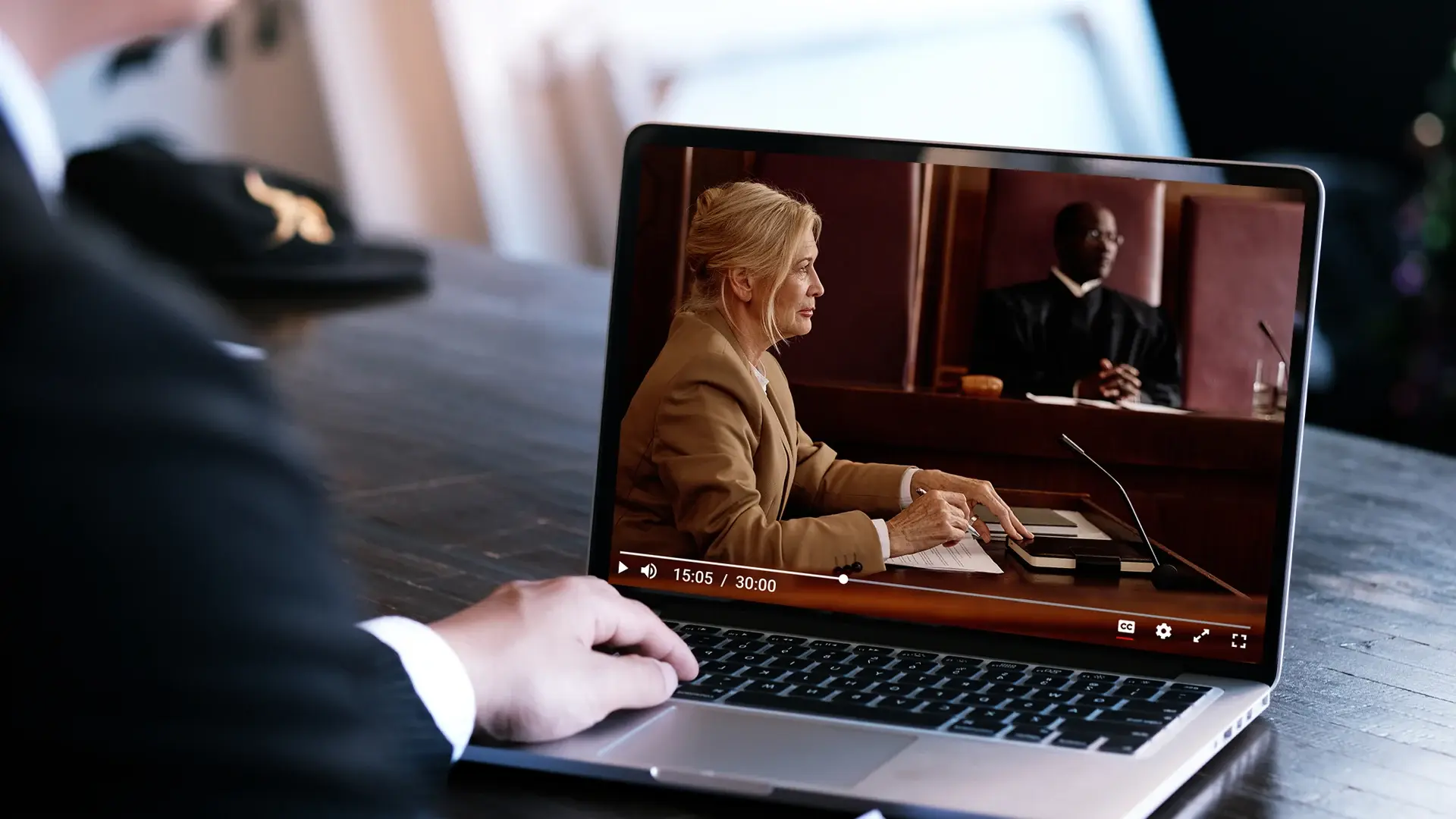
Courts adopted remote hearings under emergency conditions and then discovered they were not going back. Judges who moved to remote appearances have kept them for routine motions, status conferences, and much of the civil docket. The National Center for State Courts now treats remote participation as a permanent feature of court operations rather than a contingency, and the Council of Europe's Commission for the Efficiency of Justice found, in its 2024 evaluation of European judicial systems, that 33 of the 44 member states it evaluated permit remote hearings in criminal matters.
What most courts have not done is revisit the technology they chose in a hurry. Remote and hybrid hearing technology is usually assembled from a conferencing license bought under pressure, whatever audiovisual equipment was already in the room, and a recording arrangement that predates both. It works well enough that nobody replaces it, and badly enough that hearings stall, records come out incomplete, and nobody can find a proceeding from two years ago.
This guide is for court administrators and court IT staff who own how hearings actually run. It covers what a hybrid hearing requires, the four things that have to work simultaneously, and where the gaps usually sit.
What a hybrid hearing actually is
The definition matters because it determines what you procure.
A hybrid hearing is one where at least one participant attends from the courtroom, using the room's audio and video infrastructure, and at least one attends remotely by video, audio, or telephone. That is a harder engineering problem than a fully remote hearing, where everyone is in the same condition. In a hybrid proceeding the court is bridging two different environments and trying to give both the same view, the same audio, and the same standing in the record.
Fully remote hearings are comparatively simple. Everyone is a participant in a conference. Fully in-person hearings are the traditional case. Hybrid is where courts spend most of their difficulty, and it is also where most of the docket has landed.
The distinction also shapes the failure modes. In a hybrid hearing, the person in the room can see a physical exhibit that the remote participant cannot. The remote participant can be inaudible to the room while sounding fine to other remote attendees. The recording can capture the room clearly and the remote feed poorly. None of these is a conferencing problem, and buying a better conferencing license will not fix them.
Four things that have to work at once
A hearing succeeds when four separate systems hold up simultaneously. Courts tend to have solved one or two and assumed the rest follow.
| Requirement |
What it means |
How it fails |
Where it is discovered |
| Presentation |
Everyone entitled to see an exhibit sees the same one at the same time, and nobody sees what they should not |
The wrong exhibit is shared, or the right one cannot be |
In the hearing, immediately |
| Capture |
What was said and what was shown reaches the record accurately enough to survive review |
The room is captured clearly and the remote feed poorly; the exhibit is discussed but never recorded |
On appeal, years later |
| Access |
The right people are in the proceeding, the public gets what open justice requires, closed portions stay closed |
A closed portion is streamed, or a party cannot get in |
In the hearing, or in the press the next day |
| Confidentiality |
Sealed material, protected identities and privileged exchanges stay protected, including in the recording and the archive |
Sealed material reaches a shared screen or survives into a public archive |
Late, and usually by someone who was harmed |
These pull against each other. Wider access strains confidentiality. Better capture increases what must later be redacted. A presentation setup that makes exhibits easy to share makes it easier to share the wrong one. The design job is balancing them, and the balance is a policy decision rather than a technical one.
Courts usually discover the imbalance in a specific way. A hearing runs fine for months, then a sealed exhibit appears on a public stream, or an appeal reveals that the record never captured what the judge was shown. Both are governance failures that surfaced as technical ones, and both are cheaper to prevent than to explain. It is worth writing down, before procurement rather than after, which of the four the court is willing to constrain when they conflict. Most courts, asked directly, will say confidentiality wins over access and capture wins over convenience. Few have said it in a document that the person configuring the platform has read.
Presenting evidence when half the room is elsewhere
The most common operational failure in a hybrid hearing is somebody sharing the wrong thing, or failing to share the right thing, at a moment when the proceeding cannot pause.
Worth being clear about responsibility here: the conferencing platform does the presenting. Teams, Zoom, and Webex have screen sharing, and courts already own it. What the conferencing platform does not do is hold the exhibit, know who is entitled to open it, keep sealed material out of reach of the person sharing their screen, or record what was displayed in a way the exhibit list can be reconciled against.
That is the evidence layer's job, and it is where most courts have a gap. Presenting evidence in a virtual hearing and getting it into the record covers the mechanics: getting the right exhibit in front of the right person before the hearing starts, permissioned access during the proceeding, and reconciling what was shown against the clerk's list afterward.
There is also a category of material that must never reach the shared view. Sealed filings, protective orders, juvenile and family confidentiality, and partial public access all mean a court operates several access levels at once, and they change during a case. Sealing, protective orders, and tiered access to court records is the administrative problem underneath, and it is not solved by remembering which folder is which.
For juries, the boundary is firmer still. Jurors decide on admitted evidence and nothing else, which makes giving jurors access to admitted evidence in deliberation a question about reliable playback and navigation, with a hard line against anything that summarizes or analyzes the material for them.
Capturing the record when the reporter is gone
The record used to be a person. Increasingly it is not, and this is the change courts have been slowest to absorb.
The US stenographer workforce has fallen roughly 21 percent over a decade to around 23,000. Enrollment in stenography programs is down 74 percent, and about 42 percent of those programs have closed (industry data from AAERT, the trade association for electronic court reporting). In California, of 4,214,365 family law, probate and unlimited civil hearings held between April 2023 and March 2026, about 3,007,651 took place with no verbatim record at all, which is 71.3 percent (Judicial Council of California). This is a structural shortage rather than a hiring cycle, and no amount of recruitment budget resolves it.
What replaces it is digital capture plus transcription with human review. That involves two separate decisions courts routinely treat as one. The first is what captures the audio, which for a physical courtroom means microphones and recording hardware, and for a virtual or hybrid hearing means the conferencing platform's own recording. The second is what happens to that audio next: transcription, speaker separation, translation where needed, search, retention, and export. Digital court recording after the stenographer shortage works through both, and argues that the second decision matters more and gets less attention.
Capturing what was shown is a separate discipline from capturing what was said, and it is the one that fails silently. An exhibit displayed during a hearing is only useful later if the record captured it, and courts frequently discover the gap on appeal. That question, along with formats that will still open when the appeal is heard, is covered in the guidance on getting exhibits into the record.
When a case moves up, all of this has to be assembled into something the reviewing court can use. The appellate record is a deliverable with a recipient: a transcript-linked, searchable record with the admitted exhibits attached, transmitted in a format that still opens years later.
Language access is part of the record, not an add-on
Courts that receive federal financial assistance in the US owe meaningful access to people with limited English proficiency under Title VI. In Europe the Council of Europe's CEPEJ adopted guidelines for quality interpreting in judicial proceedings in June 2026, covering its 46 member states; separately, EU courts operate across the Union's 24 official languages. Across much of Asia the position is more demanding still: proceedings routinely run in more than one language, and speakers switch mid-sentence.
The scale some judiciaries operate at is instructive. India's Supreme Court had machine-translated more than 53,000 judgments by 2024, on a system covering 19 Indian languages, so that litigants can read decisions affecting them. A Philippine Supreme Court transcription pilot cut transcription time by half on average, and by as much as 80 percent in some courts, while raising accuracy from 70 percent to as high as 95 percent, across proceedings that mix Tagalog and English.
The practical point for a hybrid hearing is that language access is a property of the record rather than a service bolted onto it. Language access obligations for transcription and translation covers where automated work is appropriate, where a certified human is required, and how legal terminology survives translation.
Access, archives, and the long tail
Two distinct audiences want to see a proceeding: the parties, and the public. For the parties, the narrower question of giving evidence and sharing it securely via video link sits underneath everything below.
Public access is where open justice and privacy collide inside a single hearing, sometimes minute by minute. A stream may be public by default, closed for a portion, and reopened. Jurors, victims, minors, and witnesses need protection while the broadcast runs. And once a stream has been captured elsewhere, takedown becomes an aspiration rather than a control. Livestreaming court proceedings without losing control covers that balance, including appellate and supreme courts that publish oral argument as a standing transparency commitment.
The archive is the part nobody budgets for. Hearings accumulate faster than anyone retrieves them, and the retrieval problem only becomes visible years later when a case reopens or a journalist files a request. Retention tied to case type and appeal windows, tiered storage, legal holds that suspend destruction, and format migration all belong in the design rather than in a later project. Archiving court proceedings for retention and retrieval treats the archive as an operational system rather than a storage bill.
One group is served badly by nearly all of this. Most guidance about hearings and evidence assumes the participant has a lawyer. A growing share do not, and courts owe them access anyway. Designing evidence submission for self-represented litigants covers assisted submission, plain-language instruction, accessibility, and the fact that the evidence is usually a phone video.
Reviewing how your court handles hearings end to end? Request a demo to talk through capture, ingestion, retention, and the record.
The operational load nobody budgets for
Every court that runs hybrid hearings well has someone running the technology during the hearing. Every court that runs them badly expected the clerk to do it alongside everything else.
The Supreme Court of Victoria in Australia allocates court operators to facilitate content sharing for both in-room and remote trials, which is an acknowledgment that this is a role rather than a task. NCSC's Hybrid Hearings Improvement Initiative found funding, technology, facilities, staffing, and process all shaping whether hybrid hearings actually work, with staffing consistently underestimated.
The practical consequences are mundane and expensive. Somebody has to admit remote participants, manage who can present, watch the public stream for material that should not be on it, notice when audio fails, and know what to do when the platform drops mid-hearing. If that person is also taking the minute, one of the two jobs is being done badly.
Courts that treat this as a staffing question early tend to end up with fewer continuances than courts that treat it as a technology question. The practical route to funding it is to count the continuances that technology failures caused last year and price the role against them, because a continuance has a cost a budget office already recognizes and a technology post does not.
Where the recording goes afterwards
A court already has a way of capturing proceedings, whether that is a dedicated courtroom recording system or the conferencing platform it runs for remote appearances. Consolidating the record does not require replacing either. What changes is where the recording goes once the hearing ends.
VIDIZMO's Digital Evidence Management System (DEMS) pulls the recording in and files it against the case. Recordings come directly from Microsoft Teams and Zoom, and from other conferencing and recording systems as configured, then route to the case folder automatically or by a clerk. The hearing recording sits beside the exhibits, the filings, and the orders for the same matter, under one retention schedule and one chain of custody, rather than in a separate video system that knows nothing about the case. The wider workflow is Evidence Lifecycle.
What arrives with it: transcription across 82 languages with speaker separation, search across the resulting text, and policy-driven retention and storage tiering, so a court's schedule is executed rather than merely documented. Access is permission-controlled at case and item level, which is what lets a sealed hearing and a published one live in the same system.
Where this stops: DEMS does not capture courtroom audio and is not a substitute for recording hardware or a microphone array. It does not present evidence during a hearing, and it does not host the hearing, which remains the conferencing platform's job. Transcription runs after a proceeding rather than during it, so a court needing live captioning should treat that as a separate requirement.
Where courts should start
If your court runs hybrid hearings today on arrangements chosen in 2020, the highest-value review is not the conferencing platform. It is the three things around it.
Start with the record, because the reporter shortage is structural and the exposure grows every month. Establish what captures the audio and, separately, what turns it into a searchable, retained, exportable record.
Then look at the exhibit path: where evidence sits before a hearing, who can open it, and how what was shown gets reconciled against the exhibit list.
Then look at access as a system rather than as a setting, covering public streaming, sealed material, and the archive together, because they are governed by the same policy and usually administered by the same person.
Remote and hybrid hearing technology stopped being an emergency measure some years ago. Most courts have not yet procured it as though that were true.
Request a demo to see how hearing recordings, exhibits, and filings sit together on one case.