A court has to be understood by the people appearing in front of it, and it has to produce an accurate record of what was said. When a hearing runs in a language the court does not work in, both of those get harder at the same time.
Most jurisdictions are clear about the duty. Far fewer courts have enough qualified interpreters and transcribers in the languages their communities actually speak, which is where the problem starts.
In the United States, courts receiving federal financial assistance owe meaningful access to people with limited English proficiency under Title VI of the Civil Rights Act, and the Supreme Court has held that national origin discrimination includes discrimination on the basis of language. Worth noting for anyone working from older guidance: Executive Order 13166, which is what much of the published federal LEP material was written against, was revoked in March 2025. The Title VI obligation itself is statutory and was not affected. In Europe, the Council of Europe's CEPEJ adopted guidelines for quality interpreting in judicial proceedings in June 2026, setting qualification standards and interpreter registers across its 46 member states. EU courts carry a further layer, since the Union operates in 24 official languages. Across much of Asia the position is more demanding still, because proceedings routinely run in more than one language and speakers switch between them mid-sentence.
The guide to remote and hybrid hearing technology treats language access as a property of the record rather than a service attached to it. This article covers the obligations and where technology genuinely helps.
What the obligation actually requires
The duty is usually framed as meaningful access, which is deliberately outcome-based rather than prescriptive. In practice it decomposes into several distinct requirements that courts often conflate.
Interpretation during a proceeding, so a party can follow and participate in real time. This is a human function in almost every jurisdiction for anything consequential, and technology's role is supporting rather than replacing it.
Translation of documents, so a party can read what they are being asked to respond to and what was decided.
Access to the record afterward, so a party or their representative can review what was said.
And accessibility obligations that travel alongside language, covering disability accommodations that are legally distinct but operationally adjacent.
Courts that write a language access plan covering only the first of these have addressed the most visible obligation and left the others.
Where multilingual proceedings are normal
The scale in some jurisdictions makes the point better than argument does.
India's Supreme Court built SUVAS to translate between English and 19 Indian languages, producing 36,271 judgments in Hindi and 17,142 across 16 other regional languages by 2024. Singapore's courts use speech translation trained on legal terminology. A Philippine Supreme Court transcription pilot cut transcription time by half on average, and by up to 80 percent in some courts, while raising accuracy from 70 percent to as high as 95 percent, across proceedings that mix Tagalog and English.
That last figure is the interesting one, because the proceedings were code-switched. A speaker beginning a sentence in one language and finishing it in another defeats systems that select a language per session, which is how most transcription is configured. Detection per utterance rather than per session is the design difference, and courts in multilingual jurisdictions should test for it specifically.
Where automation is appropriate, and where it is not
The honest division is narrower than vendors suggest and wider than skeptics assume.
Automation is appropriate for producing a first-pass transcript of a recorded proceeding, for translating that transcript so a party can review it, for making the record searchable across languages, and for translating published decisions so litigants can read what was decided.
Automation is not appropriate as a substitute for a certified interpreter in a consequential proceeding, and it is not appropriate for producing a certified translation where the jurisdiction requires one. The certification is a professional attestation, and a machine output presented as certified misrepresents what it is.
The workable pattern is machine output plus human review and certification, which is a different labor profile rather than an absence of labor. The accuracy thresholds and review design are covered in whether AI transcription can be trusted with the official court record.
Translating a proceeding stacks two error surfaces
Worth separating from document translation, because courts routinely budget review for one layer and not both.
A filed document arrives as text and is translated once. A proceeding arrives as audio, so it is transcribed first and then translated, and each step introduces its own errors. A word misheard at transcription becomes a confidently mistranslated word downstream, and nothing in the output signals that the error entered two steps back.
The review consequence is specific. Checking a translated transcript against the source-language transcript finds translation errors and cannot find transcription errors, because the mistake is already baked into what is being compared. Only going back to the audio finds those. A court that reviews one layer has checked the cheaper half and should know that is what it did.
Interpreted testimony compounds it again. Where a witness answers in one language and a court interpreter renders it in another, the recording holds both voices, and machine-translating that produces a translation of a translation. The attribution scheme has to keep witness and interpreter apart rather than treating the exchange as one speaker, because where the accuracy of the interpretation is itself in issue, that distinction is the entire question.
Legal terminology is where general translation fails
General-purpose translation handles conversational speech well and legal language badly, because terms of art do not survive literal translation.
A term with a precise meaning in one legal system may have no equivalent in another, or may have a superficially similar term meaning something materially different. Translation that preserves the surface and loses the meaning is worse than no translation, because it reads as authoritative.
What addresses this is domain adaptation: terminology control lists, glossaries maintained by the court, and review by someone who knows both the language and the law. Singapore's approach, training on domain-specific terms, is the pattern.
Verification when nobody speaks every language
A court operating across a dozen languages cannot staff review in all of them, and this is the practical constraint most language access plans avoid stating.
The approaches in use are risk-based: certified human review for anything consequential, sampling for routine material, and clear labeling of what has and has not been verified. Labeling matters most. A transcript marked as an unverified machine draft is useful. The same document unmarked, filed, and relied on is a problem waiting to surface.
For parties without representation, who are disproportionately affected by language barriers, the submission side of this is covered in designing evidence submission for self-represented litigants. Published decisions are covered in AI translation of judgments and legal documents.
How VIDIZMO fits
Transcription and translation run on one platform AI stack, self-hosted by default including air-gapped, and the same stack is available across VIDIZMO's products. That matters for a court under a residency constraint, since proceedings in a minority language can be transcribed and translated without the audio leaving the institution. Which product to buy depends on where the output is going.
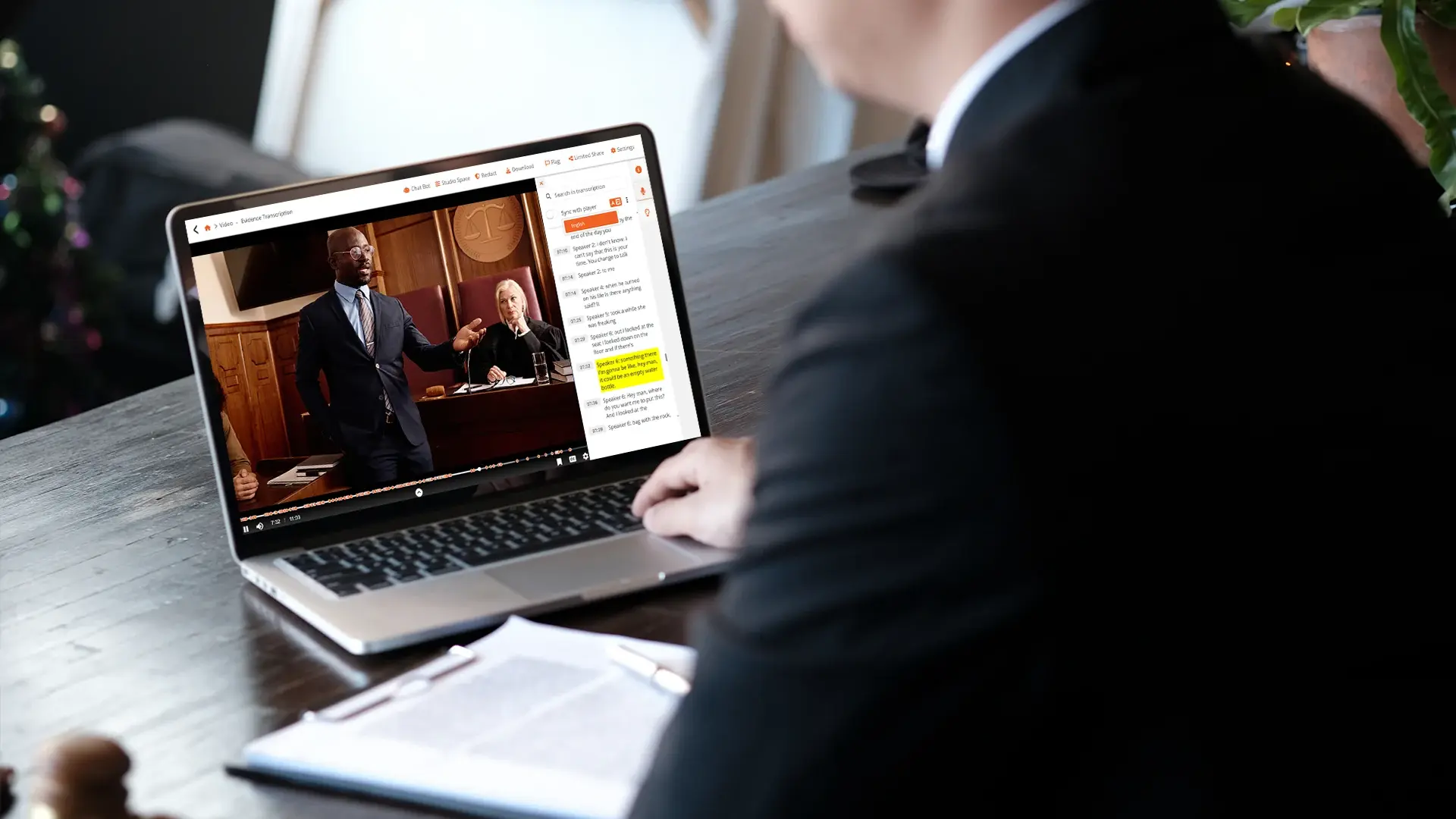
For the record, VIDIZMO's Digital Evidence Management System (DEMS). Transcription across 82 languages with speaker diarization, which matters because attributing passages correctly is a precondition for a usable transcript in a multi-party hearing, and automatic translation of the resulting transcripts across 50+ languages. Timestamped and translated transcript export templates produce the artifact a party or an appellate court receives, and it sits under the same custody and retention rules as the proceeding it came from.
For the corpus, VIDIZMO AI Intelligence Hub. Search runs across the transcribed and translated text so a passage can be found regardless of the language it was spoken in, with source citation back to the document and moment. Document translation for filings and published decisions runs here too, which is covered in AI translation of judgments and legal documents.
Where neither is the answer: transcription and translation here are asynchronous, running after a proceeding rather than during it. This is not a live interpretation service and not a real-time captioning system, and courts needing either should treat that as a separate procurement. Nor does machine output constitute certification, which remains a human professional act.
Building a plan a court can staff
A language access plan fails when it commits to a standard the court cannot meet.
Start from the languages actually appearing in your court, measured rather than assumed. Decide what level of assurance each artifact needs: certified, reviewed, or machine draft with labeling. Automate the machine-draft tier, which is where the volume is. Reserve human capacity for the consequential tier. And write down what is not covered, so the gap is a known risk rather than a surprise.
Book a DEMS demo to test transcription and translation against recordings in the languages your court actually hears.