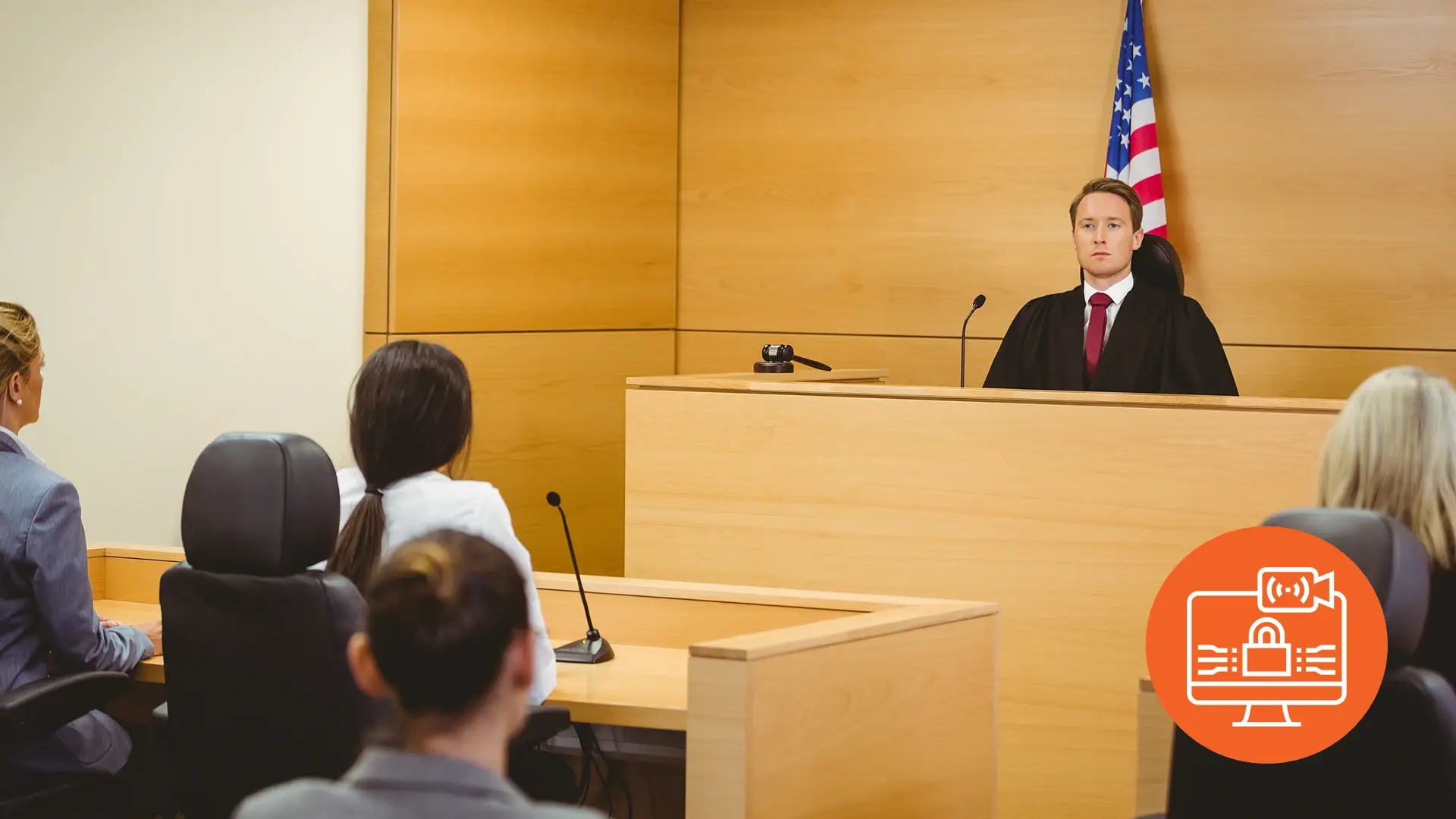
Open justice is a principle with an implementation problem. Courts are public, the public increasingly expects to watch remotely, and livestreaming court proceedings is now routine in jurisdictions that would have refused it a decade ago.
The difficulty is that openness and protection apply to the same proceeding, sometimes within the same hour. A hearing may be public until a witness is asked about a protected matter, closed for that portion, and reopened. Jurors have identities that must not be broadcast. Victims and minors have protections that survive the hearing. And once a stream has been captured by a viewer, the court's control over it has ended regardless of what its policy says.
The guide to remote and hybrid hearing technology treats access and confidentiality as two of the four things that must hold simultaneously. This article covers the streaming half.
Courts are not the only public body with this problem, and the parallels are useful. Election livestreaming raises the same transparency-versus-control tension, where the stream is a trust instrument and the protected individuals are officials and observers rather than jurors and witnesses. The technical requirements overlap; the legal duties do not.
Deciding what is public, and who decides in the moment
The threshold question is not technical. Which proceedings are streamed, and who authorizes it.
Most courts land on a default plus exceptions: certain case types are streamed by default, others never are, and the presiding judge may vary either. What matters is that the default is written down and the variation mechanism is quick, because a judge who has to make a written application to stop a stream will simply not allow streaming at all.
The in-hearing decision is harder. When counsel signals that the next questions touch protected matters, somebody has to interrupt the stream before rather than after. That requires a person watching with authority to act, which is a staffing decision as much as a technical one.
Interrupting cleanly also matters. A stream that cuts to a holding card and resumes on the judge's direction is manageable. A stream that continues with muted audio while the video shows a witness in distress is not.
Protecting people while broadcasting a room
Courtrooms contain people who did not choose to be on camera.
Jurors are the clearest case, and the usual protection is camera positioning that excludes the jury box entirely rather than relying on editing. Victims, minors, and vulnerable witnesses may have statutory protections requiring that they not be identified, which extends to voice as well as image. Members of the public in the gallery have a weaker but real interest.
The operational rules that follow: fixed camera positions with known fields of view rather than an operator following the action, no audience shots, and an explicit procedure for what happens if someone protected enters frame. A court that relies on an operator's judgment in real time will eventually have an incident.
Where a stream is being managed alongside sealed material and tiered access, the administrative side is covered in sealing, protective orders, and tiered access to court records.
Streaming reliably when interest spikes
Court streaming has an unusual load profile. Most hearings have a handful of viewers. Occasionally one has tens of thousands, and it is never the hearing anyone planned for.
That argues for infrastructure that scales without configuration rather than capacity sized to the average. It also argues for testing the failure mode: what viewers see when capacity is exceeded, and whether the proceeding itself is affected. A stream that degrades gracefully is acceptable. A stream whose failure disrupts the hearing is not, which is a reason to keep the public stream architecturally separate from the platform conducting the proceeding.
Appellate and supreme courts publishing argument
Appellate and supreme courts occupy a different position. Many publish oral argument as a standing transparency commitment rather than case by case, and the audience is professional as well as public.
That changes the requirements in specific ways. Permanence matters more, because argument video is cited and needs a stable location for years. Searchability matters, because a professional viewer wants a passage rather than a session. And linkage to the written record and the eventual opinion is what turns a video library into a usable resource.
Transcribing published argument is what makes it findable. An hour of unsearchable video is technically public and practically closed to anyone without an hour to spend.
The archive, takedown, and the permanence problem
The stream ends and the recording begins its much longer life.
Courts should decide, before streaming, how long recordings remain publicly available, whether they are downloadable, and what the takedown process is. That last one requires candor: once a stream has been captured by a third party, removal from the court's platform does not remove it from the internet. A takedown policy that implies otherwise misleads the people it is meant to protect.
The realistic protection during the stream is prevention rather than removal, which is why the in-hearing controls matter more than the post-hoc ones.
The archive is a different case, and courts conflate the two to their cost. The live stream cannot be recalled. The recording that goes into the public archive has not been published yet at the moment it is created, and it can be redacted before it is: a face obscured, a name muted, an exhibit blurred, with the unredacted original retained under custody as the record. That is the same workflow described in AI redaction for court records and public release, applied to a recording rather than a filing. A court that treats its archive as unalterable because its stream was has given up a control it actually has.
There is a reputational dimension courts sometimes miss. A takedown request that the court cannot actually fulfill, made to a person who was promised protection, damages trust more than an honest statement of the limits would have. Courts that explain at the outset what streaming does and does not allow them to control tend to face fewer complaints than courts that promise more and deliver less.
Retention of the public archive should align with the court's wider schedule, covered in archiving court proceedings for retention and retrieval. Where a court also publishes written decisions, the anonymization obligations on those are treated in anonymizing judgments before publication.
What the platform handles, and what it does not
VIDIZMO handles delivery and archive rather than the courtroom equipment. Low-latency live streaming with adaptive delivery, so a spike in viewers does not require reconfiguration. Permission-controlled portals, so a stream can be public, restricted, or closed without moving platforms. Persistent links for recurring proceedings, which matters for a court publishing to a stable location. And transcription with search across the archive, so published argument is findable by passage rather than by session.
The recording that follows the stream is the part that belongs with the case. It lands in the court's evidence repository alongside the filings and orders for the same matter, on the court's retention schedule, and it can be redacted before publication with the unredacted original retained under custody as the record.
Where it does not help: it does not supply courtroom cameras or capture equipment, and it does not decide what may be broadcast, which is a judicial determination. It also cannot recover material once a viewer has captured it, which no platform can.
Getting the policy in place first
Streaming failures are almost always policy failures that appeared as technical ones.
Write the default and the variation mechanism. Fix camera positions to exclude the jury. Assign someone to watch the stream with authority to cut it. Decide the archive period and the takedown process, and describe the latter honestly. Then configure the platform to match.
Request a demo to walk through streaming, access control, and the release workflow against a real proceeding.