The people who produced the verbatim record are leaving faster than they can be replaced. The US stenographer workforce has fallen roughly 21 percent over a decade to around 23,000, enrollment in stenography programs is down 74 percent, and about 42 percent of those programs have closed (industry data from AAERT, the trade association for electronic court reporting). In California, of 4,214,365 family law, probate and unlimited civil hearings held between April 2023 and March 2026, about 3,007,651 took place with no verbatim record at all, which is 71.3 percent (Judicial Council of California). Worth weighing the two sources differently: the workforce figures come from a body whose members benefit when courts move away from stenography, while the California count comes from the court system itself. The argument holds on the second set alone.
This is a structural shortage, not a hiring problem, and recruitment budgets do not solve it. Courts are choosing a digital court recording system because there is no longer an alternative, which changes how the purchase should be approached: not as a modernization project with time to deliberate, but as a replacement for capacity that has already gone.
As the guide to remote and hybrid hearing technology sets out, capture is one of four things that must hold in a proceeding. This article covers the capture decision and, more importantly, the decision courts routinely fold into it and should not.
One thing to be clear about at the outset. Courtroom capture is its own market, with vendors who build microphones, mixers and room integration, and nothing here argues for changing what records your courtrooms. The argument is about what happens to the audio afterwards, which is the half that carries the recurring cost and the half courts consistently under-scope.
Two decisions, routinely treated as one
Courts tend to procure "court recording" as a single thing. It is two.
The first decision is what captures the audio. For a physical courtroom that means microphones, mixing, redundancy, and the room integration to make it reliable. For a virtual or hybrid hearing it means the conferencing platform's own recording, because that is where the audio already is.
The second decision is what happens to the audio next: transcription, speaker separation, translation where needed, indexing so it can be searched, retention, and export for appeal.
These are separable, and treating them as one purchase has consequences. The capture market is consolidating, and courts that bundle both decisions into a single supplier lose the ability to change either independently. Keeping them separable is the practical form of the advice in data ownership, portability, and vendor lock-in.
What capture has to deliver
The capture requirements are well understood and worth stating because they are where a cheap solution fails.
Audio quality sufficient for transcription, which is a higher bar than audio quality sufficient for a human in the room to follow. Separate channels where possible, because separating the bench, counsel, and witness at capture makes everything downstream easier than trying to separate them afterward. Redundancy, because a failed recording of a hearing that cannot be repeated is an unrecoverable loss. And a clear indication to everyone present that recording is running.
For hybrid proceedings there is an additional requirement that catches courts out. The room audio and the remote participants' audio have to end up in the same recording at comparable quality. A recording that captures the courtroom clearly and the remote feed poorly produces a record with holes in exactly the places where a remote witness spoke.
The layer above capture, which is where the value is
Recorded audio is not a record. It is a large file that somebody has to listen to.
What turns it into a usable record is the processing layer: transcription producing searchable text, speaker separation attributing passages correctly, translation where proceedings run in more than one language, indexing so a phrase can be located across years of hearings, and export in a form an appellate court can use.
This is also where the workload actually sits. Producing a transcript from a recording, reviewing it, and certifying it is the labor that replaced the stenographer's labor, and courts that budget for capture without budgeting for this discover the gap in month two.
The accuracy question deserves its own treatment and is covered in whether AI transcription can be trusted with the official court record, including thresholds, review, and what certification means.
Speaker identification and courtroom acoustics
Two technical realities shape what is achievable.
Courtrooms are acoustically hostile: hard surfaces, distance between participants, and overlapping speech during objections. Speaker separation performs well with separate channels and poorly with a single ambient microphone, which is a capture decision determining a processing outcome.
Accented and multilingual speech is where error concentrates, and courts serving diverse populations should evaluate on their own recordings rather than on a vendor's sample. Ask for a trial on your audio, using a hearing with the acoustic conditions you actually have rather than a clean one chosen to demonstrate well.
There is a related budgeting point. Improving capture is usually cheaper than compensating for poor capture downstream. A court weighing whether to fund separate channels in its busiest courtroom should price that against the ongoing review time that single-channel audio will cost every week for the next decade, rather than against the capital cost alone.
Retention, retrieval, and export
Recordings accumulate faster than anyone retrieves them, and the retrieval problem becomes visible years later.
Retention should be driven by case type and appeal windows rather than by storage cost, with legal holds able to suspend scheduled destruction. Retrieval from archive needs a defined time and a known cost, because a case reopening after five years is exactly when a court cannot afford a slow answer. And export has to produce something an appellate court can open.
Archiving court proceedings for retention and retrieval covers the long tail in full.
How VIDIZMO fits above capture
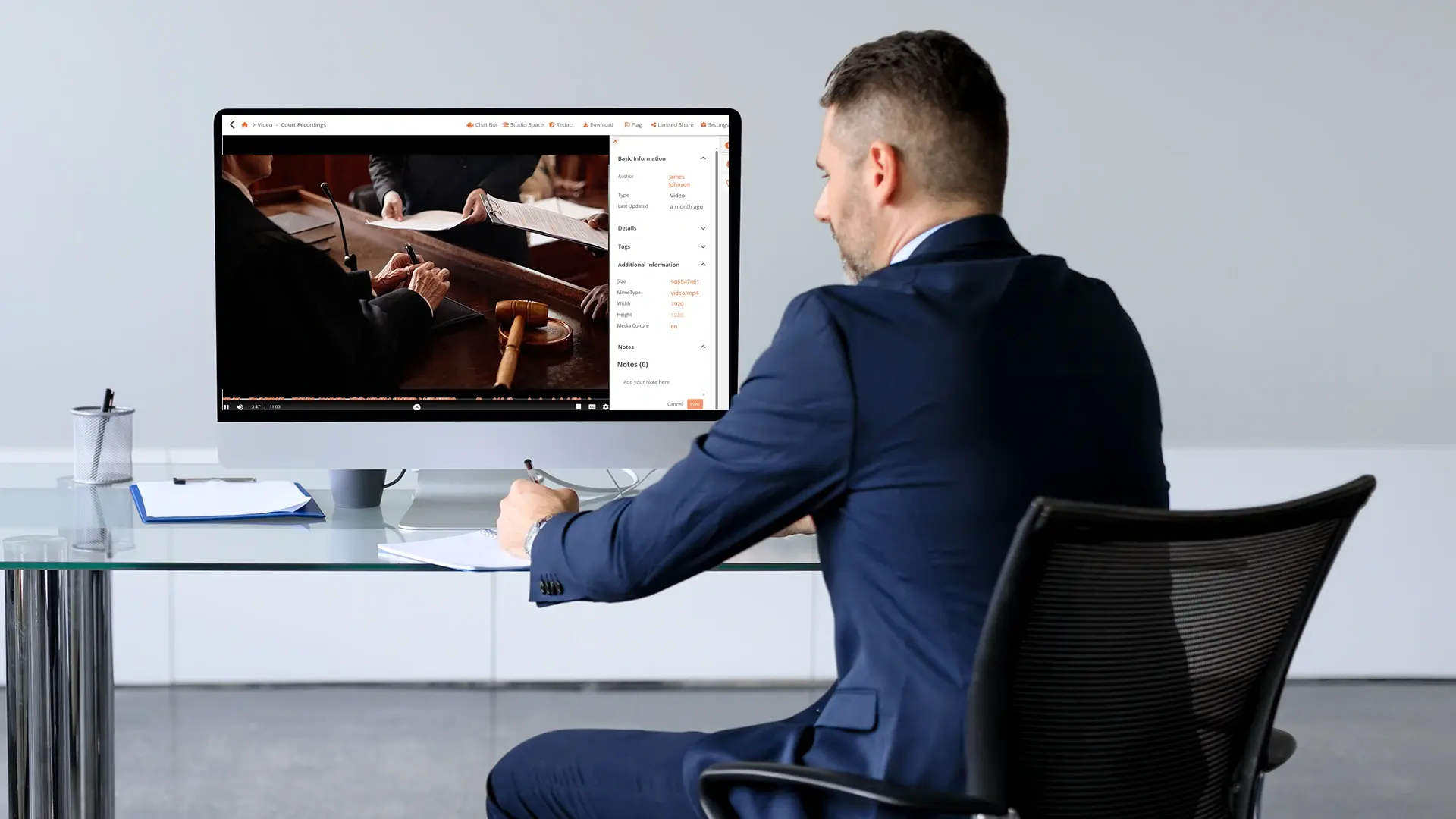
A capture vendor sells a recording. What a court needs is a record: transcribed, attributed to speakers, searchable, retained on schedule, and filed with the case it belongs to. VIDIZMO sits above capture rather than replacing it, and that gap is where it operates. Whatever records the proceeding, a dedicated courtroom system or the conferencing platform used for remote appearances, the resulting recording is ingested into VIDIZMO's Digital Evidence Management System (DEMS) and filed against the case. Recordings come directly from Microsoft Teams and Zoom, and from other systems as configured, routed to the case folder automatically or by a clerk.
What that gives a court is one place where the recording, the transcript, the exhibits, the filings, and the orders for a matter sit together. The transcript lands beside the evidence it relates to, under a tamper-evident chain of custody with SHA-384 integrity verification, on the retention schedule the court sets, exportable in a court-ready layout. Transcription, translation, and search run on one platform AI stack, self-hosted by default including air-gapped, so the record does not have to leave the court's control to become searchable. The wider workflow is Evidence Lifecycle.
Where the problem is finding things across years of proceedings rather than holding them, searching a court's own prior rulings covers the retrieval layer that sits on top.
Where this is not the answer: VIDIZMO does not sell a court recording system. It makes no courtroom capture hardware and does not compete with dedicated court recording vendors on microphones, mixers, or room integration. DEMS transcribes a proceeding after it ends rather than during it, so it is not a live captioning service for the hearing itself. Courts needing either should procure them separately.
Choosing without locking yourself in
Three things keep the decision reversible.
Buy capture and processing as separate decisions even if from the same supplier, with separate terms. Require that recordings export in widely supported formats rather than a proprietary container. And test the export before go-live, on a real hearing, including the transcript and any timing data, because that is what a future migration depends on.
The shortage forced the timeline. It does not have to force the architecture.
Book a DEMS demo to test transcription, speaker diarization, and retention against recordings from your own courtrooms.