Many machine failures show themselves well before they stop anything, as oil pooling under a gearbox, a drip from a hydraulic fitting that slowly turns into a stream, product building up on a frame, or an access door left open after a repair on the night shift. A camera already pointed at that machine records every one of those changes, and in most plants nobody is watching the feed when they happen. Visual equipment monitoring lets those cameras raise the warning themselves, and this article covers what a camera can and cannot see on equipment, the method that works with no training data, and how an alert turns into a work order.
It is one part of our guide to predictive maintenance with video AI, and it stays with the machine itself, leaving the flow of product along the line to our article on production line monitoring on cameras you already have.
What a camera can see on equipment, and what it cannot
A camera sees surfaces, so the warnings it can catch are the ones that show on the outside of a machine or on the floor around it. Leaks under pumps, valves, gearboxes and hydraulic units belong in that group, along with fire, buildup on a frame, a guard left open and a scene that has changed when nothing about it should have, and many of them appear hours or days before the failure they lead to.
Just as much stays out of view, and a plant should be clear about it before adding cameras to a maintenance plan. Bearing wear, internal temperature, lubrication breakdown, insulation failure and anything inside a housing are invisible to a lens until the failure is far advanced, so the vibration probes, thermal surveys and oil samples that measure them remain the right instruments. Thermal imaging does see heat, but it is a separate field with its own cameras and analysis, and an ordinary plant camera does not provide it.
| Visible to an ordinary plant camera |
Not visible to it |
| Leaks, drips and pooling on the floor or a frame |
Bearing wear and imbalance |
| Fire |
Internal or surface temperature |
| Product, dust or debris building up |
Electrical condition and insulation |
| A guard, panel or access door left open |
Lubrication and oil condition |
| A tool, part or rag left on or beside a machine |
Anything inside a housing or out of the camera's view |
Alerts without a list of faults
The method that suits equipment best needs no list of what to look for, because each fixed camera learns what its own scene normally looks like and flags the part that later differs. During a learning period, which can run from 15 minutes to 30 days with a week as the default, the camera samples its view at intervals and keeps those frames as its picture of normal. The learning period should span the machine's ordinary life, including shift changes, cleaning and changeovers, because anything the camera never saw while learning will later look like a change.
Once the camera is switched to monitoring, it compares each check with what it learned. A region inside the zones drawn on the camera's view that differs from everything learned, and keeps differing for a set number of consecutive checks, opens an event with a box around the region, a snapshot of the frame, a severity and a confidence, and the event closes when the region is no longer seen.
This suits equipment because nobody has to predict where the trouble will appear. A leak at the left flange of a pump is flagged for the same reason as one at the right flange, which is that the floor there no longer looks like the floor the camera learned, and nobody had to label a single leak to get that alert. The method reports that something changed, not what the change is, so a dark patch beneath a gearbox could be oil, the shadow of a parked cart or a dropped rag, and the person who receives the alert makes that call, helped by object detection on the same camera for the classes it was trained to name. Our article on blocked exits, spills and moved cameras applies the same method to exit routes and walkways.
Fire, and questions for situations nobody listed
Fire is the other visible warning that ships ready to use, because fire is one of the classes AI Live Insight detects on live camera feeds, and a detection raises an alert. A fire starting in a dust extraction unit, a motor housing or a panel area is a maintenance event as well as a safety one, and in a part of the plant with no flame or heat detector the camera may be the first instrument to see it, as an addition to the fire protection the code requires and never a replacement for it.
For a situation that fits neither a learned scene nor a detection class, a written question can be put to frames cached from the live pipeline, for example whether there is liquid on the floor beneath the hydraulic unit, and a multimodal model answers it without any training. That analysis is an add-on that needs both AI Live Insight and AI Intelligence Hub, it runs after capture rather than in real time, and every run costs model usage, so it suits a scheduled check on a few critical spots better than continuous watching. Our article on anomaly detection without a preset list covers the written-question method, what it costs and how to keep its questions governed.
Gauges, misalignment and wear are trained for each plant
Reading an analog pressure gauge, spotting a belt drifting off its pulley or noticing a surface wearing thin come up in almost every conversation about cameras and maintenance, and none of them is a shipped detection class. Each needs a class trained for that plant, on footage of that gauge face or that belt, as part of an engagement scoped for the asset. Once trained, the class behaves like any other, with its own confidence threshold and severity on each camera and alerts raised through the same pipeline.
That work means collecting footage under the lighting and angles the camera will actually see, finding and labeling examples of the condition, and confirming the camera is close and sharp enough for a needle position or a belt edge to resolve at all. For many assets the learned-normal method already catches the larger visible symptom, a belt that has come off or a guard swinging open, with no training at all.
From alert to work order
An alert is only worth raising if it reaches someone who will act on it, and the evidence it carries decides how quickly they can. Every anomaly event carries a snapshot of the frame at the moment it started, so whoever receives it sees the pool under the pump without opening the camera. Every camera AI Live Insight reads is also recorded continuously for a retention window, 30 days by default, and where the anomaly rule is set to create a recording, a clip is cut from that recording with the seconds before the alert included and filed in the library. A technician can then watch the drip begin before walking over, and arrive with the right tools and the right part.
Each alert then moves through a recorded lifecycle, arriving as New, acknowledged by the person who picks it up, and either resolved with a note or marked a false positive with a note saying why, so the plant's decisions sit beside the events they were about. A single flag can be a coincidence, whereas the same camera flagging a change three nights running is a pattern worth a work order.
The work order itself belongs in the maintenance system, which stays the authority on maintenance work. An alert or a monitor firing can be sent by webhook to any system that is listening, or reach the Computerized Maintenance Management System (CMMS) through a connector authored against its Application Programming Interface (API), and the CMMS then creates the work order under its own rules and priorities. Our article on connecting video AI to your maintenance system covers that seam, and our article on troubleshooting a machine fault with recorded repairs and an AI assistant covers what the technician does once the order is open. Where a vibration or temperature alarm comes first instead, the design in our article on combining sensor data with video for maintenance brings the footage to the alarm.
Keeping the alerts trustworthy
An alerting method that floods a maintenance team gets ignored within weeks, so tuning matters as much as detection does. Sensitivity, the number of consecutive checks before an alert, and severity are set on each camera's anomaly rule, and zones should leave out the parts of the view where machinery moves by design, such as a robot cell or a conveyor carrying product, so that only the floor, frame or guard being watched can raise an event.
Relearning is a deliberate step, needed whenever a camera is moved, re-aimed or zoomed, or a machine is relocated in its view, and it is done by switching the camera's anomaly rule back to learning, which discards the old scene and starts a new learning period. Plants that run a change process for layout moves can add relearning to its checklist. Where learned frames are kept for review, which is the default, each one appears in the Object Library, and deleting a frame that was not normal, such as one sampled while a leak was already on the floor, removes it from what the camera compares against without a full relearn. A camera that is knocked, covered or blinded, with more than about a third of the frame changing at once, raises a single camera tamper event instead of a burst of region alerts.
The habit that keeps the method trusted is a weekly look at the false positives with the people who maintain the machines, because they recognize at once which flags were early warnings and which were ordinary activity, and our article on alert fatigue and tuning confidence and severity covers that review. The honest limit is lighting, since a change the camera never saw while learning, such as low winter sun through a dock door, can raise alerts until the camera is relearned, and a plant with strong seasonal swings faces a real question about how long learning should run. Telling a harmless change from a developing fault still takes a person looking, and no accuracy or false-alarm figure exists for this method, so the plant's own pilot is the measure that counts.
How AI Live Insight handles visual equipment monitoring
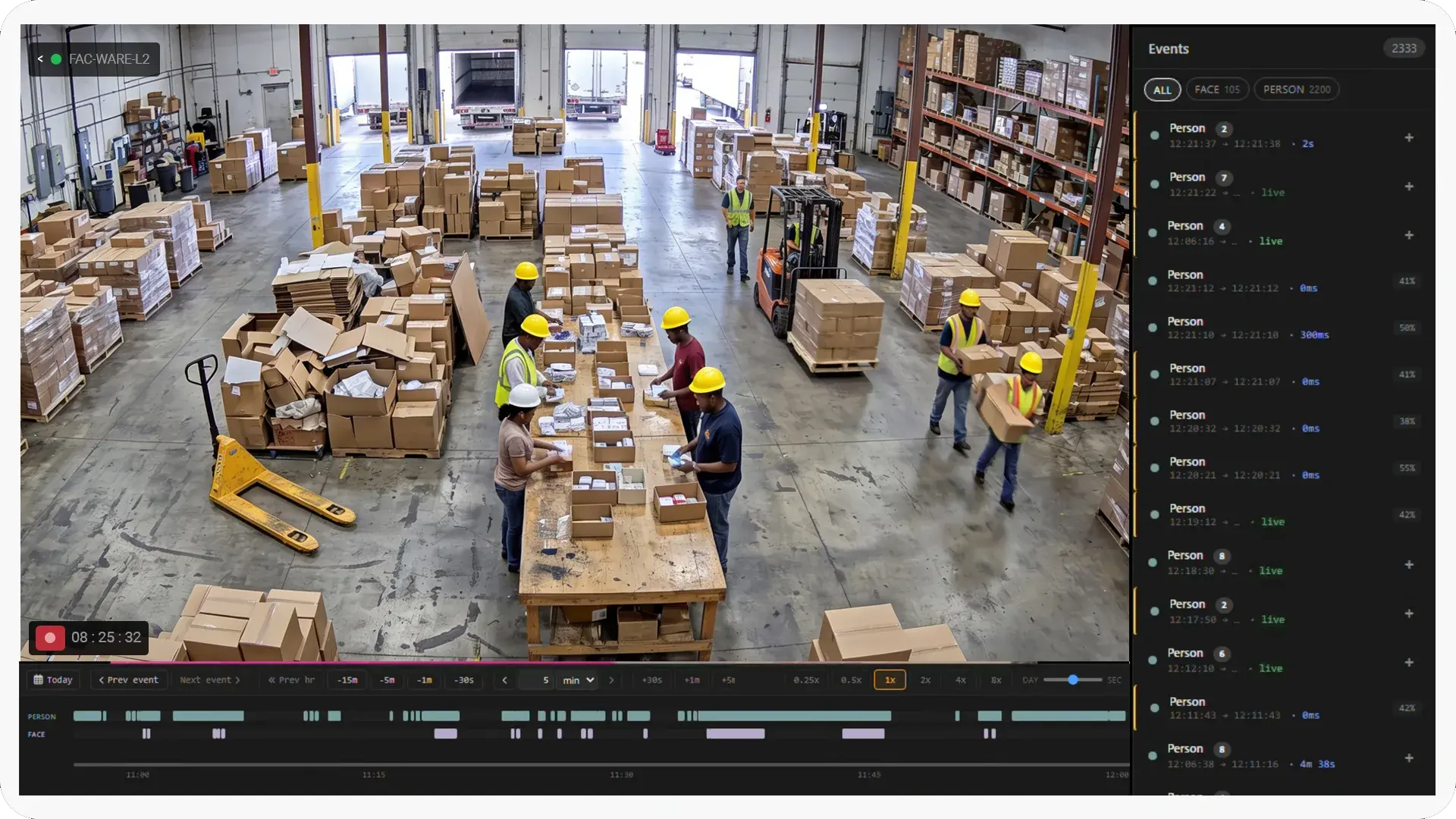
VIDIZMO AI Live Insight runs visual equipment monitoring on the cameras a plant already owns, with processing on the plant's own servers near the cameras, since continuous analysis of many feeds needs Graphics Processing Unit (GPU) capacity close to the streams rather than bandwidth to send them off site. The learned scene is an anomaly step in each camera's workflow, and object detection runs on the same camera beside it, fire included, so one view of a dust extraction unit can raise both a fire alert and a flag for buildup that was never there while it learned. Alerts carry their snapshots, clips are cut from continuous recording wherever a rule is set to record, and events reach the maintenance system by webhook or through a connector, while AI Intelligence Hub adds the written questions for spots no class covers, as a licensed add-on that runs on cached frames after the fact.
A sensible first project picks one asset class with a visible failure mode and a camera already watching it, such as hydraulic units that weep, runs a learning week that includes a changeover and a cleaning shift, reviews the learned frames before monitoring starts, and reads the first month of alerts with the technicians who know the machines. See AI Live Insight in action and request a demo.