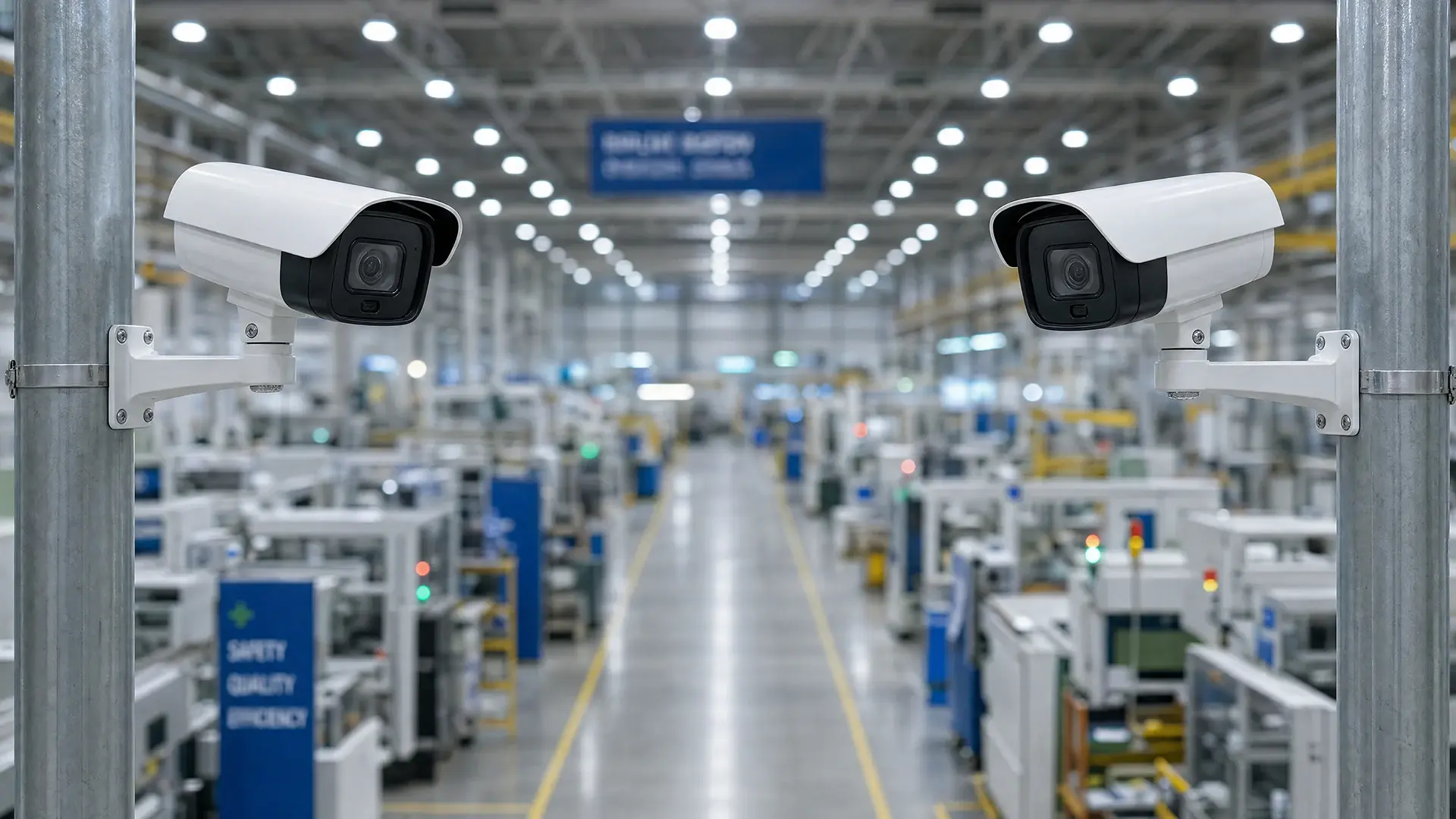
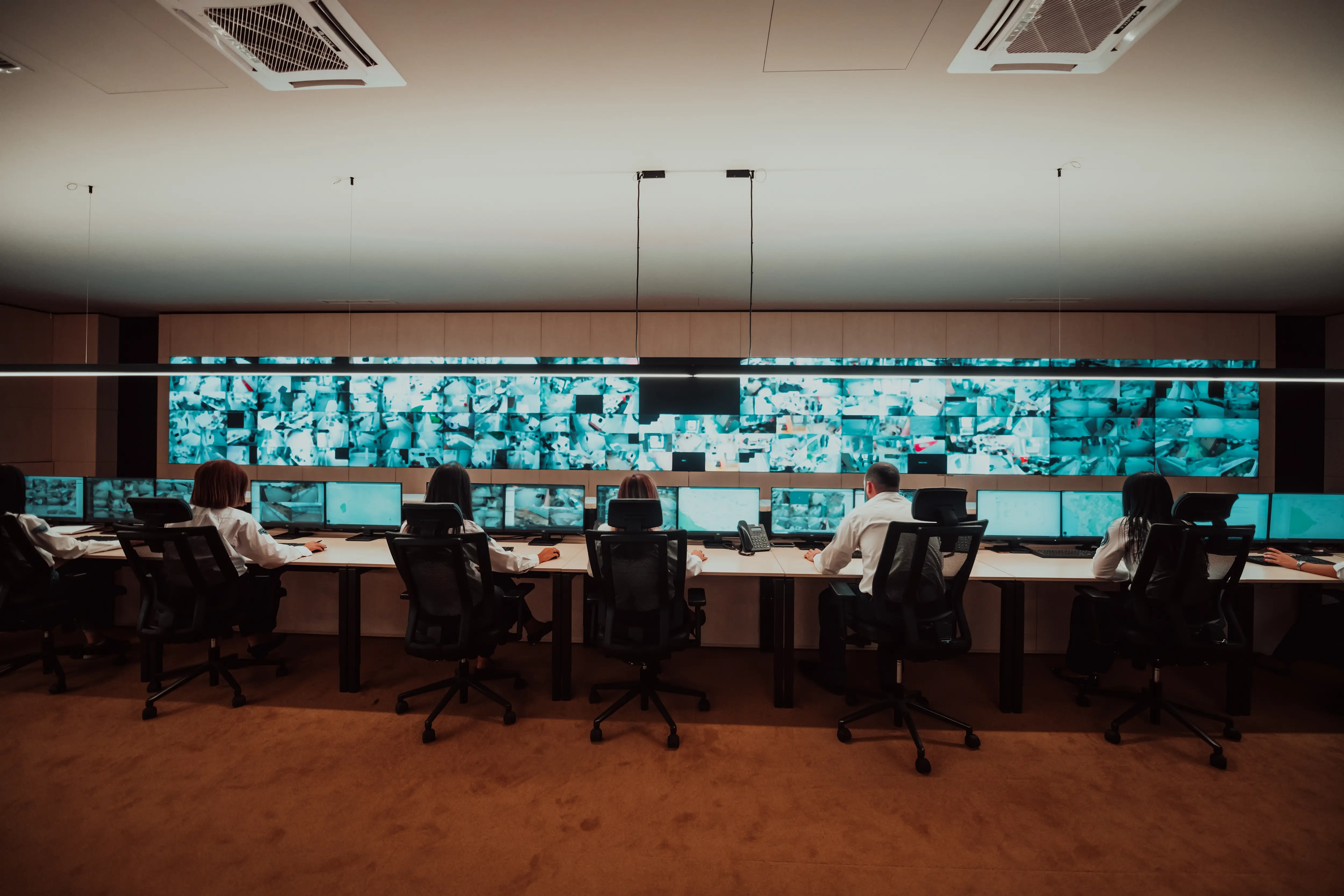
Walk the length of any production hall and count the cameras, and then ask what they are for. The answer, almost everywhere, is security: they watch doors, docks, and high-value inventory, they feed a recorder that overwrites itself monthly, and they get consulted when something goes missing. Meanwhile, thirty feet away, the line they incidentally overlook runs blind between the points where a sensor or a Programmable Logic Controller (PLC) tag happens to report, and the operations team learns about a jam, a starved station, or a buildup the way it always has, when a person notices or a downstream number sags. The strange economics of this arrangement deserve a moment of attention, because the plant has already paid for continuous visual coverage of its most valuable process and uses almost none of the information in it. This article is about closing that gap with detection rather than hardware, and it extends the ground covered in our pillar guide to AI-powered video analytics for manufacturing.
What cameras see that sensors miss
Instrumentation tells a plant what its designers decided to measure, and the gaps between measurement points is where visual information lives. A conveyor's drive reports that the motor runs; it does not report that product has stopped moving on the belt because a carton wedged at a transfer. A counter at the end of the line reports throughput; it does not report the buildup two stations upstream that will become a stoppage in four minutes. An andon system reports what an operator flagged; it does not report the flag nobody raised because the operator was clearing the problem by hand, again, the way they have every Tuesday since the guide rail bent.
Every one of these is a visual fact sitting in plain view of a lens. A camera watching the line sees stopped material on a running belt, sees accumulation growing at a station, sees the gap in flow where an upstream feeder starved, sees the operator intervention that never became a ticket. What has changed is that software can now watch those cameras continuously, which was always the missing piece, because no plant could ever afford to staff a person per camera per shift, and sampling a live wall of monitors catches almost nothing. Detection turns each enrolled camera into a reporting point, and suddenly the spaces between the sensors are no longer dark.
The detection building blocks are the same ones the safety articles in this series describe, pointed at different subjects. Trained detection types recognize the units the plant actually produces, because a generic model knows what a person is but not what a compliant carton stack looks like, and unit-flow detection types track product moving, or failing to move, along the line. Zone rules convert geometry into meaning: a dwell rule on a transfer point fires when material sits too long, which is a jam signature; a crowd-style rule on a buffer area fires when accumulation exceeds what the space should hold; a direction rule catches material or vehicles moving against process flow. Tracking underneath keeps one carton one object, so counts are counts rather than flickers, and every event lands timestamped with its clip preserved around it.
Three quick wins
Sites that instrument their lines this way converge on the same three early wins, and they are worth naming because they shape where the first cameras' attention should go.
The jam that announces itself late is the classic. Between the moment material stops moving and the moment anything electronic notices, there is an interval, sometimes seconds, often minutes, in which product piles, upstream stations keep feeding, and a small stoppage compounds into a long one. A dwell detection at the known pinch points, transfers, mergers, labelers, diverts, fires inside that interval, and the alert reaches the line lead while the fix is still a thirty-second clearance rather than a teardown. Nothing about this is sophisticated. It is simply a watcher that never blinks, positioned where the process is known to fail.
The starvation that no department owns comes second on the list. When a station stops receiving material, its own metrics look like idleness while the cause sits upstream, and the gap between departments is where the minutes disappear. Flow detection sees the absence, a stretch of belt that should carry product and does not, and the alert names the boundary where supply failed rather than the victim who ran dry, which changes which phone rings and how fast.
The invisible workaround is third, and it is the one with the longest payback. Every line accumulates operator interventions that keep production moving and never enter any system: the nudge at the bad transfer, the manual restack before the wrapper, the sensor that gets waved at because it misreads. Each is a small tax on every shift, and collectively they are capacity nobody can see. A camera watching the station records the pattern, the event history makes it countable, and the count is what converts "that station is fine" into a maintenance work order with evidence attached. Plants consistently describe this as the discovery that surprised them most, less the dramatic failures than the sheer volume of quiet human compensation their lines were running on.
Example: instrumenting a packaging line
Concreteness helps, so consider a typical secondary packaging line: erector, filler, checkweigher, wrapper, palletizer, with four existing cameras covering it for security and two added for gaps. The instrumentation plan that comes out of a half-day walk looks like this. The erector's outfeed gets a dwell rule, because deformed cartons wedge at the first transfer and the pile grows for ninety seconds before the filler faults. The buffer before the wrapper gets an accumulation rule set from what the conveyor should hold, because buffer overflow is the leading indicator of a wrapper problem that has not yet stopped the line. The palletizer cell gets a unit-flow watch, because its micro-faults are cleared by hand and never logged. And the aisle crossing the line's tail gets a vehicle rule, because the forklift route to the stretch-wrapper crosses product flow, which is a safety fact and an operations fact at once.
Six rules, six cameras, one afternoon of drawing zones, two weeks of silent baseline. What the baseline showed at the site this example is drawn from, and shows in some form nearly everywhere: the erector transfer jammed not occasionally but nightly, clearing in under a minute each time and costing twenty-some minutes a week nobody had ever summed; the wrapper buffer ran near overflow through every changeover, meaning the changeover standard understated its real duration; and the palletizer's hand-cleared faults outnumbered its logged faults roughly five to one. None of these findings required advanced analytics. They required watching, continuously, which is the entire proposition.
The effect on Overall Equipment Effectiveness (OEE)
Operations teams keep score in OEE, so it is worth placing this capability against the metric's three factors. Availability losses are where line monitoring bites hardest: earlier jam detection shortens stops, starvation alerts recover minutes at the boundaries between areas, and the hand-cleared micro-stops that never reached the log finally enter the availability picture at their true size. Performance losses come partially into view, because reduced-speed running and the drag of constant small interventions are visible as flow behavior even when no stop occurs. Quality losses belong to a different capability, per-unit inspection, covered in its own articles in this series, and conflating the two leads to buying the wrong thing. A site should expect line monitoring to firm up the availability and performance halves of its OEE arithmetic, first by making the losses visible at their real magnitude, then by shrinking the response times that let small losses compound, and should expect the quality factor to require the inspection stack instead.
From alerts to line behavior
The live alerts justify the deployment; the accumulated record changes how the line is understood. Event histories by station, shift, and product answer questions that used to require a study: which transfer jams most, whether the night shift's flow differs from day's, what the changeover to the difficult Stock-Keeping Unit (SKU) actually does to accumulation patterns. This is the same shift the safety articles describe, from anecdotes to measurement, applied to throughput, and it feeds naturally into the deeper work covered elsewhere in this series, cycle time and bottleneck analysis for the process engineers and downtime cause analysis for the reliability team, both of which consume the same event stream this monitoring produces.
Because every event preserves its clip, the record also ends arguments cheaply. The question of what happened at the wrapper at 3:40 has a video answer, reachable from the event itself, and the difference between reviewing a clip and interviewing a shift is measured in both hours and goodwill.
Limitations
The scope limits deserve plain statement, because they draw the line between this capability and adjacent ones a buyer might conflate with it.
Camera-based line monitoring observes macro process behavior: presence, absence, motion, accumulation, intervention. It is not high-speed inspection of individual units for quality defects, which lives at different frame rates and optics and is covered honestly in our article on visual quality inspection. It sees what a camera can see, so a line section under a hood or inside a machine frame stays dark, and coverage review belongs at the start of the project, not after the gap is discovered. And detection types for a plant's specific products and flow patterns are trained per engagement on representative footage, which is scoping work rather than a switch to flip, the same honest note that runs through this whole series.
It also does not replace the PLC layer, and it is not trying to. Machine truth, states, faults, speeds, lives in the control system, and the richest picture comes from joining the two, visual events correlated with machine events, which is precisely what the integration and correlation articles in this series cover, from connecting video AI to Manufacturing Execution System (MES) and Supervisory Control and Data Acquisition (SCADA) to correlating a line stop with what the cameras saw. The camera layer's particular contribution is the stretch of reality no tag reports: what happened physically, between the sensors, in view of a lens that was already there.
How VIDIZMO fits
VIDIZMO AI Live Insight attaches detection to the cameras a plant already owns rather than requiring AI-enabled replacements, reading standard Real-Time Streaming Protocol (RTSP) and ONVIF (Open Network Video Interface Forum) streams from fixed cameras and from the Video Management System (VMS) or Network Video Recorder (NVR) already recording them. Processing runs on the customer's own hardware, on site, which for a continuous, latency-sensitive workload is the practical architecture rather than a preference. Unit and flow detection types are trained on the plant's own footage and then behave like any built-in detection type, with confidence and severity per camera; zone, dwell, and direction rules are drawn on each camera's frame; and every event raises its alert, lands on the timeline, and preserves its clip in the VIDIZMO Nexus portal the deployment works alongside, under access control and retention policy. The alert-quality disciplines from the safety side of this series, silent baseline, graduated ramp, weekly tuning review, transfer without modification, because an operations team can be fatigued into ignoring a system exactly as fast as a safety team can.
A note on the operations-versus-safety boundary, since the same cameras serve both. Nothing prevents a plant from running the safety rules this series covers and the flow rules this article covers on the same cameras, and most eventually do, but the governance travels with the use case, not the hardware: the no-discipline commitments and worker-privacy provisions the safety articles develop apply with full force the moment a camera watches people rather than product, and an operations team inheriting a safety deployment inherits its agreements too.
The starting point that proves value fastest is one line with a known personality: the transfer that jams, the station that starves, the intervention everyone knows about and nobody logs. Two weeks of silent monitoring there produces the count that makes the case, and the count is usually larger than anyone in the room predicted.