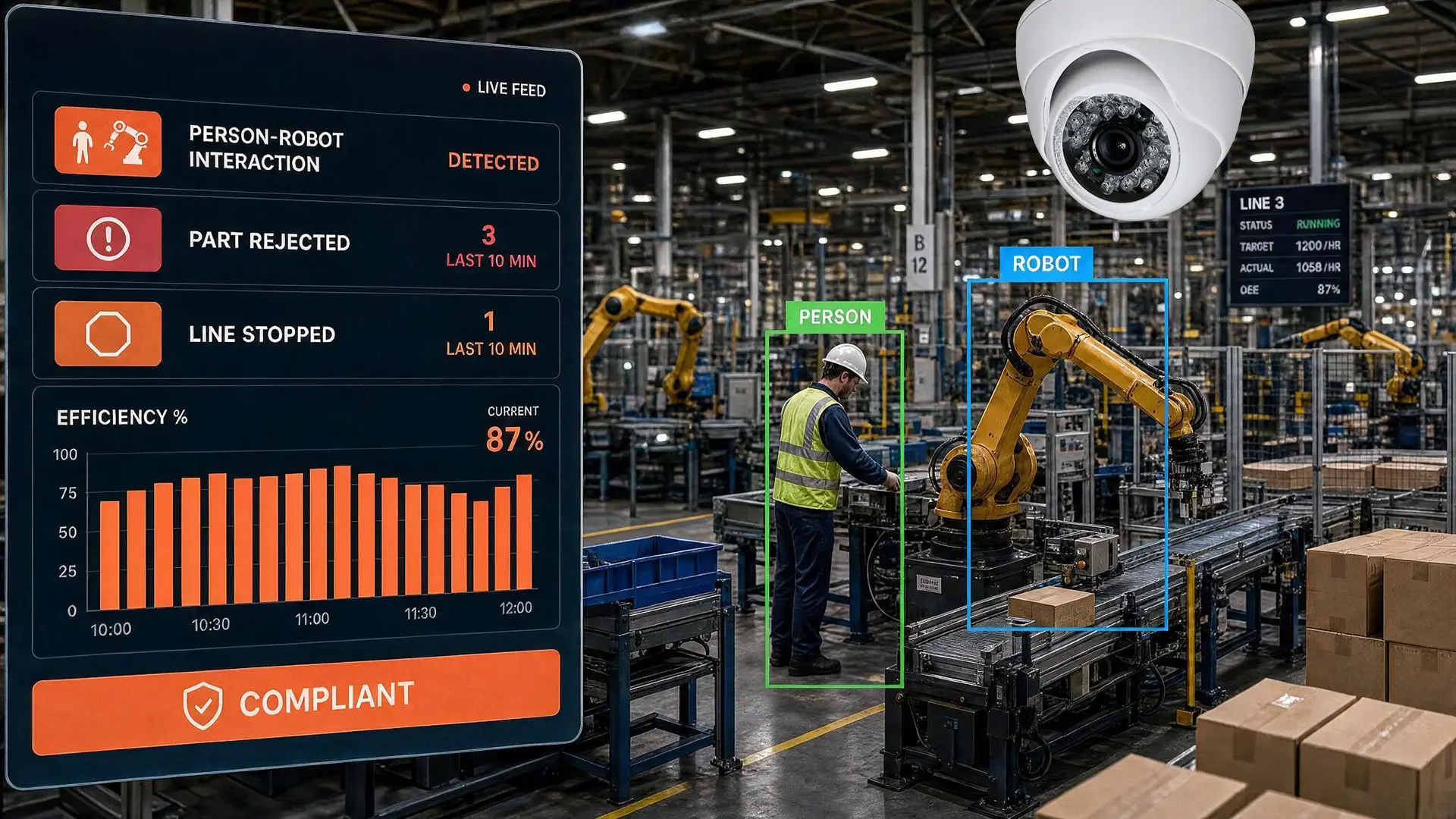
Every monitoring technology eventually faces the question that decides whether it becomes infrastructure or remains an island: how does it talk to everything else? A detection layer that keeps its events to itself is a better pair of eyes on a worse silo, and the plant already has enough of those. The Manufacturing Execution System (MES) knows the works orders, the historian knows the machine states, the Computerized Maintenance Management System (CMMS) knows the maintenance history, the Quality Management System (QMS) knows the holds and dispositions, and the value of a visual event, the stop, the deviation, the flagged unit, multiplies precisely when it lands inside those systems, in their formats, under their workflows. This article is the integration chapter of the series, written for the IT and Operational Technology (OT) leaders who will own the plumbing, and it covers both directions of flow, the honest architecture of each, and the boundary this series does not cross. It extends our pillar guide to AI-powered video analytics for manufacturing.
Sending events to your plant systems
The direction most deployments need first is outbound: detections leaving the video layer and arriving where work happens. The mechanics are deliberately boring, which is a compliment in integration architecture. Every detection, the Personal Protective Equipment (PPE) absence, the line stop, the Standard Operating Procedure (SOP) deviation, the flagged unit, is a structured event carrying timestamp, camera, detection type, severity, and confidence, and two standard paths carry it outward. Webhooks push: the platform calls a customer endpoint when something happens, so the receiving system reacts to events rather than polling for them. The REST API pulls and does everything else: events, content, and metadata are queryable by any system that speaks HTTP, under credentials scoped to the integration rather than borrowed from a person, so the connection survives staff changes and is revocable on its own.
What those two paths enable is the closed-loop grammar this series has referenced throughout: the housekeeping detection that becomes a CMMS work order, the inspection flag that becomes a QMS hold, the SOP deviation that lands in the Environmental, Health and Safety (EHS) system's incident queue, the downtime event that arrives in the historian's timeline wearing the same timestamp discipline as the fault codes beside it. Each of these is an afternoon of receiving-side configuration against a documented payload, not a project, and the pattern deserves its plain name: the video layer becomes one more well-behaved event source among the plant's many, distinguished only by what it can see.
How new integrations are added
The deeper integration question is the reverse direction and the richer one: the agent and workflow layer reaching into plant systems to read context, the maintenance history behind a stop, the works order behind a variant check, and here the architecture matters enough to explain rather than assert.
An integration in this platform is a JSON catalog rather than code. A connector is a folder holding an operations.json that describes the operations a system exposes, and one hardened engine executes every connector's operations, the same executor serving the workflow designer's configuration pickers and the runtime's actual calls, which keeps what you configured and what runs in agreement. The consequence for a plant's integration roadmap is structural: any system with a REST API is reached by authoring a manifest against the existing engine, so adding the CMMS, the MES vendor's API, or the quality system is authoring work, not a product release, and the set of reachable systems is open rather than a fixed connector list on a slide.
The engine's hardening is the part an OT security review should hear stated, because a component that can call URLs named in configuration is exactly the component to interrogate. Egress is guarded against server-side request forgery on every call including pagination links, with DNS-rebinding protections; credentials are pinned to their hosts; redirects are refused; response sizes are capped; pagination and fan-out carry ceilings that apply even when a caller sets none; retries are idempotent-only, so a write is never silently sent twice; and failures return translation keys rather than leaking provider text or internal URLs. Reads of connectors and grants sit behind the same permission subjects as the rest of the platform. None of this is exotic; all of it is the difference between an integration engine and a script with credentials, and a buyer should hear equivalent answers from any vendor at the table.
Alongside the manifest path, systems that publish their own Model Context Protocol servers are reachable through MCP, with queries executing under the asking user's permissions so the source system continues enforcing its own rules, and the agent layer's tools, the subject of our investigations article, are built on exactly these reaches.
Example: a work order from a spill detection
One loop walked concretely shows every piece in motion. The housekeeping layer detects a recurring spill condition at a press, per the floor-monitoring article, and the webhook fires into the CMMS's intake API with the event's payload: detection type, zone, severity, timestamp, and the link to the clip. The CMMS's own rules create the work order, in its own priority scheme, assigned by its own logic, because the receiving system stays the authority on its own domain. The technician who works the order opens the clip link, sees the leak's actual source and reach before walking over, and closes the order in the CMMS as always. Meanwhile the event, like every event, remains in the video layer's own record, so when the same zone fires again the following week, the correlation over recorded events surfaces the recurrence, and the second work order arrives carrying the pattern: third occurrence, same gasket, dates attached. The maintenance planner now has what neither system alone could give, a physical-evidence trail inside the workflow they already run, and nobody involved learned a new interface. Multiply this loop across inspection holds into the QMS, deviation records into the EHS platform, and stop events into the historian's timeline, and the integration strategy is visible in miniature: small, boring, verifiable seams, each one paying for itself before the next is built.
Questions to ask any vendor
The integration conversation is where video-AI vendors are most easily separated, because architecture cannot be improvised in a meeting. The questions that do the separating: Which direction does each integration flow, and is the outbound path standard webhooks and REST or a proprietary bridge? Is adding a new system a manifest against a documented engine or a statement of work for custom code? Where do integration credentials live, what scopes them, and what revokes them? What are the SSRF, redirect, and retry semantics of the component that calls URLs from configuration, and can the security team read its hardening as a document? And what, precisely, does the platform decline to do at the OT boundary, because the vendor who answers that last question with a feature instead of a boundary has told the OT leader everything needed. Fluent answers to all five are not proof of a good product, but stumbling on any of them is proof of the alternative, and the hour spent asking costs less than the quarter spent discovering.
Where the OT boundary sits
Now the sentence an OT leader reads this article to find: nothing in this architecture writes to control systems, and nothing should. The integration layer reads context and writes into business systems, work orders, holds, incidents, records. The Programmable Logic Controllers (PLCs), the safety instrumented systems, and everything else on the control side of the Purdue-model line remain exactly as reachable as the site's OT architecture already decides, which for well-run plants means reachable through the historian and the MES, read-only, across a governed boundary. When this series says a detection can "trigger" a response in Supervisory Control and Data Acquisition (SCADA)-adjacent workflows, the honest mechanics are these: the event lands in the system the operators already act from, and the action, if any, is taken by that system under its own interlocks and its own authority. A video vendor proposing anything more direct is proposing to join the control loop, and the correct response is the one every OT engineer already has loaded.
The same conservatism that draws the control boundary shapes the network posture around it. The whole video stack runs on the plant's own hardware, inside the boundary, for the latency and sovereignty reasons this series states throughout, so the integration conversation is a familiar firewall discussion, which internal APIs may be reached, read or write, from which segment, rather than a novel cloud-egress negotiation. Service accounts are scoped and reviewed like any system account, the source systems' permission models remain the enforcement point, and the audit logs on both sides record who reached what, which is the posture a security review can approve without inventing new policy.
Which integrations to build first
Integration roadmaps fail by attempting everything, so the working order, observed across deployments, is worth recording. First, alerts to people through existing channels, email and SMS routing to the roles that own responses, because value starts the day detection does. Second, events to the maintenance system, because the housekeeping, micro-stop, and camera-health tickets are the highest-frequency, lowest-controversy wins, and they teach the receiving side the payload. Third, events to the QMS and EHS systems, where the closed-loop holds and incident records live, per the routing patterns of our EHS integration article. Fourth, context reads for the agent layer, maintenance history, works orders, because briefings need them, and by this stage the credential and boundary questions have been answered three times already. The correlation layer that joins video events with machine events, the analytical summit of this thread, is covered in its own article on correlating a line stop with what the cameras saw, and it consumes the same plumbing this sequence builds.
One organizational note completes the chapter: integrations rot when nobody owns them, and the ownership model that works assigns each seam a business owner and a technical owner, named in the deployment's written terms. The business owner, the maintenance planner for the CMMS seam, the quality manager for the QMS seam, answers whether the flowing events still match the receiving workflow; the technical owner answers credentials, API changes, and the reconciliation check. A quarterly seam review, fifteen minutes per integration against its reconciliation report, is the entire maintenance burden, and it is the difference between a working set of integrations and an archaeology site of half-working connections, which every plant over a certain age has excavated at least once.
How VIDIZMO fits
The pieces named across this article map to the platform as follows. AI Live Insight emits the events and holds the clips; the Nexus portal holds the library, the audit trail, and the API surface; webhooks and the REST API carry events outward under integration credentials; and AI Intelligence Hub carries the inbound reaches, manifest-based connectors executed by the hardened engine, MCP where vendors publish servers, and the agent tools built on both. Adding a plant system is manifest authoring against its API, scoped per engagement, and the deployment's written terms record which systems, which operations, and which direction, so the full list of integrations is a document rather than a folklore. For calibration on what the catalog already holds: Microsoft Dynamics 365 and ServiceNow ship as maintained connectors today, and the recorded list reaching SAP, Oracle NetSuite, Workday, Epic, and their class is served on request through the same manifest model, which is the pattern a plant's own MES, CMMS, or QMS joins.
Payload design rewards one more paragraph of care before the checklist. The temptation is to send everything the event knows; the discipline is to send what the receiving workflow uses, plus the clip link, because every field that crosses a seam becomes a compatibility commitment the next upgrade must honor. Sites that version their payloads from day one, a schema number in every webhook body, buy themselves painless evolution, and sites that do not learn why integration engineers speak of payloads the way masons speak of foundations.
Identity deserves its closing sentence too: where the plant runs single sign-on and SCIM provisioning, the video layer joins that identity setup like any other application, so the people side of access, joiners, movers, leavers, is governed by the directory the IT team already operates, and the integration credentials this article discusses remain the only accounts with their own lifecycle to mind.
The preparation that makes the first integration meeting productive costs an hour: list the five systems that would consume or feed video events, note for each whether it exposes a REST API and who owns its credentials, and mark which direction the value flows. That one-page inventory, walked against this article's sequence, is the integration roadmap in draft, and it converts the vendor conversation from promises about connectors into specifics about manifests.