The hazards that turn up most often on an exit route inspection are rarely exotic. A pallet gets staged in front of a fire door because the lane beside it was full, a cart sits across an egress aisle for the length of a changeover, or a drum leaks onto a walkway and nobody has reported it yet. Blocked exit detection sounds like a problem cameras should have solved long ago, yet a detector working from a fixed list tends to miss it, because it only finds what it was trained to name and nobody can list every object that might end up in front of an exit. This article explains a different method, in which a camera learns what its own scene normally looks like and flags the part that has changed, and it is plain about where that method stops.
It belongs to our guide to AI for workplace safety in manufacturing, which sets out where detection fits in a safety program as a whole. This piece stays with one corner of that program: exits and egress routes, spills, areas that should look the same when nobody is working in them, and the cameras themselves.
Why exit routes fail between inspections
The Occupational Safety and Health Administration (OSHA) exit route standard at 29 CFR 1910.37 requires exit routes to be free and unobstructed, and it says no materials or equipment may be placed, either permanently or temporarily, within the exit route. That obligation belongs to the employer and holds every minute the building is occupied, while the check that verifies it usually happens once a shift or less, when a supervisor or a safety walk passes the door. Obstructions appear in the hours between, for ordinary reasons. A receiving lane overflows on a heavy delivery day, a maintenance crew parks its tool cart wherever is closest to the job, or a driver leaves a load in the aisle during a break and means to move it straight after.
Consider an illustrative case. A fire door at the end of a staging lane is clear at the 6 a.m. walk. By mid-morning the lane has filled with inbound pallets, and the last two sit across the door's swing. By the afternoon walk a forklift has cleared them. The exit was blocked for most of a shift, the inspection log shows two clean checks, and the only record of the gap is on a camera that recorded all of it and told nobody.
That gap is what monitoring between inspections is for. The inspections, the program and the judgment about what counts as a violation stay with the plant, and what a camera can add is a prompt to go and look, sent while the obstruction is still there.
Why a detection list cannot name every obstruction
A conventional detector works from a list of object types it was trained on, and each detection says what it found. On AI Live Insight's live feeds that list covers people, vehicles, protective equipment in present and absent forms, fire, and trash and litter, among other groups. Naming the object is what makes a detector useful for a missing hard hat, and it is also what limits it here, because a stack of cartons, a coiled hose or a rolling rack is not a type on anyone's list and next week's obstruction will be something else again. Training a detector for each would mean collecting labeled footage of objects nobody can predict.
There is a second way past a fixed list, which is putting a written question to frames cached from the live feed with a multimodal model, and our article on unsafe behavior you cannot put on a preset list covers it. That approach interprets a situation, such as whether someone appears to be working at height without fall protection, so it suits behavior that has to be understood. It needs AI Intelligence Hub and runs as a second look rather than in real time. The method in this article does a narrower job, noticing that a fixed view no longer looks like itself, and it runs on the live feed all the time. The two answer different questions, and plenty of plants will want both.
How a camera learns its normal scene
For a learning period, the camera samples its own view at intervals and keeps those frames as its picture of normal. The period can run from 15 minutes to 30 days, with a week as the default, and its length matters more than any other setting, because the camera only knows the normal it was shown. A dock area that looks different on Monday morning, at shift change and over a quiet weekend has to be learned across all of those states, so a week that includes them makes a far better learning period than one calm afternoon.
During learning, each part of the frame also gets its own sense of how much it normally varies. A doorway that people walk through all day varies a great deal, while the stretch of floor in front of a fire door barely changes. That is why the same object reads differently in different places: a pallet that is unremarkable in a staging lane stands out sharply on floor that is normally bare.
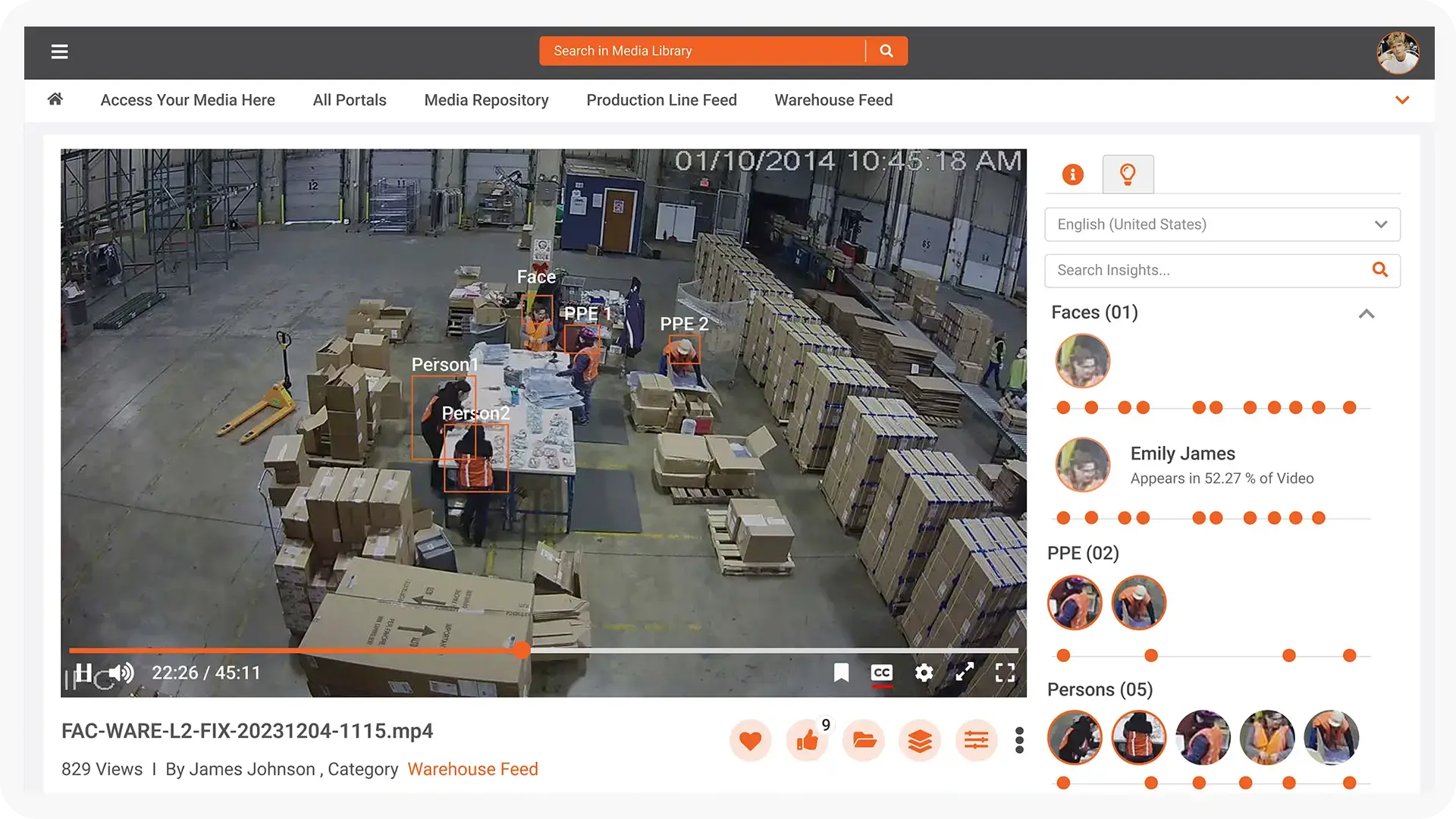
Once the camera is switched to monitoring, it compares each check against what it learned. A region that differs from everything the camera saw, inside the zones drawn for it, and keeps differing over several checks in a row opens an event. Persistence is what separates a pallet left in place from something passing through, although how long counts as persistent is a setting, and a slow vehicle crossing floor that is normally empty can still be flagged. The event carries a box around the region, a snapshot, a severity and a confidence, it can raise an alert and start a recording, and in playback the box is overlaid on the video for as long as the region stayed different. When the region is no longer seen, the event closes.
Four uses on a plant floor
Exits and egress routes
A zone drawn over the floor in front of a fire door and along the aisle that leads to it tells the camera where to pay attention. Anything that settles there and stays raises an event with a snapshot, so whoever receives it sees the obstruction and the door in one image and can decide whether to send someone. Severity is set on each camera, so events from the cameras covering exits can arrive as High while a camera over a storage area stays Low.
Spills and material in walkways
A liquid spreading across a floor that is normally dry, dropped packaging or a pile of offcuts in a walkway each change a scene that otherwise looks the same. The camera does not know the region is a spill, only that the floor there no longer looks like the floor it learned, and that is often enough to get someone with a cone and absorbent there sooner. How visible a spill is depends on the liquid, the floor finish and the light, so a thin, clear film on a glossy floor may barely change the image. Our article on housekeeping and 5S compliance on the production floor covers the wider housekeeping program, and this method is one way to catch the hours between its audits.
Controlled areas when nobody is working in them
Some areas should look the same whenever they are idle, such as a chemical store, a cage of finished goods or an electrical room. When the learned normal for those cameras is mostly the idle state, a door left open, a container moved or an item left behind stands out. Zone rules, covered in our article on hazard zones and restricted areas in factories, handle the cases where you know what should not enter, a person or a vehicle. A learned scene handles the cases where you only know what the area should look like.
The camera itself
A detection program is only as good as the views it still has. A camera clipped by a forklift mast, turned by a cleaning crew, covered with a bag or blinded by a work light stops watching what it was installed to watch, and a detector looking for people or objects reports nothing at that point, because nothing it looks for is in view. When more than about a third of the frame changes at once, the camera raises one camera tamper event instead of a burst of region alerts, and region alerting resumes once the scene settles. For the corporate security team that owns the camera estate, that event is the signal that a view has been lost, and our article on alert fatigue explains why a silent camera is a worse problem than a noisy one. A camera that has been moved for good then needs to relearn its new view, which the tuning section below covers.
What the method cannot do
The method suits fixed cameras. A camera that is moved, re-aimed or zoomed has a new view and has to relearn it, and a pan-tilt-zoom camera touring between presets never holds one view long enough for this approach to have a stable normal to compare against. Scenes that change constantly by design, such as a busy dock door with trailers coming and going all day, leave little stable background to learn, so the method has least to offer exactly where activity is highest.
Variation that was not learned reads as change. If the learning week never included the bay with its lights off, the low sun through a dock door in winter or a seasonal product stacked in a new spot, those conditions can raise alerts until they become part of what the camera learned. That is a reason to choose the learning period with care, not a defect to be tuned away.
Most important, the method says that something changed and nothing more. It does not know what the object is, and it cannot tell a blocked exit from a delivery that will be moved in two minutes or judge whether an obstruction breaks the code. Object detection on the same camera names the things it was trained for, and a person decides what the rest means. Each alert moves through a lifecycle in which the person handling it acknowledges it, resolves it or marks it a false positive, with a note required to resolve or to mark it false, so the judgment is recorded next to the event.
Tuning, relearning and checking what the camera learned
Sensitivity, persistence and zones are set per camera. A pilot does best when it starts narrow, with zones drawn only over the exits and aisles that matter, and widens once the event volume is understood.
Relearning is a deliberate step, not something the camera decides on its own. Switching the camera back to learning and publishing the change discards the learned scene and starts a new learning period, which is the right move after a rack is relocated, a line is moved or a camera is re-aimed. Plants that already run a change process for layout moves can add "relearn the affected cameras" to its checklist, so the cameras are not left comparing a new floor against an old normal.
The step a safety lead should insist on is the review of what the camera learned. Where learned frames are kept for review, which is the default, each one appears in the Object Library, and an operator can delete any frame that was not normal. If the exit happened to be blocked on the third day of the learning week, that frame is exactly the one to remove, because otherwise the camera treats a blocked exit as part of normal. Deleting it takes it out of what the camera compares against, with no need to relearn.
The learned frames will include whoever was walking past while they were sampled. The method watches the place rather than any person in it, and the commitments in our article on works councils, worker privacy and the no-discipline commitment apply to these frames and events as they do to every other part of the program.
How AI Live Insight runs it
VIDIZMO AI Live Insight runs visual anomaly detection on the cameras a plant already has, with processing on the plant's own servers close to the cameras, which is where continuous live analysis belongs once the bandwidth and latency of dozens of feeds are counted. The learned scene is set up as an anomaly step in each camera's workflow in the rules designer, with its own learning period, sensitivity, persistence and zones, and an event reaches people wherever that step is connected to a raise-alert output. Object detection runs on the same camera beside it, naming what it was trained to find, fire and litter included, so one camera over an egress aisle can flag both a fire and an unexplained change to the floor.
Where the anomaly step's route reaches a create-recording output, each event cuts a clip from the continuous recording, including the seconds before the region was flagged, and the clip lands in the library of the VIDIZMO Nexus portal the deployment works with, under its access control and retention rules. The same learned-scene method, applied to leaks and changes around equipment, is the subject of our article on visual equipment monitoring on plant cameras, and the way the safety pieces fit together is described on the Safety and Compliance Monitoring page.
A sensible pilot takes two or three exit routes with a history of obstructions, a learning week that spans a full production cycle, a review of the learned frames before monitoring starts, and a few weeks of events read through with the supervisors who walk those routes. By the end of it, the plant knows how often its exits are blocked between inspections. See AI Live Insight in action and request a demo.