A quality escape is usually found by someone outside the plant. A distributor opens a case and sees the wrong label, or a customer's incoming inspection rejects a part, and the complaint that reaches the quality team carries a lot number, a photograph and a request for a written response, often weeks after the lot shipped. Most plants answer it from the batch record and what people remember about that shift, which is thin material for a root cause and thinner still for a customer who wants proof.
This article walks a quality escape investigation in the order a quality engineer runs it, from containment and scoping through reconstruction and root cause to the response, and shows where footage from the cameras over the line changes each step. It is part of our guide to quality control in manufacturing. Two limits are worth stating at the start: linking a clip to a lot automatically is integration work for each plant, and footage shows what happened, which is not always the same as why.
What a quality escape is, and the two clocks it starts
A quality escape is a nonconforming unit that passed every internal check and reached the customer. The definition puts two failures on the table at once, whatever produced the defect and whatever should have caught it, and an Eight Disciplines (8D) problem-solving report or a corrective action report asks for both. A response that explains only the first usually comes back with a question about the second.
The first clock is the customer's. Containment comes before analysis, so suspect stock in the warehouse, in transit and at the customer is quarantined and sorted before anyone knows the cause, and the deadline for each step is set by the customer, normally in its supplier quality manual.
The second clock belongs to the footage. Cameras that AI Live Insight reads are recorded continuously for a retention window configured in days, 30 by default, and anything older than that is gone except the clips cut from it around detections. A complaint that arrives six weeks after packing may find the rolling recording already overwritten, so the first practical step is to check what still exists for the production window and, if a claim looks likely, to protect it.
Take an illustrative case that runs through the rest of this article. A distributor reports that cartons from one lot carry the label of a neighboring variant. The lot was packed on a night shift three weeks earlier, on a line with cameras over the labeler and the case packer.
Scoping the lot: from the complaint to the production window
The lot or serial number leads to the production window, and the Manufacturing Execution System (MES) or batch record holds it: the line, the stations, the shift, the start and end times, and the material lots that went in. That system stays the authority on genealogy, and footage is found through the times and stations it provides.
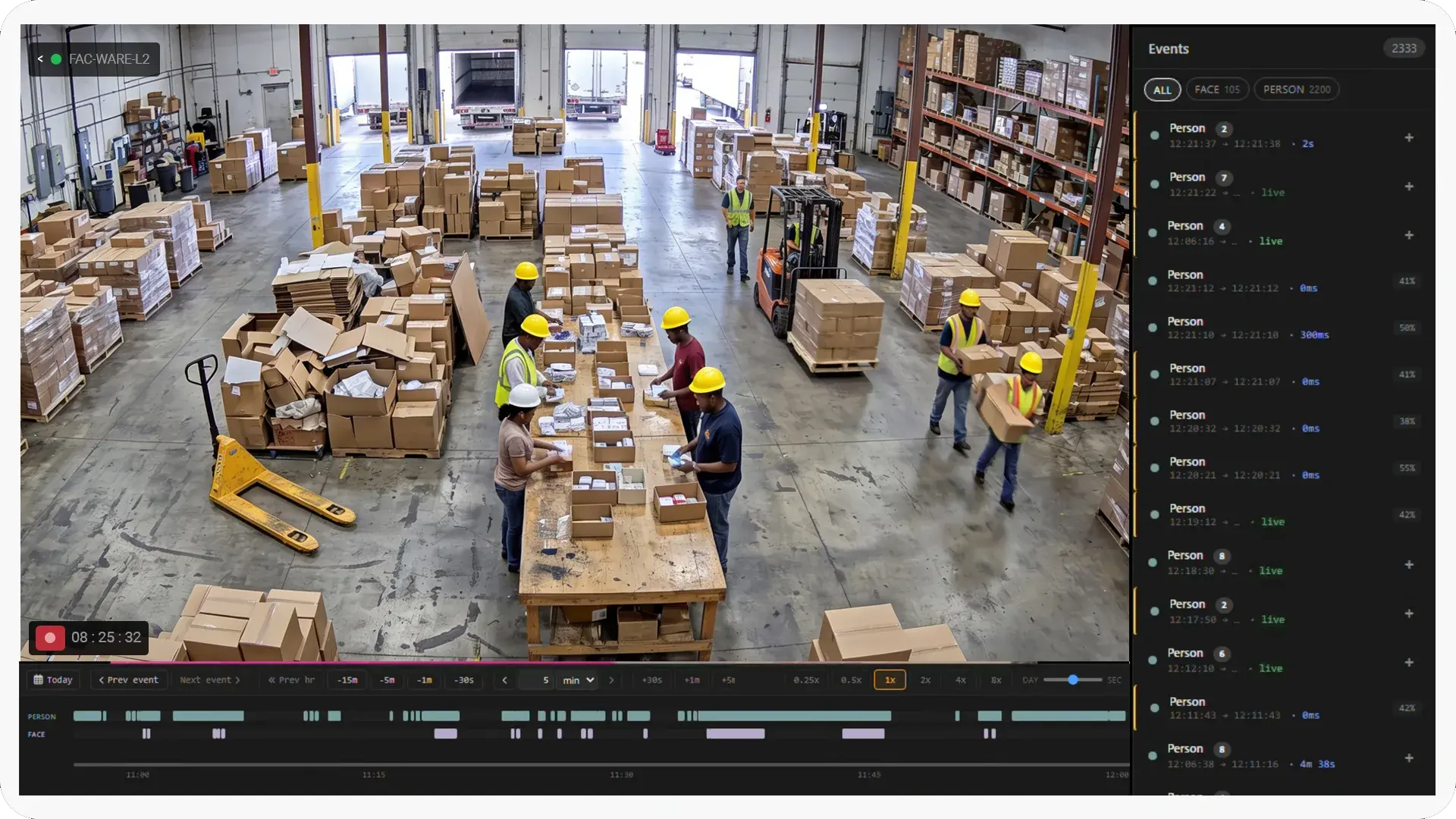
With the window known, footage is pulled by camera and time. Each camera's continuous recording is reviewed in its own player for as long as retention holds it, and the clips cut around detections sit in the library in a folder for each camera, organized by time, so one station's clips from one shift are a short list.
The next question is whether the problem started before the complained lot or ran on after it, because the answer decides how much stock is contained. Labeling errors often start at a changeover or a roll change, so the footage to watch first is the labeler at the changeover into the lot and again on the way out of it. If the wrong roll went on before the lot started, the previous lot is suspect too.
Linking clips to lots directly is possible, and it should be scoped plainly. Lot, batch and line can be defined as custom attributes in the library, typed, searchable and usable as filters, and they are set by hand, in bulk across a selection of clips, or by the plant's own systems through the Representational State Transfer (REST) Application Programming Interface (API). Nothing fills them on its own, so this is integration work set up for each plant. Without it, a plant scopes by camera and time, which works as long as the camera clocks and the MES clock agree.
Reconstructing what happened at each station
Start at the station that should have caught the escape and work upstream from it. In the illustrative case that is the labeler and its own check, then the case packer, and the questions are concrete: was the wrong roll loaded, when, and did anything flag the cartons that followed. Where the escape is a missing part rather than a wrong label, the station that installs the part is the first place to look, as our article on assembly verification and missing-component checks explains.
Search is what keeps the review from turning into hours of watching. Video in the library, alert clips included, can be indexed with generated descriptions of what it shows, so a plain-language query such as "carton with an open flap at the case packer" finds the matching moments, with the match made on descriptions in language rather than on image similarity. Word-level text recognition reads the printed text in recorded video and in scanned paperwork such as travelers, batch sheets and the line clearance checklist, and a result opens at the timestamp or the page. A lot code on a carton is found this way only where the camera resolved the print well enough to read it.
Where trained checks were running on AI Live Insight, such as a label presence class trained on the plant's own cartons, the flagged events from the window are the quickest place to begin, because each carries a clip that includes the seconds before the detection. A presence check that saw a label on every carton still says nothing about which label it was, and that gap belongs in the 8D's account of why the escape was not caught.
AI Intelligence Hub answers a written question across footage text, batch records and procedures, for example what the line clearance procedure requires at a label changeover and what the night shift recorded for this lot. The answer cites the material it drew on as cards the engineer opens, retrieval runs under the engineer's own permissions, and checking each statement against its source stays with the engineer. Our articles on asking questions of plant footage in plain language and agentic AI for manufacturing investigations cover that step in more depth.
From what happened to why: root cause with footage as one input
Footage shows the event and rarely explains it, because the conditions behind a mistake usually sit outside the frame. The labeler camera may show an operator loading a roll at the changeover. It will not show that the two variants' rolls are stored in adjacent rack slots with labels that look alike from the aisle, or that the scanner meant to verify the first label of each run had been bypassed after a week of false rejects. Those come from interviews, maintenance history, line clearance records and the materials themselves, and the root cause is usually among them.
Footage earns its place by testing candidate causes rather than generating them. Each branch of a fishbone diagram, or each answer in a five whys chain, predicts something about what the cameras should show, and the recording either supports the prediction or rules it out. A mixed delivery of label rolls from the supplier would put wrong labels partway through a roll, while a changeover error would start them at the roll change. Working this way keeps the analysis on the process rather than on whoever stood nearest the event.
The no-discipline commitment that governs safety footage belongs here too, agreed with worker representatives before anyone needs it. An operator who took the wrong roll from a badly laid-out rack is evidence about the rack, and a plant that disciplines people from escape footage will find its next investigation short of candor. Our article on investigating a workplace accident from camera footage sets out the same evidence discipline for an injury, and label, marking and seal verification on the packing line covers the checks that would catch a label or seal escape at the line next time.
Closing the loop and answering the customer
The response to the customer is an evidence pack as much as a report. For an 8D or corrective action report it usually holds the clips that show the event with their timestamps, stills taken from them, the batch record excerpt for the lot and the custody record of every action on each item. In VIDIZMO Nexus that custody record lists every action with the user, their email address, the IP address, the local time and the event, from ingestion to disposition, and a clip cut down to the relevant minute is saved as its own item with the cut itself recorded in the trail. Where hashing is enabled for the portal, the hash recorded at ingest can be re-verified to show a file has not changed since, which speaks to the file and not to what it depicts.
Before footage leaves the plant, the people in it should be masked. Redactor detects the faces in a clip, an operator reviews and corrects what it found, and the masks are burned into a new copy while the original stays where it was, and since detection quality follows the source, that review is the step that matters on a dim or distant camera. The masked clip then goes out as a share limited to named recipients that expires by date and by view count, rather than as an attachment that can be forwarded indefinitely. If a claim looks likely, a legal hold on the lot's footage overrides the retention schedule until an authorized administrator releases it.
An 8D closes when the fix is shown to hold, not when it is installed. The cameras that reconstructed the escape can watch the same station through the next few changeovers, and where a trained check runs there, a monitor can fire when that camera flags more than a set number of cartons within a window, notifying the quality team by email or sending the firing by webhook to a quality system that is listening. Our article on visual quality inspection with fine-tuned models covers the inspection record that makes this kind of verification routine.
Some parts of the job stay hard for every plant and every vendor. Automatic genealogy from a unit to its footage needs the plant's own systems to supply the lot and its times, so it is an integration project rather than a feature. Footage does not explain cause on its own. Reading lot codes live on a moving line is a harder problem than finding them in recorded footage afterwards. And no system produces a closed 8D, because the analysis, the corrective action and the judgment that it worked all stay with the quality team.
How VIDIZMO helps
VIDIZMO AI Live Insight records every camera it reads continuously for the retention window and cuts a clip around each detection it is set to record, with the seconds before it, filed by camera and time, and where checks trained for the plant run on it, flagged events and fired monitors reach a quality system by webhook.
The VIDIZMO Nexus portal holds those clips with custody of every action, optional hashing, legal hold and shares that expire, and makes library footage and scanned paperwork searchable by what they show and by the text in them. AI Intelligence Hub answers questions across that material with citations, under each user's permissions, and Redactor masks workers before footage reaches a customer. The AI video analytics page shows how these fit together on the cameras a plant already has.
A useful readiness test costs an afternoon: take the last customer complaint and time how long it takes to find the footage of that lot's production window, if it still exists. To work through that for your own lines, talk to a specialist about your quality investigations.