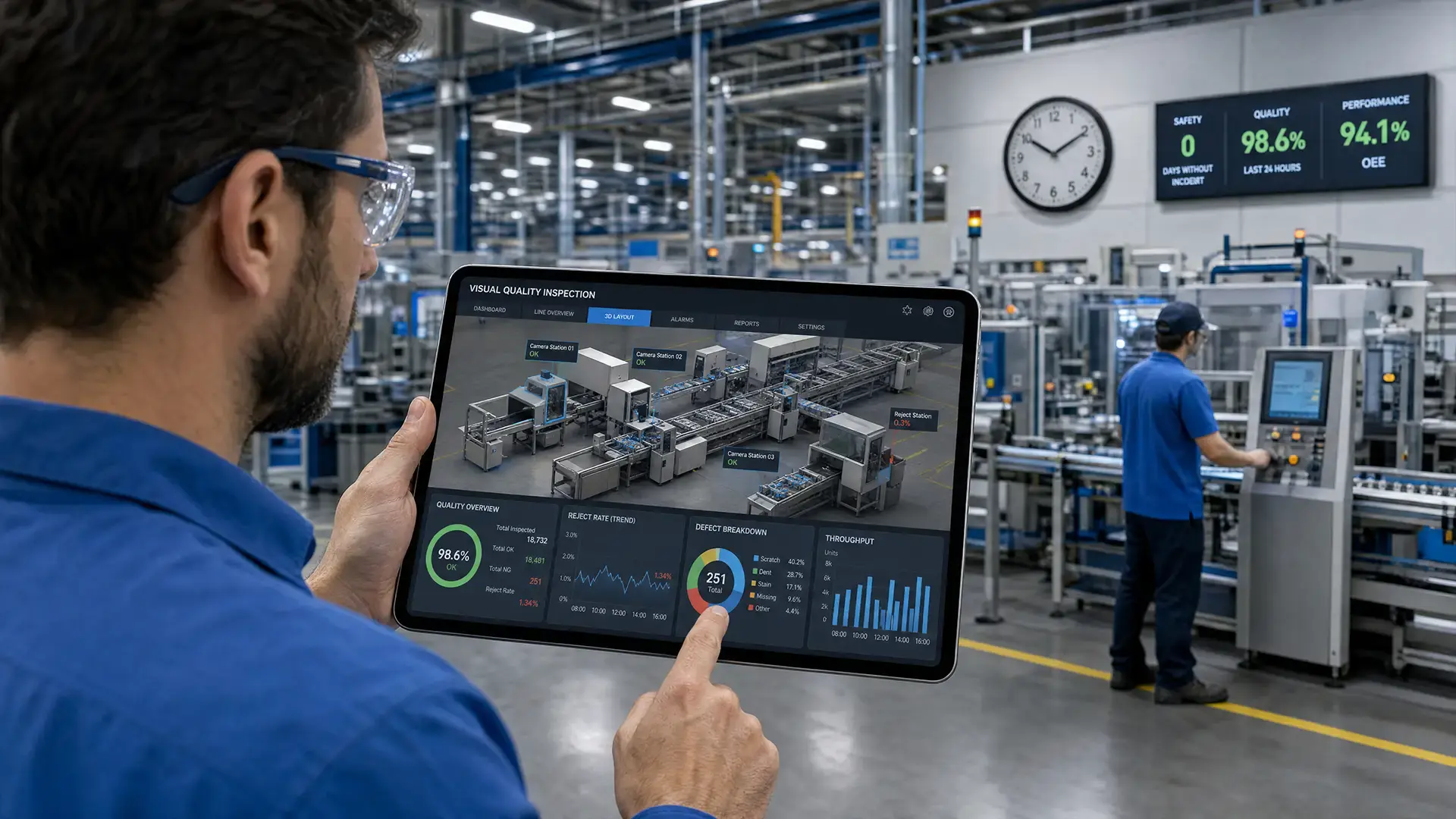
Quality managers live inside a sampling compromise so old it has stopped feeling like one. Human inspectors cannot examine every unit on a line running at production speed, so the plan inspects a sample, the sample stands in for the population, and everyone involved understands, statistically and viscerally, what that means: the defects that escape are the ones that happened between samples. Attention compounds the problem, because a person's ability to spot the hundredth subtle flaw of a shift is not what it was for the tenth, and the inspection that catches everything at 8 a.m. is a different instrument by 2 p.m. The machine-vision industry answered this decades ago for the plants and products that could afford it, with purpose-built stations, engineered optics, and controlled lighting. This article is about the newer middle path, fine-tuned detection models running on ordinary cameras over the line, where it genuinely works, what it demands from the plant, and where the purpose-built station remains the honest answer. It extends our pillar guide to AI-powered video analytics for manufacturing.
Why generic AI fails at quality inspection
The defect that matters at your plant is invisible to a general model, and understanding why sets every expectation that follows. Off-the-shelf detection knows the visual world's common categories, but a compliant weld versus a defective one on your product line, a properly seated connector versus one missing a pin, an acceptable surface finish versus a reject, these are facility-specific distinctions, learned only from examples of your product, your defects, your cameras, your lighting. Generic tools evaluated against this problem produce the result quality teams have learned to expect from them: false-positive rates high enough to require a manual review queue, which quietly rebuilds the inspection burden the automation was bought to remove.
Fine-tuning inverts the economics that make the generic tools disappoint. The plant provides labeled samples, frames and clips tagged as compliant or defective by the people who know the difference, and a model is trained to that specific taxonomy. The resulting detection types behave like any other in the detection pipeline, with per-camera confidence thresholds and severity, firing events with clips attached, and they know nothing except what the plant taught, which is precisely their value. Product classification distinguishes variants and wrong-part placement; assembly-machine-state detection types verify presence and position against the expected configuration, ground covered in depth in our article on assembly verification; and defect detection types proper, the scratches, dents, cracks, and contamination, are the subject of our companion piece on what a fine-tuned model needs from you, because the training-data conversation deserves its own article.
One newer layer belongs in the picture, scoped honestly. For the ambiguous, contextual anomalies that resist a fixed taxonomy, the something-looks-wrong category every senior inspector recognizes, a cached clip can be put to a multimodal model with a written question, and the description that returns flags what no trained detection type was built to name. It runs downstream of the live pipeline on a cadence, carries no accuracy percentage for reasons our article on analysis beyond the preset list explains, and serves as a reviewer's assistant rather than a gate.
Camera coverage, inference cadence, and GPU sizing
Inspecting every unit is a throughput statement, and it deserves engineering arithmetic rather than slideware. The detection pipeline's inference cadence is configurable, which is the pivotal fact: run inference on every frame and nothing passes unexamined, at the cost of GPU capacity that scales with resolution and rate; run on an interval with tracking between, and the same hardware serves many more cameras at coarser temporal resolution. Neither setting is right in the abstract. A station inspecting discrete units at takt has a natural cadence, the unit's dwell in the inspection zone, and the requirement is simply that inference sample each unit's window, which is a far gentler demand than per-frame everywhere. A continuous-web process is a different conversation, and an honest vendor will have it rather than wave at it.
The same honesty applies to optics, because no model outruns its input. A defect spanning a few pixels at surveillance distance is not detectable at surveillance distance, whatever the training budget, so the feasibility review starts with arithmetic: defect size, camera resolution, field of view, and lighting, which on most floors varies by shift and season in ways a controlled inspection tunnel never permits. The practical consequence is a tiering of the problem. Macro defects, missing components, gross damage, wrong variants, packaging faults, are comfortably within reach of good fixed cameras over the line. Fine surface inspection at speed, the micron-scratch-under-raking-light class of problem, belongs to purpose-built machine vision with engineered illumination, and a vendor who claims otherwise on ordinary cameras is selling a pilot that will teach the lesson expensively. The middle tier, and it is wide, is where a dedicated ordinary camera, positioned for the task with decent local lighting, delivers per-unit inspection at a fraction of a proprietary station's cost, and it is the tier this capability is honestly aimed at.
What the inspection record adds to the quality system
The alerting is the demo; the record is the product. Every inspection event, pass or flag, lands timestamped with its clip, and the accumulated stream becomes something quality systems have always modeled and rarely possessed: a complete, evidence-backed inspection history. Escapes become investigable, because the unit that reached a customer has a recorded moment on the line, reviewable rather than reconstructable. Defect rates become trendable by shift, Stock-Keeping Unit (SKU), and lot with the clips behind every count, which converts the corrective-action meeting from category argument to footage review, the same shift the downtime article describes for its own domain. And the audit posture changes materially: buyer-mandated factory audits and ISO 9001 surveillance both run on documented evidence that inspection happened as described, and a timestamped visual record per unit is a different class of documentation from a sampling log and a signature.
Process discipline flows through the same channel the inspection events travel. Where the inspection zones watch, they also see the upstream behaviors that manufacture defects, the handling that dents, the bypass that skips a check, and those observations feed the same review loops the operations articles in this series describe, with the same no-discipline governance the safety side established, measurement of conditions rather than cases against people.
Requirements in regulated industries
For plants supplying medical devices, aerospace, automotive safety components, or defense programs, inspection is not merely an internal economy but a documented obligation, and the evidence properties of the inspection record move from nice to necessary. Three consequences follow for how this capability should be deployed in regulated environments. The record must be attributable and intact: inspection events with timestamps, preserved clips, controlled access, and audit logs over every view and export, so the file presented to an auditor or a customer quality engineer carries its own provenance. The process must be validated in the language the regime expects: the silent-run comparison against human inspection, the held-out confusion review, and the threshold decisions all documented as the validation evidence for the automated method, alongside the standing procedure for revalidation when products or models change. And the boundaries must be stated in the quality system itself: which characteristics the visual layer inspects, which remain with human or purpose-built methods, and how flagged units route, because an auditor's first question about any automated inspection is where its authority ends. None of this is exotic; it is the same discipline regulated quality systems already apply to any measurement equipment, extended to a newer instrument, and plants that treat the deployment as a quality-system change rather than an IT install clear it without drama.
How the validation review works
The silent validation period ends in a meeting that deserves its own description, because it is where the deployment becomes real or does not. On the table: the confusion review, every disagreement between model and inspectors for the period, watched clip by clip in four piles. Model caught, inspector missed, the pile that justifies the project, and it is rarely empty, because attention fatigue is real and the model does not tire at 2 p.m. Inspector caught, model missed, the pile that scopes the next training round, usually concentrated in the rare types the dataset conversation flagged as thin. Model flagged, nothing there, the false-positive pile that sets thresholds, read for its patterns, the lighting condition, the SKU variant, the smudge that mimics a crack. And both missed, discovered downstream, the humbling pile that keeps everyone honest about what any inspection layer, human or trained, actually achieves. The meeting's output is a threshold decision per detection type, a training backlog, and a written scope of what the model now gates versus flags versus ignores. Run this way, the readout converts skeptical quality engineers faster than any demonstration, because it is their own footage, their own defects, and their own judgment doing the convincing.
Start with one station
Quality inspection punishes the boil-the-ocean rollout more than any use case in this series, because every SKU added multiplies taxonomy, samples, and tuning. The deployments that succeed start with one station, one product family, and one defect set chosen by escape cost rather than frequency, run the trained detection types silent against ongoing human inspection for a validation period, and read the confusion honestly: what the model catches that inspectors miss, what it misses, what it flags that is not there. That comparison, on the plant's own footage, is the only accuracy conversation that means anything, and it sets thresholds from evidence before the model earns gate responsibilities. Expansion then follows the taxonomy outward, SKU by SKU, with each addition inheriting a proven pipeline rather than a promise. Iteration is permanent and should be planned as such: products change, defects drift, and new variants enter, so labeled-sample refresh is a standing quality activity, not a project phase that ends.
How VIDIZMO fits
VIDIZMO AI Live Insight runs fine-tuned inspection detection types on cameras over the line, reading standard Real-Time Streaming Protocol (RTSP) and ONVIF (Open Network Video Interface Forum) streams, with training performed per engagement on the plant's own labeled footage and the resulting models isolated to that customer, which matters when the defect taxonomy is itself competitively sensitive. Processing runs on the customer's own hardware on site, the practical architecture for a continuous line workload and the mandatory one for plants under export control or data-residency constraints. Inference cadence is configured to the station's real takt, per-camera thresholds and severity govern what fires, and every event preserves its clip in the Nexus portal the deployment works alongside, under access control, retention policy, and audit logs, which is what makes the inspection record an audit asset rather than a folder of screenshots. Inspection events flow onward to the Quality Management System (QMS) or Manufacturing Execution System (MES) through the REST API and webhooks, the closed-loop path our article on connecting video AI to plant systems covers.
Where inspection findings need to reach people fast, the routing runs through the same channels as everything else in this stack, alerts by severity to the roles that own the response, a hold flag to the QMS by webhook, and the clip a click away from the event, so a flagged unit is a decision in minutes rather than a discovery at the pallet.
The staffing question deserves one honest paragraph, because automated inspection is routinely sold as headcount removal and rarely lands that way in practice. What per-unit detection actually does is move inspector effort up the value chain: away from staring at a conveyor toward adjudicating flags, maintaining the taxonomy, running the refresh loop, and investigating the escapes and patterns the record now exposes. Plants that plan for that redeployment get a quality function with better coverage and better evidence at similar cost, which was the defensible promise all along; plants that cut first and discover the adjudication workload second reproduce the review-queue problem they paid to escape.
The first conversation with any vendor in this space, VIDIZMO included, should be the feasibility arithmetic on your actual defect: its size, your cameras, your light. A vendor who starts there is planning your deployment. A vendor who starts anywhere else is planning their demo.