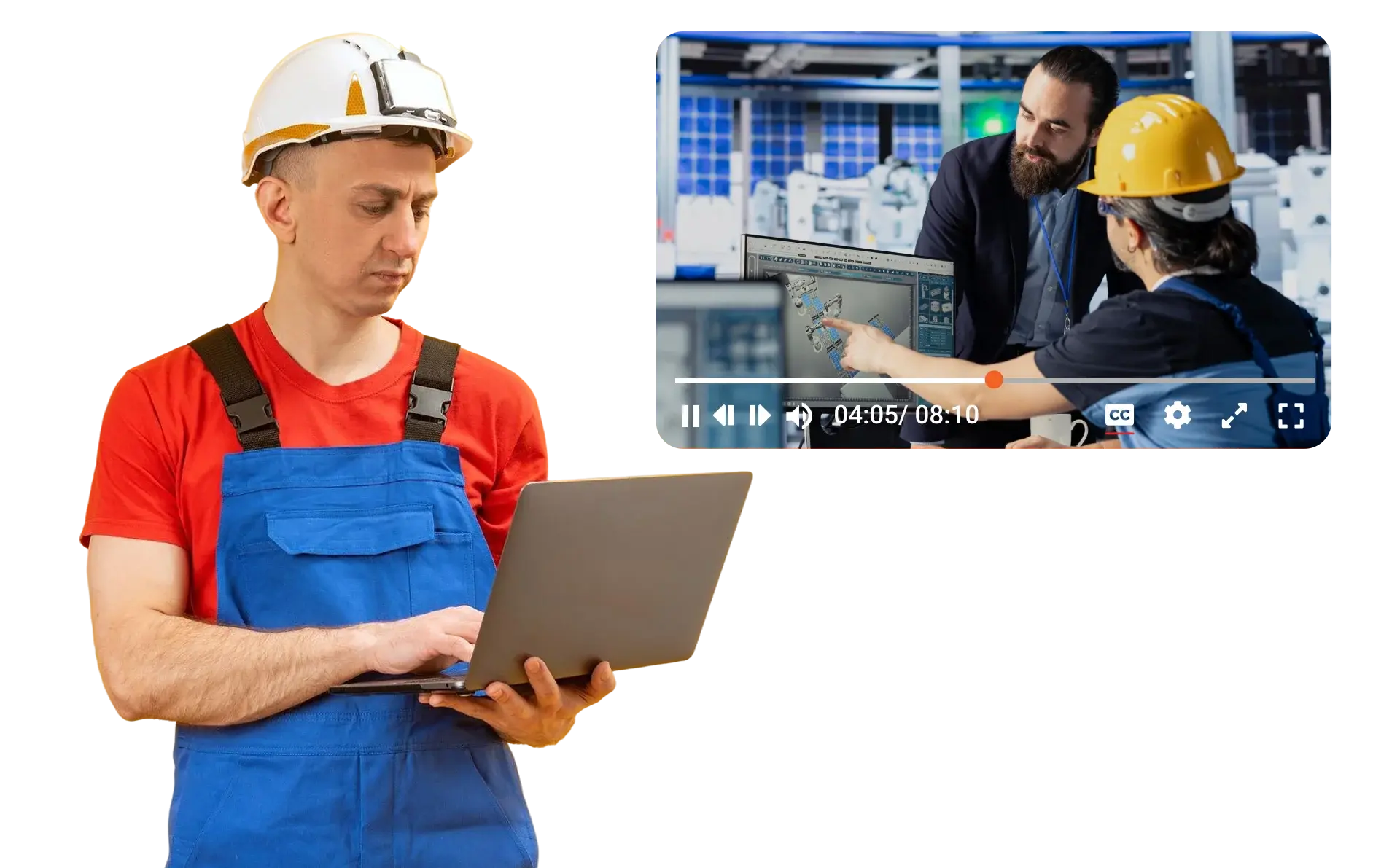
Manufacturing onboarding in many plants still means a week of classroom slides, a signature on an attendance sheet and then shadowing whoever happens to be on shift. The plant finds out what the new hire missed when a part is scrapped or a guard is left open, which is the most expensive moment to learn it. A better program is built around the measure operations already cares about, time to competency, and the evidence quality already needs, a training record that names the person, the procedure and its revision, the date and what they understood.
This article applies the training half of our guide to knowledge transfer in manufacturing to a new starter's first weeks. It covers building learning paths from the plant's own procedure videos, placing a question at the step where mistakes happen rather than a test at the end, setting completion windows, and producing records that hold up when an auditor or a customer asks who was trained on what.
Why manufacturing onboarding is slow and hard to prove
Shadowing is the backbone of most manufacturing onboarding, and its quality depends on who is on shift and what happens while the new hire is watching. A starter paired with the best operator on the line during a quiet week learns a great deal, while one paired with a stand-in during a week of rush orders learns the shortcuts, and neither of them sees the rare fault they most need to recognize. Slides cannot help much with that, because they cannot show motion, sound or the feel of a job done right.
Mixed-language crews make the gap wider, since a procedure written in one language and explained aloud in another loses detail at each step of the relay. Seasonal intakes and new shifts make it wider still, because a plant onboarding thirty people at once cannot give each of them a week beside an expert. The paperwork does not close the gap either. An attendance sheet records that someone was present in a room, which is a long way from showing that they understood the lockout sequence they will perform on their second day.
Build the learning path from the plant's own material
The strongest onboarding material is the plant's own, recorded at its own machines by the people who run them, and our article on capturing tribal knowledge on the plant floor covers how those recordings are made. A learning plan puts that material in order for a role or a station, with the procedure videos, the documents that go with them and any Sharable Content Object Reference Model (SCORM) courses the plant already owns sequenced as one unit, so progress is tracked across the whole plan rather than item by item.
Assignment turns the plan into a program, because learners in scope are enrolled automatically, the assignment carries a start and an end date, and an enforced completion window requires the plan to be finished by a set date, so a supervisor no longer has to chase each starter. That window is also what produces the evidence that named people completed named material in time, which matters more to an auditor than any amount of available content.
The hardest part of this step is not in the software, and it is defining what competency means at each station. A workable definition lists the tasks a person must perform alone, the standard each task is judged against, and who makes the judgment, usually the area supervisor or a lead operator. Writing that down first keeps the learning plan honest, because every item in it should map to one of those tasks.
Put the check at the step that matters
A test at the end of a module mostly measures short-term memory of the last ten minutes. A question placed at the point in the video where a step is shown measures whether the learner understood that step while it is in front of them, and it can be put exactly where mistakes happen on the floor, such as the isolation point that comes after the main disconnect in a lockout sequence or the order in which guide rails are set during a changeover.
The check only means something if it cannot be skipped, so a mandatory interaction holds playback at that point until the learner completes it, the number of retakes is configurable, and a failed attempt can require the learner to rewatch the section before trying again. That combination is the difference between offering material and requiring it, and it puts the rewatch where it does the most good, on the step the learner just got wrong.
A crew that speaks several languages needs the same recording and the same check in a language each person reads well. The transcript of a procedure video can be translated into caption tracks in 11 languages for audio and video, while transcription itself covers 82 benchmarked languages, so a recording narrated in one language can carry captions in the languages the crew reads. Technical terms deserve a review after machine translation, and our article on editable AI translation for technical training explains why.
What a training record has to show
The record is the plant's obligation, and the rules that create it differ by sector, so the place to start is the text of the rule that applies. Drug manufacturers work under the current good manufacturing practice rules in the Code of Federal Regulations (CFR), where 21 CFR 211.25 requires training in the particular operations each employee performs and in current good manufacturing practice as it relates to the employee's functions, with the good manufacturing practice training conducted by qualified individuals on a continuing basis. Food plants covered by the Food and Drug Administration (FDA) rule for human food work under 21 CFR 117.4, which requires each person who manufactures, processes, packs or holds food to receive training in the principles of food hygiene and food safety, as appropriate to the food, the facility and the person's assigned duties, and requires records that document that training. The Occupational Safety and Health Administration (OSHA) lockout/tagout standard requires the employer to certify that employee training has been accomplished and is being kept up to date, with each employee's name and the dates of training. It also requires retraining for authorized and affected employees when their job assignments change, when a change in machines, equipment or processes presents a new hazard, or when the energy control procedures change. The powered industrial truck standard requires a certification that includes the operator's name, the date of the training, the date of the evaluation and the identity of the person who performed the training or evaluation, and an evaluation of each operator's performance at least once every three years.
The rules differ in what they name, but a record that would satisfy any of them, and the auditor reading it, usually contains:
- the named person and their role or station
- the named procedure and its revision
- the date of training, and of evaluation where the rule asks for one
- evidence of understanding, not just attendance
- who trained or evaluated the person
- retraining after a change to the procedure, the machine or the job
Much of that record comes out of the training itself when manufacturing onboarding runs on assigned paths. An assignment with an enforced window shows who completed which plan and when, progress is tracked per learner for each item, quiz results are reported per participant and per question, and a certificate of completion is issued from the portal's own template when the plan is finished. A certificate of completion records that someone finished the material, which is not the same as showing they can do the job, so the supervisor's evaluation at the station remains the step that counts and belongs in the plant's own system of record.
Retraining after a change needs a deliberate step, because when a procedure's video is replaced with a new recording, the item keeps its address, statistics and settings. The code on the machine still works, but the statistics carry over from the old file and do not by themselves show which revision a person watched. When a revision requires retraining, assign the changed item again as a new assignment with its own window, and keep the revision in a field on the item, so the record shows who completed the new method and when. Where electronic training records fall under the FDA electronic records rule in 21 CFR Part 11, validating the system for that use is the plant's responsibility, as it is for any system the plant relies on. Injury records are a separate obligation, and our article on OSHA recordkeeping and what camera evidence supports covers them.
Measure time to competency
Time to competency is the number of days between a new starter's first shift and the point where a supervisor signs them off to run a station alone. It is the measure an operations director cares about, because every day of it is a day the plant pays for a person who cannot yet work without help. Measuring it needs both ends defined in advance, with the first shift recorded at hire and the sign-off recorded against the competency definition for that station.
The training data shows where the days go, since progress per learner shows who is behind on their plan, per-question results show which step a cohort keeps getting wrong, and the playback heatmap for each item shows which parts of a recording people watched and which they skipped. A question that most of a cohort fails usually points to the recording rather than the people, and re-filming one step is often cheaper than another week of shadowing. Once a starter is signed off, the same library keeps working for them on shift, which is the subject of our article on just-in-time training at the machine.
How the VIDIZMO portal runs onboarding
Onboarding on the VIDIZMO training platform uses the same items the plant records and searches, held on VIDIZMO Nexus, so a procedure video becomes a lesson without being moved anywhere. Learning plans, assignments with auto-enrollment and an enforced window, quizzes placed at a point in the video, mandatory interactions with retake and rewatch rules, certificates of completion from the portal's own templates, and per-participant and per-question reports all work on those items. Existing SCORM 1.2 and 2004 courses are delivered from the same portal with their own reports on attempts, scores, questions and time spent.
A plant that already runs a Learning Management System (LMS) does not have to replace it, since content can be delivered inside the LMS over Learning Tools Interoperability (LTI) 1.3, and quiz results achieved on that content are sent back to the LMS gradebook automatically on submission, with manual grading where a response needs review, so quiz results land in the gradebook the plant already keeps. The same mechanics serve safety lessons drawn from real events, which our article on safety training from real incidents covers.
Manufacturing onboarding gets faster when the path is assigned, the check sits at the step that matters and the record is produced as the work happens rather than assembled before an audit. To plan that for your own plant, talk to a specialist about your onboarding program.