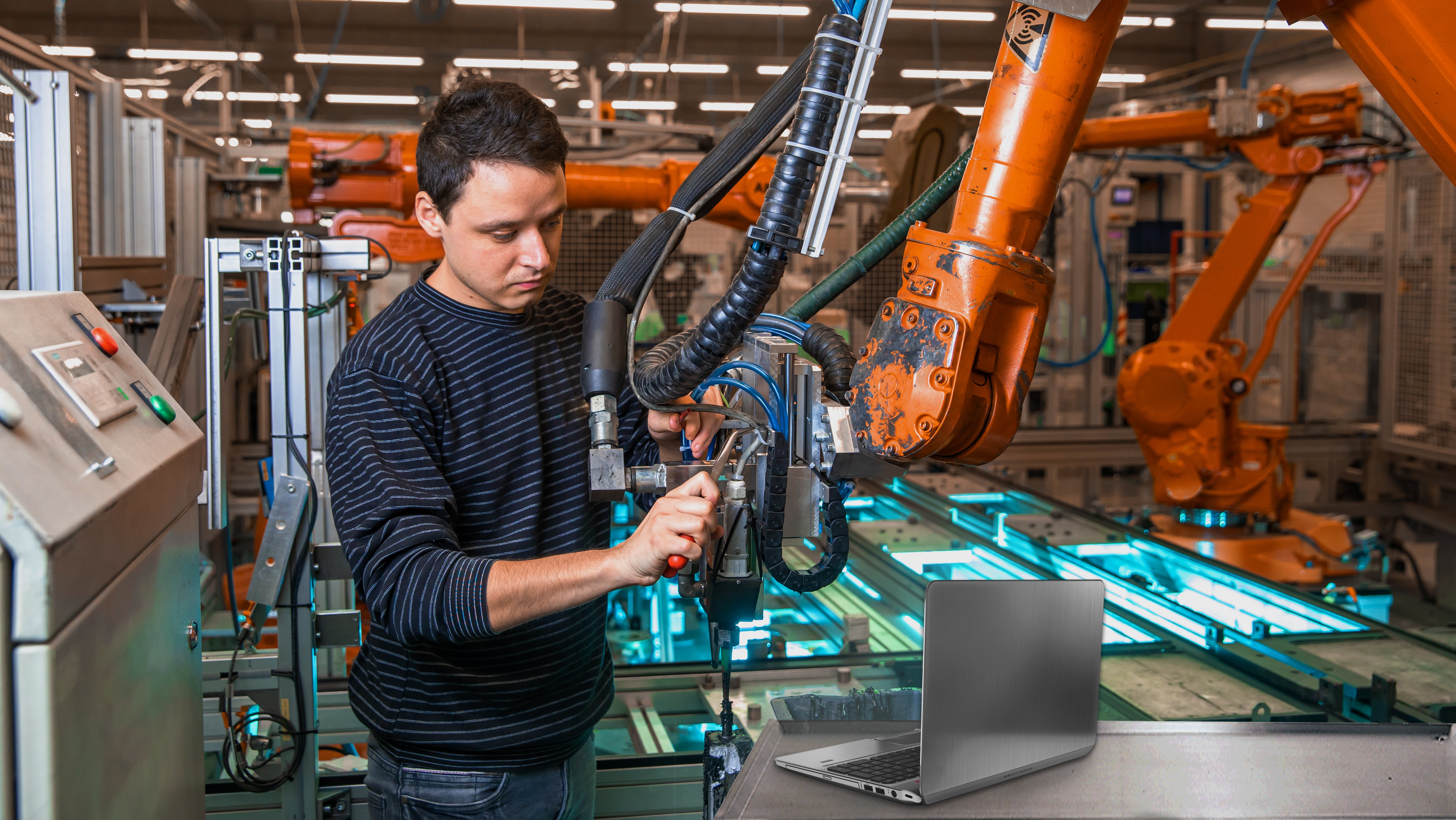
Every plant has a handful of people whose absence shows up in the numbers during the same week they are gone. When the senior setter is on leave, changeovers on the third press run long, and when the technician who has kept the same filler running for twenty years calls in sick, a fault that usually takes ten minutes to clear takes most of a shift. What those people know is rarely in the binder. Knowledge transfer in manufacturing is the work of getting that know-how out of their heads and into a form the next person can find at the machine, ask questions of and be trained on, and then keeping it current as the process changes.
This guide defines the discipline, explains why the usual methods struggle on a plant floor, and walks the loop that works in practice: capture, organize and find, answer, train and prove, with standard work holding the result together across shifts. It also argues a position that shapes every later decision, which is that the library a plant builds is the asset and generative AI can only be as good as what was captured, so capture comes first. A reader should be able to start the loop on one line by the end, with or without VIDIZMO.
What knowledge transfer in manufacturing covers
Plant knowledge comes in two kinds, and the distinction decides which methods can move it from one person to another. Explicit knowledge is what can be written down without losing much: the procedure, the drawing, the torque value, the setpoint, the changeover checklist. Tacit knowledge is the part the expert does without thinking of it as information, such as how a die feels when it seats properly, which change in pitch means a bearing is going, or the workaround the night shift uses when the third press double-feeds.
Explicit knowledge rarely walks out of the door, because somebody already wrote it down for an auditor or a customer. Tacit knowledge leaves with the person, and it is usually the part that keeps output steady, since it covers the situations the written procedure did not anticipate. A third kind sits between the two and is the easiest to lose of all: the reason a step exists. When nobody remembers why the extra purge cycle was added after a contamination event six years ago, the step looks like waste, and it gets cut in the next improvement event.
Knowledge transfer is therefore a narrower and more practical job than knowledge management in general, which our guide to knowledge management best practices covers as the discipline of storing and sharing what an organization knows. On a plant floor the question is sharper, because it asks whether the person at this machine tonight can do what the expert would have done, and find out how in the time the line allows.
Why the usual methods fail on a plant floor
The pressure on plant knowledge comes from the workforce first, and it is large enough to be planned for rather than hoped away. A 2024 study by Deloitte and The Manufacturing Institute estimated that US manufacturers may need as many as 3.8 million new workers between 2024 and 2033, and that around 1.9 million of those jobs could go unfilled if the industry's workforce challenges are not addressed. Every one of those openings is filled, if it is filled at all, by someone who has to learn the job from the people still there.
Retirements and turnover also concentrate the risk in a few people rather than spreading it across the floor. A line can run with a team of twelve and still depend on one person for the changeover that only happens twice a month, so losing that person costs far more than one twelfth of the line's capability, and few plants have anything of theirs recorded beyond a name on the roster.
The traditional answer is shadowing, and it works less well than its popularity suggests, because it depends on shift overlap and on the right events happening during the weeks the trainee is watching. A night-shift expert and a day-shift trainee may never work the same hours, and the rare fault the trainee most needs to see may not occur at all during the shadowing period.
Binders and printed procedures have a different weakness, which is that they cannot show motion or sound. A photograph of a gauge does not show how fast the needle should settle, and a paragraph cannot carry the sound of a pump starting to cavitate. Mixed-language crews widen the gap, since a procedure written in one language and explained verbally in another loses detail at every step of the relay.
Procedures also change faster than training does, and that mismatch turns training into a liability. An engineering change lands on Tuesday, the sheet at the station is updated on Friday, and the classroom module recorded last year keeps showing the old method to new starters for months, who then have to recall it weeks later at the machine with nobody nearby to ask.
Capture: recording the work in every form it already takes
Capture works best when it records the job from the point of view of the person doing it, because that is the view the next person will have. A head, helmet or chest-mounted camera, or simply a phone in a mount, records what the expert sees and hears while they work, and the file is uploaded to the library afterwards like any other recording. The plant does not need special devices for this, since an ordinary recording that reaches the library from a browser, a desktop client or a watch folder is enough.
The recording itself is only half of the value, and the other half comes from asking the expert to say why at each decision point. Silent footage of a changeover shows the sequence, while the same footage with the setter explaining that they check the guide rail here because it walks after a cold start shows the judgment no procedure captured. Short recordings of one task each are also far easier to find and replace later than a two-hour recording of a whole shift.
Not everything worth keeping happens on the floor, and capture should take the other forms the know-how already lives in. Screen recordings of machine software or a Human-Machine Interface (HMI) can be made in the browser or with whatever recorder the plant already uses. Photographs of a correct setup, scanned manuals, wiring diagrams and drawings all belong in the same library, and so do the e-learning courses a plant has already paid for, which in most plants were built to the Sharable Content Object Reference Model (SCORM) standard.
Two practical problems decide whether capture actually happens, and neither is solved by software. The first is choosing whose knowledge to record first, and a workable ranking weighs how soon the person may leave, how many critical tasks only they can do and how often those tasks occur, so the retiring setter who owns two monthly changeovers comes before an operator whose tasks three colleagues also know. The second is getting time from experts on a running line, which goes better when capture is scheduled into planned downtime and an engineer runs the camera while the expert works and talks.
Organize it so it can be found at the machine
Knowledge transfer in manufacturing succeeds or fails at the point of work, because a recording only helps if the operator can find it while the problem is in front of them. The practical test is the operator at the machine with a jam and three minutes to clear it, which means the right thirty seconds have to be findable without watching an hour of video first.
Search has to work on everything the recording contains, not only on its title. Speech is transcribed with every word aligned to the timeline, so a search inside a recording for "guide rail" plays from the moment the setter said it. Text on screen or on a scanned page is searchable across the library and opens at the timestamp in a video or the page in a document, which matters for HMI screens and fault codes. Video is also searchable by what it shows, through generated descriptions of the visual content, and long recordings can be divided into chapters so a reader jumps to the right section.
Fields matter as much as search, because a plant thinks in lines, machines and procedures rather than in keywords. Custom metadata fields such as line, machine, procedure, revision and owner are defined once for the library, and each can be searched and used as a filter. A review date kept as one of those fields is the simplest defense against a library that slowly fills with outdated methods, since an owner can list the items past their review date every month.
A printed link or Quick Response (QR) code on the machine is the most direct route from the floor to the right recording, and it only works if the link survives the next revision. Replacing a file keeps the item's address, views and settings, so the code on the station keeps opening the current method after the video is re-recorded. Replacement is not version control, though, because the previous file goes to the recycle bin, so a plant whose quality system must retain superseded methods should save the old revision as its own item first.
Mixed-language crews need the library in more than one language, and coverage differs by capability, so the figures are worth knowing before planning around them. Transcription covers 82 benchmarked languages, translation of audio and video into another language's captions covers 11, and document translation covers 80. A translated caption track sits beside the original with the original timings, so a viewer switches languages in the player.
Finding is the half of the loop where most knowledge programs earn the floor's trust or lose it, so it deserves study before any tool is chosen. Explore how organizations handle knowledge capture to see capture, search and training sitting together in one library.
Answer new questions from what was captured
Generative AI changes what a library can do, because it can combine several recordings and documents to answer a question nobody filmed directly. An operator who asks why the filler throws a particular fault after a product change does not need a video of that exact situation if the library holds the fault recovery recording, the changeover procedure and the manufacturer's manual. A retrieval-based assistant finds the relevant passages across transcripts, on-screen text, visual descriptions and document text, and writes an answer grounded in them.
An answer is only useful on a plant floor if it shows where it came from, so the operator can check the method before acting on it. Answers cite the material they drew on as cards the reader opens, and inside a recording, transcript search and on-screen text search take the reader to the moment the step is shown. Checking that each statement follows from its source stays with the reader, which is the right place for it when the subject is a machine that can injure someone.
Permissions have to hold in the answer as firmly as they hold in the library. Retrieval runs under the asking user's own identity with their access applied before anything is retrieved, so an assistant cannot answer from material that person could not open. An assistant can also be scoped to a defined part of the library, such as one line's folder or the procedures tagged for one product family, which keeps a packaging-line assistant from answering with a method from a different plant.
The most important property of these assistants is also the one vendor material mentions least, which is that they only know what was captured. If the fix for the jam on line four was never filmed or written down, the assistant cannot produce it, and at best it returns a general answer that cites the manual. Supervisors should treat that pattern as information, because the questions that come back with a thin or generic answer are the clearest list a plant will get of what to record next, and keeping that list turns the assistant into a guide for capture.
Train, then prove competence
Onboarding in a plant is measured by time to competency, the days between a new starter's first shift and the point where a supervisor signs them off on a station, and every training decision should be judged against that number. Material that is merely available does little for it, while material that is assigned, sequenced and checked moves the new starter through the right content in the right order before they reach the machine.
Assigned learning paths do most of that work for a plant onboarding program. A learning plan sets an ordered sequence of recordings and documents for a role, an assignment enrolls the people in scope automatically, and an enforced window requires completion by a date, which produces the evidence of who completed what and when. Progress is tracked across the whole plan, so a supervisor can tell the starter who is halfway through from the one who has not begun.
The check belongs at the step that matters, not at the end of the module. A quiz inserted where the lockout sequence is shown asks about lockout while it is on screen, a mandatory interaction holds playback until the question is answered, and a failed attempt can require the learner to rewatch that section before retaking it. Assessment reports break results down by question, so a training lead can see when a whole cohort misreads the same step, which usually means the recording needs fixing rather than the people.
Completion produces a certificate from the plant's own template, and results can return to the plant's Learning Management System (LMS) gradebook over Learning Tools Interoperability (LTI), so the training record stays where it is already kept. A certificate of completion records that someone finished the material, not that they can do the job, so the supervisor's sign-off at the machine remains the measure that counts. Our guide to corporate training programs with enterprise video covers training delivery beyond the plant.
Standard work: one method on every shift
Standard work is the current best method for a task, written down, followed by everyone who does the task and improved by the people who run it, and it is what holds knowledge transfer together over time. Without it, each shift slowly develops its own version of the job, and improvements regress after a project team moves on, since nothing keeps the new method in front of the people who were not in the room.
Holding standard work as video beside the written sheet shows the method in a way a sheet cannot. The standard for a station becomes a short recording of the current method, made by the crew that owns it, approved by the supervisor and filed under that line and station. When the method changes, the recording is replaced in place, the code on the station keeps working, and a short quiz on the change goes to everyone assigned there.
Checking on camera that standard work is followed is possible, with a condition that should be stated plainly. Where a detection has been trained for that line on the plant's own footage, as an engagement rather than from a shipped catalog, AI Live Insight can flag a step done out of order or skipped, and our article on Standard Operating Procedure (SOP) compliance at the loading bay covers that camera half. Any camera check of how people work also needs the written commitments in our article on works councils, worker privacy and the no-discipline commitment, because a crew that reads the cameras as a discipline tool will stop recording its own methods.
Where the loop pays back first
The loop pays back fastest on tasks that are infrequent, costly when done wrong and held by few people, since those are the tasks where one recording replaces the most guesswork. Changeovers come first in most plants, because a changeover done twice a month is never practiced enough to become routine, and the gap between the best and the average setter shows up directly in lost production time.
Start-up and shutdown sequences follow, together with recovery from the faults that happen a few times a year. Safety-critical steps such as lockout, confined space entry and chemical handling belong on the list even when they are well documented, because a recording of the correct method is what a quiz at the step and a toolbox talk build on. Maintenance repairs are the other large category, since the repair the senior technician did last spring is what the night-shift technician needs when the same machine fails again.
Where this is the wrong tool
Some knowledge does not transfer well through recordings and an assistant, and a plant saves money by recognizing those cases early. A process that changes every run, such as a job shop building one-off assemblies or a prototype line, produces recordings that are out of date before anyone watches them. Genuine individual craft, such as hand finishing that takes years to learn, can be supported by video but not transferred by it, and an apprenticeship remains the honest answer there.
A plant with no time set aside for experts to record will end up with an empty library, whatever it buys. Capture is labor, and if the schedule never releases the expert from the line for an hour, nothing gets recorded and the assistant has nothing to answer from. Measuring tacit knowledge directly is also not possible, so a program should track proxies it can count, such as time to competency on a station, how often a supervisor is called for a task, and how many critical tasks have a current recording.
Anything whose validation belongs in the plant's quality system should stay in that system, with the library supporting it rather than standing in for it. A recording becomes a controlled document only if the plant's document control process says it is, and in regulated sectors such as medical devices or aerospace, a change to a documented procedure goes through the quality system's change control before any video of the new method is published.
How VIDIZMO helps
The loop described above needs one library that holds every form of plant knowledge and makes all of it findable, which is the job VIDIZMO Nexus does. It holds video, documents, images and SCORM 1.2 and 2004 courses, with their interaction reports, in one portal across 315 file extensions, uploaded from the browser, the desktop client, a watch folder or the Application Programming Interface (API). It indexes what is said, shown on screen and shown in the frame, so the right moment is found at the machine, and its custom fields and in-place replacement keep the code on each station pointing at the current method.
AI Intelligence Hub answers questions from that library with citations to the material it used, under each user's own permissions, and an assistant can be scoped to one line or one product family. Its language models can run on the plant's own servers, so recordings of the plant and the AI that reads them stay inside the plant's network, on-premises or fully disconnected. Our page on AI knowledge management shows cited answers at work across a library of this kind.
Training sits on the same portal, so a recording becomes a lesson without being moved anywhere. Learning plans, assignments with an enforced window, quizzes at the step, certificates of completion and results returned to the LMS all use the same items the operators search, so replacing a method's recording updates the training built on it.
Where to go from here
Knowledge transfer in manufacturing touches every other part of plant performance, and the other guides in this series take the same loop into their own areas. AI for workplace safety in manufacturing covers how existing cameras catch the conditions that lead to injuries and how an incident becomes training for the crew. Quality control in manufacturing covers inspection, traceability and the record behind every hold, predictive maintenance with video AI covers what cameras and recorded repairs add to a maintenance program, and AI video analytics for manufacturing covers cameras as an operations instrument.
The practical first step for knowledge transfer in manufacturing is deliberately small, which is to pick one line, list the tasks only one person can do, and record them this month with that person talking through the reasons. If you want to see how the capture, search, answers and training described here work on one portal, request a demo.