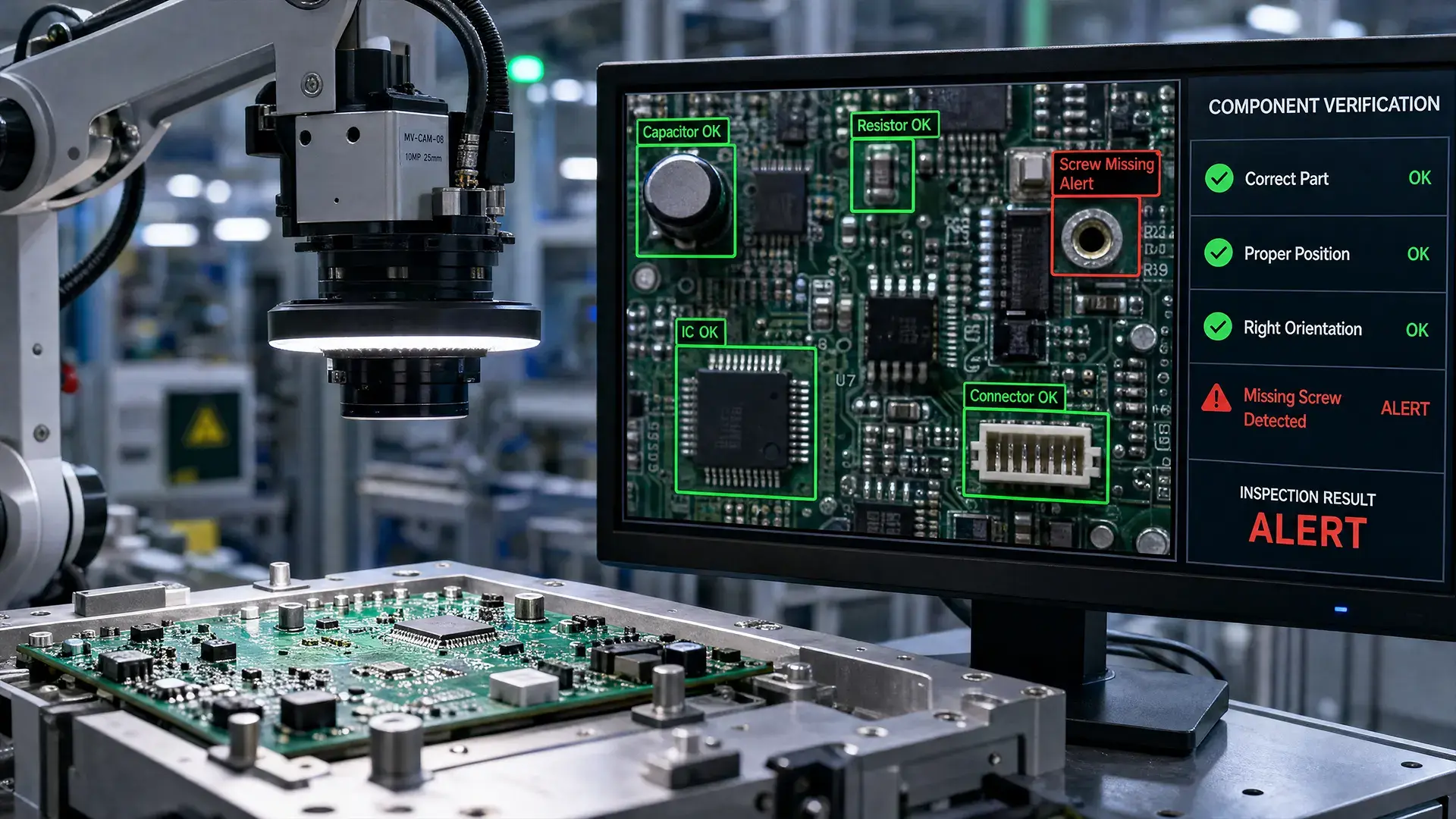
The defects that embarrass a manufacturer most are rarely the exotic ones. They are the absences: the fastener that never went in, the gasket that never got seated, the accessory kit that never made it into the box, the label that belongs to the other variant. Absence has a special status in quality work because it is the failure mode humans are worst at catching, and the psychology is well understood: an inspector's eye is drawn to what is present and wrong, while what is simply missing generates no signal at all, especially on the hundredth unit of a shift, especially when the assembly is 98 percent complete and looks, at a glance, exactly like every correct one. This article is about pointing trained detection at that particular blindness, verifying presence, position, and sequence against what a unit is supposed to contain, and it sits alongside our broader articles on visual quality inspection and the pillar guide to AI-powered video analytics for manufacturing.
Presence, position, and sequence checks
Assembly verification is a comparison between what the camera sees and what a specification says should be there, and the comparison operates at three levels of ambition, each with its own engineering reality.
Presence is the foundation and the workhorse: the component is in the frame where the configuration requires it. Classes trained on the plant's own components, at the station, under the station's lighting, recognize the bracket, the connector, the seal, and their absence-forms fire when the expected object fails to appear in the zone the specification maps to. Most of the value in most deployments lives here, because presence checks catch precisely the class of miss that human attention handles worst, and they run on every unit rather than a sample.
Position is the second level: present, and where it belongs, oriented as it should be. Detection with location, read against zone geometry, distinguishes the seated connector from the one resting beside its socket, and the label applied within its window from the one drifting off it. Position tolerance is a specification conversation, not a software toggle, and the feasibility arithmetic from the visual inspection article applies with full force: pixels per millimeter decide what position accuracy a given camera can attest.
Sequence is the third: steps performed in the required order. Because tracked detection produces events in time, the record can verify that the gasket event preceded the cover event, that torque came after placement, that the test-fixture dwell happened at all. Sequence verification shades into standard-operating-procedure territory, ground our Standard Operating Procedure (SOP) compliance article covers in a heavier-industry setting, and it is where assembly verification quietly becomes process verification, catching not just the missing part but the skipped step that produces missing parts downstream.
Handling product variants
A plant with one product and one configuration barely needs this article. The manufacturers who feel the missing-component problem acutely are the ones running variant complexity, the same station assembling configuration A and configuration B in alternating lots, the export build with the extra bracket, the customer-specific kit list, and variant complexity is exactly where paper travelers, pick lights, and operator memory strain hardest.
For detection, variants change the question from "is the component present" to "is the component that this unit's configuration requires present," which means the verification layer needs to know what the current unit is supposed to be. Two patterns serve. Product-classification detection types distinguish the variants visually, reading which build is on the fixture from the unit itself, and the verification rules follow the classification, which works when variants differ visibly. Where they do not, the works order carries the truth, and the integration surface brings it in: the Manufacturing Execution System (MES) or Enterprise Resource Planning (ERP) publishes what the station should be building, the event layer consumes it, and the same webhook-and-API path that carries results out, covered in our plant-systems integration article, carries context in. Either way, the outcome that matters is that the flag fires on this unit against this unit's specification, not against a generic notion of completeness.
Wrong-part detection deserves its own sentence, because it is presence's evil twin: the hole is filled, with the wrong thing, the look-alike fastener, the previous variant's connector, and it defeats casual inspection precisely because something is there. Classes trained to distinguish the near-neighbors the plant actually confuses, informed by the taxonomy discipline the defect-detection article describes, convert the plant's historical mix-ups into watchable detection types, and the reject-bin archaeology of past wrong-part escapes is the exact training inventory to start from.
Where to place checks and what they trigger
Where a check sits on the line decides most of its economics. A verification at final pack catches everything and catches it at the most expensive possible moment, when the remedy is teardown. The better pattern places lightweight checks at the stations where absence is created, immediately after the step that installs the component, where the fix is a reach rather than a rework order. The arithmetic per station is the familiar one: cadence set to the station's takt, camera positioned so the components of interest survive the pixel budget, lighting adequate for the distinction being asked. Sites usually discover that three or four well-placed presence checks cover the large majority of their historical escapes, and that discovery, made from escape data rather than instinct, is the right basis for the deployment map.
What a flag triggers is a quality-system decision that belongs in writing before go-live. The gentle end is an operator prompt at the station, a chance to fix the miss in cycle, which is where most flags should resolve. The firm end is a hold: the event flows by webhook to the MES or Quality Management System (QMS), the unit's identifier is flagged, and downstream processing pauses until adjudication, the closed-loop pattern regulated plants in particular expect. Between them sits the review queue with the clip attached, and the clip matters operationally, because an adjudicator who can watch the station's last cycle resolves a flag in seconds, while one staring at a text event walks to the line. Every flagged event preserves its footage automatically, which converts adjudication from an interruption into a glance.
The same record accumulates into the audit posture the visual inspection article describes: a timestamped, evidence-backed verification history per unit and station, reviewable when the customer quality engineer asks how the plant assures configuration, and considerably more persuasive than a sampling log. For plants whose customers audit configuration control formally, automotive and aerospace above all, that history tends to justify the deployment by itself.
Example: fixing a short-shipped kit
A concrete case makes the mechanics tangible in a way no general description manages. A manufacturer of electrical enclosures ships each unit with an accessory kit, hardware bag, mounting brackets, documentation pack, dropped into the carton at final assembly, and the kit is the company's most persistent complaint generator: a low single-digit percentage of shipments arrive missing one element, each miss costing a support contact, an expedited parts shipment, and a dent in a distributor relationship. The verification build for that one station is modest. A camera over the pack point, positioned so the open carton's interior survives the pixel budget at pack cadence. Three presence detection types trained from a few hundred labeled frames of the bag, the brackets, and the doc pack, in the carton, under station lighting, plus the compliant-carton negatives the line produces all day. A zone over the carton position, an event per pack cycle, and a rule: cycle closes without all three presence events, operator prompt fires while the carton is still open in front of them.
The validation month runs silent beside the existing process, and the confusion review tells the plant what it bought: the detection types catch the misses human sampling was structurally unable to see, the false-positive pattern concentrates in a glare condition after the afternoon shift's door opens, one camera-angle adjustment resolves it, and the threshold gets set from the evidence. The after picture is the point of the story: the miss rate at the customer end drops toward the noise floor, the prompt resolves most flags in cycle without a queue, and the per-unit verification record quietly becomes the standard answer to the distributor quality questionnaire. Nothing in the example is heroic, which is the argument: absence verification is the accessible end of vision-based quality, and the accessible end is where most of the money was.
Configuration audits with per-unit evidence
Configuration control is a standing topic in customer audits across regulated and contract manufacturing, and the traditional evidence is procedural: travelers, pick confirmations, training records, the paper shadow of the physical work. A per-unit verification record with footage changes the conversation's ground. The auditor's hypothetical, how do you know unit X shipped complete, gets a concrete answer, the verification events for that serial's window and the clip behind any flagged step, and the systemic version, how do you know your process holds, gets the trend: verification rates by station and shift, misses caught and resolved in cycle, the correction loop's timestamps. Plants report that this record shortens audits, because the sampling the auditor came to do has, in effect, already been done continuously, and redirects the audit conversation toward process improvement, which is where both parties would rather spend the day.
Limitations
The boundaries track everything this series has established. A camera verifies what a camera can see, so internal components, blind-side fasteners, and anything the assembly's own geometry occludes at the check station stay outside the method's reach, and the coverage review must say so per component rather than in general. Torque, force, and electrical continuity are not visual facts; verification complements the test bench, never replaces it. Classes are trained per engagement on the plant's own parts and stations, which is scoping, not fine print. And for the ambiguous flags, the assembled-but-odd cases a fixed taxonomy cannot name, the escalation layer this series returns to earns its keep here too: a clip put to a multimodal model with a written question, does this assembly appear complete and correctly seated, returns a second reading for the adjudicator, with the standing cautions, recorded prompt, no quotable accuracy, covered in our beyond-the-preset-list article.
The sequence tier repays one more paragraph of specificity, because it is where verification catches what no end-of-line check can. A missing component at final pack tells you a step failed somewhere; a sequence record tells you which step, on which cycle, and what the operator was contending with when it happened, because the surrounding events and the clip carry the context. Plants using sequence verification on their historically troublesome stations report a second-order effect: the record vindicates operators as often as it flags them, showing the skipped verification dwell that traces to a fixture that jams, the out-of-order steps forced by a material presentation problem, and that evidence redirects the fix toward the station's design, which is where most chronic sequence deviations actually originate.
How VIDIZMO fits
VIDIZMO AI Live Insight runs assembly verification as trained presence, position, and classification detection types on cameras at the stations, reading standard Real-Time Streaming Protocol (RTSP) and ONVIF (Open Network Video Interface Forum) streams, processed on the plant's own hardware on site. Zones map the specification onto each camera's view, per-camera confidence and severity govern what fires, flags carry their clips into the Nexus portal the deployment works alongside, under access control, retention, and audit logs, and events flow to the MES or QMS by REST API and webhook for prompts, holds, and routing. Models are customer-isolated, and the validation path is the silent-run-and-confusion-review discipline the quality articles in this series describe, run against the station's human checks before the model earns gate authority.
One design choice rounds out the picture: what happens to the compliant units' events. Keeping the pass events, not just the flags, is what makes the record a verification history rather than an exception log, and storage arithmetic favors it, since events are small and the clips behind routine passes can carry shorter retention than flagged ones. The per-unit trail that results is the artifact the audit section above depends on, and it costs a configuration decision rather than a project.
The first station picks itself: pull the last two years of customer complaints and internal escapes, and rank stations by where the misses were created. The station at the top of that list, instrumented with a presence check and a month of silent validation, produces the before-and-after number the rest of the rollout gets justified with, and it is usually a short month.