Digital Evidence Management, Artificial Intelligence, AI Intelligence Hub
 Updated September 17, 2026
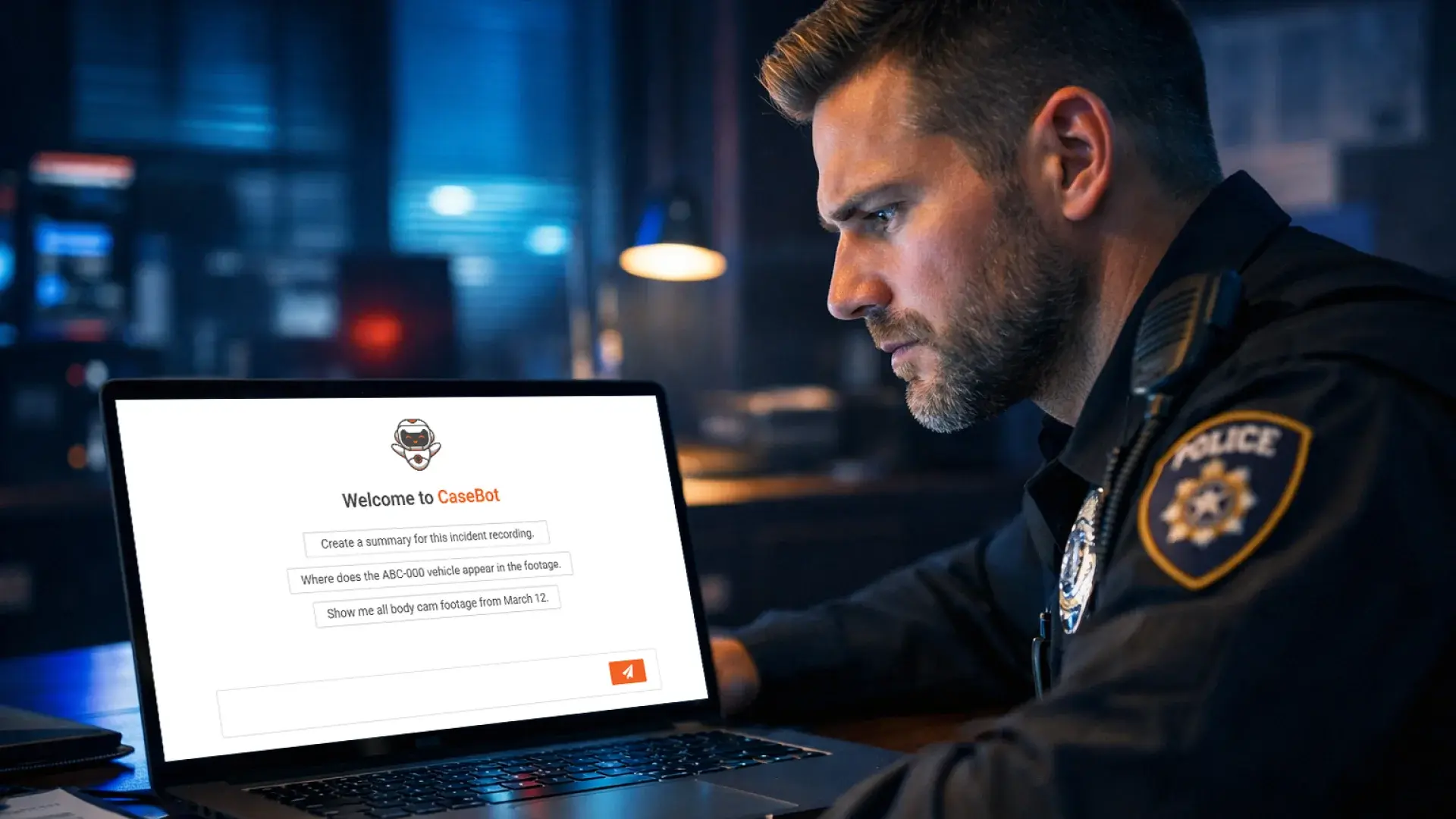
An investigator pulls up 14 hours of body cam footage from a drug arrest that happened three days ago. Somewhere in those files is the moment a suspect made a statement about a second location. Finding it manually means scrubbing through every minute, pausing, rewinding, and hoping nothing slips by.
An AI chatbot for video evidence changes that workflow entirely. Instead of watching hours of footage frame by frame, officers type a question and get a timestamped answer in seconds.
The Problem: Hours of HD Footage, Minutes to Find What Matters
Body-worn cameras generate massive volumes of video. A single patrol shift can produce eight or more hours of continuous HD recording. Multiply that across every officer involved in an incident, and investigators face a wall of footage that no one has time to watch end-to-end.
The manual review process is slow and error-prone. Evidence technicians scrub through timelines, listen for keywords, and flag segments by hand. Critical moments get missed when reviewers are fatigued or unfamiliar with what to look for. Patrol supervisors reviewing use-of-force incidents face the same bottleneck: too much footage, not enough time.
This is not just an inconvenience. Delayed evidence review slows case resolution, creates backlogs, and puts pressure on already understaffed agencies. Learn more about the core challenges agencies face in body camera video storage and management.
What an AI Chatbot Actually Does
A RAG-powered AI chatbot, the conversational surface of VIDIZMO AI Intelligence Hub, sits on top of your evidence library and lets officers interact with footage using plain language. Think of it like searching your email, except you are searching across video transcripts, detected objects, metadata, and visual content all at once.
Here is how it works in practice:
Ask a question in plain language. Type something like "Show me all body cam footage from March 12" or "When did the suspect mention a second address?" The chatbot queries transcripts, AI-detected objects, and metadata across the case.
Get timestamped results. The chatbot returns specific moments in the footage, not entire files. Officers jump directly to the relevant segment instead of scrubbing through hours of video.
Search across multiple evidence items. A single query can pull results from 10, 20, or 50 files in a case. The chatbot connects evidence items that would take days to cross-reference manually.
This is not keyword search on a transcript. The AI combines automatic transcription, speaker identification, object detection, and visual descriptions to understand what is happening in the footage, not just what is being said. For a broader look at how AI is transforming evidence workflows, see 12 ways AI is boosting efficiency in evidence management.
Real-World Use: Drug Arrest Footage and Incident Review
Consider a narcotics investigation with body cam video from four officers, dash cam footage from two vehicles, and an interview room recording. An investigator needs to find every mention of a specific street address across all seven files.
Without AI, that is a week of manual review. With a chatbot, it is a single query. The system searches transcripts for the spoken address, flags visual matches such as street signs captured on video, and returns every instance with timestamps.
See how AI helps law enforcement for managing digital evidence.
For use-of-force reviews, patrol supervisors can ask the chatbot to "show the moment the suspect was detained" or "find where the officer issued a verbal warning." The AI identifies those events by combining transcript analysis with activity recognition, giving supervisors direct access to the moments that matter.
Cross-interview analysis is another area where chatbots prove their value. When investigators need to compare statements from multiple witnesses, the chatbot can surface similarities and discrepancies across 10 to 20 interviews for a single incident, a task that would take analysts days to complete manually. Explore how VIDIZMO DEMS handles interrogation room video evidence management best practices for further context on interview workflows.
Visual Search and Transcript Analysis: Working Together
The real power of an AI chatbot comes from combining multiple AI capabilities into a single query interface.
Transcript search finds spoken words and phrases across body cam audio, even in noisy environments. With support for 82 languages, agencies serving multilingual communities do not hit a wall when evidence includes non-English speech.
Object detection identifies weapons, vehicles, license plates, persons, and other objects in video footage. An investigator can ask "Show me frames where a firearm is visible" and get results from visual analysis, not just transcript matches.
Visual descriptions and summarization give officers a quick overview of long recordings without watching them. The AI generates summaries and breaks lengthy videos into chapters, so reviewers can scan for relevance before committing to a full review.
When these capabilities feed into a single chatbot interface, officers do not need to know which AI model to use or which search filter to apply. They just ask their question. To see a full breakdown of AI capabilities available in modern evidence platforms, visit the Digital Evidence Management guide for agencies.
Key Takeaways
- Manual body cam review is a time sink that delays investigations and creates evidence backlogs.
- AI chatbots let officers query video evidence using natural language, returning timestamped answers in seconds.
- Cross-evidence search connects related moments across dozens of files in a single query.
- Combined transcript, object detection, and visual search capabilities eliminate the need for multiple review tools.
- Agencies can reduce days of manual review to minutes without sacrificing thoroughness.
Smarter Evidence Review Starts with the Right Question
AI chatbots for video evidence are not replacing investigators. They are giving officers a faster way to find what they already know is buried in the footage. Instead of scrubbing through timelines, your team asks questions and gets answers.
The chatbot capability comes from VIDIZMO AI Intelligence Hub, an agentic RAG platform whose every answer carries a source citation. In a Digital Evidence Management deployment it surfaces as CaseBot, a RAG-powered investigation assistant that enables natural-language querying across transcripts, detected objects, metadata, and case data. Because it runs inside the same platform that handles evidence ingestion, chain of custody, and secure sharing, there is no separate tool to manage, and every answer stays grounded in the source evidence.
If your agency is spending more time searching for evidence than analyzing it, request a free DEMS trial and see how CaseBot works with your own footage.

FAQ
Frequently Asked Questions
What is an AI chatbot for video evidence?
An AI chatbot for video evidence is a natural-language query interface that sits on top of a digital evidence management system. Officers type questions about body cam footage, surveillance video, or interview recordings, and the chatbot returns timestamped answers by searching across transcripts, AI-detected objects, and metadata. VIDIZMO DEMS includes CaseBot, a RAG-powered chatbot purpose-built for investigative evidence queries.
How does AI help with body cam footage review?
AI automates the most time-consuming parts of body cam review. Automatic transcription converts speech to searchable text in 82 languages. Object detection identifies weapons, vehicles, and persons in video. Speaker identification distinguishes who is talking. Together, these capabilities let officers search footage by content rather than scrubbing through it manually.
Can AI search detect objects in police body cam video?
Yes. AI object detection identifies faces, persons, vehicles, license plates, weapons, and other objects across video footage. VIDIZMO DEMS uses object detection and tracking to flag relevant items throughout a recording's duration, so investigators can locate specific objects without watching entire files.
Is AI video analysis admissible in court?
AI-generated metadata such as transcripts, detected objects, and timestamps serves as an investigative aid, not standalone evidence. The underlying video remains the primary evidence. When the platform maintains chain of custody with SHA-256 tamper detection and comprehensive audit logging, the original footage and its AI-generated annotations stay court-ready.
How does an evidence chatbot compare to keyword search?
Traditional keyword search only matches text strings in metadata or manually entered tags. An AI chatbot combines transcript search, object detection, visual analysis, and metadata queries into a single natural-language interface. This means officers can find relevant moments even when they do not know the exact words spoken or tags applied.
What types of evidence can an AI chatbot search?
AI chatbots built for digital evidence management can search across video, audio, images, and documents. VIDIZMO DEMS supports 255+ file formats and applies AI processing including transcription, object detection, OCR, and summarization across all ingested evidence. Officers can query body cam footage, dash cam video, interview recordings, surveillance clips, and scanned documents from a single interface.
TopicsDigital Evidence ManagementArtificial IntelligenceAI Intelligence Hub
About the author
Ali Rind is a Product Marketing Executive at VIDIZMO, where he focuses on digital evidence management, AI redaction, and enterprise video technology. He closely follows how law enforcement agencies, public safety organizations, and government bodies manage and act on video evidence, translating those insights into clear, practical content. Ali writes across Digital Evidence Management System, Redactor, and Intelligence Hub products, covering everything from compliance challenges to real-world deployment across federal, state, and commercial markets.
You may also like
Finding Every Recording a Person Appears In
Some investigations open with the answer already in hand. There is a name, and there is a photograph, taken from a ...
What Analysis Can Still Do With an Incident Already Recorded
A person came to attention on one of your cameras today, and the next question is whether they have been here before. ...
How an Incident on Camera Becomes Known
A camera estate runs unwatched. That is arithmetic rather than a failure of discipline, because a site with a few ...