Every incident leaves evidence in a dozen places, the county 911 center, township cameras, a store, a bus, a resident's doorbell, the department next door. Here's how one platform brings all of it into a single case you can defend. The hard part isn't collecting it. Every source has its own format, its own clock, and its own channel.
Files from outside the department are the hardest to defend, and every records request has to be reviewed before anything is released. Meet Alex, the lieutenant who runs evidence and records for Willow Creek Township. Let's follow one case, a hit-and-run on Elm Street, from the first call to the courtroom. Saturday, 9:41 PM.
A silver sedan turning onto Elm clips a man in the crosswalk and drives off. The pharmacy's camera on the corner records it. Within a minute, the county 911 center takes the call. Listen.
County 911, what is the address of your emergency? Elm and Maple in Willow Creek. A car just hit a man in the crosswalk. He's down.
Is he awake and breathing? Yes. The township's street cameras are already connected to AI Live Insight over ONVIF and RTSP, including Axis and Hanwha Vision. Adding one takes a stream address and a name.
Each camera gets rules built without code. Elm Street is one way, so the rule is simple, object detection, a wrong direction check, and a zone drawn on the road. At 9:42, camera ELM03 flags the sedan driving up Elm against traffic. The camera only flags.
A person decides. Alex files the alert clip into the Elm Street case. A camera alert is now evidence. Now the evidence comes in, and most of it isn't ours.
The officer's body cam and in-car video, the 911 audio and dispatch record from the county, the pharmacy camera, a bus camera from the transit operator, a resident's doorbell, a plate reader hit, and body cam video from the Northfield Police who found the car. Different owners, different formats, one case. Everything lands in the case folder, reports, statements, video, and the call recording, organized the way investigators work. For partners and residents, Alex sends requests from inside the case, the pharmacy, the transit operator, and the resident at 9 Elm Street, each with the incident location.
The resident opens the link and uploads the doorbell video. It lands in a separate partner portal where it's scanned and reviewed before it joins the case. The doorbell shows the car fleeing. The bus camera shows the same car undamaged two minutes before, and Northfield's body cam finds it in the owner's driveway, its front corner smashed.
From the moment a file arrives, its chain of custody starts, and it gets a cryptographic hash, a fingerprint of the original. Every clip or redacted copy gets its own hash, so the original can always be verified. Then the sources have to tell one story. Alex asks Intelligence Hub what happened, when, where, who is involved, and where the case stands.
The answer comes from the case files with citations. Then Alex asks for a map of the evidence, the bus at 9:39, the pharmacy at 9:41 with a partial plate, the doorbell, the street camera, the plate reader at 10:05, and Northfield at 10:31, all connected. Every entry cites its source, and that's where the conflicts show. The witness remembers 10 o'clock.
The cameras say 9:41. The doorbell clock runs a minute fast, and the owner says he was home all evening while the bus camera, the pharmacy camera, and the plate reader put his car on Elm Street. A detective weighs each one with the sources side by side. Alex shares the thread with Detective Patel, who picks it up with the same context.
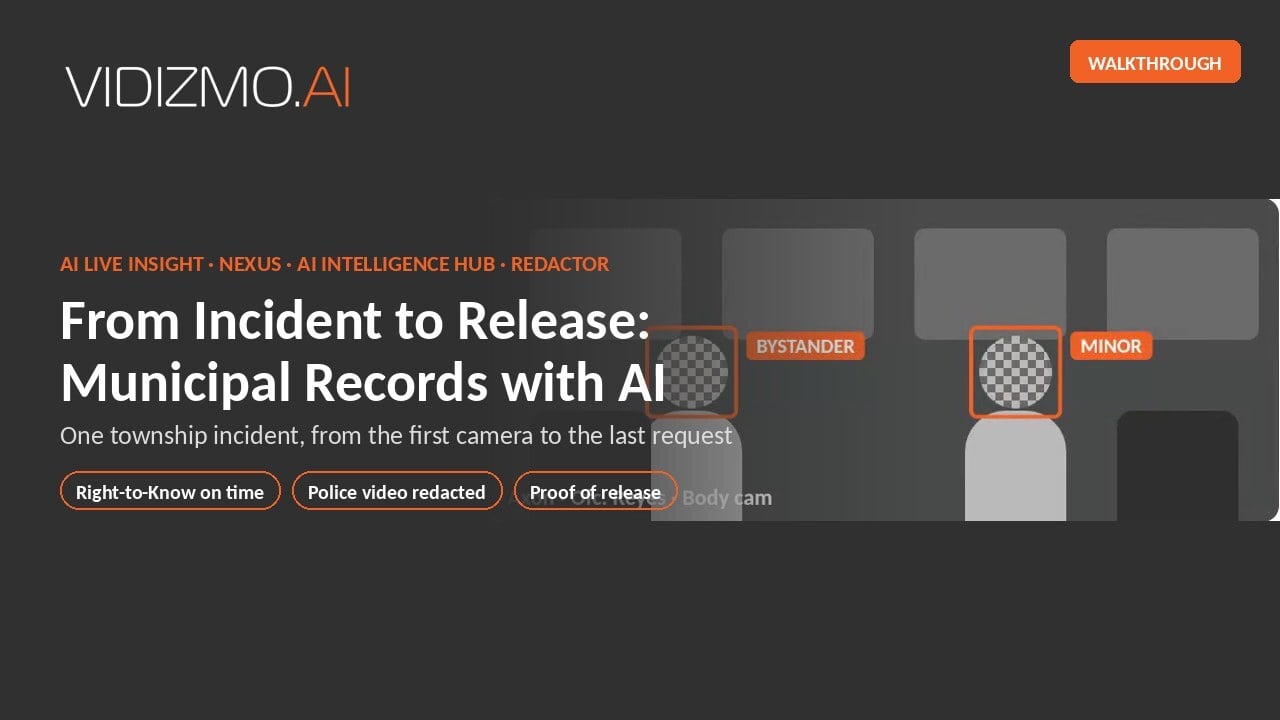
Then a newspaper files a records request. Here's the body cam as recorded. Names are spoken, and faces are visible. Listen.
Sir, I'm Officer Alvarez. What's your name? Marcus. Marcus Ellison.
I'm Priya. I called it in. Silver car. And the copy for release.
Faces covered, names bleeped. Your name? Marcus. Marcus Ellison.
I'm Priya. Nothing goes out unreviewed. What's your name? In the redaction studio- Marcus Ellison.
I'm Priya. Every detection is checked before export. The 911 call gets the same treatment. The caller's name, address, and phone number are bleeped in the audio and in the transcript.
Listen. 911, what is the address of your emergency? Elm and Maple in Willow Creek. A car just hit a man in the crosswalk.
He's down. Is he awake and breathing? In the audio studio, each bleep is reviewed against the transcript, and every redaction is logged. Finally, the case goes to the district attorney.
Alex shares it through a secure link with an expiry date. Every file carries its chain of custody, partner files included, and the audit log covers the whole system. All of it runs where your agency decides, in a government cloud, on your own servers, or fully air-gapped, built to meet CJIS security policy controls. Evidence never has to leave your boundary.
And it connects to the systems agencies already run, cameras and video systems from Axis, Hanwha Vision, Avigilon, and Verkada over ONVIF and RTSP, dispatch and record systems on request. More than 150 integrations are listed, and anything not listed can be built to your requirement or reached through an API. The same platform serves the rest of the township, records requests redacted under state exemption codes and council meetings streamed with captions and searchable afterwards. Every source, one case.
Alerted, collected, verified, connected, released, and proven with a person deciding at every step. Bring one closed case and see it end to end. Request a demo at vidizmo.ai.