Scaling a real-time video analytics deployment is not one smooth curve where everything simply gets bigger. It is a series of different walls, each hit at a different size, and the reason projects stall is usually that they planned for the wall they could see and got blindsided by the next one. A setup that runs beautifully on sixty cameras can fall over in a completely different way at six hundred, and again at six thousand. Knowing which wall comes next, and in what order, is most of the skill of building something that actually reaches city scale. This is a tour of those walls and how a system is designed to get past each of them.
The walls, and roughly where each one shows up, look like this:
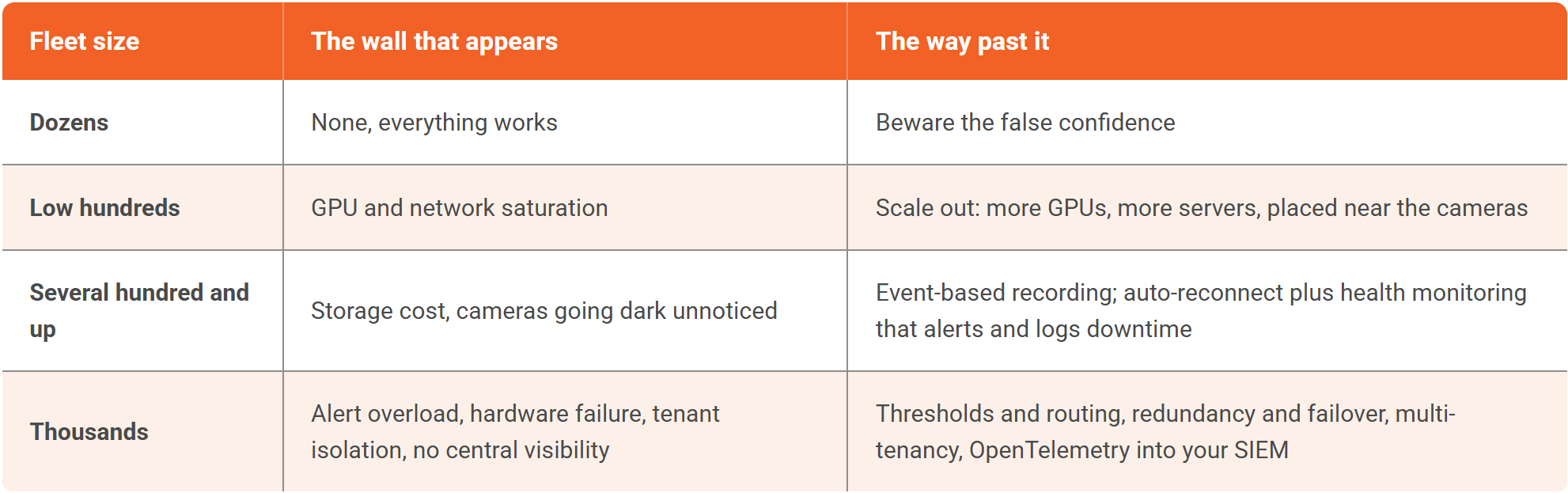
Each row is a section below.
At a few dozen cameras, almost anything works
This is worth saying plainly because it is where most pilots live and where a lot of false confidence is born. At twenty or fifty cameras, a single server with a GPU handles everything, the network barely notices, storage is an afterthought, and the operator can still more or less watch the feeds. Everything looks easy, and every architectural sin is invisible because nothing is under stress. The mistake is to conclude from a smooth pilot that the design will scale. It tells you the software works. It tells you almost nothing about what happens when the numbers grow, which is exactly what the rest of this piece is about.
The first wall, in the low hundreds, is compute and network
The first real wall arrives somewhere in the low hundreds of cameras, and it is usually the GPU or the network rather than anything to do with the AI. One server's GPUs fill up, or the links carrying all that video start to strain. Both are the subjects of their own detailed treatment, GPU capacity planning and network and bandwidth design, and both have the same shape of answer: you stop trying to make one machine or one link do everything, and you spread the load out. Add GPUs inside a server, then add servers, and place those servers close to the cameras they serve so the heavy video stays local. Scaling horizontally like this is what turns a hard ceiling into a straight line you can keep extending, and it is the single most important architectural property for getting past this wall.
The next wall is human, and it is the one people forget
Push past the compute and network wall by adding servers, and the next limit is often not technical at all. It is the people. A system watching six thousand cameras can generate more alerts in an hour than an operations center can act on in a day, and an alert nobody has time to look at is exactly as useful as no alert. Scale multiplies detections, and without discipline it multiplies noise at the same rate.
The answer is not to detect less, it is to be ruthless about what rises to a human, through thresholds on confidence and severity, and about where each alert is routed so it reaches someone who can actually act. This is enough of a problem in its own right that it becomes its own discipline, and at scale it is the difference between a system people trust and one they have learned to ignore.
Storage stops being an afterthought
Somewhere on the way up, storage quietly turns from a rounding error into one of the largest line items in the whole deployment. Continuous recording of a few dozen cameras is nothing. Continuous recording of thousands, retained for weeks or months, runs into petabytes, and the cost curve is steep enough to reshape a budget.
The lever here is to stop treating recording as an always-on default and start treating it as a policy decision. Event-based recording keeps the clips around detections, with a buffer before and after, rather than every second of every camera forever, which cuts the total to a fraction. Continuous recording keeps its place where regulation demands it, but applied selectively rather than universally it is often the difference between a storage tier that is affordable and one that is not.
Availability, because at scale something is always failing
At a few cameras, a server going down is an inconvenience you notice and fix. At thousands, hardware failure is not an event, it is a constant background condition, something is always failing somewhere, and the system has to be built on that assumption rather than surprised by it.
A server dropping out cannot be allowed to take its whole slice of the fleet dark and silent, because a blind spot nobody is aware of is worse than a known outage. This is why redundancy and failover stop being optional past the pilot: a failed node needs to shed its cameras to another and keep going, so that coverage degrades gracefully instead of disappearing in a chunk. Designing for the failure you know is coming is what keeps a large deployment trustworthy.
The cameras themselves misbehave at scale
There is a subtler operational wall that only shows up with numbers. A handful of cameras are all reliable and reachable. A fleet of thousands always contains some that are flapping, dropping their connection, coming back, going stale, or quietly degrading, at any given moment. A system that assumes every camera is always healthy will spend its life choking on the ones that are not.
Handling this gracefully at scale means automatic reconnection when a stream drops, health monitoring that knows which cameras are actually live, and the equivalent of a circuit breaker that stops the system from hammering a camera that is down and dragging everything else with it. None of this matters at pilot size. All of it matters at fleet size, and it is the kind of robustness that separates a demo that worked once from a system that runs for years.
Recovering from a flaky camera is only half of it, though, and at scale the more important half is knowing. A camera that has quietly gone dark is a blind spot, and a blind spot nobody is aware of is the most dangerous state a surveillance system can be in, worse than a known outage because it fails silently and is found only when someone goes looking for footage that was never captured.
So camera health is not just something the system heals from in the background, it is something it surfaces: every camera's status is tracked and shown as a live fleet view of what is online, reconnecting, or down; a camera dropping offline raises a notification the way any other event does; and the outage is logged with when it fell and when it returned. That turns downtime from something you discover after the incident into something you are told about the moment it happens and can prove afterward, which, on a fleet where something is always misbehaving, is most of what separates a monitored operation from a wall of screens quietly going blind.
You cannot operate what you cannot see
The same logic scales from a single camera up to the whole system. A couple of servers you can watch by hand; thousands of cameras across dozens of servers is an operation, and an operation run without observability is run by guesswork and firefighting. The errors, the pipeline and GPU health, the per-stream metrics, and the camera-health events all have to land in one place rather than scattered across machines nobody logs into.
The system emits standards-based OpenTelemetry, logs, metrics, and traces, so all of it can flow into whatever observability or SIEM platform you already run rather than into yet another bespoke console. Centralizing it there is what lets you catch a trend before it becomes an outage, alert on the health of the system itself and not only on what the cameras see, and give a security or operations team the same error and audit trail they expect from everything else in their estate. At pilot size you can live without it. At fleet size, observability is the line between operating the system and merely hoping it is still running.
Many tenants, kept apart
Large deployments are frequently not one system but several sharing the same infrastructure, different agencies, departments, or sites, each needing its own cameras, models, data, and configuration kept strictly separate from the others. That isolation is easy to hand-wave at small scale and unforgiving at large scale, where a leak between tenants is a serious failure. Multi-tenancy that keeps each tenant's data and configuration properly walled off is therefore a scaling concern as much as a security one, and it is far easier to have designed in from the start than to retrofit once several tenants are already live.
The meta-strategy is to never scale all at once
The thread running through every one of these walls is the same: they are survivable if you see them coming and brutal if you do not. Which is why the sanest way to reach thousands of cameras is never to deploy thousands at once. Start with a phased rollout, one corridor, district, or facility at a time, so each wall is met at a manageable size, understood, and designed around before the next tranche of cameras arrives. Prove a slice, learn what that environment does to your numbers, harden the operations, then grow. A deployment that arrives at city scale through a series of proven steps is a very different and far more reliable thing than one that tried to leap there in a single bound.
In practice a growth path to a few thousand cameras tends to run in four moves. A pilot of forty or fifty cameras on a single server proves the environment and tunes the real numbers. A first expansion into the low hundreds forces the move to multiple servers and a distributed layout that keeps video near the cameras. A push into the low thousands is where alert discipline, failover, and storage policy stop being optional and become the things that keep the system standing. And only then comes the final climb to the full fleet, by which point every wall has already been met and solved at a size you could survive. The cameras arrive in tranches, and so do the problems, which is exactly why the approach works.
Where this scaling story sits alongside the compute, the network, the alerting, and everything else, is in Real-Time AI Video Analytics at Scale: The Systems Engineering Guide.
See how AI Live Insight handles failover, alert routing, and camera health monitoring at fleet scale.

FAQ
Frequently Asked Questions
What breaks first when scaling video surveillance past a few hundred cameras?
GPU capacity and network bandwidth are usually the first constraints, appearing in the low hundreds of cameras. The fix is scaling horizontally: adding GPUs inside a server, then adding more servers placed close to the cameras they serve.
How many cameras can one surveillance server handle before it needs to scale out?
A single server comfortably handles dozens of cameras with room to spare. The first real wall appears in the low hundreds, at which point GPU or network capacity is usually exhausted and additional servers are needed.
Why does adding more cameras increase false alarms in AI video surveillance?
Scale multiplies detections and noise at the same rate. A system watching six thousand cameras can generate more alerts in an hour than an operations center can act on in a day unless thresholds and alert routing are used to control what actually reaches a human.
Should surveillance footage be recorded continuously at large scale?
No. Continuous recording across thousands of cameras runs into petabytes and reshapes storage budgets. Event based recording, which keeps only the clips around detections, cuts total storage to a fraction, with continuous recording reserved for cases where regulation requires it.
What's the right way to roll out a large camera deployment?
In phases, not all at once. A typical path moves from a 40 to 50 camera pilot on one server, to a multi server expansion in the low hundreds, to alert discipline and failover in the low thousands, then the full fleet, so each scaling wall is met and solved at a manageable size.
What operational problems become unavoidable at thousands of cameras?
Hardware failure stops being a rare event and becomes constant background noise, and some cameras are always flapping or going offline. At this scale, systems need redundancy and failover so a failed node hands its cameras to another, plus automatic reconnection and health monitoring so an outage is surfaced immediately instead of discovered later.
TopicsAI Live Insight

About the author
Farooq Khan is the co-founder and CTO of VIDIZMO, where he leads the engineering, product, and AI strategy behind its platform for making sense of unstructured media. He builds applied and generative AI that turns organizations' video, audio, images, and documents into searchable, governed, and usable intelligence at enterprise scale. Over the past 20 years, he has built systems that capture, scale, and now understand media, from voice logging platforms to large scale commerce to VIDIZMO's AI platform. He leads the product team that builds every VIDIZMO product, including Redactor, AI Intelligence Hub, AI Live Insight and the platform they all run on.
You may also like
What Is a Real-Time Crime Center? A Guide for Cities and Counties
Somewhere in the last two years, someone probably asked your department whether it should have a real-time crime ...

Staffing a Real-Time Crime Center When Software Does the Watching
Most chiefs who hear a pitch for a real-time crime center ask the same question before any other, which is whether they ...

RTCC, EOC or Situational Awareness Center: What Each Room Is For
Walk into a real-time crime center, then into a city's emergency operations center, and you will see much the same ...