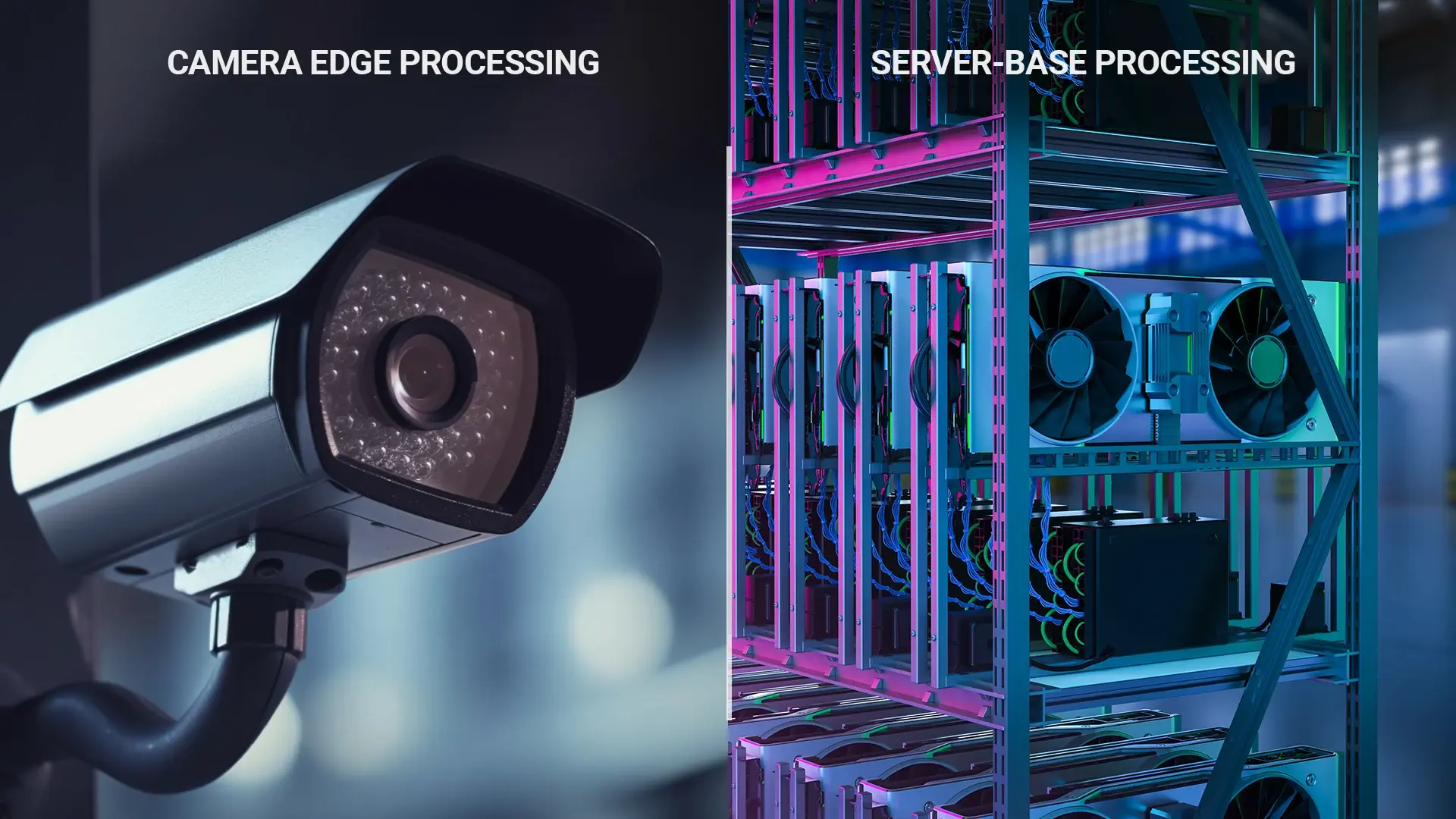
There are two honest places to run AI on a video feed, and the choice between them shapes almost everything else about a deployment, its cost, how it scales, how accurate it can be, and whether you have to replace your cameras to change your mind later. One puts the intelligence in the camera. The other puts it on a server. Both are legitimate, both win in real situations, and most of the marketing you will read about either one quietly omits what it gives up. This is an attempt to lay out the trade the way an engineer would, so you can tell which side of it your deployment actually sits on.
What the two approaches actually mean
Edge processing runs the model on a chip inside the camera, or on a small box bolted next to it. The camera looks at its own picture, decides what it is seeing, and sends out only the results, a detection, an event, a small piece of metadata, rather than the full video. Cameras built this way are common and good, and vendors like Axis, Hanwha Vision, and i-PRO ship capable lines of them.
Server-based processing does the opposite. The cameras stay ordinary, they simply produce video, and that video travels to a server with a GPU that analyzes many feeds at once. The intelligence lives centrally, on hardware you own and control, rather than in each lens. VIDIZMO AI Live Insight is built around this second approach: its own models run centrally, on GPUs you control. It is not, however, blind to the edge, and where cameras produce their own on-board analytics it can take those in as signals and fuse them with the central processing, a point worth its own section later.
They are not equals on every axis, though, and it is worth being honest about that. On raw capability the server is genuinely ahead, because a central GPU can run larger, more numerous, and more complex models than a low-powered camera chip has room for. Where the edge wins is not sophistication but placement: bandwidth, latency, and reach. So they make different trades rather than equal ones, and the right choice depends on what you are building and what you already own.
The case for the edge
The argument for edge processing is real and worth stating fairly, because for some deployments it is the better answer.
Because inference happens next to the lens, you never have to move the full video anywhere. Only the small results travel, so bandwidth stays low, and a camera at the far end of a thin rural link, a remote substation, a roadside pole, a border sensor, can still be intelligent without a fat connection back to a server.
Latency is minimal for the same reason, nothing has to travel before it is analyzed, which matters for the narrow set of jobs that must react in a handful of milliseconds. And capacity grows the moment you buy the camera, because every new unit arrives with its own processor, so you never have to size a central pool of compute against the size of the fleet.
For a greenfield deployment where you are purchasing cameras anyway, and especially one scattered across places the network barely reaches, edge inference is a reasonable and sometimes superior answer.
The latency question, honestly
You will hear that edge processing is faster, and it is, but it is worth being precise about whether that speed matters for what you are doing. Inference at the lens returns a result in a few to a few tens of milliseconds, with nothing to move first, while a server-based pipeline adds network transit and the wait to fill a batch, which can push it to tens or a couple of hundred milliseconds in total. That sounds like a large multiple, and for a machine-vision task on a production line that has to trigger a physical actuator the instant something happens, it genuinely is.
For surveillance and situational awareness, which is most of what these systems do, it almost never is. "Real time" there means a human or a downstream system reacts within a second or two of an event, and both approaches clear that bar with room to spare. The honest version of the latency argument is that the edge's advantage is real and usually irrelevant, and the rare case where it is not, a hard, fast, closed-loop control task, is exactly the case that also wants a single fixed model, which is the edge's home ground anyway.
The case for the server, and what it buys that the edge cannot
Server-based processing makes the opposite trade, and it is the right one whenever you already own cameras you would rather keep, or whenever the analytics you want are more than a single camera chip can do.
The first advantage is the one that saves the most money. Putting the intelligence in the camera makes the camera the thing you must replace in order to change the intelligence. Every model update, every new detection type, every improvement means new hardware, which turns "add AI" straight into "rip out and rebuild the estate." Server-based processing keeps the cameras ordinary and interchangeable, so the same camera you installed years ago becomes intelligent the day you attach a server to its stream, and stays useful through every future change to the models.
The second advantage is flexibility. Because the intelligence lives on a server rather than inside a fixed chip, you can run several models against the same feed at once, swap a model for a better one next quarter without touching a single camera, and fine-tune a detector on your own labeled footage to catch the things no general model would know, a specific unsafe behavior on a line, a part out of place, a step done out of order.
The third advantage is accuracy and depth. A server can load a larger and more accurate model than a camera chip has room for, and it can run the kind of multi-stage pipeline that a small edge processor simply cannot, detecting, then tracking, then classifying, then correlating an object across several cameras. Some of the most valuable scenarios are impossible at the edge for exactly this reason, and they only exist on a server.
The cost you accept in return is honest and concrete. You have to carry the streams across the network, and you have to size the GPUs to keep pace, which are real engineering tasks rather than afterthoughts. The companion piece on GPU capacity planning is about exactly that second task.
The trade-off, side by side
%20vs.%20Server-Based%20(Central%20GPU).webp?width=2074&height=1276&name=Edge%20(On-Camera)%20vs.%20Server-Based%20(Central%20GPU).webp)
The hidden costs of the edge
The edge's weaknesses are quiet ones, which is why they are easy to miss until you are living with them. The models are whatever the chip can hold, usually one or two fixed detectors, so the day you want a third detection type or a better model, you are back to a hardware project. Vendor lock-in is baked in, because the intelligence is tied to a particular manufacturer's camera, and switching means re-buying the estate.
And the tidy "one processor per camera" scaling story hides the fact that you are paying for a processor in every single camera whether it is doing hard work or easy work, where a central pool lets a smaller amount of compute be shared across many feeds that are rarely all busy at once.
None of this makes edge wrong. It makes it a commitment, and the commitment is easy to underprice on the day of purchase.
What breaks, and what you maintain
Two things that rarely make the sales conversation tend to decide how a deployment feels to run a year in. The first is how it fails. Edge failure is distributed and small, a camera dies and that one camera goes blind while the rest carry on, whereas server failure is concentrated, a server dies and every camera it was analyzing goes dark at once unless you have built in the redundancy and failover to catch it, which at scale you must. Neither is strictly better. They are different shapes of risk, and the server's shape is one you engineer around deliberately rather than hope about.
The second is how you maintain it. Improving an edge fleet means touching every device, a model pushed to, or a technician sent to, thousands of cameras, each one a small chance to go wrong. Improving a server-based deployment means updating the servers, a far smaller number of machines in a controlled place, and every camera benefits at once. Over the years that a system actually lives, the gap between updating thousands of endpoints and updating a handful of servers is not a footnote, it is a large part of what the thing costs to own.
The same logic runs through the hardware bill: the edge adds an intelligent chip to every camera whether that camera is doing hard work or easy work, while a central pool lets a smaller amount of shared compute cover many feeds that are rarely all busy at once, which is why edge tends to look cheaper on a small greenfield build and server tends to win decisively once the fleet is large and already installed.
What about hybrid
A reasonable question is whether you can have both: a light first pass on the camera to decide what is worth a closer look, and heavier analysis on a server for the frames that matter. You can, and AI Live Insight is built for exactly this. Its own models run centrally, on hardware you control, and where cameras already produce their own edge-analytics detections it consumes those as standards-based signals through the ONVIF analytics profile (Profile M, the open standard for streaming analytics metadata and events off a device) and folds them into that central processing.
The result is genuinely the best of both worlds: the edge does the cheap, low-latency first pass and cuts what has to travel, while the server brings the larger models, the multi-model pipelines, and the fine-tuning that a camera chip cannot hold. Because the bridge is an open standard rather than one manufacturer's SDK, this stays camera-agnostic while it does it, the edge becomes another signal the central layer can fuse rather than a separate architecture you are forced to choose instead.
Three deployments, three answers
Abstractions decide nothing, so here are three concrete situations and where each lands.
A utility monitoring remote substations across a wide rural service area, each site on a thin cellular link, is the edge's home ground. Moving full video back over those links is impractical, the job at each site is usually one fixed thing, and paying for a smart camera per location costs less than the connectivity would. Put the intelligence at the lens.
A city adding analytics to the thousands of cameras it already operates across intersections, parks, and buildings is the server's. The cameras exist and replacing them is out of the question, the analytics will grow over time from a couple of detections to many, and the footage already reaches central facilities. Attach servers and keep every camera.
A manufacturer covering its lines and loading docks wants PPE compliance today, unsafe-behavior detection next quarter, and cycle-time analytics after that, all on the cameras already installed, some of them fine-tuned to that specific plant. That growth and that fine-tuning are only possible on a server, so that is where it belongs.
The pattern across all three is simple: the more your cameras already exist, and the more you expect the analytics to grow or specialize, the more firmly you belong on the server side.
How to tell which side you are on
Strip away the marketing and the decision usually comes down to a few honest questions. Do you already own cameras you would rather not replace? That points to a server. Are your sites so remote or so starved for bandwidth that moving full video is impractical? That points to the edge. Do you need more than one or two simple detections, or the ability to improve the models over time, or accuracy that a small chip cannot reach? That points firmly to a server. Is there a single, fixed, latency-critical job on a brand-new camera in a place with no network? That is the edge's home ground.
Most real deployments, especially retrofits onto an existing fleet with analytics that will grow over time, land on the server side of that line, which is why AI Live Insight is built there. But the honest answer is that the two approaches are tools for different jobs, and knowing which job you have is the whole decision.
The wider view of where this choice sits, alongside ingestion, GPU sizing, the network, and everything else that has to hold at scale, is in Real-Time AI Video Analytics at Scale: The Systems Engineering Guide.
FAQ
Frequently Asked Questions
Should AI video analytics run on the camera or on a server?
It depends on what you already own and need. Edge processing (on the camera) wins for remote, bandwidth-starved sites with one fixed detection job, while server-based processing wins for existing camera fleets that need flexible, multiple, or evolving models, which is most real deployments.
Is edge AI processing faster than server-based processing?
Yes, edge inference returns a result in a few to a few tens of milliseconds versus tens or a couple hundred milliseconds for server-based processing. For surveillance and situational awareness, both are well within the one to two second reaction time that counts as real time, so the difference rarely matters in practice.
Do you need to replace existing cameras to add server-based AI analytics?
No. Server-based processing keeps cameras ordinary and interchangeable, since the intelligence runs on a GPU server rather than inside the camera. Edge processing, by contrast, usually requires replacing cameras with AI-capable hardware.
Can edge cameras and server-based AI analytics work together?
Yes. A hybrid approach lets edge cameras do a first pass and send their detections to the server over the ONVIF analytics profile (Profile M), where the central system fuses them with its own larger models. This combines the edge's low latency with the server's flexibility and model depth.
What are the hidden costs of edge-based video AI?
Edge cameras are capped to whatever detectors the chip can hold, usually one or two, so adding a new detection type means a hardware project. There's also built-in vendor lock-in, and you pay for a processor in every camera even when most aren't doing hard work at any given moment, unlike a shared server-based compute pool.
TopicsAI Live Insight

About the author
Farooq Khan is the co-founder and CTO of VIDIZMO, where he leads the engineering, product, and AI strategy behind its platform for making sense of unstructured media. He builds applied and generative AI that turns organizations' video, audio, images, and documents into searchable, governed, and usable intelligence at enterprise scale. Over the past 20 years, he has built systems that capture, scale, and now understand media, from voice logging platforms to large scale commerce to VIDIZMO's AI platform. He leads the product team that builds every VIDIZMO product, including Redactor, AI Intelligence Hub, AI Live Insight and the platform they all run on.
You may also like
What Is a Real-Time Crime Center? A Guide for Cities and Counties
Somewhere in the last two years, someone probably asked your department whether it should have a real-time crime ...

Staffing a Real-Time Crime Center When Software Does the Watching
Most chiefs who hear a pitch for a real-time crime center ask the same question before any other, which is whether they ...

RTCC, EOC or Situational Awareness Center: What Each Room Is For
Walk into a real-time crime center, then into a city's emergency operations center, and you will see much the same ...