Asking whether AI transcription is accurate enough for court is the wrong question, because accuracy is not a single number and the record is not a single artifact. AI transcription court record accuracy depends on what was recorded, in what conditions, in which languages, and above all on what happens to the output before anyone relies on it.
The question courts actually face is narrower and answerable: what threshold, on what material, with what review, produces something that can be certified. Legislators are now asking the same thing. The Research and Oversight of AI in Courts Act of 2026, introduced in March 2026 as H.R. 7997 and S. 4154, would require a 15-member judiciary task force on AI speech-to-text and automatic speech recognition in federal courts.
The guide to writing a court AI policy treats transcription as the most common institutional AI use in courts. This article covers whether it can carry the record.
Accuracy measured on courtroom audio, not clean speech
Published accuracy figures are usually measured on prepared audio, and courtrooms are not that.
The conditions that degrade recognition are all present: hard reflective surfaces, participants at varying distances from microphones, overlapping speech during objections, rapid exchanges, people speaking while turned away, and domain vocabulary that general models handle poorly. A system reporting high accuracy on clean speech may perform materially worse in a real courtroom, and the gap is not predictable from the published figure.
The only useful evaluation is on your own recordings, from your own rooms, including a difficult one rather than a showcase. Courts that evaluate on a vendor sample are measuring the vendor's audio.
A useful evaluation set is three recordings: a routine hearing in your busiest room, a hearing with a remote participant, and the worst-sounding recording your court produced last month. If a system performs acceptably on all three, the published figure is irrelevant. If it performs well on the first and poorly on the third, you have learned something the datasheet would never have told you.
What is achievable is worth knowing. A Philippine Supreme Court transcription pilot, run in the Sandiganbayan and 41 first- and second-level courts from July 2023 to September 2024, reported accuracy rising from 70 percent to as high as 95 percent, with time cut by half on average and up to 80 percent in some courts, across proceedings that mixed Tagalog and English, with human oversight retained throughout.
Speaker identification, which matters as much as words
A transcript that records the right words against the wrong speaker is worse than one with a few errors in the text, because it misattributes rather than merely mistakes.
Diarization performance depends heavily on capture. Separate audio channels for bench, counsel, and witness produce good separation. A single ambient microphone produces poor separation regardless of the processing applied. This makes speaker attribution a capture decision as much as a software one, which is covered in digital court recording after the stenographer shortage.
Mapping separated speakers to roles is a further step courts should specify. A transcript labeling participants as numbered speakers requires someone to identify them, and if that step is undefined it either does not happen or happens inconsistently.
Where error concentrates
Errors are not distributed evenly, and knowing where they cluster tells reviewers where to look.
Accented speech, multilingual proceedings, and code-switching produce elevated error rates. Proper nouns, particularly names and place names unfamiliar to the model, are frequently wrong. Numbers, dates, and figures are error-prone and consequential. Domain terminology may be rendered as a plausible common word. And the ends of long sessions can drift if alignment degrades.
A review process that reads uniformly will spend most of its attention where errors are not. A review process directed at these categories finds more in less time. Where proceedings run in more than one language, the language-access dimension is covered in language access obligations for transcription and translation.
The review step, and what certification means
This is where courts have to make a decision they often defer.
Machine output is a draft. Certification is a professional attestation that a transcript is a true and accurate record, and it is made by a person. What varies between courts is what that person does before attesting: full listen-through against the audio, targeted review of flagged and low-confidence sections, or something between.
Full review preserves the previous assurance level and captures a smaller share of the time saving. Targeted review captures more of the saving and depends on the flagging being reliable. Courts should choose deliberately rather than drifting, and should state the choice, because a certification whose basis is unclear is difficult to defend if challenged.
Two provisions make either model workable. Confidence indicators at passage level so reviewers can direct effort. And clear labeling of unreviewed output as a working draft rather than a transcript, so nothing uncertified circulates as though it were the record.
Logging what happened
For an artifact as consequential as the record, the processing history should be retained: the source recording, the model and version used, the output as generated, the reviewer, the time of review, and the changes made.
The differences between generated and certified versions are the useful part, because they evidence that review was substantive. Retention should follow the retention of the record itself.
How VIDIZMO DEMS fits
A note on where transcription actually lives, because it affects what a court buys. Speech-to-text is a platform capability rather than a separate product, and the same stack is available across VIDIZMO's products, AI Intelligence Hub included. The question is not which one can transcribe. It is where the transcript is going, and a transcript that has to carry the record is going somewhere specific. It is self-hosted by default, including in air-gapped deployments, which is what lets a court transcribe proceedings without the audio leaving its own environment. Courts under a residency constraint should confirm that during evaluation rather than assume it.
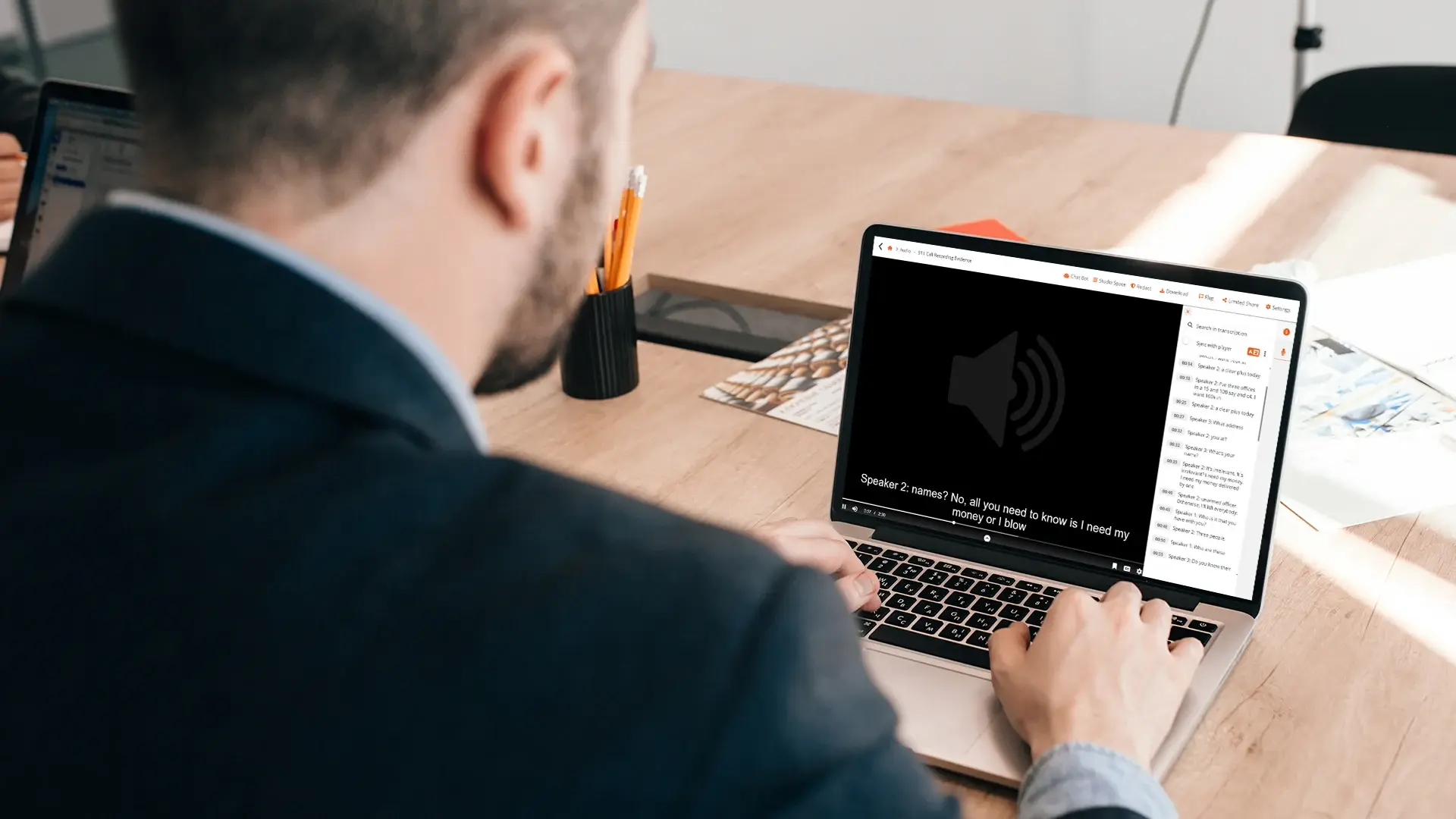
VIDIZMO's Digital Evidence Management System (DEMS) is where the transcript meets the record. Transcription runs across 82 languages with speaker diarization, producing timestamped output, which is what allows a reviewer to move between text and audio at a specific point. Automatic translation covers the resulting transcripts across 50+ languages. Search operates across transcripts, so verification against an earlier session is a query rather than a listen. Transcript export templates produce the certified artifact in linear, tabular, timestamped, or translated layouts. And because the transcript sits inside the evidence system, the processing history is retained on the same chain of custody and tamper-resistant audit log as the material it describes, which is what the logging section above asks for.
Where the review gate needs to be enforced rather than asked for, that sits in VIDIZMO AI Intelligence Hub, which can run the sequence as a workflow step the process cannot bypass: recording finalized, transcribe and index, draft transcript, then a named human who reviews before anything is certified.
Three limits stated plainly. Transcription is asynchronous, running after a proceeding rather than during it, so this is not live captioning. Passage-level confidence scoring on transcripts is a requirement to put to any supplier, including this one, rather than something to assume ships. And no platform certifies anything; certification remains a human professional act, and no product should be represented as performing it.
Deciding for your court
Evaluate on your own difficult audio, not a sample. Decide the review model and write it down. Require confidence indicators and use them to direct effort. Label uncertified output clearly. Log the processing and the review. And revisit the threshold once you have real data on where errors actually occur in your rooms, because the categories above are general and your court's will be specific.
Book a DEMS demo to test transcription, speaker diarization, and certified export against recordings from your own courtrooms.