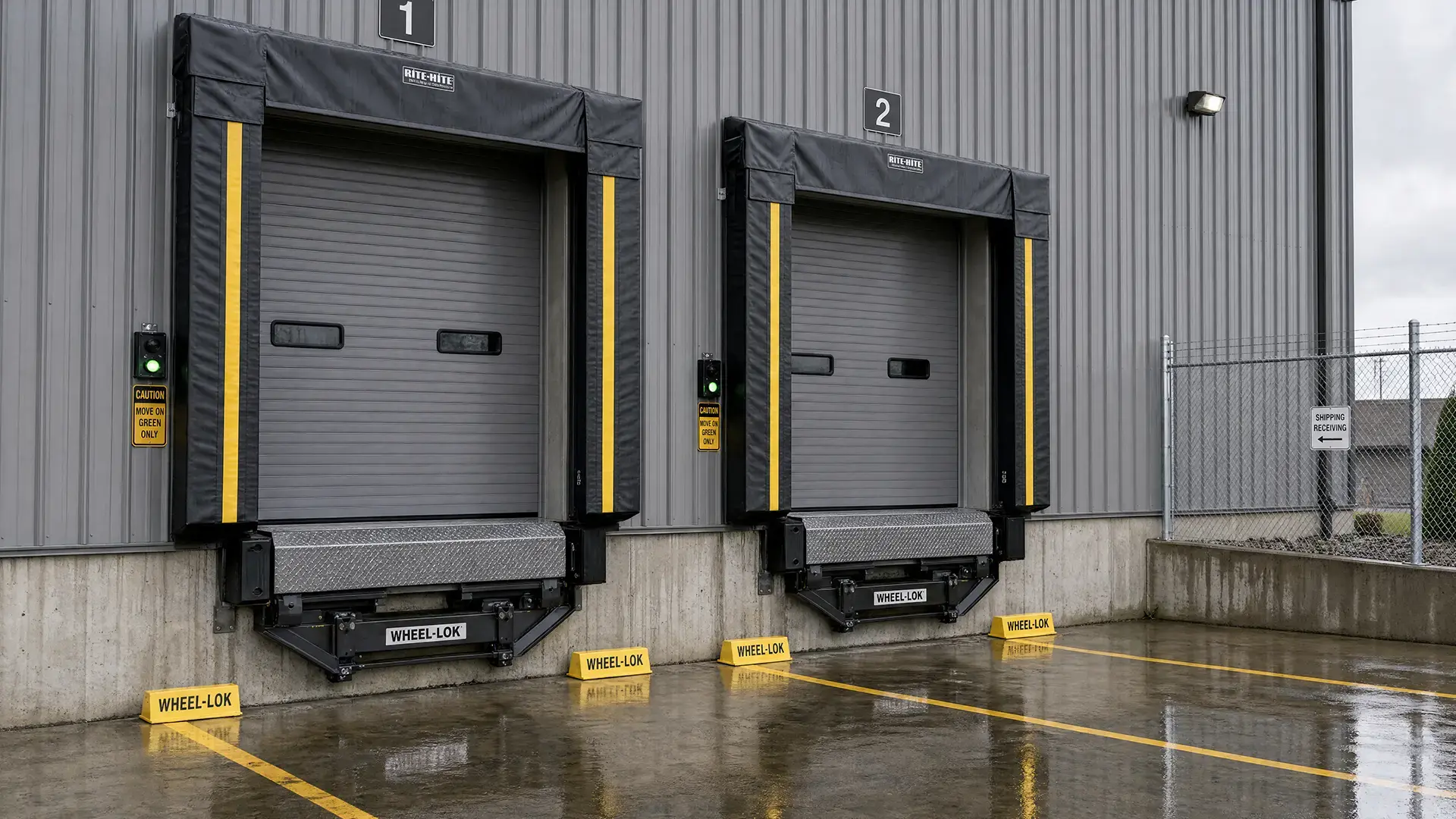
Consider the loading bay at a steel processor, where coils weighing more tons than anyone wants to think about are lifted, positioned, chocked, and strapped onto trailers, in a sequence written down precisely because deviation from it has killed people and destroyed cargo across the industry's history. Now consider how that sequence is actually verified at most operations: a checklist, completed by the crew that performed the work, signed by a supervisor who observed some fraction of it, filed against the possibility that anyone ever asks. The document says the procedure was followed. What actually happened at bay three at 2:14 is a separate question, and every operations director knows it, which is why the checklist system survives on a collective agreement not to look at it too hard. This article is about replacing that agreement with a record, using the cameras already pointed at the bays, and it extends our pillar guide to AI-powered video analytics for manufacturing.
Why signed checklists fail under pressure
The checklist's weakness is structural, not moral, and it mirrors the near-miss reporting problem this series examined on the safety side: the record is produced by the people under pressure, about their own work, after the fact. On a normal day, the gap between paper and practice is small and harmless. On the day the schedule is collapsing, three trucks are waiting, and the crew is short one person, the procedure's slow steps are exactly what gets compressed, and the checklist records the procedure anyway, because recording the deviation means explaining it. The system thus fails precisely under the conditions that make failure dangerous, which is the worst possible correlation for a control to have.
The external world increasingly declines to accept this arrangement. Insurers underwriting cargo and liability ask what evidence exists that securement procedures are followed per dispatch, not per policy. Regulators investigating an incident subpoena what records exist and draw conclusions from their nature. And customers whose cargo arrives damaged, or whose delivery was the one behind the incident on the interstate, litigate against whatever documentation the operation can produce. A signed checklist, in each of these rooms, is testimony. A timestamped visual record is evidence, and the difference prices itself.
Turning a written procedure into watchable events
A standard operating procedure is a sequence of observable states: the trailer chocked before loading begins, the spotter positioned during the lift, the coil seated in the cradle before strapping starts, the straps at their stations before the trailer moves, no person in the fall zone while the load is suspended. Each of those is the kind of fact this series has spent twenty articles teaching cameras to observe, and SOP validation is their composition.
The building blocks assemble from the established kit. Trained detection types recognize the domain's objects and states, the coil, the cradle, the strap configuration, the chock against the tire, per-engagement training on the operation's own footage, as everywhere in this series. Zone rules carry the spatial half: the fall-zone exclusion while a load is suspended is an intrusion rule with severity that pages, the spotter requirement is a presence expectation in a drawn area, the no-trailer-movement condition is a direction rule on the bay's exit. And sequence, the soul of an SOP, comes from the event stream's timestamps: strapping events before chock events, movement before securement completion, each a detectable ordering violation, evaluated over the recorded events, with the compound and cross-camera conditions handled by the correlation layer our article on correlating events across cameras and minutes describes.
What comes out the other end is the artifact the checklist pretended to be: a per-dispatch record, assembled automatically, timestamped throughout, with the deviations flagged and the footage attached. Compliant dispatches close with a clean event trail. Deviations raise alerts in the moment, to the supervisor who can still intervene, and land in the record either way, because the point is the record's completeness, not its flattery.
Live alerts versus recorded-sequence checks
SOP monitoring earns its keep twice, and the timing differs. The first payoff is live: the fall-zone entry during a lift pages immediately, detection on the stream as the event is tracked, because that alert is a safety alert in operations clothing and it gets safety-alert treatment, the same severity discipline the alert-fatigue article develops. The second payoff is the pattern: which steps get compressed, on which shifts, under which schedule conditions, visible in the aggregated deviation record the way near-miss patterns are visible on the safety side. Operations that read the pattern honestly tend to find the procedure itself has defects, the step that is always skipped because it is redundant with another, the sequence that fights the bay's physical layout, and revising the SOP against the evidence is a legitimate outcome, arguably the system's highest use. A procedure that survives contact with its own compliance record is a procedure the operation can defend anywhere.
The sequenced-analysis layer runs at the cadence this series has been consistent about: violations composed from recorded events arrive seconds to minutes behind the live moment, not within it, and the live page is reserved for the single-detection conditions, the zone entries and presence absences, that the live pipeline evaluates directly. An operation should know which of its SOP conditions live in which tier, and a vendor should be able to say so per condition without being pressed.
The same approach for other industrial procedures
The loading bay makes the cleanest example because its procedure is dramatic, but the decomposition, procedure into observable states into watchable events, generalizes to most of the SOPs an industrial operation runs. Tanker loading and unloading at chemical sites: bonding connection before flow, spotter presence, exclusion zones during transfer, each a presence or zone fact. Die and mold changes: lockout state visible, crane rigging sequence, personnel clear of the swing path, the same grammar. Batch charging in process industries: the order of additions, the presence of the second operator the procedure requires, the dwell at the verification step that operators under pressure are tempted to compress. Receiving inspection: the quarantine placement that is supposed to precede putaway, visible as a dwell-in-zone fact. In each case the method is identical, walk the written procedure with the people who perform it, mark which steps are observable states, instrument those, and be honest in the gap log about which steps are not observable, because the unobservable residue, torque values, verbal confirmations, judgment calls, defines where the visual record ends and other verification continues. Operations that run this decomposition on three or four of their highest-consequence procedures end up with something they did not set out to build: an inventory of which of their controls are verifiable at all, which is worth having independent of any camera.
Reading the deviation trend
A quarter of deviation data answers the question every operations director should ask before believing their own procedures: where does compliance decay under pressure? The trend by shift, by schedule condition, by crew size, is the operational analogue of the near-miss map on the safety side, and it points budget with the same specificity. Deviations that cluster when trucks queue point at scheduling, not discipline. Deviations that vanish when a particular supervisor rotates in point at supervision capacity. Deviations concentrated in one step, across all shifts, indict the step. The record thus functions as a stress test of the operation's real capacity to follow its own rules, run continuously and free, and the operations that treat it that way, fixing the conditions that generate compression rather than prosecuting the compressions, get both the compliance rate and the workforce trust moving in the same direction, which no checklist regime has ever achieved.
Workforce agreements matter even more here
Procedure monitoring watches people performing work more directly than anything else in this series, and the governance stakes rise accordingly. The commitments the worker-privacy article develops apply at full strength, and one addition earns its place in the written agreement: deviation review is procedure-focused by default, meaning the weekly review examines steps and conditions, not crew members, and individual footage reaches a disciplinary context only through the narrow, listed exceptions every honest agreement carries. The strongest version enlists the crews in the procedure-revision loop, because the people compressing a step under schedule pressure are the world's leading experts on why that step invites compression, and a record that visibly feeds procedure fixes rather than write-ups converts the workforce from the system's subjects into its editors. Operations that skip this conversation get the outcome the safety articles predict: the cameras acquire blind spots, and the record quietly hollows.
Insurers, courts, and customer audits
The dispatch record's audience extends past the operation's own walls, and its handling should be designed for that from day one. Insurer conversations change character when securement compliance is a queryable, evidence-backed rate rather than an assertion, the same shift the safety-Key Performance Indicator (KPI) article describes for underwriting generally. Incident litigation, the trailer that shed its load fifty miles away, meets a per-dispatch trail with footage, and meets it under the evidence-handling discipline this series specifies everywhere: clips in the Nexus portal under access control, views and exports logged, integrity verifiable, holds applied the day an incident is known, per the practice in our recordkeeping article. And customer audits, increasingly common up the supply chain, find an operation that can demonstrate its procedures rather than describe them, which has won contracts in industries where every bidder's brochure says the same things.
Training the domain detection types for a bay is more tractable than the quality-inspection cases this series covers, and buyers should know why: the objects are large, the stations are fixed, the states are few, and the operation performs the procedure dozens of times a week, which means representative footage accumulates fast and the labeled-sample burden is modest. A bay's set of detection types typically trains from a few weeks of ordinary operation plus a staged session covering the states the period happened not to produce.
The question of who reviews deviations deserves an explicit answer in the program design, because SOP records create review obligations the checklist never did. The working split assigns the live pages to the shift supervisor, the weekly deviation review to the operations and safety leads jointly, since loading-bay procedures serve both masters, and the quarterly trend review to the director level, where the procedure-revision decisions and the resourcing calls live. Left unassigned, the record accumulates unreviewed, and an unreviewed compliance record is a liability dressed as a control, which is the one outcome worse than the checklist it replaced.
How VIDIZMO fits
VIDIZMO AI Live Insight runs SOP validation on the cameras already covering the bays, reading standard Real-Time Streaming Protocol (RTSP) and ONVIF (Open Network Video Interface Forum) streams, processing on the operation's own hardware on site. Domain detection types are trained per engagement on the operation's own footage and stay customer-isolated; zone, presence, and direction rules are drawn per camera with severity that separates the page-now conditions from the record-and-review ones; sequence and compound conditions evaluate over the recorded event stream; and every dispatch accumulates its timestamped trail with clips preserved in the Nexus portal under access control and retention. Deviation events flow to the operation's systems by REST API and webhook, and the reporting layer turns the record into the rates and trends the insurer and the operations review both consume.
A closing note on scope discipline: resist the temptation to instrument every step of every procedure at once. The decomposition exercise will surface twenty observable states per SOP, and the deployment that tries to watch all of them inherits twenty tuning problems and an alert channel nobody trusts. The steps worth instrumenting first are the ones whose compression appears in the operation's own incident and damage history, usually three or four per procedure, and the rest can join as the record proves which deviations actually correlate with loss. The SOP monitoring program, like the procedure it watches, works best when it does a few consequential things reliably.
The pilot that proves this is one bay, one procedure, one month: the SOP decomposed into its watchable states, the record run silent beside the existing checklists, and the two compared at month's end. The gap between what was signed and what was seen is the business case, stated in the operation's own footage, and no slide deck argues with it.