This session is presented by Nadeem Khan, founder and CEO of VIDIZMO, and Sean Dalal, Director of Business Development, who works with townships and police departments across Pennsylvania. VIDIZMO is an enterprise AI company based in Tysons, Virginia, with more than a hundred customers in production. Today's session is called From the Moment It Happens to the Moment It's Released. At AI in Action 2026, Ann Gergen of AGRiP gave the frame for this whole session.
She said we are good at keeping records, because the law makes us, but bad at keeping the why. And she named two biases that get in the way: recency, overweighting what just happened, and anchoring, holding on to an old reference point. As Ann put it, if we have a knowledge retention gap, AI is our solution. Ann gave us a layer cake.
The bottom layer is operational, and she named public records responses and police surveillance in it. That's where we'll spend the next twenty minutes. The second layer is AI built into governance, two to three years away. The third is disruption, where cities become platform operators.
And her warning was: don't get stuck on the bottom layer. So everything you'll see runs on one platform, in your own environment, so what you build this year feeds the next two layers. Meet Janet. Janet is the only open records officer in a small township.
On a Friday evening, Linda Whitfield is struck by a car in the lot behind the township building. By Monday, her daughter Emma has one question: what happened to my mother? By Tuesday, Janet has three requests on her desk and a five-day clock on each. This July, a Pennsylvania borough paid the maximum penalty over camera footage it couldn't account for, and counties around us raised taxes by up to 19 percent.
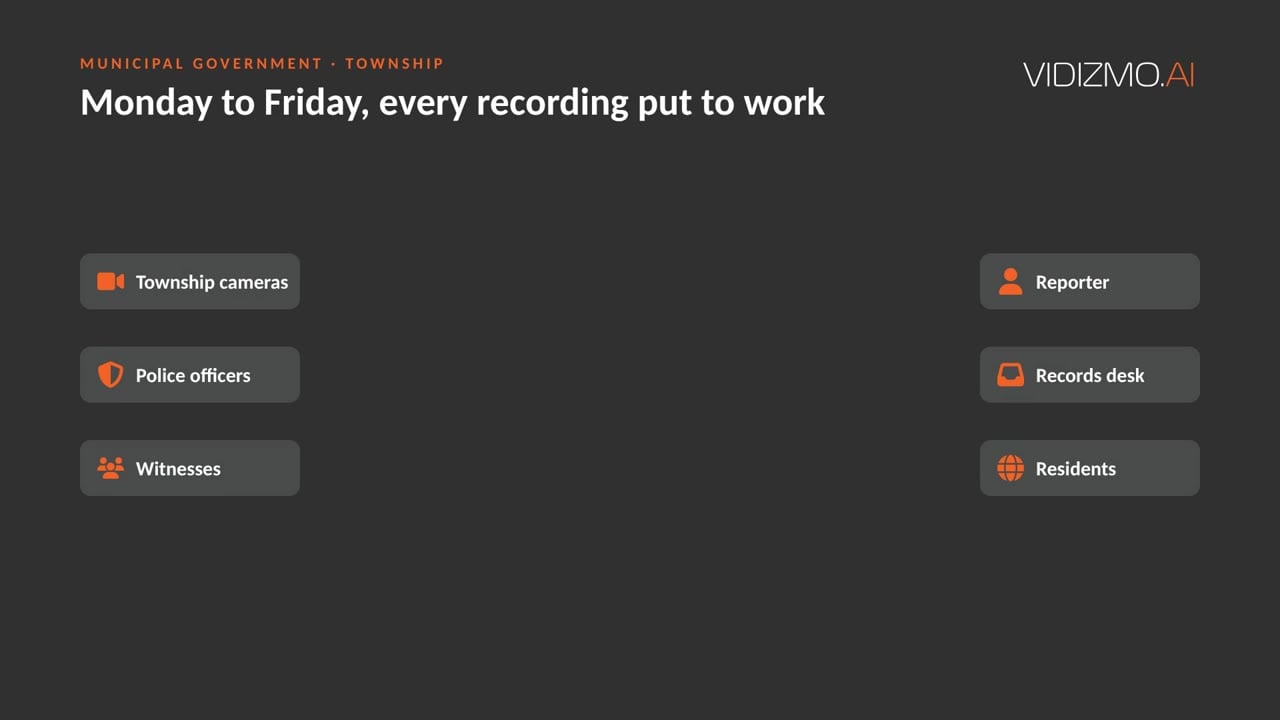
So, how many of you have been Janet? Here is how that township answers it, in five steps: Watch, Keep, Understand, Release and Share. One incident now pours in from every system your township runs: body cams, lot cameras, 911, the report, the email thread, the council recording. And the requests stack up.
VIDIZMO connects to 156 systems, 91 available today and 65 on request. The pressure is highest where the stakes are highest: the five-day clock, police video, penalties, claims, council meetings and resident privacy. Let's follow one incident in the Township of Valley Brook through five steps. Step one, Watch.
AI Live Insight runs on the cameras the township already has. The lot camera flags the incident, alerts dispatch, and saves the clip before the first officer arrives. Steps two and three, Keep and Understand. On Tuesday the reporter's request lands.
One search finds the lot camera, the body cam moment, the report page, the September lighting email and the council meeting where a resident raised it. Step four, Release. Redactor blurs a bystander and a child, blacks out personal details in the report, and a reviewer on your staff approves each one. Step five, Share.
Approved records go out as secure links that expire when you decide, with a record of who opened what. And two weeks later, the council recording is searchable to that exact moment. Janet answered all three requests with two days to spare, and Emma saw what happened to her mother, with every bystander protected. But think about your last incident.
How many systems held a piece of it, and how many belong to someone else? Let's go deeper into the evidence, from the first camera to the courtroom. One incident leaves a trail across a dozen systems: a 911 call, body cams, a doorbell, a plate reader. Each holds part of the story.
None holds all of it. The hard part isn't collecting video. It's everything after. Different formats, systems that don't talk, clocks that disagree.
Hours of review, faces and names to redact, and every step on trial. Meet Alex, the lieutenant who runs evidence and records for a township police department. We'll follow one case, from the first camera to the courtroom. It starts with the cameras the township already has: the municipal building, the rec center, the parking lot and the street.
Each joins one library with a stream address and a name. No new hardware. Alex builds rules without code. On the street camera, Alex draws a zone and sets a wrong-direction check.
Each camera also learns what normal looks like, so unusual activity, like a fire, is flagged where nobody wrote a rule. In the operations center, cameras with active alerts rise to the top. Every alert is saved with its clip, searchable by camera, type and time, and ready to become evidence. Then a 911 call: a car coming and going from a house on Elm Street at all hours.
The case opens from the dispatch record, with the incident number, time and location carried over. The department's own evidence flows in next: body-worn cameras, in-car video, county 911 audio and the records system. Whatever the vendor, it lands in the case, by connector, API or bulk import. Partners send what they have by secure link: a public works camera, a plate reader at the township line, a neighboring department, a witness's doorbell.
No accounts to create, no discs to burn. Every file is logged and fingerprinted on arrival. The original stays untouched, and a viewing copy is made for playback. If anything ever changes, the record shows it.
Each recording is transcribed, translated, chaptered and summarized, so Alex can read a body cam in minutes instead of watching it for an hour. Now triangulation. Every source snaps onto one clock. The doorbell runs four minutes fast, so it's corrected once.
The plate read, the street camera, the doorbell and the 911 call line up into one account. Alex asks the whole case: is the car in the 911 call the same car on the street camera? Yes, with the plate read and the clip as proof. And where sources disagree, the contradiction is flagged for the Brady check.
Before anything leaves, faces in the body cam are covered, names in the 911 audio are bleeped and personal details in the report are blacked out. Every box and every bleep is reviewed, then logged. The case goes to the district attorney through a secure link that expires. The neighboring department sees only the clip it needs.
Chain of custody and the audit log account for every action. It runs in government cloud, on your own servers or fully disconnected, on a CJIS Security Policy-aligned architecture. And it serves more than police: council meetings, Right-to-Know requests, code enforcement. For the IT directors here, the real question is how all of this connects, without new hardware and without a new login for every partner who sends you a file.
This next case is a hit-and-run with evidence in nine partner systems. Watch the three ways in. Tuesday, six-eighteen p.m., in Millbrook Township. A dark SUV hits a cyclist on Main Street and drives off.
The cyclist is hurt. The evidence is everywhere. The evidence already sits in nine partner systems: body cams, in-car video, the 911 recorder, CAD, plate readers, a store camera, a doorbell, EMS and county detectives. There are three ways in, and one place to land: APIs and connectors, bulk import, and secure links, all into VIDIZMO Nexus.
Body and dash camera files sync through the API, each with its metadata: officer, device, time, place and incident number. That's how every file finds the right case. The dispatch record and a plate read follow and attach to the case. Documents, data and images are evidence too, kept beside the video and audio.
The 911 recorder export arrives as one batch, and each recording is logged as it lands: who imported it, from where and when. Businesses and residents get secure upload links. The hardware store and a neighbor send their video, no thumb drives to collect, and every file lands in the case with its source. County detectives send a secure download link from their canvass.
Their files join the case with the source recorded, so the chain starts at the partner. Fifteen files from every source now sit in one case: video, audio, documents and images, filed and treated the same way. Every recording is transcribed, translated and summarized. A caller's Spanish becomes English: a dark SUV hit a cyclist and went north toward Route 29.
One search for dark SUV finds every mention, across 911 transcripts, body cam audio, the CAD record and the canvass notes. The sergeant asks the whole case which recordings show the SUV, and when. The answer points to the store camera, the doorbell and the gas station, with a cracked headlight and a partial plate. Fifteen files on one timeline.
From the impact to the plate read eight minutes later, every source lines up to the second. The key moment is clipped as its own evidence, always linked back to the original store video. The next week, requests arrive from a reporter, the cyclist's attorney and an insurer. Nothing leaves until it's redacted.
Redactor covers bystanders' faces and an uninvolved plate, bleeps the caller's name and number, and blacks out personal details in the report. Nothing is redacted blind. Each detection is reviewed and logged, and requests are routed by department, each with its own rules. Evidence goes out through expiring secure links: the full case to the district attorney, discovery to defense counsel, redacted copies to county detectives.
The chain of custody starts at the partner system, and the audit log records every view, download and share. Six people, one case. The sergeant, the 911 supervisor, the store owner, the detective, the prosecutor and the township manager each got what they needed from the same record. One incident touches more people than any of us expect: the IT director, the lieutenant, the 911 supervisor, a resident with a phone, the prosecutor and the manager.
This last story is told through all six of them. Friday, 9:40 p.m., in Millbrook Township. A car turns the wrong way onto Ridge Road. This story is a dramatization.
It crashes and catches fire. Residents film on their phones, 911 takes the calls, and officers arrive with body cameras on. Collecting recordings is the easy part. Each one lands in a different system, with its own login and its own export.
The hard part is everything after: footage from a dozen systems, hours of review, bystanders to protect, and every step has to hold up in court. Let's follow one incident through five stages: Watch, Keep, Understand, Release and Share. Sam, the township's IT director, connects the cameras it already has to AI Live Insight. Each needs only a stream address and a name.
Lieutenant Alex Rivera draws a zone and sets a wrong-direction rule, with no code. When the car crosses it, the alert fires and the clip is saved. Cameras with active alerts rise to the top. Seconds later, the fire is flagged as unusual activity, each alert saved with its clip.
In VIDIZMO Nexus, one case holds it all: the alert clips, body and dash video, the incident report and three 911 calls. Maria filmed the fire from her porch. A secure link reaches her phone, she uploads her video, and it lands in the case, logged. The alert, the 911 calls, Maria’s video and the body cameras line up on one timeline, to the second.
By Monday the crash is all over social media, and records requests arrive from a reporter, an insurance attorney and a neighbor. Faces are covered in the video, names and addresses are bleeped in the 911 call, and fields are blacked out in the report. Nothing is redacted blind. Every box is reviewed, every redaction logged, and each request routed by department.
Evidence goes to the prosecutor and the defense through a secure link with an expiry date, not burned to a disc. Every file carries its chain of custody: who viewed, downloaded or shared it, from where and when. sends calls to the case, not a disc. Maria's name stayed private.
Alex has one record, Priya gets the chain of custody, and Karen answers the public faster. None of this asks you to replace what you already run. VIDIZMO connects to 156 systems, 91 available today and 65 on request, from body cameras and records systems to Microsoft 365 and your meeting platforms. One county public safety agency measured the change after six months.
Video releases went from 62 days to 7, and overdue requests went from 75 to 3. And you buy it the way you already buy. VIDIZMO builds and supports the platform, and the partners and contract vehicles you use today deliver it, in your cloud, on your own servers, or fully disconnected. Emma got the truth about what happened to her mother.
Janet met her deadline and went home on time. And the township kept the public's trust. Here's the next step. Visit the VIDIZMO table today and bring one request you handled this year; we will run it with you.
Pennsylvania's Local Share Account grant is open through November 30th. VIDIZMO will help you apply. Scan the code on screen to download this deck, the videos and the use cases. Nadeem Khan and Sean Dalal are at the VIDIZMO table in the Centennial Ballroom all day.
Thank you.