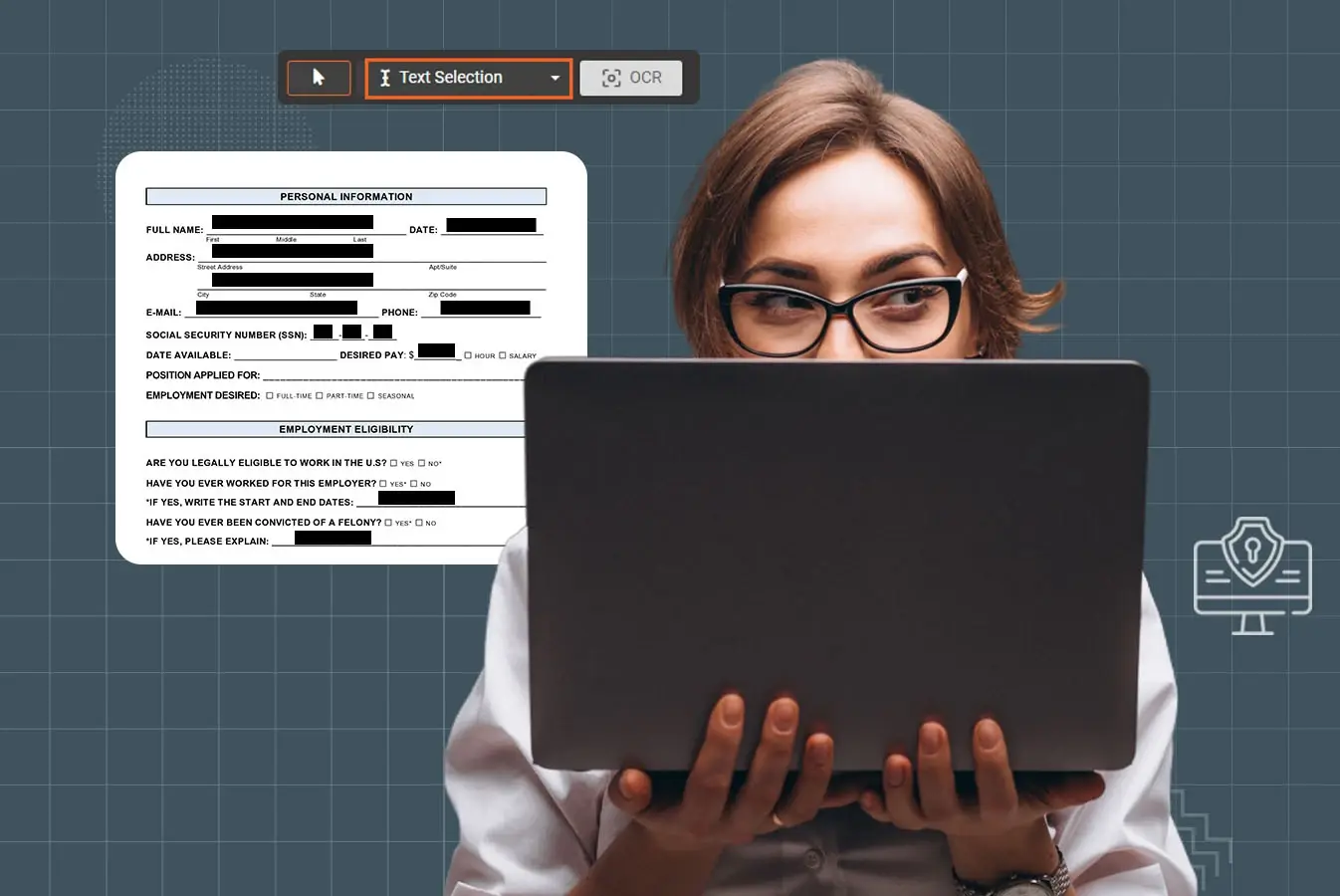
Protecting sensitive data is crucial for compliance and privacy. This blog explores PII redaction software, how it helps organizations safeguard Personally Identifiable Information (PII), and the importance of compliance with global data protection laws like GDPR, HIPAA, and CCPA.
Imagine filling out an online form with your full name, email address, and social security number: only to realize later that this data is being stored and shared without adequate security. With 87% of people failing to protect personal information, such data remains vulnerable to unauthorized access, misuse, and even regulatory fines.
As reliance on digital information grows, so does the volume of Personally Identifiable Information (PII) flowing across industries. From government agencies handling ID records to businesses managing customer details, PII is collected, processed, and stored unprecedentedly.
However, this data can be misused without proper safeguards for identity theft, fraudulent transactions, and financial fraud.
To address these risks, regional and cross-border privacy regulations such as GDPR, HIPAA, and CCPA enforce strict measures to ensure organizations responsibly handle PII. Failure to comply can result in hefty penalties and reputational damage.
This is where PII redaction software plays a crucial role. Organizations can protect personal data, ensure compliance, and prevent unauthorized access by automatically detecting and redacting sensitive information in videos, documents, and transcriptions.
What is Personally Identifiable Information (PII)?
PII, or Personally Identifiable Information, is any data that can be used to identify a specific individual. Examples of PII include but are not limited to driver's license numbers, social security numbers, addresses, full names, etc.
PII isn't limited to apparent identifiers like the ones above; it also extends to data fragments that could reveal an individual's identity when combined with other datasets.
What are the types of Personally Identifiable Information (PII)?
Personally Identifiable Information falls into two categories: Sensitive PII and Non-Sensitive PII.
Sensitive PII consists of personal data that, if leaked or stolen, could significantly harm an individual. It is not publicly available and is subject to strict data protection regulations.
Social Security number (SSN), among other identifiers like driver's license numbers, passport numbers, and government-issued I.D. numbers, is an excellent example of sensitive data.
Non-sensitive PII refers to personal data that, when leaked or stolen in isolation, is less likely to harm an individual. It may or may not be unique to a person and is often made public.
For example, a social media handle would be a non-sensitive PII. It could identify someone, but a malicious actor couldn't commit identity theft armed with only a social media account name. Other examples of non-sensitive PII include zip code, race, gender, etc.
It's important to note that the classification of PII as sensitive or non-sensitive can depend on context.
Data sensitivity may change based on how information is used, combined, or disclosed. A full name may be non-sensitive, but a list of people who have visited a particular doctor would be sensitive.
Similarly, a person's phone number may be publicly available, but a database of phone numbers used for two-factor authentication on a social media site would be sensitive PII.
And if you are wondering, "Is all personal data considered PII?" No, it is not; for instance, someone's Netflix usage is not considered PII because identifying an individual based on this data is hard, if not impossible.
What do privacy laws say about PII?
According to McKinsey, 75 percent of countries have implemented data privacy laws governing PII collection, retention, and use.
In the United States, organizations follow guidelines from the National Institute of Standards and Technology (NIST) to protect Personally identifiable information.
Here, PII means any information that can be used to determine who someone is, including names, social security numbers, birth dates, and even unique physical characteristics. It also covers any data that, when combined with other information, can identify a person, like health records or financial details.
In the European Union, a directive called 95/46/E.C. defines personal data as any information that can tell you who a person is. This includes I.D. numbers or details about a person's physical, mental, or social identity.
In Australia, the Privacy Act of 1988 sets out rules for handling PII, giving people the right to know why their information is being collected and who will have access to it.
This law is based on the Information Privacy Principles (I.P.P.s), which guide how the government and businesses can collect and use PII in Australia.
What is PII redaction Software?
PII redaction software automates concealing sensitive information that, if exposed, could identify an individual or entity. AI-powered detection identifies personally identifiable information (PII) in documents, videos, and audio and applies blurring, pixelation, or redaction overlays to protect its integrity.
By leveraging PII redaction software, organizations can efficiently detect and redact sensitive data across various media formats, ensuring compliance with privacy regulations while preventing unauthorized data exposure.
Why is PII Redaction Software Important?
The need for PII redaction software has become more critical than ever due to the exponential growth of personal data collection and storage in the digital age. Organizations across industries handle vast amounts of personally identifiable information (PII), making data privacy and security a top priority.
Now, more than ever, individuals and businesses know the risks associated with PII exposure and demand responsible and secure data handling. Subjective information can be misused without proper safeguards, leading to legal consequences and compliance violations.
This is why implementing PII redaction software is essential to:
- Ensure Privacy and Security: By automating PII redaction, organizations can prevent unauthorized access and disclosure of sensitive data, crucial in legal proceedings where confidential information could become public.
- Meet Compliance Requirements: Data protection laws such as the California Consumer Privacy Act (CCPA), Health Insurance Portability and Accountability Act (HIPAA), General Data Protection Regulation (GDPR), and Freedom of Information Act (FOIA) enforce strict measures to safeguard PII integrity.
By integrating PII redaction software, businesses can efficiently detect and redact sensitive data across documents, videos, and transcriptions, ensuring compliance while protecting individual privacy.
How to Perform PII redaction?
Personally identifiable information can be redacted manually, or AI-backed PII software can be used for automatic redaction.
Manual redaction
Here are some key aspects of manual PII redaction:
- Human Oversight: Manual redaction relies on human judgment and expertise. Trained personnel review documents or data to identify and redact PII, such as social security numbers, addresses, and names.
- Accuracy and Precision: Human reviewers can exercise discretion in identifying and redacting only the necessary information, ensuring that legitimate data remains intact.
- Control: Manual redaction offers a high level of control, making it suitable for handling complex documents or unique cases where automated tools might struggle.
- Time-Consuming: This method can be time-consuming, especially for large datasets or extensive documents, and may not be scalable for organizations with substantial PII redaction needs.
Automatic Redaction
A.I. detects faces, objects, PII information, and other elements present in a video or audio file and conceals it.
Here are the key features of automatic PII redaction:
- Speed and Scalability: Automatic redaction tools can quickly process vast amounts of data, making them ideal for organizations with high-volume PII redaction needs.
- Consistency: Automation ensures consistent redaction, reducing the risk of human error or oversight.
- Pattern Recognition: These tools use pattern recognition and machine learning to identify PII, consistently finding and redacting information.
Read more about Automatic Redaction or Manual Redaction: Which One's Better?
Best tool for PII redaction: VIDIZMO Redactor
Want a combination of both Manual and Automatic redaction? VIDIZMO Redactor is the right choice for you.
It is an AI-backed PII redaction software that allows autonomous and manual redaction to ensure no personally identifiable information is left behind.
If a media file includes transcribed content, the system will automatically detect and redact PII information within the media playback and its associated transcription file when uploaded to the VIDIZMO redactor portal.
Besides that, VIDIZMO Redactor enhances efficiency with bulk document redaction, allowing PII to be detected and redacted across multiple files in just one click.
And that is just the tip of the iceberg; several features, bells, and whistles make your life easy.
For a full comparison of PII redaction software and how to evaluate one, see our guide to PII redaction software.
Final Thoughts: Why PII Redaction Software is Essential for Data Protection
In an era where personal data flows across digital platforms, organizations must proactively safeguard personally identifiable information (PII). Implementing PII redaction software ensures that sensitive data remains protected, reducing the risk of compliance violations and unauthorized exposure.
Businesses can secure documents, videos, and transcriptions by automating PII redaction while meeting regulatory requirements such as GDPR, HIPAA, and CCPA. Whether handling bulk redaction or specific data masking needs, VIDIZMO Redactor provides a seamless and efficient solution.
FAQ
Frequently Asked Questions
What is personally identifiable information (PII)?
Personally identifiable information (PII) is any data that can identify a specific person, either on its own or when combined with other information. It ranges from obvious identifiers like a name, social security number, or passport number to quasi-identifiers like a date of birth or ZIP code that can single someone out when combined.
What are examples of PII?
Direct examples include full name, social security number, passport or driver's license number, email address, phone number, and biometric data such as fingerprints or facial images. Indirect or quasi-identifiers include date of birth, ZIP code, gender, race, and IP address, which can identify a person when combined with other data.
What is the difference between sensitive and non-sensitive PII?
Sensitive PII, such as a social security number, financial account, health record, or biometric data, can cause serious harm if exposed and usually requires stronger protection. Non-sensitive PII, such as a name or ZIP code, is often publicly available on its own but can become identifying when combined with other data.
What privacy laws protect PII?
Major frameworks include the EU's GDPR, the California Consumer Privacy Act (CCPA) and CPRA, HIPAA for health information in the US, and sector or country-specific rules elsewhere. They set requirements for how PII is collected, stored, shared, and, where required, redacted or deleted, with penalties for mishandling.
TopicsRedactionRedactorSecurity and ComplianceCIO and IT Leadership

About the author
Moazzam Iqbal is a Product Marketing Executive at VIDIZMO covering digital evidence management, enterprise video solutions, and AI-powered technology. He focuses on helping public safety agencies and government organizations make informed decisions about evidence and video infrastructure.
You may also like
Fire and Smoke Detection as a Second Set of Eyes in Schools
Let the first sentence of this article do the compliance work: nothing described here replaces, modifies, or competes ...
Weapon Detection in Schools: Detection, Verification, Response
No school safety technology carries more emotional weight than weapon detection, and no school safety technology is ...
School Safety Grants: What the Money Can Buy
School safety improvements have a funding problem that is really a sequencing problem: the need is continuous, the ...