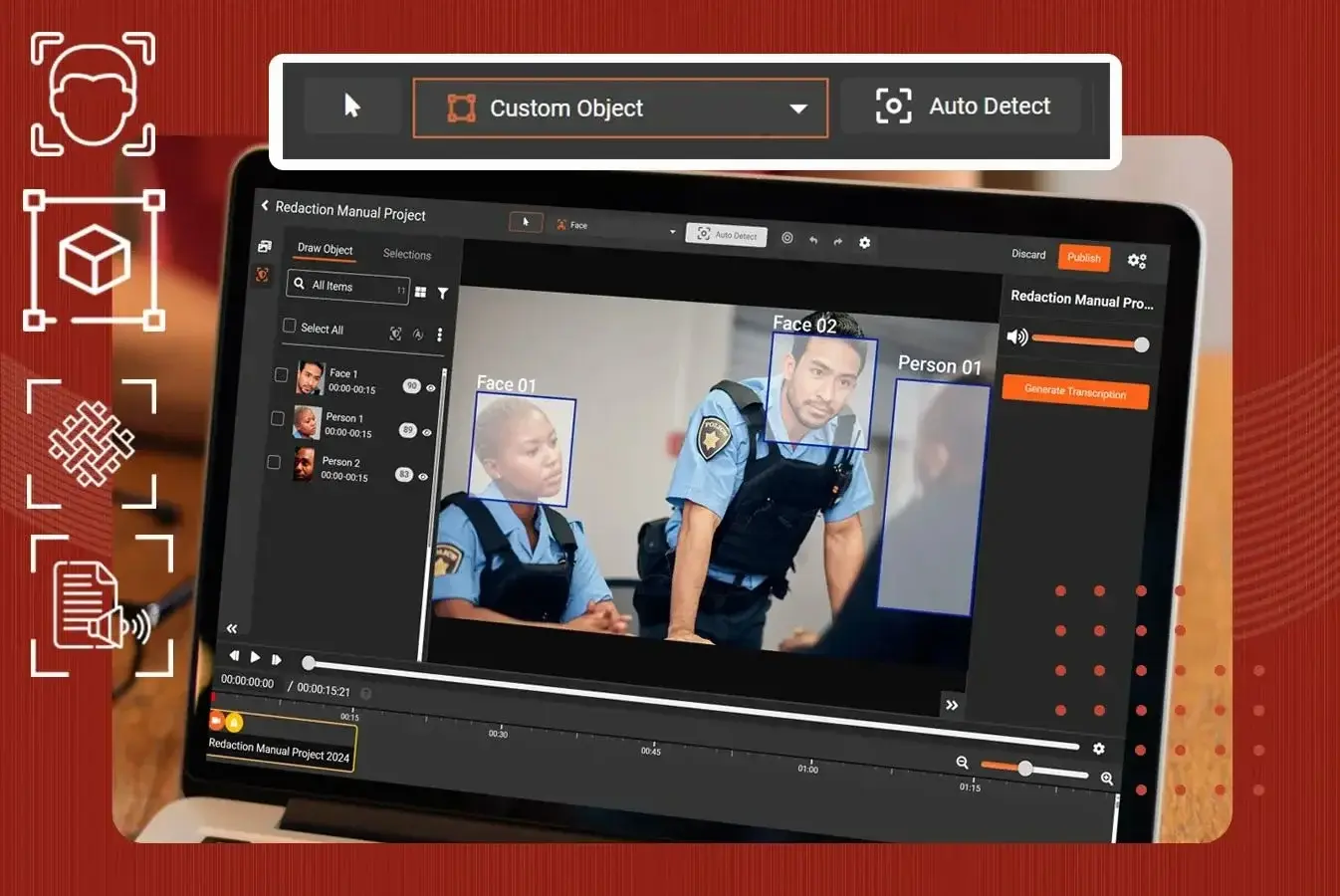
Redacting sensitive information from digital evidence is no longer optional — it’s a legal and operational necessity.
From body-worn cameras and CCTV footage to mobile recordings and surveillance systems, organizations today handle massive volumes of video containing Personally Identifiable Information (PII). Faces, license plates, addresses, weapons, and even spoken names must often be concealed before public release.
This is where automated redaction and manual redaction come into play.
But which one is better?
In this guide, we’ll break down:
- What automated redaction really means
- How it compares to manual redaction
- Where each approach works best
- Why hybrid redaction is becoming the industry standard
What Is Automated Redaction?
Automated redaction is the use of artificial intelligence (AI) and computer vision technologies to detect and conceal sensitive elements in video, audio, or images without frame-by-frame human intervention.
Modern automated redaction systems can detect:
- Faces and people
- License plates
- Vehicles
- Weapons
- Screens and documents
- Logos
- Text using OCR (Optical Character Recognition)
- Spoken PII using speech-to-text analysis
Instead of manually drawing bounding boxes across every frame, AI models automatically identify objects and track them throughout the video.
The result? A significantly faster redaction workflow — especially for high-volume digital evidence environments.
How Automated Video Redaction Works (Step-by-Step)
Understanding the workflow helps clarify where automation excels and where human validation is still required.
1. Video Ingestion
The file is uploaded into a redaction platform (cloud, on-premises, or hybrid environment).
2. AI Object Detection
Computer vision models scan each frame to detect faces, objects, license plates, or custom entities.
3. Object Tracking
Once detected, AI tracking algorithms follow the object throughout the video — even if it moves, changes angle, or partially exits the frame.
4. User Review & Validation
A human operator reviews detections to:
- Confirm accuracy
- Remove false positives
- Add missed detections
5. Redaction Application
The user applies:
- Blur
- Pixelation
- Opaque box masking
6. Export & Audit Logging
The redacted file is exported while maintaining metadata and audit trails.
This workflow is especially valuable in environments processing hundreds or thousands of videos per month.
Manual Redaction: Maximum Control, Maximum Effort
Manual redaction involves a user reviewing each frame of a video and placing bounding boxes over sensitive elements.
Because a human evaluates each frame:
- Contextual understanding is higher
- Accuracy can be extremely precise
- Edge cases are better handled
However, manual redaction presents significant challenges:
- Extremely time-consuming
- Not scalable for large data volumes
- High labor cost
- Risk of human fatigue errors
- Slows investigations and compliance response
For example, redacting one hour of body cam footage manually can take several hours depending on complexity.
In high-volume digital evidence environments, this quickly becomes operationally unsustainable.
Where Automated Redaction Struggles
While AI-powered redaction has advanced rapidly, it is not flawless.
Common limitations include:
1. Low-Quality Footage
Most real-world footage comes from:
- CCTV cameras
- Body-worn cameras
- Mobile phones
- Dash cams
These often have:
- Low resolution
- Motion blur
- Poor lighting
- Obstructions
AI detection accuracy can drop in such conditions.
2. False Positives
AI may:
- Detect objects that resemble faces
- Mislabel patterns as license plates
- Duplicate detections
3. Missed Edge Cases
Unusual angles, partially visible objects, or obstructed elements may not be detected.
This is why fully unsupervised automated redaction is rarely recommended for sensitive use cases.
Accuracy Comparison: Automated vs Manual Redaction
| Factor | Manual Redaction | Automated Redaction |
|---|---|---|
| Speed | Slow | Very Fast |
| Scalability | Low | High |
| Labor Cost | High | Lower |
| Accuracy (High Quality Footage) | Very High | High |
| Accuracy (Low Quality Footage) | High | Moderate |
| Fatigue Risk | High | None |
| Compliance Support | Manual tracking | Automated audit logs |
Automated redaction dramatically improves speed and scalability, while manual review strengthens accuracy in complex cases.
The Hybrid Redaction Approach: The Industry Standard
Instead of choosing one over the other, many organizations now adopt a hybrid redaction workflow.
This combines:
- AI-based automated detection
- Human validation and correction
The benefits:
- Faster processing times
- Higher final accuracy
- Reduced workload
- Improved compliance confidence
AI handles repetitive detection tasks, while humans focus on reviewing and refining results.
This model is particularly valuable in:
- Law enforcement agencies
- Government bodies
- Legal teams
- Corporate compliance departments
- Public records offices
The future of redaction is not AI replacing humans — it is AI assisting them.
Compliance Considerations in Redaction
Redaction is often tied to regulatory and legal obligations, including:
- CJIS compliance (law enforcement data handling)
- GDPR (European privacy regulation)
- HIPAA (health information privacy)
- FOIA responses
- Public records laws
Automated redaction systems that support:
- Audit logs
- Encryption (e.g., AES-256)
- Role-based access controls
- Secure file handling
help organizations maintain chain-of-custody and data protection standards.
Security in Automated Redaction Platforms
When handling digital evidence, security is critical.
Enterprise-grade redaction tools should provide:
- Encryption at rest and in transit
- Secure cloud or on-premises deployment
- Access control policies
- Detailed audit logs
- Version control for overwritten files
Security and compliance features are just as important as detection accuracy.
Does the Market Offer Hybrid Redaction Tools?
Many tools in the market provide either:
- Manual-only redaction
or - Fully automated redaction
However, fewer platforms allow:
- Automated detection
- Manual corrections
- Single-iteration refinement
- Multi-file batch processing
- Integrated evidence management
Some enterprise digital evidence platforms now combine AI detection with manual validation workflows to support scalable and compliant redaction operations.
For example, VIDIZMO’s Redaction Tool integrates:
- AI-powered face, object, and license plate detection
- Active object tracking across frames
- Manual correction capabilities
- Metadata tagging for enhanced search
- Secure SaaS, cloud, or on-prem deployment options
The tool is available both as:
- A standalone redaction solution
- An integrated component of a Digital Evidence Management System (DEMS)
This integrated approach supports organizations managing high volumes of sensitive digital evidence.
When Should You Choose Automated Redaction?
Automated redaction is ideal when:
- Processing large volumes of footage
- Responding to public records requests
- Redacting routine CCTV releases
- Reducing labor-intensive workflows
- Accelerating investigations
Manual-only redaction may be preferred for:
- Extremely sensitive court-bound evidence
- Ultra-low quality footage
- Unique or complex visual scenarios
However, in most modern digital evidence environments, a hybrid workflow provides the best balance of efficiency and accuracy.
Enterprise-Grade Automated Redaction: A Closer Look at VIDIZMO Redactor
As redaction demands increase across law enforcement, public safety agencies, legal teams, and enterprise compliance departments, organizations require more than basic AI detection. They need a solution that combines automation, security, scalability, and compliance controls in one unified platform.
VIDIZMO Redactor is designed specifically for high-volume digital evidence environments where both speed and accuracy are critical.
AI-Powered Automated Detection
VIDIZMO Redactor uses advanced computer vision models to automatically detect:
- Faces and individuals
- License plates
- Vehicles
- Weapons (pistols, rifles, etc.)
- Custom objects
- On-screen text
Detected elements can be redacted in a single action using:
- Blur
- Pixelation
- Opaque masking
The system also supports object tracking, ensuring detected elements remain redacted throughout the entire video even when moving across frames.
Hybrid Workflow: Automation with Human Validation
Unlike many tools that offer either manual or automated redaction, VIDIZMO Redactor supports a true hybrid workflow.
Users can:
- Review AI detections
- Modify bounding boxes
- Remove false positives
- Add missed elements
- Apply redaction after validation
This ensures higher accuracy while still dramatically reducing redaction time compared to manual-only workflows.
Built for Digital Evidence & Compliance
Redacting sensitive footage is often part of:
- FOIA responses
- CJIS-regulated evidence handling
- Court submissions
- Internal investigations
- Public disclosure requirements
VIDIZMO Redactor is built with compliance and security in mind:
- AES-256 encryption (at rest and in transit)
- Role-based access controls
- Audit logs for chain-of-custody tracking
- Secure SaaS, government cloud, commercial cloud, or on-prem deployment
- FedRAMP-compliant environment through partnerships
This makes it suitable for government agencies and regulated enterprises.
Batch Processing & Scalability
For organizations processing hundreds or thousands of files:
- Multiple videos can be processed simultaneously
- Automated detection accelerates redaction workflows
- Files can be saved as new versions or overwrite originals
- Metadata tagging improves search and retrieval
This significantly reduces investigation timelines and operational bottlenecks.
Flexible Deployment Options
VIDIZMO Redactor is available as:
- A standalone automated redaction solution
- An integrated module within VIDIZMO’s Digital Evidence Management System (DEMS)
- An add-on to EnterpriseTube Video Content Management (EVCM)
- API-enabled integration into RMS or CMS systems
This flexibility allows organizations to embed redaction directly into their existing workflows.
Who Is VIDIZMO Redactor Best For?
- Law enforcement agencies
- Federal and state government departments
- Legal teams handling sensitive evidence
- Public safety organizations
- Enterprises managing confidential surveillance footage
In environments where privacy, compliance, and operational efficiency intersect, AI-assisted redaction tools like VIDIZMO Redactor provide a balanced approach between automation and human oversight.
You Can Start Your Free Trial Today - No Credit Card Needed

Final Verdict: Automated vs Manual Redaction
There is no universal winner.
- Manual redaction provides maximum control.
- Automated redaction provides maximum scalability.
- Hybrid redaction provides the optimal balance.
As digital data continues to grow exponentially, organizations need redaction workflows that are fast, secure, compliant, and accurate.
AI-assisted redaction with human validation is quickly becoming the standard approach for modern evidence management.
TopicsArtificial IntelligenceRedactionRedactorSecurity and Compliance
About the author
Nabeel Ali is a Senior Product Analyst at VIDIZMO, with five years at the company. An engineer by profession, Nabeel works on audio, video and DICOM redaction in Redactor, and has also worked on AI Intelligence Hub and AI Live Insight. The role sits where customers and engineering meet: hearing from customers, customer success, and the sales and marketing teams what goes wrong in real deployments, then working with the engineers until the product answers it.
You may also like

What Is a Real-Time Crime Center? A Guide for Cities and Counties
Somewhere in the last two years, someone probably asked your department whether it should have a real-time crime ...

Staffing a Real-Time Crime Center When Software Does the Watching
Most chiefs who hear a pitch for a real-time crime center ask the same question before any other, which is whether they ...

RTCC, EOC or Situational Awareness Center: What Each Room Is For
Walk into a real-time crime center, then into a city's emergency operations center, and you will see much the same ...