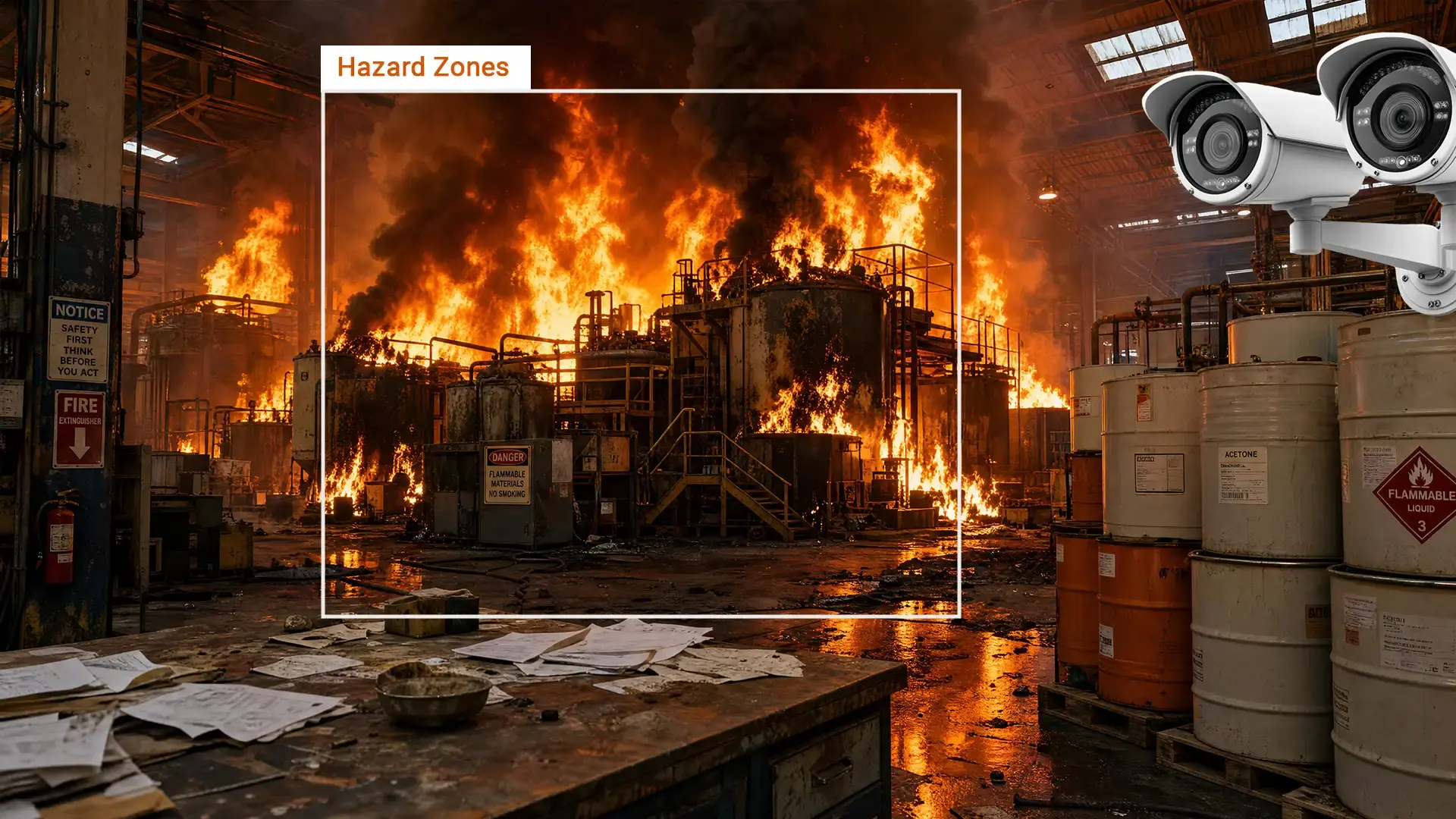
The dangerous places in a factory are almost never secrets. Everyone on the floor knows the robot cell is live, knows the area behind the stamping press is off limits during operation, knows the electrical room is badge-access for a reason. The plant painted the yellow lines, hung the signage, ran the training, and documented all of it. What the plant cannot do, on any budget that survives review, is post a person at each of those boundaries around the clock, and so the enforcement of every marked hazard zone in the building depends on the least reliable control in the hierarchy: people remembering, while busy and behind schedule, not to take the shortcut. This article covers what changes when the cameras already watching those areas are taught where the lines are, and it belongs to our wider guide on AI for workplace safety in manufacturing.
Guarded machines still leave unguarded areas
The regulatory baseline for this territory is set at the machine level. The Occupational Safety and Health Administration's (OSHA) machine guarding standard at 29 CFR 1910.212 requires that "one or more methods of machine guarding shall be provided to protect the operator and other employees in the machine area from hazards such as those created by point of operation, ingoing nip points, rotating parts, flying chips and sparks," and where the point of operation exposes anyone to injury, it "shall be guarded." Physical guarding, light curtains, and interlocks answer that requirement at the machine, and nothing in this article replaces any of them. Machine guarding sat at number ten on OSHA's most frequently cited standards for fiscal year 2025, with lockout/tagout at number four, which says plainly enough that the machine-level controls are still failing often enough to keep enforcement busy.
But a large class of incidents happens in the space around the machine rather than at its point of operation. A worker steps over the chain into the robot's envelope to clear a fault without locking out. A contractor unfamiliar with the site walks through a crane's swing radius. Someone props open the electrical room door during a busy changeover and three people who were never arc-flash trained wander through by the end of the shift. The physical guards did not fail in any of these. The boundary around them did, silently, and the site learns about it only if the outcome is bad enough to force a report.
The four zone rule types
The naive version of zone monitoring alerts whenever a person appears in a marked area, and it fails for the same reason motion-detection emails fail: presence is usually legitimate. The operator belongs at the machine. The maintenance crew belongs in the electrical room. A useful zone system has to express the difference between being somewhere and being somewhere wrongly, and that takes more than one kind of rule.
Four rule types cover most of what a factory needs. An intrusion and line-crossing rule fires when an object enters a restricted region or crosses a drawn line in the direction the arrow points, which is the tool for robot cells, press perimeters, and any boundary where entry itself is the event, with direction mattering because walking out of a cell is recovery while walking in is the emergency. A loitering rule fires when an object stays inside a zone beyond a set dwell time, which distinguishes the person walking through a transit aisle from the person who has stopped in it, and catches the unauthorized visitor lingering at a machine they have no business at. A crowd rule fires when the count of a target type inside a zone exceeds a capacity, which enforces occupancy limits in confined or rated spaces without a supervisor counting heads. A direction rule fires when movement runs against the expected flow, which is how one-way pedestrian routes around blind corners become enforceable rather than advisory.
Each rule is drawn as a polygon or line on a frame from the camera itself, names its own target type, and carries its own severity, so one camera can run a person-intrusion rule on the robot cell and a vehicle-direction rule on the aisle beside it without the two interfering. Tracking underneath ties an object's time in a zone into one continuous stay, which is why a worker pausing at the boundary reads as one event rather than a burst of entries and exits.
Two limits are worth knowing before any zones get drawn. A zone lives on one camera, so a restricted area covered by three cameras is three zones that fire independently rather than one merged region, and the coverage plan should account for that. And zone rules govern what the cameras can see, which makes camera placement the real design decision: a zone drawn on a poorly angled view inherits every occlusion in it.
Tuning decides whether the system gets trusted
A zone deployment produces its worst impression in week one, and knowing why saves the project. Default thresholds fire on the forklift driver leaning out near a line, on the operator whose legitimate work brushes the polygon's edge, on the second shift's slightly different material path that nobody mentioned during commissioning. None of this means the system is broken. It means the map does not yet match the territory, and the fix is a few deliberate weeks of adjustment rather than a vendor change.
The practical sequence that works: run the first two weeks in a log-only mode where events are recorded but nobody is paged, and review the log with the supervisors who know the floor. Redraw the polygons that are catching legitimate work, and it is normal to redraw most of them once. Set dwell thresholds from what the log shows about real transit times rather than from guesses. Raise severity zone by zone as each one proves quiet, so the alert channel earns trust gradually instead of demanding it. A site that skips this and turns on paging everywhere at once teaches every supervisor to ignore the system by Friday, and that lesson is expensive to unteach. Our companion article on alert fatigue goes deeper on the thresholds themselves.
There is also an organizational step that outranks any threshold. Every zone needs an owner who answers its alerts, named per shift. A robot-cell intrusion alert that goes to a distribution list belongs to nobody, and the response time will show it.
Contractors and visitors deserve a separate line in the tuning plan, because they break the assumption every threshold quietly makes, which is that the people in frame know the site. A contractor crew doing a week of work inside a normally restricted area will light up an intrusion zone continuously unless the zone is scheduled around the permit, and a visitor group on a plant tour will trip dwell rules that were calibrated for people who walk with purpose. The mature pattern is to tie zone scheduling to the permit-to-work process, so a live hot-work permit suspends paging for its area while leaving logging on, and the record still shows who was inside the boundary and when. That preserves the evidentiary value while sparing the pager, and it makes the monitoring system an extension of the permit system rather than a rival to it.
Example: commissioning a robot cell
Abstractions hide the work, so here is what bringing a single robot cell under zone monitoring actually looks like, step by step, with the decisions a site has to make at each one.
The cell has a physical perimeter, an interlocked gate, and one camera mounted for general surveillance that happens to see most of the enclosure and the approach aisle. The first decision is whether that camera's view is good enough, and the honest review checks three things: whether the boundary that matters is visible along its whole length, whether the approach side workers actually use is in frame, and what the occlusions are when the cell is loaded, because a zone drawn on an empty-cell view can be half blind once fixtures are in place. In perhaps a third of real cases the answer is that the camera needs repositioning or a second view, and finding that out during commissioning costs a bracket and an afternoon, while finding it out during an investigation costs considerably more.
The second decision in the commissioning sequence is the rule set itself. An intrusion polygon covers the enclosure interior, target type person, at a severity that pages immediately, because entry while the cell is capable of motion is the emergency this whole exercise exists for. A line-crossing rule along the gate approach, direction arrow pointing inward, gives an earlier and softer signal, someone heading toward the boundary, at a severity that logs rather than pages. A dwell rule on the approach aisle catches the pattern that precedes most deliberate entries, a person lingering at the boundary working up to the shortcut, and its threshold gets set from two weeks of observed transit times rather than from anyone's guess. Three rules, one camera, three different severities, and the difference between them is what keeps the paging channel meaningful.
The third decision is ownership and response, which is organizational. The cell's intrusion alert pages the area supervisor and the cell technician on shift, both named, with the snapshot attached so the responder knows whether they are walking toward a contractor who wandered or an operator clearing a jam with the machine live. The log-only events go to the weekly safety review, where the dwell and approach patterns get read as what they are, a measure of how often the boundary is tested. When the maintenance window opens and the cell is locked out, the monitoring stays on, and entries during lockout are expected and logged against the permit, which quietly builds the record that the lockout procedure is being followed, or the record that it is not.
That is the whole commissioning story for a single cell. It generalizes almost mechanically to press perimeters, electrical rooms, and crane radii, and the commissioning discipline is identical: verify the view, layer the rules by severity, name the owners, and let the log teach you the thresholds before the pager does.
What the event history is good for
The live alert is what sells zone monitoring, but sites that run it for a quarter usually find the record matters more. Every zone event lands on a timeline with its clip preserved around the moment, footage from before the trigger through after the event ends, and that archive answers questions the live alert never could.
Some of those questions turn out to be about the plant's own layout. A zone that fires constantly for legitimate reasons is the floor telling you its layout is wrong, that the marked boundary and the actual workflow disagree, and sites regularly discover that the safe path and the practical path diverge in ways the original layout never anticipated. Fixing the layout beats endlessly excusing the alerts. Some questions are about exposure: near-miss counts by zone, trending by shift, are exactly the leading indicators a safety program lacks when it runs on self-reported data alone. And some questions arrive after an incident, when the investigation needs to know not just what happened Tuesday but how often the same boundary was crossed in the ninety days before, which is the difference between an isolated act and a documented pattern. What that record implies for citations and for insurers cuts both ways, and it is covered honestly in our article on investigating workplace accidents from camera footage.
How VIDIZMO does it
VIDIZMO AI Live Insight adds zone intelligence to the cameras a plant already owns rather than requiring new AI-enabled hardware, and processing runs on site, close to the cameras, which is where a continuous live-analysis workload belongs for latency reasons alone. Zones are drawn directly on each camera's frame, the four rule types each carry their own target type, dwell parameters, severity, and color, and a rules designer lets more complex conditions be authored on a canvas and published to a camera when several detections need to combine into one alert. Detections raise alerts, land on the event timeline, and trigger event-based recording in one motion, and the clips are kept in the VIDIZMO Nexus portal the deployment works alongside, under its access control and retention policy, so a zone event is reviewable evidence rather than a line in a log.
The pilot shape that produces the fastest learning is narrow and real: two or three genuinely hazardous zones, log-only for two weeks, then paging on as each zone earns it. By the end of that cycle a site knows its false-alarm rate, its real crossing frequency, and whether its painted lines were ever where the work actually happens.