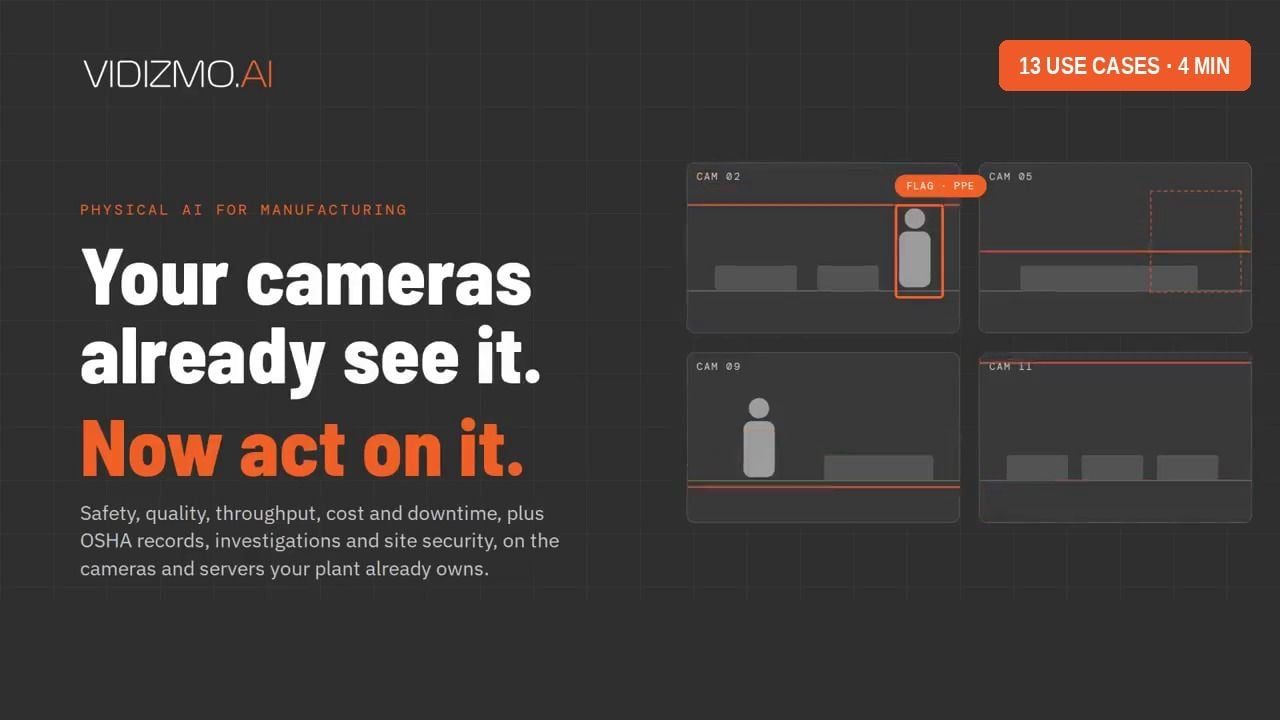
Your plant already has cameras on the floor, at the docks and in the yard. Here's what happens when AI watches them for you, for safety, quality and uptime. The problem is simple. There are more cameras than people to watch them, so footage gets pulled after something goes wrong. A single serious OSHA citation can cost more than sixteen thousand dollars. And every incident still ends in a report that someone writes by hand. And safety is only one number. The same cameras can move quality, throughput, cost and downtime. Meet Sam, the safety manager at a three-shift plant. Let's follow Sam's day. It starts with the cameras already on the wall. Here's the camera library: the factory floor, the machine area, the forklift zone and the yard. To add a camera, Sam enters its stream address and a name. No new hardware, and nothing leaves the plant's own servers. Next, Sam decides what each camera should watch for. This is the rule builder. The factory floor camera feeds an object detector, then a wrong-exit check, then an alert that saves a recording. A second rule watches the outdoor camera for anomalies. Sam drags the blocks into place. No code. Some risks don't fit a rule. So the object library records what each camera normally sees: people, vehicles and objects, at their usual times and places. That becomes the camera's baseline, and anything that breaks the pattern gets flagged. Now the shift begins. The operator dashboard shows the whole camera fleet. Cameras with active alerts sit on top, and the feed on the right lists each one: no hand protection, no safety vest, camera tampering. Open a camera, and you see what the AI sees. On the machine floor, it tracks each person. Outside, it flags unusual activity. In the warehouse, it checks for hard hats and vests, live, while the shift runs. And every flag is kept. The alerts dashboard is the record. Each alert has its time, camera, severity and the clip behind it, so Sam can pull up last night's PPE flags without scrubbing through hours of footage. Quality is different. Every product is different, so quality checks are trained. Here's how that looks. The check is trained on the plant's own good and bad parts. As parts pass the inspection camera, good ones go through, and a missing label, a scratch or the wrong cap color is flagged, with the clip saved for the quality team. Training starts with images of your own parts, good and bad. A trained check takes about thirteen to fifteen weeks, so a pilot starts with one product at one station. PPE, restricted zones, fire and smoke work from day one. The same cameras can watch standard work and downtime. If an operator skips the torque step, that cycle is flagged. If Line Two stops, the stop is flagged with the infeed clip attached, so maintenance sees the jam instead of guessing. That's live monitoring. Now, what happens after an incident, in Intelligence Hub. Recordings from Warehouse Camera Two are stored in VIDIZMO Nexus. Sam asks for a PPE compliance review, and gets each group of workers listed with timestamps, what they were wearing, and the standard that applies. Footage from other sources can be uploaded too, like this clip from Rack Aisle C. Sam asks for a compliance review. Intelligence Hub describes the climb and the fall, gives the timestamps, links each finding to the 29 CFR standard, and rates the severity. Sam reviews every finding before anything is filed. To make this repeatable, Sam turns it into an agent. The agent holds ready-made prompts: PPE compliance, forklift and pedestrian safety, restricted zones and walkways, housekeeping and exit routes. Then Sam picks a workflow for it to run, like the Safety Incident Video Analyzer. That workflow analyzes the clip, assesses each finding and checks its confidence. Low confidence goes to a person. Imminent danger and serious cases are tagged, routed and alerted, then published as an incident record. The recordkeeping workflow reads the incident document, pulls out the Form 301 facts and applies the recordability test. It drafts the 300 log and 301 entries, files the case and alerts EHS, with a person approving every draft. Cameras are one input. Gas and temperature sensors, vibration monitors, PLC and SCADA signals, wearables and badge readers can feed the same workflows. When a sensor raises an event, the workflow pulls footage from the cameras covering that spot at that moment, and builds one incident record: the reading, the clip, the finding, and who owns it. Each source connects through an API, webhooks, or a connector built for your site. So Sam's team sees problems while they're happening, keeps the proof, finds causes faster and writes less by hand. Across safety, quality, throughput, cost and downtime, on the plant's own cameras and servers. Start with a free AI-readiness assessment. Pick one line and two to four existing cameras, and see it flag on your own video.