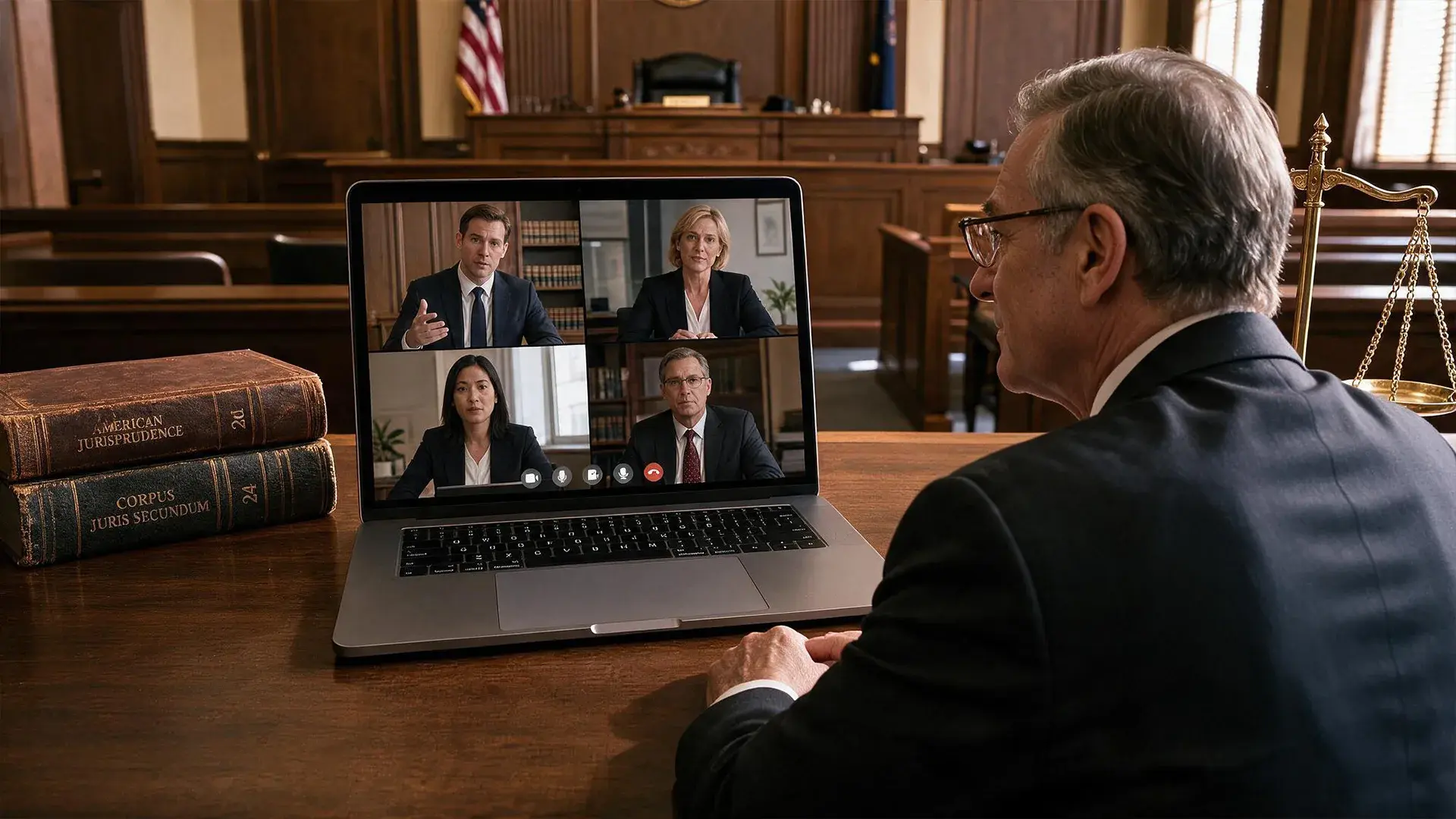
A firm of two thousand attorneys running on Teams and Zoom produces hundreds of recordings a month without anyone deciding to. Client intake calls, internal strategy sessions, CLE presentations, practice group updates, lateral onboarding, and the all-hands where the managing partner explained the merger. Those recordings sit in whichever cloud made them, under whatever retention that tool applies by default, searchable by whoever happens to have the link.
Nobody chose that arrangement, and it is why the question of a legal video platform usually arrives without anyone having set out to buy one. It is what happens when recording becomes free and governance does not follow. They are not shopping a category. They have accumulated something and then found out it is ungoverned.
This guide covers what a firm actually accumulates and where it currently sits, why privilege changes the requirements rather than merely adding to them, the three distinct buyers inside legal who each want something different, and where a platform stops being able to help. It is written for the IT director or CIO who will own the system, the knowledge management lead who will be asked to make it useful, and the professional development and communications people who generate most of the content.
The recordings exist whether or not anyone manages them
Start with what is already on the ground, because it is the reason this question comes up at all.
Zoom keeps recordings in its own cloud under its own retention. Teams puts them in the recorder's OneDrive or a channel's SharePoint, which means access follows whoever pressed the button rather than the matter the call concerned. A CLE session recorded for the associates who missed it lives in a folder somebody made. This is not a fringe posture any more: ILTA's 2025 Technology Survey, covering 580 firms and more than 152,000 attorneys, puts firms answering "mostly in the cloud" or "cloud with every upgrade" at 88 percent. None of this is misconduct and none of it is unusual; it is the default behavior of the tools, and the default is per-user rather than per-matter.
The problem that follows is not storage cost. It is that the firm now holds a body of recorded material with three properties it did not choose: no consistent retention, no access model tied to how the firm is actually organized, and no way to find anything inside a two-hour file. A recording that cannot be searched is a file rather than knowledge, and a file nobody can find is indistinguishable from one that was never made.
That last point is what turns this from an IT tidiness exercise into something worth funding. The material a firm most wants to keep, the reasoning behind a position rather than the document that resulted from it, is exactly the material that only exists in recordings. It was never written down because writing it down would have cost an expert an hour and saved a stranger ten minutes, which is the reason knowledge management in a legal department fails more often than it succeeds. Recording changed that arithmetic without anyone planning it, which is worth sitting with: the expensive part of capture already happened, as a side effect of how the firm now works.
Privilege is a design constraint, not a compliance checkbox
Every enterprise video platform will tell you it has access controls. In a law firm the interesting question is not whether access can be restricted but whether restriction can be proven and whether it holds against search.
ABA Model Rule 1.6(c) states the duty as an affirmative one: a lawyer "shall make reasonable efforts to prevent the inadvertent or unauthorized disclosure of, or unauthorized access to, information relating to the representation of a client." Comment [18] then declines to name any technology, giving five factors instead: the sensitivity of the information, the likelihood of disclosure absent safeguards, the cost of additional safeguards, the difficulty of implementing them, and whether they would make the technology harder to use.
Two things follow that firms routinely miss. Because the standard is reasonable efforts rather than a guaranteed outcome, no product can be bought as compliance, and any vendor implying otherwise has misread the rule. And because reasonableness is judged on the effort, the analysis has to exist in writing before anything goes wrong rather than be reconstructed afterward.
A firm-wide library is a conflicts hazard by construction, and it gets worse as the library gets better: the more discoverable the content, the more likely a search reaches material nobody would have thought to look for. An ethical wall that a search result can see around is not a wall.
Filtering inside the query, not after it
Filtering results after they are retrieved still leaks through result counts, pagination and relevance scores, so a user can learn that a walled matter exists without ever opening anything. Filtering inside the query does not, because restricted content is never a candidate in the first place. When you evaluate platforms, ask which of the two a given product does, and ask it as a specific question rather than a line item. The answer is rarely in the datasheet.
Raising the wall once, at the container
Rights granted on a folder or a case flow down to the content inside it, so a wall is raised once at the container rather than item by item, and propagation applies immediately rather than on the next sync. Anyone who has watched a conflict surface mid-matter knows why that timing is not a detail. The firm's conflicts process still defines who should be walled off, and no platform decides that for you; what a platform can do is enforce it at the moment of retrieval and at the moment of capture. For some firms the same reasoning runs further and ends in a decision about where the platform itself sits, which is why law firms turn to on-premises video more often than the wider market does.
Meeting recordings are where this gets tested first, because they are the material most likely to carry privilege and least likely to have been filed anywhere deliberate. Getting Zoom and Teams recordings under firm governance is usually the first project rather than the last.
Legal is three buyers, not one market
Legal is not one market, and readers arrive at this question from three different places. Find yourself in the table before reading further, because the rest of the decision changes depending on which row you are in.
| If you are |
The problem is |
Start with |
| A law firm |
knowledge, training and internal communication across offices and practice groups |
keep reading |
| In-house legal at a company |
proving a training obligation was met, to a regulator |
compliance training tracking |
| A review or eDiscovery provider |
showing reviewers were trained consistently to a stated protocol |
document review training |
The in-house case is the one most often misread, and the argument is genuinely different. A firm buys a capability. A legal department buys proof. Legal owns the mandate for anti-bribery, insider trading and conduct training, and it carries the liability when completion cannot be evidenced, so what it needs from video is a record per named person rather than a library. When a regulator asks whether the trading desk was trained on the revised policy in Q3, "we sent an email with a link" is not an answer. Proving compliance training happened is a records problem wearing a training costume, which is why it sits with legal rather than with L&D.
The service-provider case has a similar shape and a different adversary. A managed review provider's exposure is not that its reviewers were untrained, it is being unable to show they were trained to a stated protocol on a date when that protocol is challenged. Calibration sessions already happen; recording them is what turns an existing quality practice into defensibility evidence. Providers serving competing clients at once have an additional requirement most firms do not, which is genuine separation between client workspaces on one deployment.
Adoption fails when the system uses the wrong words
This sounds cosmetic and it is not, because it determines whether anyone uses the thing.
Firms organize by matter, practice group, client and jurisdiction. Platforms organize by category, collection, tag and portal. Where those two vocabularies disagree, adoption suffers in a specific way: people cannot find things because they are searching with words the system does not know, and they stop trusting search after two or three failures. Interface terminology that can be renamed per portal, so that a firm which says matter and precedent is not made to say category and media, removes that failure without a custom build.
The same argument applies to metadata. Client matter number, practice area, jurisdiction and privilege status are the fields a firm files by, and if they exist only as free text in a description they are not usable for retrieval. Typed, searchable, filterable attributes defined per portal are what let the library be interrogated the way the firm thinks. This is the least exciting requirement on the list and one of the most predictive of whether a rollout succeeds.
Where the intranet is the front door, the change is smaller than people expect but not zero. A firm intranet was built for documents and announcements, and putting video on it means streaming rather than download, access boundaries that match practice groups, and search that reaches inside recordings rather than stopping at their titles.
Two audiences sit outside the firm's network
Two audiences break the assumption that everyone is inside the firm's perimeter, and both are common enough to be worth planning for.
Offices on their own circuits
A firm with twenty offices across a dozen time zones cannot run an all-hands by having every viewer pull a separate stream from the origin, because unicast multiplies bandwidth by headcount and the offices on managed circuits fail first. Enterprise content delivery with peer-assisted distribution exists for exactly this, and it is the difference between a town hall that works and one where the London office watches a slideshow. Replay matters as much as the live event, since half the firm was asleep. Streaming firm-wide town halls is a network problem before it is a communications one.
Everyone who is not an employee
Co-counsel on a matter, a client reviewing a recorded presentation, a lateral candidate receiving onboarding material, an expert retained for eight weeks. These people need access that is scoped and time-limited rather than permanent, and the sharing has to be auditable afterward. This is also where matters that end become their own problem: a discovery project generates hundreds of hours in bursts, needs temporary access for people outside the firm, and then closes. Video for a matter that ends covers intake through to purge, including the part most cost conversations skip, which is that archived material has to be rehydrated before anyone can open it again.
CLE and compliance training have to leave a record
Continuing legal education is the obvious one, and the line between evidence and accreditation is where firms get misled.
State bars require annual credit and they audit. A platform can record attendance and completion, enforce that playback was not skipped to the end, score a knowledge check per participant, and issue a certificate on completion. What it cannot do is confer credit, because accreditation belongs to the accrediting body and no vendor grants it. Ask any vendor that blurs the two which accrediting body recognizes them, because the answer is none. Delivering CLE by video and evidencing the credit is about the evidence trail rather than the accreditation.
The same machinery serves the compliance training case above, and it is worth knowing that the deeper parts of it sit at a specific licensing tier rather than being universally available. SCORM support and LMS integration through LTI are EnterpriseTube Ultimate features, so a firm that expects to push completion data into an existing LMS should confirm the tier before assuming the integration.
How VIDIZMO EnterpriseTube fits
EnterpriseTube is the layer that holds what the firm recorded and keeps it inside the boundaries the firm has drawn.
It holds the corpus and makes it retrievable. Recordings pulled in from Microsoft Teams and Zoom as shipped connectors, with Webex and GoToMeeting available on request, become ordinary library items subject to the same retention, access control and processing as anything else, which is the whole point of moving them off the conferencing tool. Transcription across 82 benchmarked languages makes spoken content searchable, and search reaches transcripts, metadata and on-screen text rather than stopping at the title. Access rights granted on a folder or case flow to the content inside it and take effect immediately, and search results are filtered inside the query so restricted material is never a candidate.
For the training and CLE obligations, completion tracking, mandatory interaction that prevents playback being skipped, per-participant quiz reporting and certificates on completion are the evidence trail. Terminology is configurable per portal and custom attributes are defined per portal, so the firm's own vocabulary and its own filing fields survive contact with the system. Separate portals give each practice group, or each client of a service provider, its own users, branding and security policy on one deployment.
What to settle before you evaluate anything
The most common failure in this category is not choosing the wrong platform. It is writing a requirements document that lists features every vendor has, then being surprised that every response looks identical and none of them addresses privilege.
The order that avoids rework
The sequencing that works most often is unglamorous and looks like this.
- Decide who owns the decision. Knowledge management, IT and the general counsel's office all have a claim, and a project with three owners has none.
- Find out what is already recorded and where it sits. The answer is usually larger than anyone expects and is the business case on its own.
- Fix retention and access before adding search. A findable library with the wrong access model is worse than an unfindable one.
- Standardize the fields the firm files by, because retrofitting metadata across a library nobody tagged is the expensive version of this project.
- Bring in one source first, usually the meeting platform, rather than attempting everything at once.
- Add the knowledge and AI layer last, once the corpus is governed and worth searching.
Firms that invert steps three and six end up with an excellent search experience over a library they are not comfortable letting anyone search, which stalls the rollout at exactly the point it was supposed to prove value.
Requirements a vendor cannot answer generically
Write them from the firm's own obligations rather than from a vendor's feature list, and put the hard questions in writing: how are results filtered against entitlements, how quickly does an access change propagate, can the interface use our words, which fields can we define, and what happens to a matter's material when the matter closes. Then evaluate against that document rather than against demonstrations.
That evaluation is itself an obligation rather than good practice. ABA Formal Opinion 477R (2017), on securing communication of protected client information, lists "Conduct Due Diligence on Vendors Providing Communication Technology" as a numbered requirement, reading Model Rule 5.3 to oblige a lawyer with supervisory authority over a nonlawyer to make reasonable efforts to ensure that the nonlawyer's conduct "is compatible with the professional obligations of the lawyer." The questionnaire is how that duty gets discharged, and keeping the answers is how you show it was.
A legal video platform is not a media library with a login. It is the layer that holds what the firm recorded, keeps it inside the boundaries the firm has drawn, and makes it findable years later by people who were not in the room. Firms that treat it that way tend to buy less, deploy sooner, and spend far less time explaining to a client why a recording was where it was.
See how EnterpriseTube works if you are scoping this for your own firm, or read how the same question looks from inside a legal department.
 August 24, 2026