A matter produces nothing for months, then several hundred hours arrive inside two weeks because a production deadline landed. A dozen people who do not work for the firm need access to some of it for six weeks. Then the whole thing goes quiet, and stays quiet, until someone asks about it three years later.
Litigation video review usually runs on a system designed for a growing library, and such systems handle this shape badly in a predictable way. They price for steady state, they assume the people with access are employees, and they have no concept of a project that finishes. Most of a firm's wider video problem is about continuity. A matter is the opposite, and the requirements genuinely differ.
Intake happens in bursts, in whatever formats arrived
A single commercial dispute or regulatory inquiry can produce hundreds of hours of deposition recordings, surveillance clips, interview footage and produced media, and it rarely arrives in one format. A production set can contain MP4 alongside MXF, AVI, MOV, WebM and whatever the opposing party's court reporter exported.
The manual version of this is somebody spending three days converting files so that reviewers can play them, which is three days of a paralegal's time spent on a problem that is not legal work. It also tends to produce a second copy of everything, which is its own governance problem later.
What removes it is normalization at the point of ingest. Material is transcoded into renditions that play in a browser as it arrives, so the reviewable set exists by the time anyone sits down to review it. Format breadth matters more here than in almost any other use of video in a firm, because you do not control what shows up. A platform that handles a few hundred formats absorbs a production set; a platform that handles a dozen sends you back to the conversion problem.
The burst shape has a second implication people miss. Processing hundreds of hours at once is not the same as processing a few files often, and it is worth asking a vendor how a large batch behaves rather than how a single upload does.
Reviewers need the moment, not the file
Litigation video review does not scale on sequential playback with manual timestamping, and everyone who has tried it knows this by the second day.
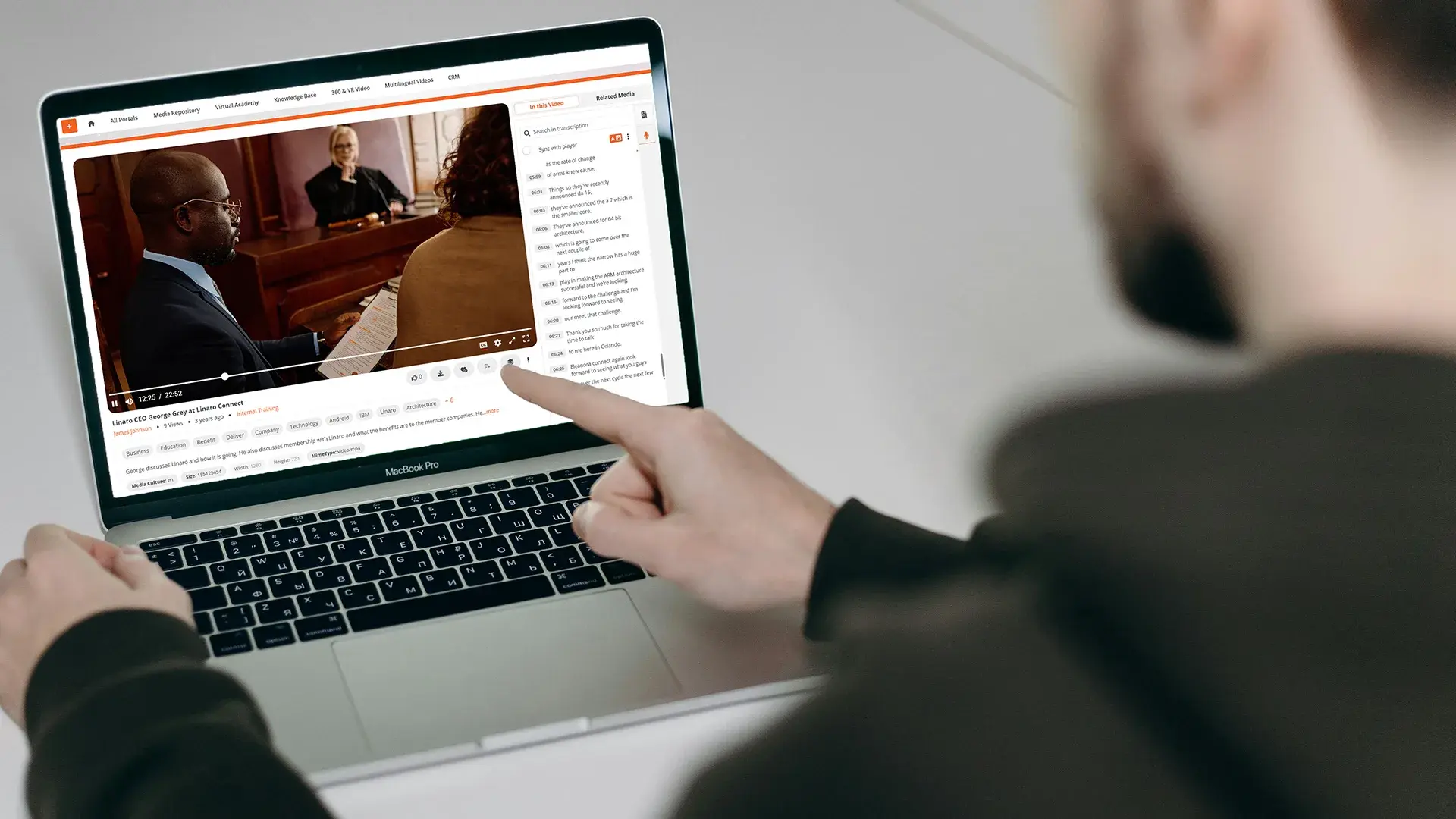
The unit reviewers actually want is the moment. Where in these forty depositions did the witness discuss the indemnity clause. Which of these interviews mentions the subsidiary by name. That means the searchable object has to be what was said rather than what the file was called, which is what transcription changes: once spoken content is indexed, search returns a point inside a recording rather than a list of files to open.
Two things extend that usefully in this context. Speaker attribution separates who said what in a multi-party recording, which matters in a deposition where the question and the answer carry different weight. And where material is not in English, transcription across a wide language set is what makes a foreign-language interview reviewable at all rather than a queue for an interpreter.
Be careful about what this is and is not. It accelerates finding material. It does not make an assertion about that material's integrity, and a review workflow that needs to establish provenance needs something built for that.
Access that expires because the matter does
This is the requirement most general-purpose platforms handle worst, and it is the one with the highest downside.
A matter involves a set of people that is specific and temporary: internal attorneys, paralegals, retained experts, co-counsel at outside firms, sometimes the client. Most of them are not on the firm's directory. The default workaround is a consumer file-sharing link, which is how confidential material ends up in a personal cloud account with no record of who opened it.
What replaces it has three properties worth insisting on. A share should grant specific rights to specific recipients rather than making content generally available. It should carry an expiry and a view limit, so that access granted for a purpose ends when the purpose does rather than persisting until somebody remembers to revoke it. And each recipient should get their own link, so activity resolves to the individual rather than to the share, which is what makes it possible to say who opened what and when.
That last property is the one people underrate. A single link forwarded to four people produces one access record and four viewers. Per-recipient links turn the same release into four accountable events, and when a firm is asked later who saw the material, an answer exists.
Closing a matter is a decision, not an event
Closure is a decision, and firms that do not make it deliberately make it by accident, which is to say they keep paying for everything forever.
Two mechanisms handle it. Storage tiering moves content from hot to cool to archive, by policy or in bulk, so material nobody has touched since the hearing costs less to hold than material in active review. And retention disposition schedules the actual end: content is disposed of on a schedule rather than by hand, with a retention period governing how long deleted content is held before permanent removal.
The limit on tiering is worth more to you than the saving is. Archived content must be rehydrated before it can be accessed. A closed matter that has to be reopened, because an appeal arrives or a related action starts, is not instantly available, and if nobody told the litigation support team that, they find out on the day they are in a hurry. Plan the tier by how likely reopening is rather than by age alone. Tiering also depends on the underlying storage provider supporting it, which is a question for procurement rather than an assumption.
On disposal, the argument runs in both directions and the two directions carry very different consequences. Holding material past its schedule is a failure in many jurisdictions, and it is usually a cost and a compliance finding.
Disposing of it too early is the one that produces sanctions. Federal Rule of Civil Procedure 37(e) applies where electronically stored information "that should have been preserved in the anticipation or conduct of litigation is lost because a party failed to take reasonable steps to preserve it, and it cannot be restored or replaced through additional discovery." On a finding of prejudice a court may order measures to cure it. On a finding that a party "acted with the intent to deprive another party of the information's use in the litigation," it may instruct the jury to presume the lost information was unfavorable, or dismiss the action outright.
The practical consequence for a matter-shaped workload is that the retention schedule and the litigation hold have to be able to override each other in the right order, and the hold has to win. An automated policy that quietly deletes on schedule is a liability the moment a hold attaches and nobody wired the two together. Ask how a hold suspends disposition, who can place one, and what the system does with material already queued for deletion. Disposed content remaining restorable while it is inside the recoverable window is the safety net that makes scheduled destruction switchable-on at all, and it is not a substitute for the hold working.
How VIDIZMO EnterpriseTube fits
EnterpriseTube covers all four stages above: the intake, the retrieval, the controlled release and the wind-down.
On intake, 300 or more formats are supported and video is transcoded on ingest into streaming renditions, so a mixed production set becomes reviewable without a conversion stage. AI processing runs on demand across a collection rather than file by file.
On retrieval, transcription across 82 benchmarked languages makes spoken content searchable, in-media transcript search returns the point inside a recording rather than the file, and speaker diarization separates participants in a multi-party recording.
On release, shares grant specific rights to specific recipients, carry an expiry and a maximum view count, and issue a separate link per recipient so access resolves to a person. On wind-down, storage tiers across hot, cool and archive by policy or in bulk, and retention disposition handles scheduled destruction with content restorable while it remains recoverable.
Four decisions, all expensive to change later
Four decisions, none of them technical, all of them expensive to change later.
Decide who owns access for the matter, because the person granting it to co-counsel should not be whoever happens to be free. Agree the expiry convention up front, so shares carry an end date by default rather than by exception. Set the tier policy against the likelihood of reopening rather than against age, and tell the people who will need to reopen it what rehydration means. And write down the disposal schedule at the start of the matter, when nobody is under pressure, rather than at the end when everyone is.
Firms that settle these once find the second matter costs a fraction of the first, because the pattern is reusable even though the matter is not. Teams running review at volume will also want to look at how reviewer training and calibration is evidenced, and firms whose depositions are recorded on Zoom or Teams should start with getting those recordings under governance.
Talk to a specialist about how a matter-shaped workload would run in your environment, or read what a legal video platform does for a firm if you are scoping the firm's wider video question.
 August 24, 2026