Most guidance about digital court recording assumes the argument is over. It describes microphones, channels, transcription accuracy and retention, all of which matter, and all of which presume the court has already established that a recording can serve as the official record of a proceeding.
For a large share of courts, that is the open question, and it is not a technology question. It is set by rule of court, by statute, or by judicial council policy, and it involves people who are not in the procurement conversation: the reporters association, the bench, the appellate courts that will receive the resulting record, and in some states the legislature.
A court that treats this as a purchase gets a long way into an evaluation before discovering that the thing it is buying cannot legally do the job in its jurisdiction. This article is about the decision itself. It does not argue that a court should make the change, because that is not a vendor's call to make. It sets out who decides, what they are actually deciding, and which objections deserve an answer.
What just changed in California, and why it matters elsewhere
In August 2026 the California Supreme Court held that courts must permit electronic recording of hearings where a certified reporter is not available, finding that a verbatim record created by electronic recording is better than no record at all (CalMatters).
The scale behind that ruling is the part other states should read. California statute already authorized electronic recording for infractions, misdemeanors and limited civil matters, but not for family law, probate or unlimited civil. Between 1 April 2023 and 31 March 2026, of 4,214,365 hearings in those excluded categories, about 3,007,651 took place with no verbatim record at all, which is 71.3 percent. The state had 1,101 court-employed reporters as of 2026 (Judicial Council of California).
The reason this travels is that the shortage is national and the restriction was local. California had drawn a line by case type, and the line held until the volume of unrecorded proceedings made it untenable. Any court whose rule draws a similar line is running the same experiment with a different start date.
Who actually decides in your state
The first useful thing a court can do is establish which instrument governs, because the answer determines the timeline and the people involved.
In some states the definition of the official record sits in a rule of court, amendable by the supreme court or its rules committee. That is the fastest route and the one most within the judiciary's control.
In others it sits in statute, which means a legislative session, a sponsor and a fiscal note. Massachusetts is currently working through a proposed Superior Court Rule 17A on the official record of proceedings, which is worth reading as a model of what a rule has to specify.
In others still it is judicial council or administrative office policy, which can move quickly but binds less firmly and tends to produce local variation between counties.
Federal practice is a separate track. 28 U.S.C. 753 provides for both reporters and electronic sound recording, so district courts have had the option for a long time, and state courts sometimes cite that as precedent without noticing that the certification arrangements differ.
Courts frequently do not know which of these applies to them until someone checks. That check costs an afternoon and determines everything downstream.
What a verbatim record rule actually assumes
The phrase "verbatim record" reads like a description of output. In most rules it is closer to a description of a process, and the process assumes a person.
A reporter is present, hears the proceeding as it happens, produces a transcript, and certifies it under their own professional credential and liability. The rule usually assumes all four. Replacing the person with a device satisfies the first and third only partly, and the fourth not at all, which is why a rule amendment is rarely as simple as inserting the words "or electronic recording."
That is the substance of the decision. Everything else follows from it.
Certification is the real question
If no reporter was present, who attests that the transcript is a true and complete record of what was said?
Rules that have worked through this arrive at one of three answers.
A certified transcriber. The transcript is produced from the official recording by a person holding a recognized credential, who certifies it. California's rules take this shape: a transcript prepared and certified from an official electronic recording is prima facie a true and complete record of the oral proceedings and satisfies a requirement for a reporter's transcript (California Rules of Court).
An approved transcriber list. The court maintains a roster and only listed transcribers may produce an official transcript. The Massachusetts proposal defines an Approved Court Transcriber as a person on a Trial Court Approved Transcriber List managed by an Office of Transcription Services. This is more administrative work and gives the court direct quality control.
A court employee under oath. Some jurisdictions place the attestation with a court officer rather than an outside credential. This is cheapest and puts the accountability inside the institution, which cuts both ways.
Note what none of these do: none of them make the recording itself the record in the sense a reporter's transcript is. The recording becomes the source, and a certified transcript remains the artifact the appellate court reads. Courts that expect the rule change to eliminate transcription labor have misread it. The labor moves; it does not disappear. That is the same point covered in whether AI transcription can be trusted with the official record, from the accuracy side rather than the rule side.
Which objections deserve an answer
The reporters association will oppose this, and treating every objection as protectionism is both unfair and tactically foolish, because two of them are real.
Readback is a genuine capability loss. A reporter can be asked to read back testimony during a proceeding, immediately, at the judge's direction. A recording can be replayed, but finding the passage takes time the courtroom does not have, unless the system indexes as it captures. Courts that moved without planning for this discovered it in week one. It is answerable, and it has to be answered rather than dismissed.
Accountability for a gap is a real question. If a reporter fails, there is a person who failed. If a channel drops and nobody notices until the transcript is ordered eight months later, the answer to "who is responsible" is a policy the court has to write in advance. Redundancy, monitoring and a defined check after each session are the substance of that answer.
Audio quality objections are testable rather than debatable. The claim that recordings are of poor quality is sometimes true and always measurable. A court can settle it by recording its own busiest courtroom under normal conditions and having the result transcribed, rather than by argument. The related capture requirements are covered in digital court recording and what to budget for.
The access-to-justice argument runs the other way, and it is the one that carried in California. A litigant who cannot afford a private reporter and receives no record cannot meaningfully appeal. Comparing an electronic record against a reporter's record is the wrong comparison for those cases. The real comparison is against no record at all.
How courts have made the transition
Three patterns recur.
Parallel running. Both a reporter and a recording for a defined period in the same courtrooms, with the transcripts compared. This produces local evidence rather than vendor evidence, and it is the most persuasive thing a court can bring to its own rules committee.
Limited case types first. Start where the rule already permits it or where the stakes are lowest, build the operational muscle, then extend. California's existing authorization for infractions, misdemeanors and limited civil is exactly this shape, and it is the reason the state had operational experience before the ruling arrived.
Phased rule amendment. Amend to permit rather than to require, which lets courts adopt at different speeds and lets the association observe rather than resist a mandate.
What does not work is procuring first and seeking the rule change afterwards. The equipment sits unused, the association gains an argument about wasted money, and the court has spent its credibility before the substantive discussion starts.
Sequencing the decision
Establish which instrument governs the definition in your jurisdiction, and who amends it.
Read the rule for its assumptions about a person, not only its words about a method, and identify which of the four the court can satisfy and which need a new mechanism.
Decide the certification model before anything else, because it determines staffing, cost and the shape of the rule amendment.
Run a parallel period in real courtrooms and keep the comparison.
Write the answers to readback and to accountability for a gap, in advance and in writing, because those are the two questions that will be asked and the two that are legitimate.
Then, and only then, procure against what the rule now permits.
Where VIDIZMO fits, and where it does not
VIDIZMO does not make this decision easier by making it unnecessary. No product changes what a rule says, and no vendor should offer an opinion on whether a jurisdiction ought to amend one.
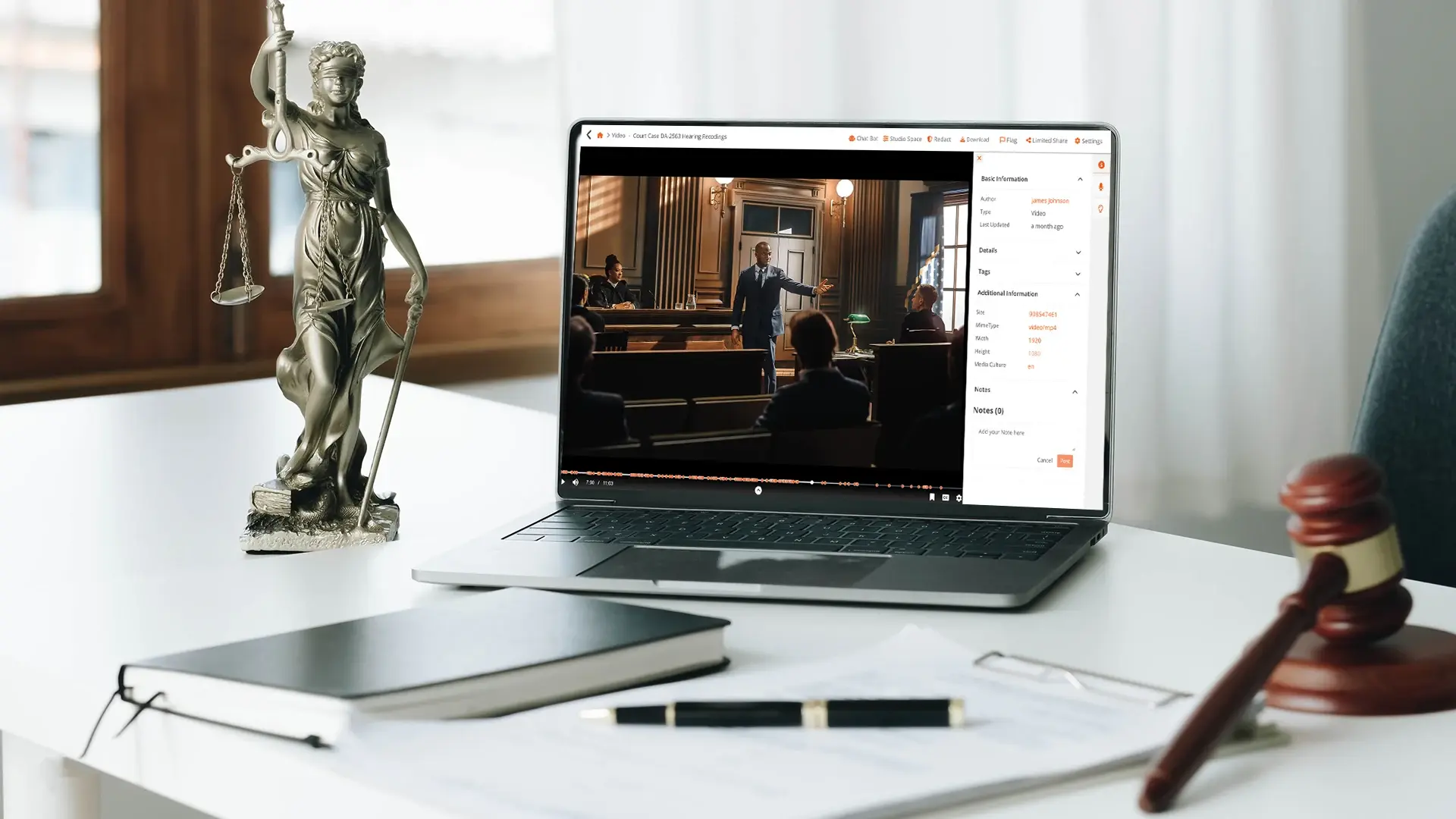
What a system can do is remove the operational objections from the argument. Recordings are ingested into VIDIZMO's Digital Evidence Management System (DEMS) from whatever captures them, filed against the case rather than into a separate media library, transcribed with speaker separation and indexed at ingest so a passage can be located in seconds rather than by scrubbing, held under a tamper-evident chain of custody with integrity verification, and retained on the schedule the court sets. Indexing at ingest is the specific answer to the readback objection, because the capability a court loses is fast retrieval rather than recording.
Where this stops: VIDIZMO does not make courtroom capture hardware, does not certify transcripts, does not determine the legal status of a transcript in any jurisdiction, and takes no position on whether a court should change its rule. Certification remains a person's act under whatever credential the rule specifies.