Video Content Management, EnterpriseTube, Video Hosting, Security and Compliance, CIO and IT Leadership
 October 8, 2025
.webp)
Do you need to upload a video and make it available on-demand for your audience, something like YouTube? Well, YouTube is not the only option. There are numerous VOD streaming platforms, and choosing the best one can be challenging. This guide helps you compare them.
Choosing the wrong VOD platform costs more than the subscription fee. For enterprise and business buyers, the wrong choice means rebuilding integrations, re-migrating entire content libraries, and explaining to IT why your video platform doesn't support SSO, Active Directory, or your industry's compliance requirements.
To cut through the noise, here are the 10 best VOD platform providers for enterprise and business use in 2026 - compared by deployment model, monetization support, compliance certifications, and the use cases each is actually built for.
Quick answer:
- Compliance-heavy industries (government, healthcare, law enforcement): VIDIZMO EnterpriseTube
- Media, publishing, and broadcasting: Brightcove
- Education and corporate training: Panopto or Kaltura
- Sales and marketing enablement: Vidyard
- SMB and creator monetization: Dacast or VPlayed
What Is a VOD Platform Provider?
A VOD (Video on Demand) platform provider is a vendor that supplies the infrastructure — storage, transcoding, delivery, security, and playback — that organizations use to host, manage, and distribute video content on demand on their own terms.
Unlike consumer streaming services (Netflix, YouTube) where content is consumed on someone else's platform, enterprise VOD platform providers give organizations their own branded, controlled environment. For a deeper dive into the technology, see our guide on what is video on demand.
How an On-Demand Video Platform Works
-
Ingest — Video is uploaded from cameras, capture devices, or existing storage
-
Transcode — The platform converts video into multiple quality formats for adaptive bitrate streaming
-
Store — Content is stored securely with metadata, access logs, and chain of custody records
-
Deliver — Content is streamed via content delivery network (CDN) to authenticated users on any device
-
Manage — Admins control access, permissions, analytics, and retention policies
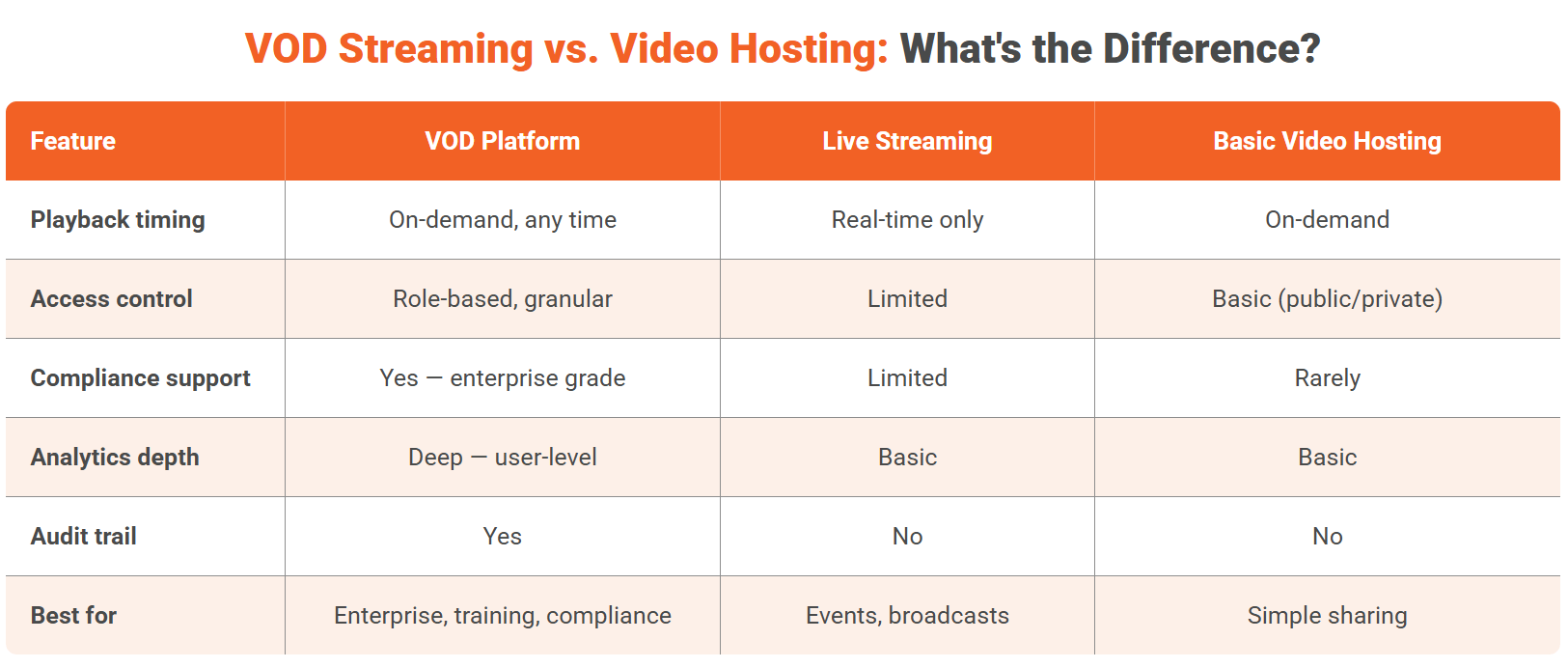
VOD also supports asynchronous video communication — a model increasingly adopted by distributed enterprise teams replacing live meetings with recorded, on-demand content.
Why Are VOD Platforms Better Than Traditional Broadcasting?
Compared to traditional video-sharing mediums, VOD platforms offer greater flexibility and control for enterprises and businesses.
--Definition%2c-History-and-Benefits-Infographic%20(1).webp?width=1600&height=1600&name=Video-on-Demand-(VOD)--Definition%2c-History-and-Benefits-Infographic%20(1).webp)
Traditional broadcasting pushes content out once, to everyone, with no record of who watched or what they retained. Enterprise VOD platforms replace that model with controlled, on-demand delivery, where access is role-based, every view is tracked, and content stays searchable across your entire library.

For organizations with compliance obligations, training requirements, or sensitive content, that difference is not cosmetic. It is the difference between a distribution channel and a managed content infrastructure.
The Growing Demand for Enterprise VOD: The Shift from Cable TV to On-Demand Streaming
Global VOD revenue keeps growing, according to Statista's market outlook, and most U.S. consumers now have at least one subscription video service. Enterprise organizations are making the same shift for training, compliance, and internal communications, building their own video libraries under their own governance policies.
Types of VOD Models Used by Businesses
Decide which access or monetization model fits your use case before you evaluate platforms, because that choice alone rules out most vendors. Consumer streaming runs on three monetization models, and organizations add a fourth for internal video. For full definitions of each type, see our guide to what VOD means and the main types of VOD.
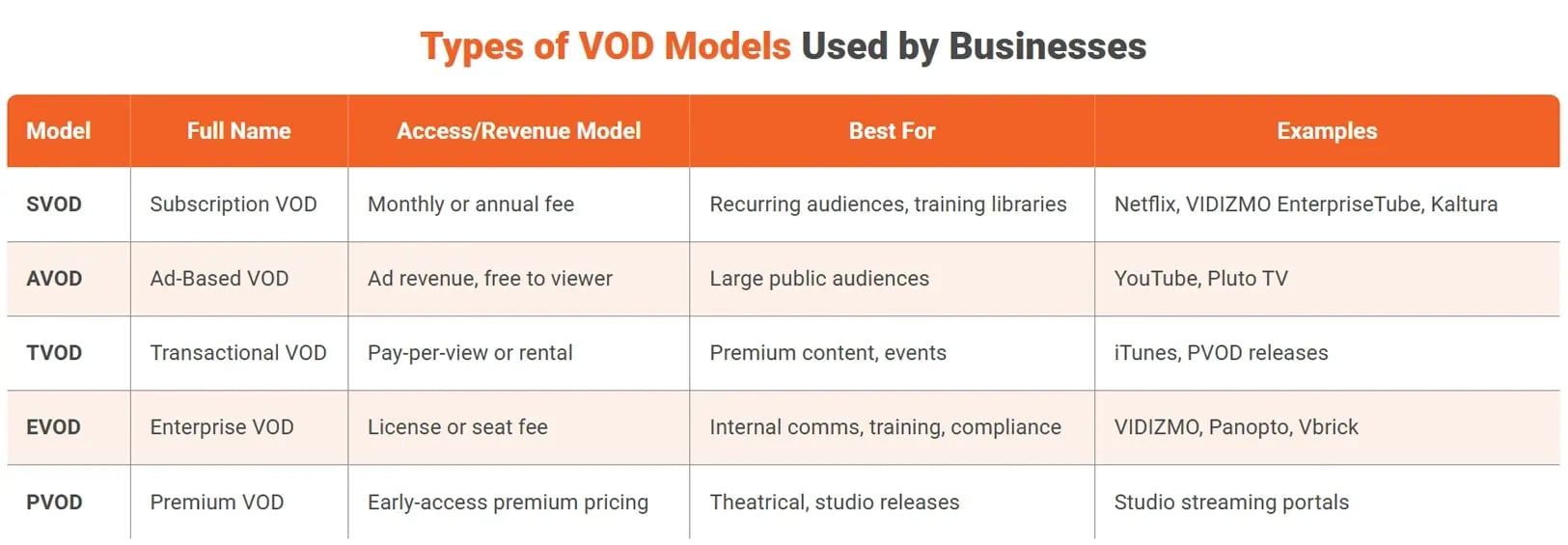
| VOD model | How it works | Examples | Best fit |
|---|---|---|---|
| AVOD (ad-supported) | Free to watch, funded by ads shown in or around the video | YouTube, Dailymotion | Public content where reach matters most |
| SVOD (subscription) | A monthly or annual fee unlocks a content library | Netflix, Amazon Prime Video | Paid external content with recurring revenue |
| TVOD (transactional) | Viewers pay per title to rent or buy, or pay per event | Apple TV and Google TV rentals, pay-per-view events | Premium one-off content, events, and individually sold courses |
| Enterprise VOD (EVOD) | Access-controlled video for known internal audiences, with no public monetization | Training libraries, recorded meetings, internal communications | Internal training and communications; regulated sectors add requirements such as HIPAA, CJIS, or FedRAMP |

Top 10 VOD Platform Providers for Enterprise & Business (2026)
As businesses and content creators increasingly turn to VOD solutions, it's important to understand the different features and capabilities that each platform offers.
Here’s a list of 10 best VOD platform providers that are currently leading the market.
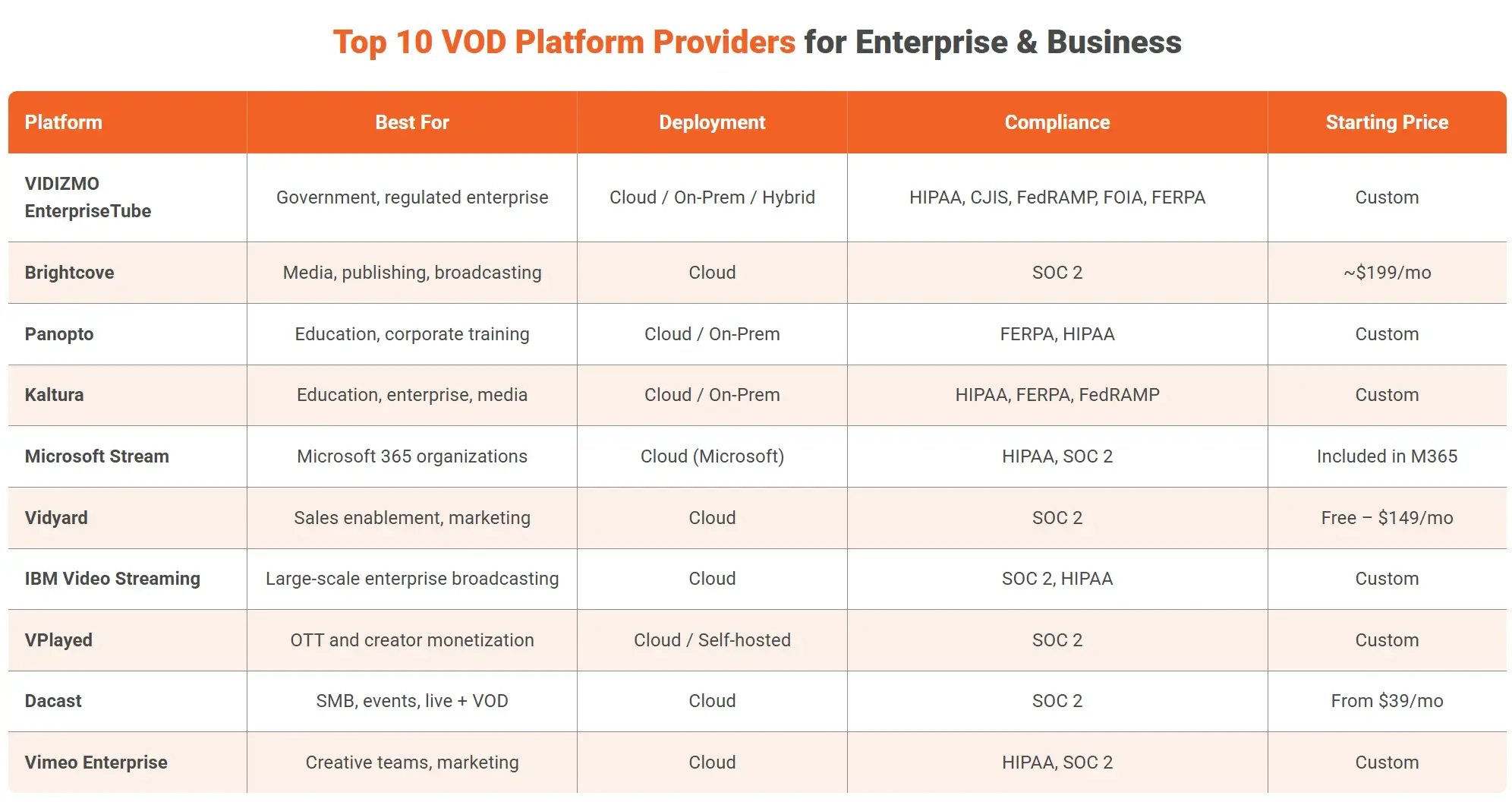
VIDIZMO EnterpriseTube
Best for: Government agencies, law enforcement, healthcare, defense, and regulated enterprise

VIDIZMO EnterpriseTube is an enterprise video platform. It is purpose-built for organizations where video security, compliance, and governance are non-negotiable. VIDIZMO is ISO/IEC 27001:2022 certified. The platform supports CJIS-compliant deployments, provides data-protection and security capabilities that help customers meet HIPAA obligations (VIDIZMO can enter into a Business Associate Agreement where required), and supports FOIA and FERPA compliance workflows. FedRAMP compliance is available through Project Hosts, a FedRAMP-authorized hosting partner, with onboarding in about three months. That makes it a fit for federal agencies, prosecutors' offices, and regulated industries that cannot afford a compliance gap.
Large enterprises have deployed EnterpriseTube to consolidate video management across complex enterprise environments. See VIDIZMO case studies for deployment details.
Key capabilities:
-
AI-powered transcription and search: transcription in 82 benchmarked languages, with transcripts indexed so spoken words are searchable across the video library
-
Audit trails and chain of custody: every action on a video is recorded with the user, IP address, and time, from upload through disposition

-
Flexible deployment — cloud, on-premises, or hybrid; air-gapped environments supported
-
Role-based access control and identity management: permissions set per portal, folder, and individual video, with single sign-on through Microsoft Entra ID, Okta, or any SAML 2.0 or OpenID Connect provider
-
LMS integration: SCORM 1.2 and 2004 packages, and LTI 1.3 delivery inside the LMS, for video-based training workflows
-
Redaction on the same portal: add VIDIZMO Redactor for automated PII redaction in FOIA and public records requests
-
Microsoft 365 integration: Teams recordings ingest automatically, SharePoint and OneDrive serve as sources and export destinations, and sign-in runs through Microsoft Entra ID; works alongside Microsoft Stream on SharePoint
-
Zoom integration — automatic ingestion of recorded Zoom meetings into the enterprise video library
-
White-label portal customization — fully branded video portals for internal and external audiences

Unique differentiator: VIDIZMO is the only platform combining evidence-grade chain of custody with enterprise video management — allowing law enforcement, prosecutors, and government agencies to manage digital evidence and training content within a single compliant environment. Learn more about VIDIZMO's approach to public safety video management.
Compliance coverage: Full details at VIDIZMO Security Overview. For government procurement, see contracting vehicles.
Limitations: Not designed for consumer-facing OTT or creator monetization use cases.
Pricing: Contact VIDIZMO for a quote or start a free trial.
Learn more about VIDIZMO as an on-demand video (VOD) platform

Brightcove
Best for: Media companies, publishers, broadcasters, and marketing teams 
Brightcove is one of the oldest and most established enterprise video platforms, with a primary focus on media publishing and external content distribution. It excels at high-volume video delivery to large public audiences with sophisticated ad monetization, and sports broadcasters and Premier League clubs use it for large-scale sports video.
Key capabilities:
-
Advanced AVOD/SVOD monetization with header bidding and ad server integrations
-
High-performance CDN with 99.99% uptime SLA
-
Customizable HTML5 player with full accessibility compliance
-
Real-time audience analytics and segmentation
-
CMS integrations: Salesforce, HubSpot, Adobe Experience Manager
Unique differentiator: Best-in-class ad tech integrations and publisher-grade analytics for externally monetized content.
Limitations: Limited compliance certifications for regulated industries. Not built for internal evidence-based video management or government procurement.
Pricing: Quote-based; Brightcove does not publish a price list.
Panopto
Best for: Higher education, K-12, and corporate learning & development
-1.webp?width=794&height=447&name=Blog%20Image%20re-size%201920%20x%201080%20(18)-1.webp)
Panopto is the dominant platform for lecture capture, corporate training recordings, and searchable video knowledge bases. Its deep LMS integrations and automatic spoken-word indexing make it the standard for education institutions managing large content libraries.
Key capabilities:
-
Automatic recording and publishing from classrooms and meeting rooms
-
Smart search across spoken words, slides, and on-screen text
-
Video quiz and assessment tools with LMS grade passback
-
SCORM and LTI integrations (Canvas, Blackboard, Moodle, D2L, Sakai)
-
FERPA and HIPAA compliance
-
On-premises deployment for data-sensitive institutions
Unique differentiator: Every word spoken in any video becomes searchable — making it ideal for large training and lecture libraries where content discovery is critical.
What it lacks: Limited monetization features. Not built for external content distribution or OTT, and holds no FedRAMP authorization.
Pricing: Custom enterprise licensing based on user count and storage.
Kaltura
Best for: Universities, large enterprises, and media companies needing deployment flexibility and an extensible platform
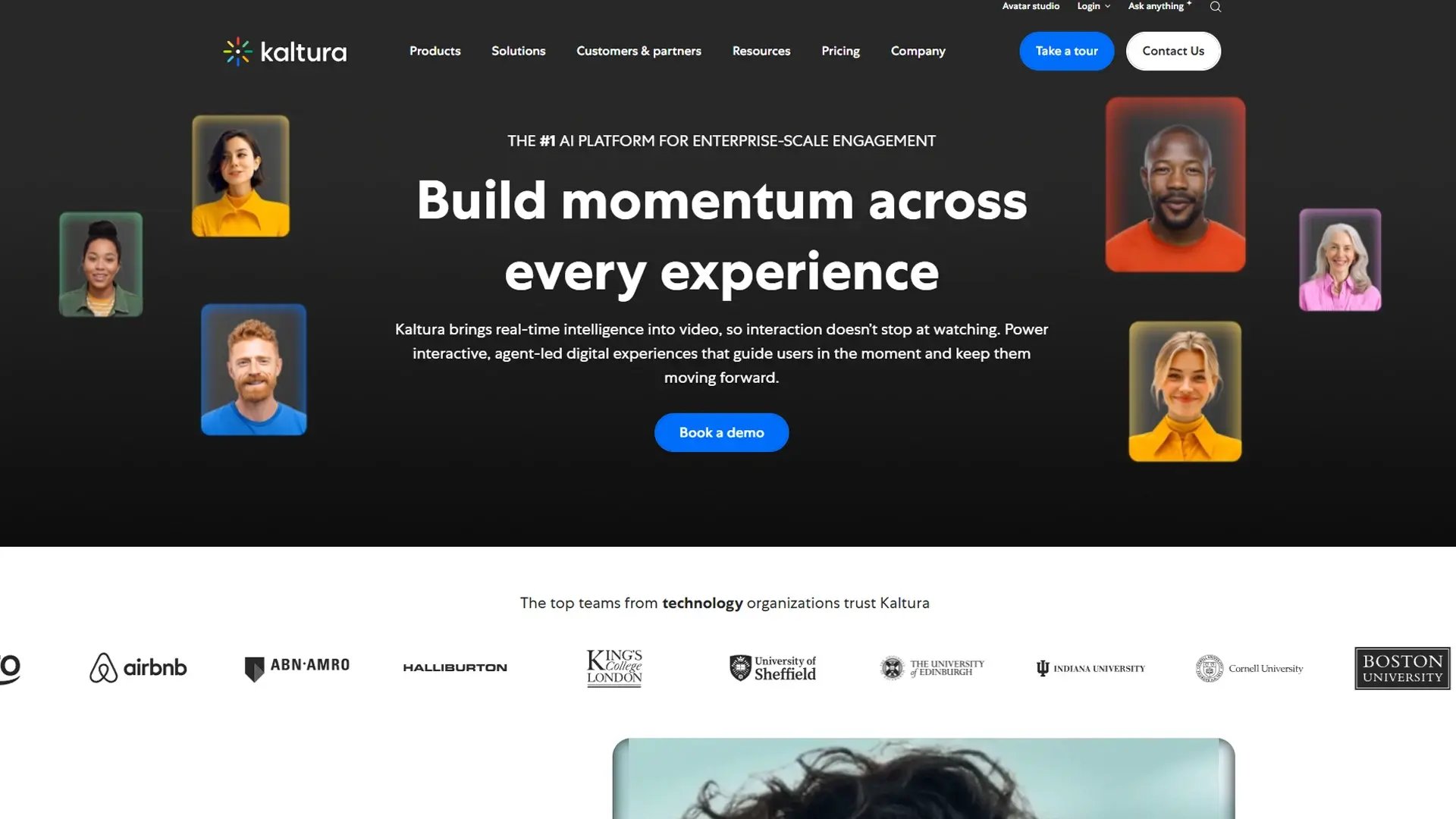
Kaltura is one of the few open-source-origin platforms to scale to enterprise, offering cloud-hosted, fully self-hosted, and hybrid deployments.
Key capabilities:
-
Open API and plugin architecture — highly customizable and embeddable
-
Cloud, on-premises, and hybrid deployment
-
Advanced media workflows — multi-bitrate transcoding, live + VOD
-
SOC 2 Type II audited, with HIPAA (under a BAA) and FERPA support
-
Real-time collaboration and interactive video tools
-
Full LMS integration suite (Canvas, Blackboard, Moodle, Sakai, D2L)
-
Multi-language transcription and caption support
Unique differentiator: Most flexible deployment and customization options of any enterprise VOD platform — preferred by organizations that need to integrate video capabilities into existing systems rather than adopting a standalone product.
What it lacks: High implementation complexity. Requires dedicated IT/AV resources for deployment and ongoing maintenance.
Pricing: Custom enterprise pricing.
Microsoft Stream
Best for: Organizations already running Microsoft 365 Microsoft Stream is the video layer of the Microsoft 365 ecosystem. If your organization runs Teams, SharePoint, and Microsoft Entra ID, Stream provides native video recording, storage, and distribution without adding a separate vendor. For a detailed comparison of Stream's capabilities and limitations, see our Microsoft Stream on SharePoint guide.
Key capabilities:
-
Automatic recording and transcription of Microsoft Teams meetings
-
SharePoint-integrated video storage and sharing
-
Microsoft Entra ID single sign-on and conditional access policies
-
Microsoft Purview integration for compliance and retention
-
Automatic transcripts and captions for uploaded videos
Unique differentiator: Zero incremental cost for Microsoft 365 subscribers — and the deepest possible integration with Teams, SharePoint, and the M365 compliance stack.
What it lacks: Limited external distribution capability. No monetization. Entirely dependent on the Microsoft ecosystem. Limited advanced analytics compared to purpose-built VOD platforms. Organizations requiring capabilities beyond what Stream provides may want to explore VIDIZMO's Microsoft 365 integration as a complement or alternative.
Pricing: Included in Microsoft 365 Business and Enterprise plans.
Vidyard
Best for: Sales teams, marketing departments, revenue-generating video
%20(1)-1.webp?width=794&height=447&name=Blog%20Image%20re-size%201920%20x%201080%20(17)%20(1)-1.webp)
Vidyard focuses almost entirely on video for sales and marketing — making it uniquely positioned in this list. It is less a platform provider in the infrastructure sense and more a video productivity tool built around driving pipeline and measurable revenue.
Key capabilities:
-
One-click personalized video recording for sales outreach
-
CRM integrations: Salesforce, HubSpot, Outreach, Salesloft
-
Video engagement analytics tied directly to deal stages
-
AI-powered video script and highlight generation
-
Video hosting for marketing pages, landing pages, and campaigns
Unique differentiator: The only platform that connects video engagement data directly to revenue metrics — tracking which rep sent a video, which prospect watched it, and what happened to the deal after.
What it lacks: Not suitable for compliance, evidence management, or training at scale. No on-premises deployment. For organizations needing both sales video tools and enterprise-grade security, pairing Vidyard with a platform like VIDIZMO EnterpriseTube is a common approach for regulated industries.
Pricing: Free tier available. Paid Starter, Teams, and Enterprise plans are quoted per plan.
IBM Video Streaming
Best for: Large enterprise broadcasting, all-hands events, global video distribution

IBM Video Streaming is built for one thing: reliable high-volume broadcasting at enterprise scale. It handles hundreds of thousands of concurrent viewers without degradation.
Key capabilities:
-
Watson AI automatic captioning and transcription
-
Enterprise SSO and SAML 2.0 access management
-
Custom branded streaming channels with white-label player
-
Advanced viewer engagement analytics and live Q&A tools
-
High-availability CDN with guaranteed SLAs
Unique differentiator: Proven at broadcast scale — IBM Video Streaming handles major corporate events, financial earnings calls, and government broadcasts requiring zero-downtime delivery to massive concurrent audiences.
What it lacks: No FedRAMP authorization for the streaming service, which limits federal use. Limited VOD content management beyond broadcast recordings.
Pricing: Plans are priced by viewer hours; enterprise pricing is custom.
VPlayed
Best for: OTT startups and content owners building branded streaming services
.webp?width=794&height=329&name=unnamed%20(2).webp)
VPlayed is a white-label OTT platform builder, it lets content owners launch their own branded streaming service without starting from scratch. It supports all VOD monetization models and handles multi-platform app delivery across every major device category.
Key capabilities:
-
White-label apps for iOS, Android, Roku, Apple TV, Fire TV
-
SVOD, TVOD, AVOD, and hybrid monetization models
-
Multi-DRM content protection (Widevine, PlayReady, FairPlay)
-
Custom branded player and UI
-
Multi-language and multi-currency support
-
Self-hosted or cloud deployment
Unique differentiator: End-to-end OTT platform launch, from web to 10+ device apps, without building infrastructure from scratch.
What it lacks: Not designed for internal enterprise use. Limited compliance certifications for regulated industries.
Pricing: Custom licensing. One-time license plus ongoing hosting costs.
Dacast
Best for: SMBs, event organizers, houses of worship, and businesses needing live + VOD at accessible pricing
Dacast is a professional-grade streaming platform at SMB pricing — a strong option for organizations that need reliable live and on-demand video without enterprise complexity or cost.
Key capabilities:
-
Combined live streaming and VOD in one platform
-
Paywall and monetization tools — pay-per-view and subscription billing
-
Secure token authentication and geo-blocking
-
Embeddable HTML5 player
-
China video delivery capability
-
24/7 live streaming reliability
Unique differentiator: Lowest total cost of ownership for organizations that need professional-quality live and VOD without enterprise licensing overhead.
What it lacks: Limited compliance certifications — not suitable for regulated industries or large internal enterprise deployments requiring governance controls.
Pricing: Starter from $39/month and Scale from $165/month, billed annually.
Vimeo Enterprise
Best for: Creative agencies, marketing teams, and brand video production 
Vimeo Enterprise layers security, SSO, advanced analytics, and team collaboration features on top of Vimeo's industry-leading video quality. The natural choice for marketing and creative teams that prioritize video fidelity and brand control.
Key capabilities:
-
Password protection, domain restriction, and SAML 2.0 SSO
-
Advanced analytics with viewer heatmaps and engagement tracking
-
Interactive video tools — forms, CTAs, chapters, annotation
-
HIPAA-compliant hosting option
-
Review and approval workflows for creative teams
-
API for embedding and CMS integrations (WordPress, Webex, Salesforce, HubSpot)
Unique differentiator: Best video quality and most polished player of any platform in this list — critical for brand-sensitive external content where presentation quality is part of the brand.
What it lacks: Not designed for compliance-heavy regulated industries at depth. Limited governance controls compared to VIDIZMO or Vbrick. No FedRAMP authorization.
Pricing: Custom enterprise pricing.
What About YouTube and Free Platforms?
YouTube and similar free consumer platforms are frequently considered as a cost-saving alternative to enterprise VOD. They are not enterprise VOD platform providers. The YouTube Data API offers some integration capabilities, but the fundamental limitations for business use remain:
-
No role-based access control — content is public, unlisted, or private with no organizational permission management
-
No regulatory coverage: YouTube offers no HIPAA Business Associate Agreement and holds no FedRAMP authorization
-
No audit trail — no chain of custody, no tamper detection, no user-level access logging
-
Google owns your data — content is subject to YouTube's Terms of Service, not your organization's data governance policies
-
Competitor ads may appear — your compliance training video may be followed by a competitor's advertisement
For internal corporate use, regulated industries, or any context requiring access control and data governance, free consumer platforms are not a viable option. See our guide on how to securely share videos online for limited time for secure sharing alternatives within enterprise environments.
Key Takeaways
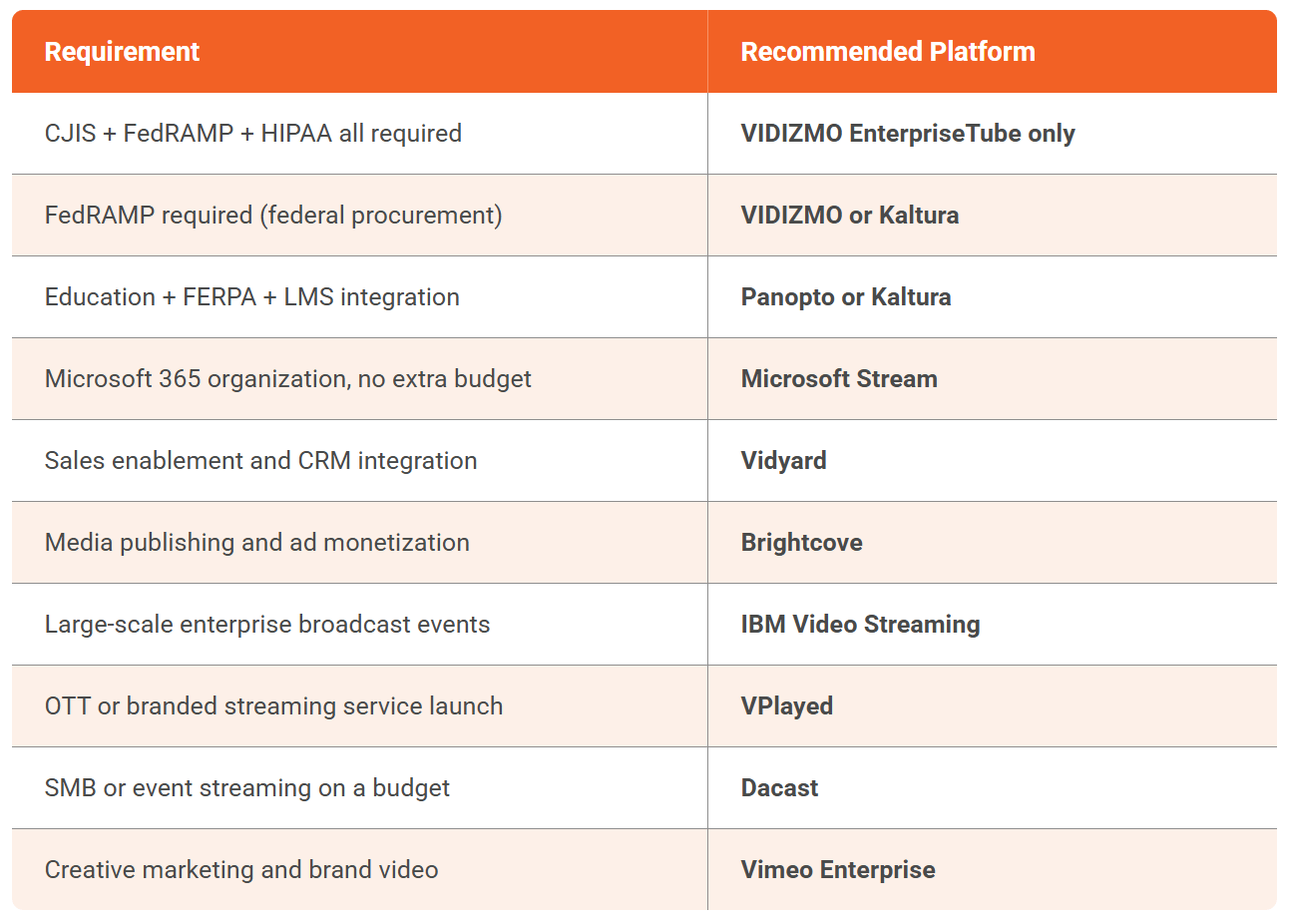
Five things every enterprise buyer should know before deciding:
-
Compliance requirements eliminate most platforms immediately — if you operate in a regulated industry, start with certifications and work backward to features. Review VIDIZMO's security and compliance overview as a benchmark.
-
Deployment flexibility matters long-term — cloud-only vendors create lock-in; platforms offering on-premises or hybrid (VIDIZMO, Panopto, Kaltura) give you options as requirements change
-
Microsoft Stream is the answer only if you're all-in on M365 — for Microsoft Stream limitations and alternatives, see our dedicated guide
-
VOD monetization and internal EVOD are different product categories — don't evaluate Brightcove against VIDIZMO; they serve fundamentally different use cases
-
Free consumer platforms are not enterprise alternatives — they lack the access controls, compliance coverage, and governance capabilities enterprise deployments require
Choosing the Best VOD Platform for Your Organization
Ask these five questions before committing:
1. What compliance requirements does your industry have?
-
Healthcare → HIPAA.
-
Law enforcement → CJIS Security Policy.
-
Federal government → FedRAMP.
-
Education → FERPA.
-
Any regulated industry → start here and eliminate non-compliant platforms immediately.
This step alone typically reduces a 20-vendor longlist to 3–4 options. For a government-specific breakdown, see VIDIZMO government contracting vehicles.
2. Do you need on-premises or cloud?
Sensitive data environments, air-gapped networks, and many government contracts require on-premises deployment. In this list, VIDIZMO, Panopto, Kaltura, and VPlayed offer on-premises or self-hosted deployment, and Vbrick, not reviewed here, does too.
The other platforms in this list are cloud-only. For cloud storage considerations, see our guide on best video cloud storage providers for 2026.
3. How large is your content library and user base?
-
Under 500 users with modest storage needs → Dacast or Vimeo.
-
Thousands of users with large or growing content libraries → VIDIZMO, Kaltura, or IBM. Consider CDN performance requirements as your library scales.
4. Do you need external monetization?
-
Internal training and communications → no monetization needed, EVOD model.
-
External paid content → SVOD/TVOD support required (VPlayed, Brightcove, Dacast).
5. What systems does it need to integrate with?
-
Microsoft 365 heavy → Microsoft Stream or VIDIZMO.
-
Salesforce/HubSpot → Vidyard or Brightcove.
-
LMS-centric (Canvas, Blackboard, Moodle) → Panopto or Kaltura.
-
Records management or CAD systems → VIDIZMO EnterpriseTube.
-
Healthcare systems → VIDIZMO with healthcare AI solutions.
-
Education → VIDIZMO or Panopto with education-specific deployment.
Get Started with the Right VOD Solution
Explore how VIDIZMO’s VOD platform can help your business scale securely with robust features designed for both internal and external video content management.
Start Your Free Trial Today! Or contact us for more details.

FAQ
Frequently Asked Questions
What is a VOD platform provider?
A VOD platform provider supplies the technology infrastructure, storage, transcoding, delivery, access control, and analytics, that organizations use to host and distribute video on demand. Enterprise VOD providers add compliance certifications, governance controls, and audit trails on top of basic video hosting.
What is the best VOD platform for enterprise?
VIDIZMO EnterpriseTube suits regulated enterprises: it supports CJIS-compliant deployments and customers' HIPAA obligations, with FedRAMP compliance through a FedRAMP-authorized hosting partner. Kaltura and Panopto are strong alternatives for education and corporate training. The best choice depends on your industry, compliance requirements, and deployment model.
What is the difference between SVOD, AVOD, TVOD, and EVOD?
SVOD (subscription) charges a recurring fee for unlimited access. AVOD (ad-based) is free to viewers and monetized through advertising. TVOD (transactional) charges per video or rental. EVOD (enterprise VOD) uses fixed licensing with role-based access controls, no public monetization, designed for internal organizational use.
Can a VOD platform be hosted on-premises?
Yes. VIDIZMO EnterpriseTube, Kaltura, Panopto, and Vbrick all support on-premises or hybrid deployment. Cloud-only platforms including Vidyard, Brightcove, Dacast, and Microsoft Stream do not offer on-premises options.
What VOD platforms support HIPAA compliance?
Kaltura, Panopto, and Vimeo Enterprise offer HIPAA-compliant configurations. VIDIZMO EnterpriseTube provides data-protection and security capabilities that help customers meet HIPAA obligations, and VIDIZMO can enter into a Business Associate Agreement where required. For law enforcement and federal agencies it also supports CJIS-compliant deployments with FedRAMP compliance through Project Hosts, a FedRAMP-authorized hosting partner. See VIDIZMO's full compliance overview.
How is an enterprise VOD platform different from Netflix or YouTube?
Consumer platforms (Netflix, YouTube) host content for public consumption on their own infrastructure under their own terms. Enterprise VOD platforms give organizations their own branded, private environment with access controls, compliance tools, and audit trails, content ownership and data governance remain with the organization. For more on this distinction, see what is video on demand.
What is the best VOD platform for government agencies?
VIDIZMO EnterpriseTube is built for government use: it supports CJIS-compliant deployments, helps customers meet HIPAA obligations (VIDIZMO can enter into a Business Associate Agreement where required), supports FOIA and FERPA compliance workflows, with FedRAMP compliance through Project Hosts, a FedRAMP-authorized hosting partner, with onboarding in about three months and no agency sponsorship required. Government buyers should review VIDIZMO's contracting vehicles for procurement pathway options.
Is VOD the same as video streaming?
Not exactly. VOD refers to the on-demand viewing model (watch anytime), while VOD streaming refers to the delivery method (how that on-demand video is streamed reliably over the internet). Most modern video on demand platforms offer VOD streaming capabilities by default.
What is the best VOD streaming platform for enterprises?
The best enterprise VOD streaming platform depends on your security, compliance, and integration needs. Enterprises typically choose platforms that support SSO, granular role-based access control, audit logs, encryption, and integrations with tools like Microsoft 365, Teams, SharePoint, and LMS systems.
How do VOD streaming platforms reduce buffering and improve playback?
They reduce buffering by using encoding, adaptive bitrate streaming, and CDN delivery. These technologies adjust video quality based on network conditions and serve content from the nearest servers, improving start time, stability, and viewing experience.
TopicsVideo Content ManagementEnterpriseTubeVideo HostingSecurity and ComplianceCIO and IT Leadership
About the author
Nohad Ahsan is a Product Marketing Executive at VIDIZMO who breaks down complex video management, digital evidence, and AI technology into practical, decision-ready insights. His content is built for government agencies, public safety organizations, and enterprise leaders navigating technology adoption.
You may also like

What Is a Real-Time Crime Center? A Guide for Cities and Counties
Somewhere in the last two years, someone probably asked your department whether it should have a real-time crime ...

Staffing a Real-Time Crime Center When Software Does the Watching
Most chiefs who hear a pitch for a real-time crime center ask the same question before any other, which is whether they ...

RTCC, EOC or Situational Awareness Center: What Each Room Is For
Walk into a real-time crime center, then into a city's emergency operations center, and you will see much the same ...