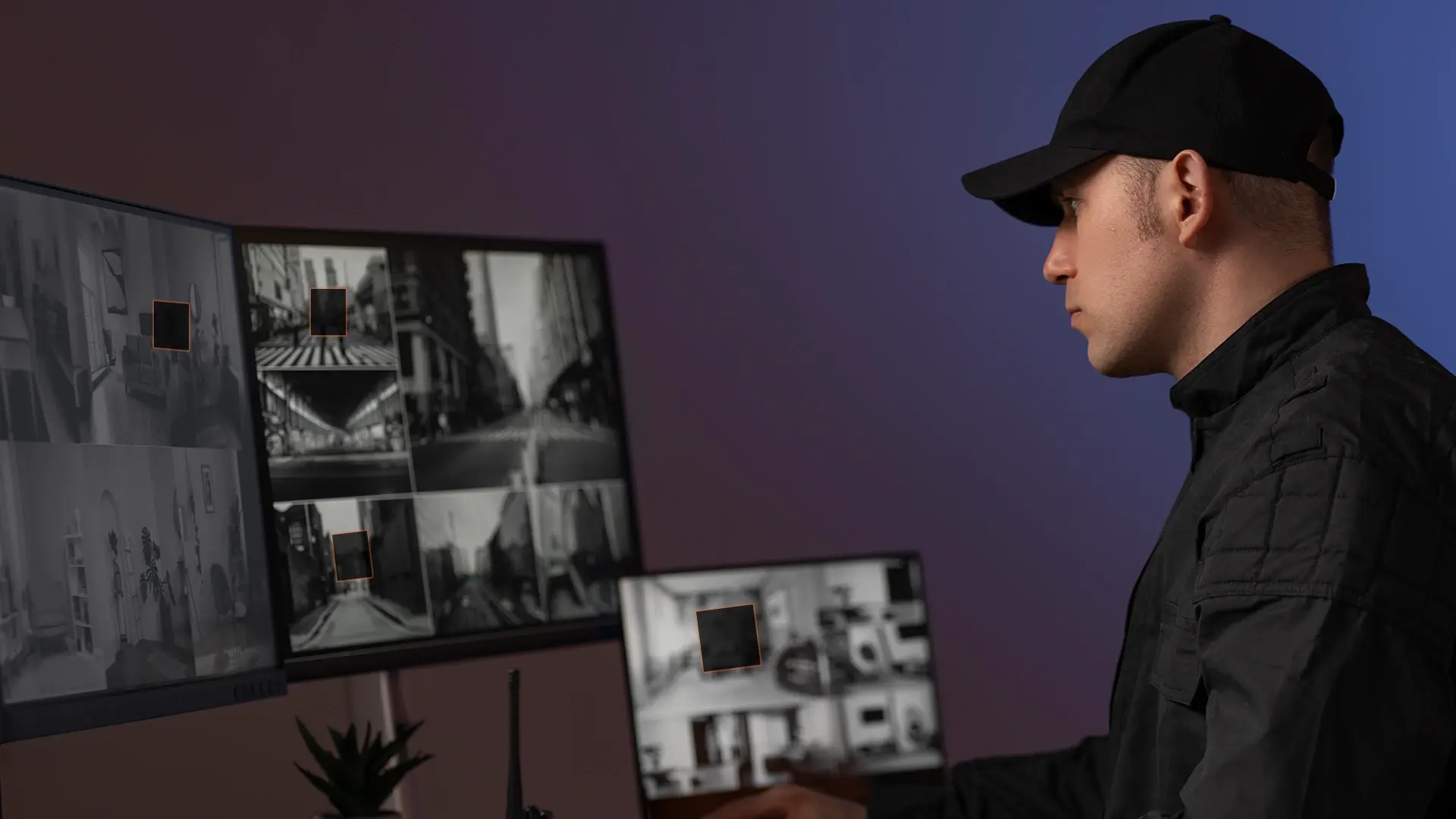
A five-camera system at a single location is a manageable redaction problem. A security operations team overseeing 50 client locations, each with 10 to 40 cameras, running 24 hours a day, is a fundamentally different problem, and trying to solve it with the same approach does not work.
The manual approach to CCTV redaction, watch the footage, identify sensitive content, apply redactions frame by frame, may be tolerable for occasional one-off requests. It does not scale to the volume, frequency, or geographic distribution of requests that a multi-site security operation regularly encounters. When a single compliance request can cover footage from 15 cameras across three buildings, and those requests arrive from multiple clients simultaneously, the manual model breaks entirely.
Automating CCTV redaction across multi-site networks is not a luxury. For security firms managing client surveillance at scale, it is the only operationally viable path to handling privacy and compliance obligations without hiring an army of analysts.
Why Multi-Site Redaction Breaks Manual Workflows
The fundamental problem with manual redaction at scale is that the work grows linearly with footage volume, and footage volume in multi-site deployments is enormous. Consider a firm managing surveillance for 30 client locations:
- Average of 20 cameras per site = 600 cameras total
- 8 hours of active recording per camera per day = 4,800 hours of footage per day
- Each hour of footage requiring redaction takes 4 to 8 analyst hours to process manually
- A single multi-camera incident involving 10 cameras across 2 hours requires 80 to 160 analyst hours to redact manually
No operations team can absorb that kind of workload as part of a managed service contract. And the problem compounds when multiple clients submit redaction requests simultaneously, which is common when regulatory deadlines or litigation timelines align.
Beyond the volume problem, manual redaction at scale introduces consistency risk. Different analysts make different judgment calls about what to redact. Some detections are missed.
Others are over-applied. Without standardized detection rules and quality review workflows, the output is uneven, and for clients in regulated industries, inconsistent redaction can be as problematic as no redaction at all. The automatic vs. manual redaction tradeoff is worth understanding before designing any multi-site workflow.
Common Triggers at Multi-Site Scale
Understanding what drives redaction volume helps operations managers design automation workflows that address the most frequent scenarios.
Incident Reports
A physical incident, a theft, a fight, a trespassing event, generates footage review across every camera that covered the affected area. In a multi-building campus environment, that may mean 10 to 20 recordings. The footage is typically needed quickly, for law enforcement, insurance, or internal HR, and must be redacted before sharing with external parties.
Client Compliance Requests
For government and public-sector clients, FOIA and open-records requests generate regular, high-volume redaction obligations. A single request can cover weeks of footage from multiple cameras. State-level open-records laws often impose short response windows, 10 business days is common, that make manual processing infeasible for large requests. Requirements vary significantly by jurisdiction, and a state-by-state open records compliance guide provides a useful reference for teams supporting government clients.
Compliance Audits
Third-party security audits, insurance reviews, and regulatory inspections periodically require footage submission. Audit-related footage releases often have specific handling requirements, documentation of what was redacted, why, and by whom, that manual workflows struggle to satisfy consistently.
Periodic Public Records Releases
Some government clients have standing obligations to proactively release footage from specific cameras, body cams, public transit systems, facility entrances, on a scheduled basis. These recurring releases require a systematic, automated workflow rather than ad hoc processing.
Client Transitions and Data Requests
When a client relationship ends or a system is migrated to new hardware, footage archives may need to be reviewed and redacted before delivery or deletion. Multi-site archives covering years of footage create significant one-time redaction loads.
What Automation Looks Like: Batch Processing, Preset Rules, Scheduled Workflows
Automating multi-site CCTV redaction requires three connected capabilities: batch processing to handle volume, preset detection rules to eliminate per-job configuration, and scheduled workflows to run processing without manual intervention.
Batch Processing allows multiple recordings to be submitted simultaneously for redaction, queued, and processed sequentially or in parallel without requiring an analyst to manage each file individually. The analyst submits a folder of recordings, or the system ingests them automatically from a watch folder, and the platform processes the entire batch using the configured rules. Results are available for review when the batch completes.
For a multi-camera incident involving 15 recordings, batch processing compresses what would be sequential per-file work into a single submission. AI detection runs across all files simultaneously, subject to processing infrastructure capacity, and the analyst receives a complete set of flagged detections to review rather than processing files one at a time. Purpose-built bulk CCTV video redaction tools are designed specifically for this workflow at enterprise scale.
Preset Detection Rules (redaction templates) eliminate the need to configure detection parameters for every job. For each client, the operations team configures a template that specifies: which object types to detect (faces, license plates, persons, screens), the confidence threshold for AI detections (25% to 90%), the redaction style (blur, pixelate, black box), which exemption codes apply for regulated clients, and the output format. That template is saved and applied to every job for that client without per-job configuration.
Templates are particularly valuable in multi-client environments where compliance requirements vary. A government client needs FOIA exemption code documentation. A healthcare campus client needs HIPAA-aligned handling. A commercial retail client only needs face blurring. Each client gets its own template, and the operations team applies the correct one at submission with no manual rework between client standards.
Scheduled and Watch-Folder Automation enables zero-touch processing for recurring redaction needs. A watch folder monitors a network location, or a camera system's export directory, and automatically submits new recordings for processing as they arrive. For clients with standing public records release obligations, footage can be routed through the redaction pipeline automatically on a defined schedule and delivered as redacted output without analyst involvement.
This model is particularly effective for overnight processing: large batches are submitted at the end of the business day, the platform processes them during off-hours, and redacted output is available when the operations team starts the following morning. Queue-based processing handles the sequencing automatically.
Centralized vs. Site-Level Redaction Management
Multi-site deployments face a structural choice between centralizing redaction processing or distributing it to individual site-level teams.
Centralized processing runs all redaction through a single platform instance managed by the security firm's operations center. Footage from all client locations is ingested into the central system, processed, and returned to the client. This model maximizes efficiency: the operations team applies consistent standards across all clients, platform licensing is consolidated, and the operations team develops deep expertise in the workflow.
The tradeoff is data handling. For clients with data residency requirements, government agencies, CJIS-regulated law enforcement, FedRAMP-mandated federal entities, footage may not be permitted to travel to a third-party processing environment. For these clients, an on-premises or client-hosted deployment is required.
Distributed site-level processing deploys the redaction platform within each client's environment. The security firm's operations team accesses the platform remotely for configuration and support, but processing runs within the client's own infrastructure. This satisfies data residency requirements and is compatible with air-gapped networks.
In practice, most multi-site security firms use a hybrid model: a centralized SaaS deployment for commercial clients without residency restrictions, and on-premises or government cloud deployments for regulated clients that require in-environment processing. Deployment flexibility is one of the primary criteria covered in a comprehensive redaction software evaluation guide.
Access Control and Audit Trails Across Multiple Client Accounts
In a multi-client redaction environment, data governance is not optional. Operations teams need strict controls that prevent cross-client data exposure while maintaining the audit documentation that regulated clients require.
Role-Based Access Control (RBAC) should enforce client-level data isolation at the platform level, not just through organizational conventions. Each client's footage, settings, and audit logs should be accessible only to that client's authorized users and the operations team members designated to their account. Access permissions should be configurable by role, submitter, reviewer, approver, administrator, to match the organization's workflow.
Audit Logs Per Job. Every redaction job should produce a complete audit trail: submission timestamp, files processed, AI detections applied, confidence scores, manual overrides, reviewer identity, approval timestamp, and export record. This log serves as the chain of custody documentation for the redacted output and should be exportable in a format usable for legal or regulatory proceedings. Structured video redaction best practices consistently identify audit trail completeness as a core defensibility requirement.
Redaction Copy Preservation. Redacted output should be generated as a copy: the original footage is preserved separately. This is essential for multi-site operations because the original may be needed as unredacted evidence while the redacted copy is released publicly or shared with insurance. Both copies need chain of custody documentation.
How VIDIZMO Redactor Handles Multi-Site Scale
VIDIZMO Redactor is built for the throughput and governance demands of multi-site, multi-client environments. Bulk batch processing handles multiple recordings simultaneously through queue-based automation, tested at over 1.1 million recordings.
Client-specific redaction templates cover detection types, confidence thresholds (25% to 90%), redaction styles, and exemption code mappings, applied at submission without per-job reconfiguration. Watch folder automation ingests recordings from monitored directories and submits them for processing automatically, enabling overnight zero-touch workflows for recurring high-volume needs.
On the format and architecture side, Redactor automatically detects and rewraps proprietary H.264 CCTV files to standard MP4, removing manual pre-conversion friction across heterogeneous camera hardware. Multi-layer redaction architecture supports per-layer exemption codes, visibility controls, and role-based export configuration for clients with complex disclosure requirements. Every job produces a tamper-proof audit trail with user, IP, and timestamp, exportable for legal or regulatory chain of custody documentation.
For access governance across multiple client accounts, Redactor enforces client-level data isolation through RBAC, with role-based permissions (submitter, reviewer, approver, administrator), SSO integration via Azure AD, Okta, or any SAML 2.0/OAuth 2.0 provider, and SCIM provisioning for automated user management. Deployment options cover SaaS for commercial clients and on-premises or FedRAMP High government cloud for regulated environments, same platform, same capabilities, matched to each client's data residency requirements.
Making the Operational Case
The operational case for automating multi-site CCTV redaction is primarily a capacity argument. Manual redaction does not scale: the hours required grow linearly with footage volume, consistency degrades with analyst fatigue and turnover, and deadline compliance becomes impossible when request volumes exceed staffing capacity.
Automation eliminates the linear relationship between footage volume and analyst hours. Detection runs in parallel across the full batch; analysts review results rather than producing them. The operations team's capacity for handling client redaction requests is determined by review throughput and platform processing capacity, not by how fast an analyst can scrub through footage frame by frame.
For security firms managing surveillance at multi-site scale, that is the difference between offering redaction as a viable service line and treating every request as a fire drill.
See how VIDIZMO Redactor handles multi-site redaction at scale. Book a demo.

FAQ
Frequently Asked Questions
How do security firms redact CCTV footage across multiple locations?
Security firms use centralized redaction platforms that support bulk batch processing and watch folder automation. Footage from multiple sites is queued and processed using client-specific templates, eliminating per-job configuration across locations.
What is redaction template automation in CCTV workflows?
A redaction template stores preset detection rules for a specific client, covering object types, confidence thresholds, redaction styles, and exemption codes. The template applies automatically at submission, removing the need to reconfigure settings for each job.
Can CCTV redaction software handle proprietary camera formats?
Yes. Platforms like VIDIZMO Redactor automatically detect and convert proprietary H.264 CCTV files to standard MP4, eliminating manual pre-conversion before batch processing.
What deployment options exist for multi-site redaction?
Most enterprise redaction platforms support SaaS for commercial clients and on-premises or government cloud deployments for regulated clients with data residency requirements. A hybrid model covers both within the same platform.
How do you maintain audit trails across multiple client redaction jobs?
Each job should generate a tamper-proof log capturing submission time, files processed, detections applied, reviewer identity, and export record. This serves as chain of custody documentation for legal and regulatory purposes.
TopicsRedactionVideo RedactionRedactor

About the author
Ali Rind is a Product Marketing Executive at VIDIZMO, where he focuses on digital evidence management, AI redaction, and enterprise video technology. He closely follows how law enforcement agencies, public safety organizations, and government bodies manage and act on video evidence, translating those insights into clear, practical content. Ali writes across Digital Evidence Management System, Redactor, and Intelligence Hub products, covering everything from compliance challenges to real-world deployment across federal, state, and commercial markets.
You may also like
Making a Digital Recording the Official Record
Most guidance about digital court recording assumes the argument is over. It describes microphones, channels, ...

A Maturity Model for Court Digital Evidence: Foundational, Developing, Advanced
Budget conversations about court technology go badly when the ask is a product and well when the ask is a stage.

Online Evidence Portal or eFiling: Where Should Exhibits Actually Be Submitted?
Courts deciding where exhibits should be submitted are choosing between an online evidence portal for court exhibits ...