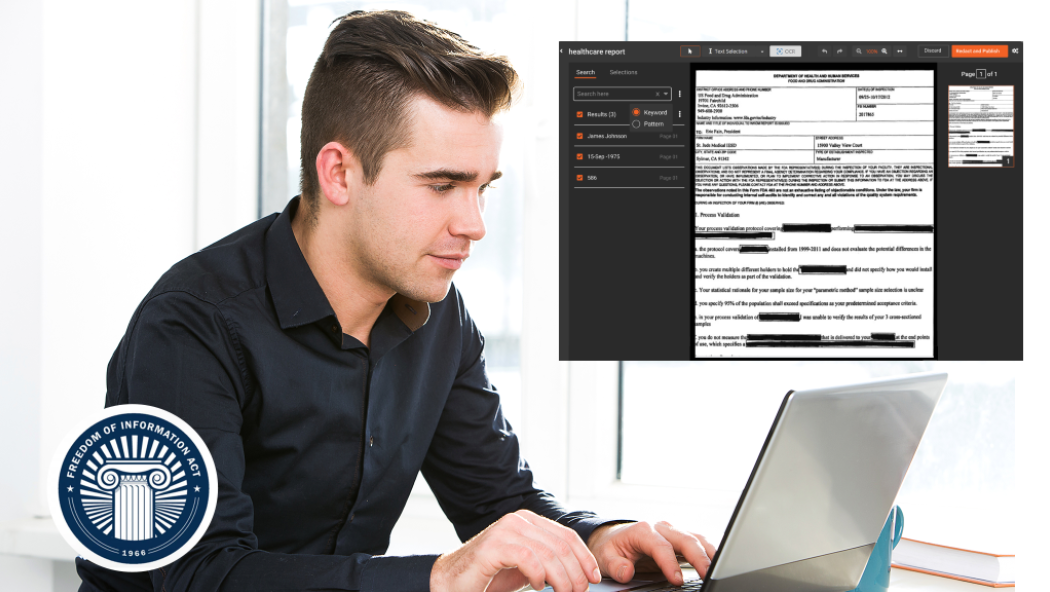
Advanced FOIA redaction software helps federal, state, and local government comply with public records requests in a timely manner.
According to the latest 2023 data obtained from the official FOIA website, more than 1.1 million FOIA requests were received, recording a 29% increase compared to 2022.
Although I’m not a fortune teller, it’s safe to say that you will receive even more requests for records due to easy information access obtained from the government. Now, the question is, with limited FOIA staff, how will you comply with FOIA requests within the stipulated time of 20 business days?
Because not only do you have to comply with these increasing number of requests within tight deadlines, but you also have to make sure that you do not unintentionally disclose some sensitive information, such as:
- Personally identifiable information (PII)
- Protected health information (PHI)
- Confidential commercial information (CCI)
- Sensitive but unclassified information (SUI)
- Payment Card Industry (PCI) Information
- Any information falling under the nine FOIA exemptions
This is where advanced FOIA redaction software can help you save time, resources, and money, which can range in thousands of dollars for just a single FOIA violation. Even worse, you can get behind bars for violating FOIA.
Complying with FOIA is an act of balancing transparency and privacy. While the public can request information from the government, it should not be provided to them intact if it contains sensitive information that could cause physical or psychological harm to a person or damage national security.
The majority of states have their own version of FOIA, so the consequences of not complying with it vary. Moreover, each state has its own unique provisions regarding the management of FOIA requests. This is why it is important to understand each state's FOIA version.
This is why this blog will help you understand FOIA-like laws at the state level and how public records redaction software helps you. But before that, let us catch a glimpse of what FOIA redaction software is.
What is FOIA Redaction Software?
FOIA records request redaction software helps you perform the balancing act of ensuring both transparency and privacy of information by letting you automatically detect and redact sensitive information, such as names, addresses, social security numbers (SSNs), account numbers, faces, license plates, and more using artificial intelligence (AI).
Advanced FOIA redaction software lets you redact sensitive information from all types of content, whether it is body-worn camera footage, 911 call recordings, investigative reports, or images of crowded streets with bystanders.
Now, let’s proceed to learn about the different FOIA laws in the US.
Information Request Laws in the US
As mentioned above, there are different versions of FOIA at the state level. Let’s list down some of them before we proceed to discussing them:
- Freedom of Information Act (FOIA)
- Public Records Act (PRA)
- Sunshine Law
- New York Freedom of Information Law (FOIL)
- Illinois Freedom of Information Act
- Pennsylvania’s Right-to-Know Law (RTKL)
- Michigan’s Freedom of Information Act
- Open Records Act
Now, let’s discuss each of the above:
Freedom of Information Act (FOIA)
The Freedom of Information Act (FOIA) is a federal law that offers the public the right to request information from any US federal agency. Enacted in 1966, FOIA strives to balance transparency and privacy. The public can request any information, except for the following nine FOIA exemptions:
- National defense or foreign policy
- Internal personnel rules and practices
- Matters exempted by other statutes
- Trade secrets and commercial or financial information
- Inter- or intra-agency memoranda or letters
- Personnel, medical, and similar files
- Law enforcement records or information
- Financial institution reports
- Geological and geophysical information and data concerning wells.
Federal departments are mandated by the law to respond to records requests within 20 days. This creates significant challenges for FOIA staff to comply with requests while ensuring privacy and meeting deadlines.
Public Records Act (PRA)
Public Records Act (PRA) is the state-level version of the federal Freedom of Information Act (FOIA) applicable in the following states:
- California
- North Carolina
- Washington
- Arizona
- Massachusetts
- Oregon
- Louisiana
- Alabama
- Nebraska
- Nevada
- Montana
- Vermont
Let’s cover each of them in detail:
California Public Records Act (CPRA). As the name indicates, California Public Records Act (CPRA) is the Californian version of FOIA. Dubbed as “one of the nation’s most strict data privacy laws,” CPRA mandates businesses to review requested records within 10 days.
The following types of information are exempted from disclosure under CPRA:
- Medical information
- Provider of health care or a covered entity
- Personal information
- Vehicle information
- Credit information
- Personal information
In case CRPA requirements are not met, authorities slap penalties of up to $7,500 for each intentional violation. Although there are no official numbers for CPRA requests received, considering that California is the most populous state, that must be a significant number.
Can you imagine responding to them while being short-staffed? No, right? This is why you need to get help from record requests redaction software.
North Carolina Public Records Act. The North Carolina Public Records Act does not specify the deadline for responding to public records requests. Instead, it states that government agencies should be allowed “reasonable times.” However, departments in North Carolina state have specified their request response times.
For instance, the North Carolina Department of Revenue (NCDOR) asks for 16 days to respond to requests due to the large number of requests received.
The following records are exempted from disclosure under the North Carolina Public Records Act:
- Communications between attorneys and government clients
- State tax information
- Trade secrets
- Criminal investigation records
- Certain lawsuit settlements
- Records about industrial expansion
However, certain personal information, such as the name and age of state government personnel, is considered public information.
Violation of the North Carolina Public Records Act results in a fine of up to $500 for each offense made.
Washington Public Records Act. The Washington Public Records Act requires local government agencies to respond to information requests within five days. The following are some of the information types exempted from disclosure to the public:
- Names
- Addresses
- Taxpayer’s information
- Social security numbers (SSNs)
- Financial information
- 911 communications
Automated public records redaction software helps local government agencies redact sensitive information from requested content while ensuring information transparency.
Arizona Public Records Law. The Arizona version of the federal information request law does not specify a deadline for responding to public records requests. However, agencies in Arizona usually request a time of 30 days to respond to requests.
In case of violation of Arizona Public Records Law, agencies have to bear the requester’s legal costs. The following information needs to be redacted to avoid violations:
- Trade secrets and intellectual property information
- Student records
- Donor information
- Research records
Massachusetts Public Records Act. Massachusetts's state FOI law requires government agencies to respond to requests within 10 business days. The following information needs redaction if found in non-exempted records:
- Information that would violate individual privacy
- Trade secrets
- Public policy development memos
- Investigative materials
Oregon Public Records Law. The Oregon state information request law mandates that government agencies acknowledge the receipt of public records requests within a period of 10 business days. Oregon Public Records Law has more than 500 exemptions to public records disclosure, including the following:
- Personal identifying information
- Testimony and evidence in a hearing
- Trade secrets
- Electronic court records
- Child support records
- Mediation communications
- Privileged communications
- Identity of an informer
Louisiana Public Records Act. The Louisiana public records request law excepts agencies to respond to requests within three business days. Such a short deadline requires an automated public records request redaction software that helps agencies comply with requests faster while ensuring the following information is redacted:
- Lawyer-client communication and common interest privileges
- Records relevant to juveniles
- Health records
- Tax returns
- Trade secret information
- Email communications
Alabama Public Records Law. The Alabama version of the federal Freedom of Information Act (FOIA) mandates agencies to respond to requests within 15 days of acknowledging the receipt.
As per the law, the following exempted information needs to be redacted from public records before complying with the request:
- Banking records
- Juvenile court records
- Hospital and probation reports
- Identity of Medicaid recipients
- Reports of suspected disease cases
- Tax and financial statements
Nebraska Public Records Law. The Nebraska state-level FOI law mandates government agencies to respond quickly to public information requests within a 4-day timeframe. The following information is exempted from disclosure under the state law:
- Personal information on the student and personnel records
- Medical records
- Trade secrets
- Academic and scientific research
- Attorney work product
- Law enforcement or investigative records
- Some archaeological records
- Real estate appraisals
Nevada Public Records Act. According to Nevada Public Records Act (NPRA), agencies are required to respond to public records requests within five business days. What makes NPRA different from the rest of the law is the fact that it contains more than 300 exemptions, including the following:
- Trade secrets
- Confidential water and energy information
- Hazardous and radioactive waste information
Montana Public Records Act. Like Nevada, Montana Public Records Act requires agencies to respond to requests within five business days. The law contains only two exemptions:
- Private writings
- Personal privacy concerns
Vermont Public Records Act. The Vermont state FOI law mandates government agencies to respond promptly to public records requests within two business days. The following information is exempted according to the law:
- Law enforcement crime investigations
- Identity of a confidential source
Texas Public Information Act
What makes the Texas Public Information Act interesting is the sheer number of exemptions. There are more than 30 exemptions. To put things into perspective, FOIA has just nine of them. Some of the exemptions of Texas PIA are as follows:
- Personnel information
- Litigation or settlement negotiations involving the state
- Competition or bidding information
- Certain real estate information
- Certain legislative documents
- Certain investigations or prosecution documents
- Certain private communications of public office holders
- Certain trade or financial secrets
- Student records
With so many exemptions, it might be safe to say that redaction of exempted information found in public records poses a significant challenge for FOIA personnel.
The penalties of violating PIA pose even greater challenges since you can be jailed or slapped with a fine for releasing sensitive information that is exempted from disclosure. Automated public records request redaction software might help tackle this challenge.
Sunshine Law
The Sunshine law is applicable in the following states:
- Florida
- Missouri
- South Dakota
- Wyoming
The following is a detailed overview of each one of them:
Florida’s Sunshine Law. Florida’s Sunshine Law guarantees the people of Florida access to governmental meetings held at both the state and local levels along with public records. Violation of the Sunshine Law results not only in fines but also imprisonment.
Like any other FOI law, the Sunshine Law also has some specific exemptions, such as:
- Personally identifiable information (PII)
- Medical information
- Identities of undercover officers in law enforcement agencies
- Photographs of government personnel
- Identities of victims in sexual harassment cases
To ensure the protection of such information, it is necessary to opt for public records redaction software that can automatically detect and redact sensitive information from government records.
Failure to do so can result in penalties up to $500 for each offence and 60 days in jail, and you would not want that to happen.
Missouri’s Sunshine Law. The Sunshine Law of Missouri requires government agencies to respond quickly to public records requests within three business days. The following information is exempted from disclosure under Missouri’s Sunshine Law:
- Mobile video recordings
- Criminal investigation records
- 911 calls
- Crime scene photographs and videos
Violating Missouri’s Sunshine Law results in a penalty of up to $100 per offence and the agency bearing the legal costs of the requester.
South Dakota’s Sunshine Law. Like the Sunshine Law in Florida, South Dakota’s Sunshine Law does not specify a deadline for responding to a public information request.
The following exemptions are a part of the Sunshine Law of South Dakota:
- Savings and loan association reports
- School records
- Juvenile court records
- Adoption records
- Hospital licensing and inspection information
- Medical research information
The Sunshine Law of South Dakota penalizes the violator at a rate of $50 per day.
Wyoming’s Sunshine Law. The Sunshine Law of Wyoming also doesn’t specify any request response time. Meanwhile, the following information is exempted from disclosure under the law:
- Law enforcement investigation records
- Testing materials
- Details of state institutions’ research projects
- Labor negotiations
Freedom of Information Law (FOIL)
The state of New York is subject to the Freedom of Information Law (FOIL). As a citizen of New York, you can request audit and quality improvement records, budget records, child support services records, Commissioner’s Office records, contract/purchasing records, and more. The following are some of the frequently requested records under FOIL:
- Email communications between key people
- Agency logs or internal reports
- Training manuals
- Database or spreadsheets
What’s interesting about this state public records request law is the short deadline of five business days to respond to the request. Like any other information request law, there are certain exemptions, such as personal privacy, law enforcement records, internal communications or memos, etc.
To ensure that such information does not get disclosed at any cost, FOIL officers need to use an automated records request redaction software. Failing to properly redact sensitive information results in the agency ending up paying the requester’s attorney fees and bearing other legal costs.
Illinois Freedom of Information Act
Although Illinois uses the same name as the federal public records request law for the corresponding law, i.e., Freedom of Information Act (FOIA), one thing that differentiates both is the stipulated time to respond to information requests.
While the federal counterpart has room for 20 business days to respond to requests, the Illinois state FOIA law only grants 5-21 days to FOIA staff.
Sensitive details, such as private and personal information, law enforcement records, business trade secrets, and more, are exempt from public disclosure under the Illinois FOIA. In case exemptions are violated due to inadequate redaction, a significant fine of up to $5,000 per offence is imposed on the agency.
Pennsylvania’s Right-To-Know Law (RTKL)
What makes Pennsylvania’s Right-To-Know Law (RTKL) distinguished is the sheer number of exemptions as well as the strict deadline to comply with public records requests. The law requires commonwealth, local, legislative, and judicial agencies to respond to requests within five business days.
Exempting 30 information types from public disclosure, the following are some of the statutory exemptions:
- Health records
- Trade secrets
- Criminal investigation records
- 911 records
- Sensitive geographical sites
- Identity of minors
- Insurance communications
Agencies should be extra careful in following these exemptions since improper redaction can cost them up to $2,000 for each offence. This is why a records request redaction software is the need of the hour.
Michigan’s Freedom of Information Act
Like many state FOI laws out there, Michigan’s Freedom of Information Act (FOIA) mandates agencies to respond to public records requests within five business days. However, agencies can request an additional ten days to respond to substantial requests.
As mentioned in a Michigan State Government document, “law enforcement exemptions of the Michigan FOIA are more restrictive than parallel provisions of the federal FOIA.”
To ensure that restrictive exemptions of Michigan’s FOIA are followed during the redaction of sensitive public records requests, it is essential to use advanced FOIA redaction software that helps respond to FOIA requests faster while ensuring exemptions are followed.
Open Records Act
Open Records Act refers to the state-level freedom of information law applicable in different states, such as:
- Kentucky
- Ohio
- Tennessee
- Georgia
- Colorado
- Oklahoma
- Kansas
Let’s discuss the particularities of each of them in some detail as follows:
Kentucky Open Records Act. The Kentucky Open Records Act (KORA) mandates agencies to respond to information requests within a short deadline of three business days.
Moreover, state legislation has a total of 14 exemptions for the disclosure of information to the public. While most of these exemptions are that of the federal information request law, some of them are unique, such as:
- Records disclosed to an agency for research purposes
- Records that would disclose any agencies overseeing financial institutions’ internal audit criteria
- Records given to an agency confidentially to get a grant, tax credits, or a license to do business.
Improper redaction of sensitive information found in requested records can lead to a jailtime of 12 months and fines of up to $500 per offence.
Ohio Open Records Act. The Ohio Open Records Act does not specify a deadline for responding to public records requests. In fact, the time to respond to requests made under this state law depends on the clarity of the request.
Ohio’s freedom of information law contains a total of 15 exemptions. Some of these exemptions are listed as follows:
- Medical records
- Trial preparation records
- Law enforcement investigation records
- Social security numbers (SSNs)
Like the Kentucky Open Records Act, the Ohio version also slaps a fine of up to $500 in case exemptions are violated or requested records are improperly redacted leaving out sensitive information.
Tennessee Open Records Act. The Tennessee Open Records Act grants a seven-day period to respond to public records requests. The Public Records Exception database reveals that certain kinds of information are exempted from disclosure, such as:
- Birth certificates
- Insurance filing and claims data
- Juvenile records
- Proprietary information
- Student records
- Hospital and patient records
- Trade secrets
- Wiretap recordings
- Patient-doctor communications
Like the New York FOIL, violation of the Tennessee information request law results in the agency bearing the requester’s legal costs.
Georgia Open Records Act. Georgia Open Records Act (GORA) requires agencies to respond to information requests within three business days. Exemptions to information under GORA include the following:
- Records specifically required by federal statute or regulation to be kept confidential
- Medical or veterinary records and similar files
- Investigative law enforcement records
- Prosecution records and mugshots
- Motor vehicle accident reports
- Jury list data, and more.
Violating GORA or failing to properly redact sensitive, exempted information results in significant fines ranging from $1,000 for the first offence to $2,500 for recurring offence. This is why public records redaction software is needed for local government agencies to ensure compliance with the state information request law.
Colorado Open Records Act. The Colorado Open Records Act (CORA) mandates local government agencies to respond to public information requests within three business days. To maintain a balance between information transparency and privacy, CORA exempts the following information from disclosure:
- Personnel files
- Law enforcement investigations
- Research projects conducted by state institutions
- Real estate appraisals when property is being acquired for public use
- Certain tax records
Violation of CORA, improper redaction of sensitive information, and missing deadlines results in fines of up to $100 for each offence.
Oklahoma Open Records Act. Like the Ohio Open Records Act, the Oklahoma version of the freedom of information law does not specify any deadline for responding to public records requests. Moreover, the Act covers more than 20 exemptions, such as:
- Personnel records
- Law enforcement records
- Market research and marketing plans
- Litigation and investigatory files
- Federal records
- Communications received by a public official
Like Kentucky’s information request law, Oklahoma Open Records Act slaps a penalty of $500 for each violation and puts the violator behind bars for a maximum of 12 months.
Kansas Open Records Act. The Kansas version of the federal Freedom of Information Act (FOIA) commonly receives requests for information, including Kansas statutes, regulations, policies, meeting records, salaries of public officials, and agency budget documents.
In efforts to keep a balance between transparency and privacy, there are certain exceptions to KORA, such as the following:
- Personnel information of public employees
- Medical treatment records
- Records protected by attorney-client privilege
- Records closed by the rules of evidence
- Records containing personal information compiled for census purposes
- Notes and preliminary drafts
- Criminal investigation records
In case of missing the deadline of 3-day request response time, not following KORA exemptions, or the overall violation of KORA, agencies end up paying up to $500 for each offence and awarding attorney fees and legal costs to the affected party.
Virginia Freedom of Information Act
The Virginia version of the federal public information request law mandates local government agencies to respond to public records requests within five business days. The law has the following exemptions for disclosing information to the public:
The Virginian information request law slaps penalties of up to $500 per offence and a maximum of 10-day jail time in case deadlines are missed or improper redactions are made to the requested records. Having FOIA redaction software at your disposal can save you from this.
Redact Government Records with VIDIZMO Public Records Redaction Software
VIDIZMO Redactor is an AI-powered public records redaction software that offers a comprehensive solution to automatically redact sensitive records, be it video, audio, document, or image-based.
The AI-powered redaction software automatically detects and redacts personally identifiable information, such as faces, license plates, vehicles, etc. Moreover, its spoken PII redaction capability lets you automatically redact sensitive portions of 911 calls and other audio recordings.
Try out VIDIZMO Redactor for free or contact us today to know more about how VIDIZMO Redactor can help you respond to public records requests faster while ensuring compliance with your state FOI law. 
FAQ
Frequently Asked Questions
What is public records redaction software?
Public records redaction software is a specialized AI-powered solution for redacting sensitive and exempted information from public records that are requested. Public records redaction software ensures that agencies comply with information request laws, such as the federal Freedom of Information Act (FOIA) and other state-level FOI laws.
Why do federal, state, and local government agencies need records request redaction software?
Federal, state, and local government agencies need records request redaction software to ensure that public records requests are responded to within the stipulated time. Advanced records request redaction software uses artificial intelligence (AI) to speed up the redaction workflow and ensure greater accuracy compared to manual redaction.
How FOIA redaction software helps ensure that the 9 FOIA exemptions are followed?
FOIA redaction software ensures that the 9 FOIA exemptions are followed by using AI-powered redaction workflows, Advanced FOIA redaction software offers features, such as object detection and tracking, spoken PII redaction, OCR-based redaction for scanned documents, confidence scores for evaluating the detection accuracy, and more to ensure FOIA compliance.
What makes VIDIZMO Redactor the best public records redaction software?
VIDIZMO Redactor offers precise redaction of public records requests by using AI-powered technologies along with human-in-the-loop approach for manual redaction. VIDIZMO Redactor uses advanced computer vision and natural language processing (NLP) technologies for object detection and tracking, spoken PII redaction, transcript-based redaction, and more.
Are redacted records securely stored in VIDIZMO records request redaction software?
Yes. Redacted records are securely stored in VIDIZMO records request redaction software. VIDIZMO Redactor offers advanced security features, such as data at-rest and in-transit encryption, custom security policies, IP and geo-restrictions, SSO login, multifactor authentication (MFA), and more.
TopicsRedaction

About the author
Rafey Iqbal is a Product Marketing Analyst at VIDIZMO specializing in enterprise video, digital evidence management, and AI redaction technology. He translates complex product capabilities into sharp, practical content that speaks directly to IT leaders, compliance officers, and operations teams.
You may also like

What Is a Real-Time Crime Center? A Guide for Cities and Counties
Somewhere in the last two years, someone probably asked your department whether it should have a real-time crime ...

Staffing a Real-Time Crime Center When Software Does the Watching
Most chiefs who hear a pitch for a real-time crime center ask the same question before any other, which is whether they ...

RTCC, EOC or Situational Awareness Center: What Each Room Is For
Walk into a real-time crime center, then into a city's emergency operations center, and you will see much the same ...