Physical security integrators install, maintain, and manage CCTV systems for dozens or sometimes hundreds of clients. Government offices, school districts, commercial buildings, retail chains, healthcare campuses. The service contract covers hardware, software, maintenance, and monitoring. What it often does not explicitly cover is what happens when the client receives a request to share, redact, or release footage.
And yet those requests land on the integrator anyway.
A city facility manager gets a FOIA request. A school district receives a subpoena for cafeteria footage. A commercial client needs footage released to an insurance carrier with employee faces removed. In each case, the client turns to the company managing their CCTV system. If the integrator has no answer, the relationship is strained. If the integrator has the wrong answer, with redaction handled informally and privacy missed, the exposure falls on both parties.
Video redaction is becoming a standard service expectation in managed CCTV. Integrators who build it into their stack are adding measurable value. Those who don't are creating a gap that will eventually cost them a contract.
The Redaction Gap in CCTV Service Contracts
Most CCTV service agreements are built around infrastructure: camera installation, recording system setup, monitoring, and break-fix support. Privacy compliance and specifically video redaction is rarely written into the scope of work.
That gap existed quietly for years because footage release requests were infrequent enough that clients handled them ad hoc. That is no longer the case. Several factors have made redaction requests a routine part of operating a CCTV system:
Expanding public records laws
State open-records statutes now cover municipal clients in ways that require regular footage releases. FOIA request volumes have grown steadily, and advocacy organizations increasingly submit bulk requests covering extended time periods. For a detailed breakdown of state-level obligations, VIDIZMO's FOIA redaction compliance guide covers the exemptions and documentation requirements relevant to footage releases.
Privacy regulation
GDPR in Europe and CCPA/CPRA in California created affirmative obligations to protect identifiable individuals in footage before it is shared externally. Organizations that fail to redact appropriately face regulatory fines, not just reputational exposure. CCTV redaction for GDPR compliance outlines what those obligations look like in practice for surveillance footage specifically.
Insurance and litigation
Premises liability claims, workers' compensation disputes, and employment litigation routinely involve CCTV footage. Releasing that footage without redacting uninvolved parties creates additional privacy exposure on top of the underlying claim.
Security system proliferation
As camera counts grow, driven by AI analytics adoption and IP camera cost reduction, the volume of footage that may need to be redacted per incident grows proportionally.
Integrators whose clients span government, education, and commercial verticals are seeing redaction requests across all of them. The question is whether that becomes a friction point or a service line.
When Clients Ask for Redacted Footage and Why It Lands on the Integrator
The client's logic is straightforward: the integrator runs the system. They know where the footage is, how to access it, and how to export it. Asking them to also make it privacy-compliant before release is a natural extension of the relationship.
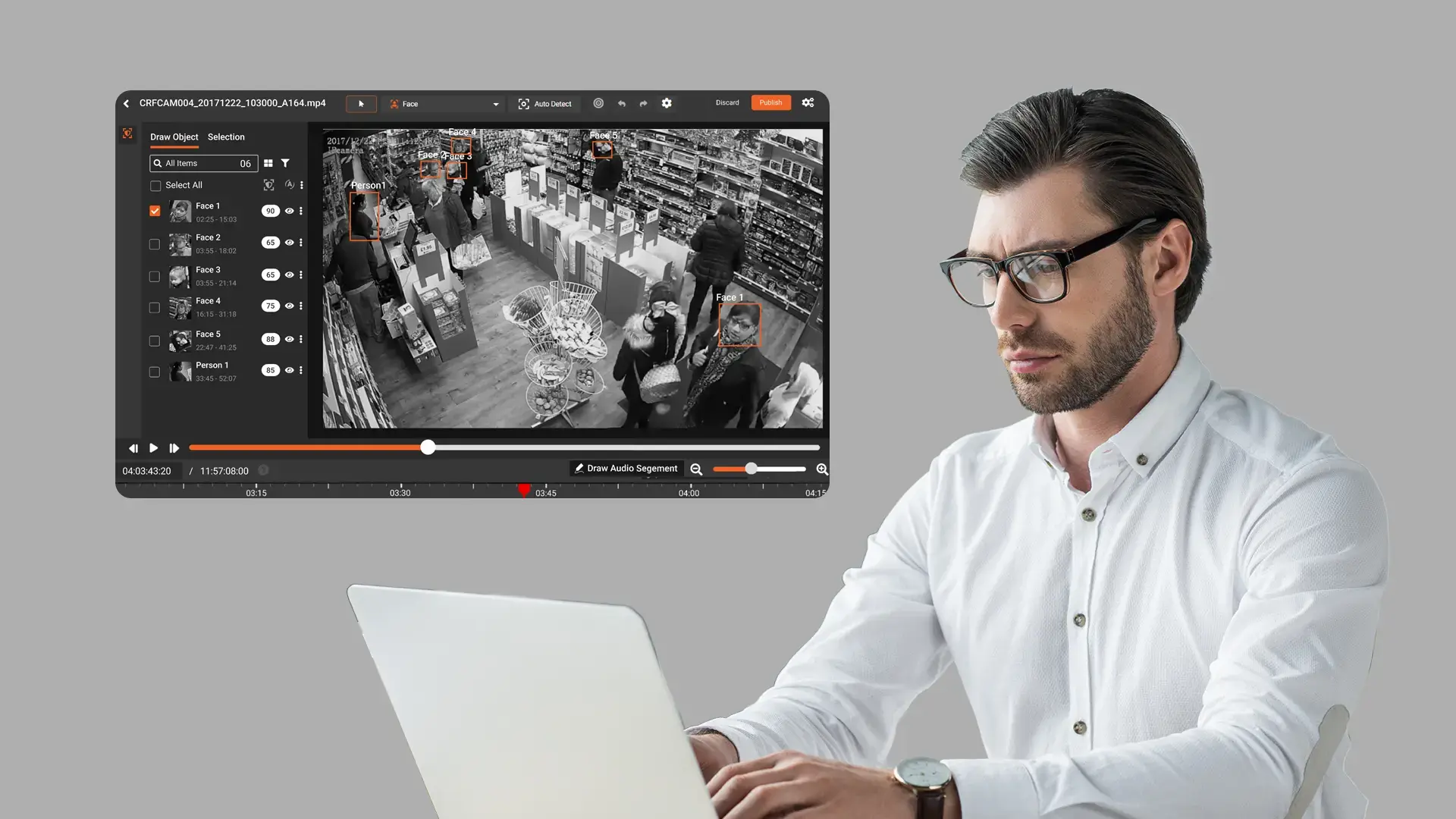
The operational reality is more complicated. Redacting footage requires specific technical capabilities, including AI object detection, frame-accurate tracking, audit logging, and exemption code documentation, that most integrators do not have built into their service stack.
Without purpose-built tools, the integrator faces a choice between declining the request (straining the relationship), attempting it manually (hours of analyst time, inconsistent results, legal risk), or subcontracting it (margin compression and chain of custody concerns).
None of these are good outcomes. And the frequency of the request is increasing.
What Redaction as a Managed Service Looks Like Operationally
Integrators who add redaction to their service offering typically structure it in one of two ways:
Self-Service with Managed Platform Access
The integrator deploys a redaction platform, either in its own environment or as a white-labeled SaaS, and provides client administrators with access to submit footage for redaction. The integrator handles platform management, configuration, and support. Clients submit footage, review results, and export redacted files. The integrator earns a recurring technology fee and differentiates the service contract.
Fully Managed Redaction Service
The integrator handles the entire redaction workflow on behalf of the client: ingesting footage, running AI detection, applying redactions, conducting quality review, and delivering redacted output. This model requires more internal capacity but commands a higher service fee and creates a deeper dependency in the client relationship.
Both models require the same underlying capabilities in the platform: reliable AI detection, configurable workflows, multi-client access controls, audit logging, and the ability to handle the proprietary CCTV formats that most IP camera systems produce.
Key Features Integrators Need: Batch Processing, Multi-Client Access, Audit Logs
When evaluating redaction software for an integrator service model, the feature requirements differ from what a single-client deployment needs. Integrators should prioritize:
Batch and Bulk Processing
A client submitting footage from a multi-camera incident scene may send 10 to 20 recordings simultaneously. The platform needs to handle concurrent batch jobs without requiring manual queueing by the integrator. Purpose-built bulk CCTV video redaction tools support batch processing with queue-based automation. Files are submitted, processed sequentially or in parallel, and delivered without manual intervention per file.
Multi-Client Access Controls
The integrator's platform must maintain strict separation between client data. Each client's footage should be accessible only to that client's authorized users and the integrator's designated support staff. Role-based access control with client-level permissions, not just user-level, is essential. This prevents cross-client data exposure while allowing the integrator to manage the platform centrally.
Audit Logs per Client
When a client's footage is redacted and released, the entire workflow should be documented in an audit log: who submitted the footage, what AI detections were applied, what manual adjustments were made, who approved the output, and when the redacted copy was exported. This log belongs to the client's record and should be exportable for legal or compliance purposes.
Proprietary CCTV Format Support
Client systems run a wide range of IP cameras and DVR/NVR equipment. The footage formats are not always standard MP4 or AVI. Platforms that require manual pre-conversion before processing create friction and introduce error risk. Look for platforms that automatically detect and rewrap proprietary H.264 CCTV container formats, which is a material operational advantage for integrators managing heterogeneous client environments.
Redaction Styles and Configurable Detection
Different clients have different requirements. A government client needs FOIA exemption codes documented with every redaction. A commercial client may only need face blurring before sharing with their insurance carrier. The platform should support configurable detection sensitivity, multiple redaction styles (blur, pixelate, black box), and client-specific rule templates that can be applied without reconfiguring from scratch on each job. For a broader overview of what to evaluate, this video redaction software selection guide covers the key criteria.
Deployment Options
Some integrator clients, particularly in government and healthcare, have data residency requirements that restrict footage from leaving their network. The redaction platform should support on-premises deployment for these clients alongside SaaS for clients without those restrictions. An integrator with a mixed client base needs a platform that handles both without maintaining two separate product lines.
How VIDIZMO Redactor Fits an Integrator's Service Stack
VIDIZMO Redactor is built for the multi-client operational model that integrators run. It processes video, audio, images, and documents across 255+ file formats, including proprietary CCTV H.264 formats that are automatically rewrapped to standard MP4, so integrators don't need to pre-convert footage before processing.
The platform supports multi-tenant deployments with isolated access controls per client, AI detection of faces, license plates, vehicles, and custom objects tracked persistently across frames, and configurable confidence thresholds from 25% to 90% to balance coverage against review workload. Every redaction action is logged with user, IP address, and timestamp in a tamper-proof audit trail, and original recordings are preserved separately from redacted outputs to maintain chain of custody for both.
Deployment options include SaaS, dedicated cloud, on-premises, government cloud (FedRAMP High via ProjectHost), and hybrid models. An integrator with a mixed client base covering commercial, government, and healthcare can match each client's data residency requirements without running separate platforms.

Building Redaction Into the Service Contract
Integrators who have not yet formalized redaction as a service offering can structure it as a tiered add-on to existing CCTV management contracts. A basic model might include:
- Platform access tier: Client gets a login to the redaction platform and can self-service routine requests. Integrator provides configuration, support, and training.
- Managed service tier: Integrator handles the full redaction workflow, from submission through delivery. Client gets audit-ready output with no internal effort.
- Compliance tier: For government and regulated-industry clients, includes FOIA exemption code documentation, compliance reporting, and chain of custody delivery as part of the service.
Each tier creates recurring revenue, differentiates the service contract from commodity CCTV installation, and deepens the client dependency in a way that supports renewal and expansion.
The Competitive Argument for Adding This Now
The physical security market is consolidating. Clients increasingly expect their integrators to handle more of the privacy and compliance surface area that comes with operating surveillance systems, not just the hardware. Integrators who position themselves as full-lifecycle CCTV partners, including privacy compliance, are better positioned in competitive RFPs and renewal conversations than those offering installation-and-maintenance-only contracts.
Redaction is not a niche add-on. It is a core operational requirement for every client subject to public records laws, privacy regulation, or litigation, which in practice means most of them.
Want to see how VIDIZMO Redactor fits into a managed CCTV service model? Book a demo or explore deployment options for multi-client integrator environments.
FAQ
Frequently Asked Questions
Do physical security integrators have a legal obligation to redact client CCTV footage?
Not always directly, but integrators managing CCTV systems for government or regulated-industry clients are often the de facto point of contact when a footage release is required. If redaction is handled incorrectly or skipped, liability can extend to the integrator depending on the service agreement and applicable privacy laws.
What is the difference between a self-service and fully managed redaction model for integrators?
In a self-service model, the integrator deploys and manages the redaction platform while clients handle their own submissions. In a fully managed model, the integrator runs the entire workflow from ingestion to delivery. The managed model commands higher fees but requires more internal capacity.
Can redaction software handle footage from multiple CCTV brands and formats?
Yes, platforms like VIDIZMO Redactor support 255+ file formats, including proprietary H.264 CCTV container formats from major IP camera and DVR/NVR manufacturers, which are automatically rewrapped to standard MP4 without manual conversion.
How do integrators keep client footage separated on a shared redaction platform?
Through multi-tenant architecture with client-level access controls. Each client's footage is only accessible to that client's authorized users and designated integrator staff, preventing cross-client data exposure while allowing centralized platform management.
What should be included in a redaction audit log for CCTV footage?
A complete audit log should capture who submitted the footage, what detections were applied, any manual adjustments made, who approved the output, and when the redacted file was exported, along with user ID, IP address, and timestamps for each action.
You may also like
Making a Digital Recording the Official Record
Most guidance about digital court recording assumes the argument is over. It describes microphones, channels, ...

A Maturity Model for Court Digital Evidence: Foundational, Developing, Advanced
Budget conversations about court technology go badly when the ask is a product and well when the ask is a stage.

Online Evidence Portal or eFiling: Where Should Exhibits Actually Be Submitted?
Courts deciding where exhibits should be submitted are choosing between an online evidence portal for court exhibits ...