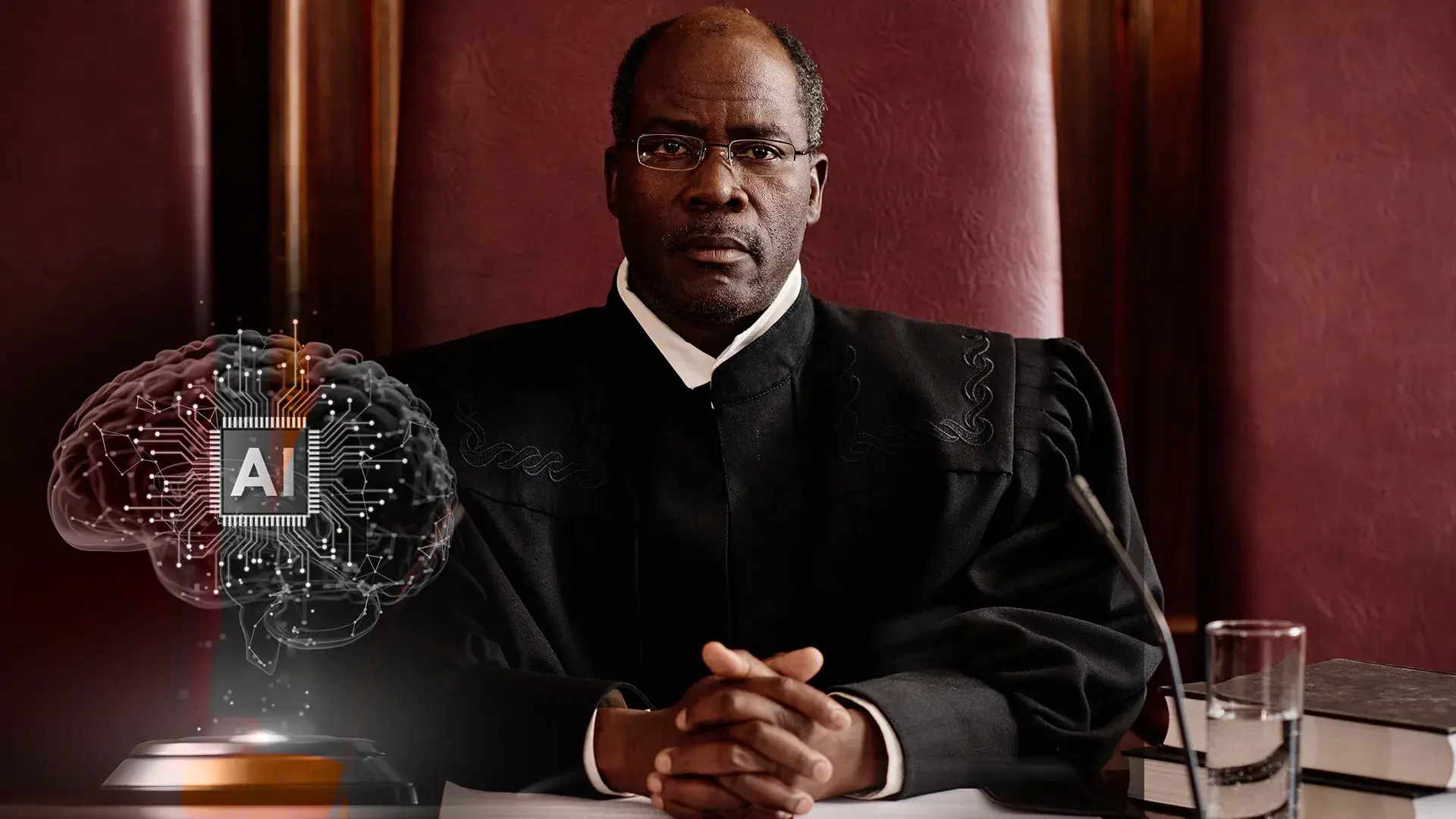
Judges are already using AI. A Northwestern University study of 502 sampled federal judges found more than 60 percent of the 112 who responded had used an AI tool at least once in their judicial work, and around 22 percent used one daily or weekly. UNESCO's global survey, feeding guidelines drawn from consultation across more than 160 countries, found 44 percent of judicial operators had used AI tools while only 9 percent said their institution had issued guidance or provided training. Seventy-three percent said there should be mandatory rules.
That combination, widespread use with almost no training and an explicit appetite for regulation, is the actual situation. The question of whether to allow AI on the bench was settled by adoption before most courts wrote a policy. What remains is the harder question: which tasks genuinely help a judge, which are off limits, and how a court tells the difference before it signs a contract.
This guide is for judicial officers deciding what is worth using, and for the court IT and legal staff who will have to support it.
It is deliberately not the policy document. Who approves a use case, what gets disclosed to parties, how review is recorded, what the logs must contain and what a vendor must commit to are institutional decisions, and they are set out in writing a court AI policy. This article assumes that document exists or is being written, and asks the narrower question underneath it: which tasks genuinely help a judge, which are off limits, and how a court tells the difference.
The workload that created the demand
Nobody adopted these tools because they were interesting. They adopted them because the volume stopped being humanly tractable.
A modern case file is not a folder of pleadings. It is filings, exhibits in a dozen formats, transcripts of prior hearings, video and audio, expert reports, and correspondence, accumulated over months by parties with an incentive to file more rather than less. A judge is expected to arrive at the hearing having absorbed all of it, form a view, and rule.
Some of that work is genuinely judicial and does not compress. Weighing credibility, applying law to facts, exercising discretion, and writing reasoning that will bind future parties are the job, and no tool substitutes for them.
But a large share of the surrounding work is mechanical. Finding the passage where a witness said something. Establishing which exhibits were admitted and which were refused. Locating how comparable matters were handled before. Reading a 300-page filing to extract the six facts that matter. Reconciling documents that disagree. These are retrieval and organization problems dressed as legal work, and they consume the time that should go to the parts that are not.
The commercial market has noticed. There are products sold specifically into courts today for brief and motion summarization, for tentative-draft generation, and for judicial data warehousing, from established legal-technology suppliers and from startups built for this buyer alone. Several US state court systems have run drafting pilots. This is a real category with real buyers and reference customers, not a speculative one.
That maturity cuts both ways for a court evaluating options. It means the tools are past the demonstration stage and reference customers exist, which is a genuine improvement on the position two years ago. It also means the category now contains products built for quite different jobs under similar language. A judicial data warehouse, a brief summarizer, and a drafting assistant are not variations on one thing, and a court that has not decided which problem it is solving will be shown all three and struggle to compare them. Deciding the task before taking the meeting is the cheapest thing on this list.
The line every authority draws
Across three separate bodies governing three different regions, the guidance converges on the same principle, and it is worth stating in the terms they use.
UNESCO's Guidelines for the Use of AI Systems in Courts and Tribunals, published in 2025 as the first global framework of its kind, advocates AI as an assistive rather than substitutive tool, always under meaningful human supervision. The Council of Europe's CEPEJ adopted its European Ethical Charter on the use of AI in judicial systems in 2018, built on principles including respect for fundamental rights, non-discrimination, quality and security, and transparency, impartiality and fairness. In the US, Chief Justice Roberts has written that AI cannot substitute for the wisdom, judgment, experience, and informed discretion a human judge exercises.
India's SUPACE is the clearest working example of what compliance with that principle looks like in a shipped system. Launched in 2021 as the Supreme Court Portal for Assistance in Court's Efficiency, it sifts large case files, surfaces related precedents, summarizes evidence, and drafts outlines. It is explicitly barred from decision-making. Its designers describe it as augmented intelligence: the machine handles collection and analysis, the judge does the reasoning.
A detail from SUPACE's rollout is worth noting for anyone planning a deployment. The Supreme Court has said the constraint on wider use is hardware rather than software, because the models need high-grade GPUs to run at scale. Courts intending to run these tools inside their own environment should budget accordingly.
What sits on the wrong side of the line
Stating the principle is easy. The useful version is naming what falls outside it, because vendors will not always do that for you.
Off limits at the bench: outcome prediction, sentencing recommendation, risk scoring that feeds a discretionary decision, and anything that produces a conclusion the judge is invited to adopt rather than reach. European legal scholarship identifies predictive systems in judicial proceedings as high risk or unsuitable, and the reasoning is not squeamishness. A model trained on prior decisions reproduces the patterns in those decisions, including patterns a court would not defend if they were stated explicitly.
The full permitted, restricted, and prohibited tiering, written so a court can hand staff a list rather than a principle, belongs in the court AI policy. One boundary from it is worth restating here because judges enforce it in the room rather than read it in a document: nothing may summarize or analyze evidence for a jury, which is worked through in giving jurors access to admitted evidence.
There is a gray area worth naming honestly. Drafting assistance sits close to the line, because a draft carries reasoning. Courts that permit it, and several now do, require the judge to read and edit before anything is adopted. AI drafting support and the review gate works through what that gate has to enforce, what gets logged, and why the draft is a starting point rather than an output.
What actually helps at the bench
Set against that, the genuinely useful applications are narrower than the marketing but more valuable than skeptics expect.
Finding things. Filename and metadata search fails on a case file of any size. Semantic retrieval across filings, transcripts, media, and exhibits, with every answer cited back to the document and page, is the single highest-return capability. Working a case file from search through to analysis covers how retrieval turns into structured preparation, and where that work must stop.
Returning to the moment. Corroborating testimony means going back to the exact point in a recorded proceeding where something was said, during the hearing or years later on appeal. With the stenographer shortage pushing courts toward audio as the primary artifact, finding the moment a statement was made has become a routine need rather than an occasional one.
Precedent within your own record. Judges look for how comparable matters were handled before. This splits into two products that get conflated: searching published case law, which is what Westlaw, Lexis, and vLex do, and searching a court's own prior rulings and transcripts, which is retrieval over the judiciary's own corpus. The second is where a court's institutional memory actually lives, and it is usually unsearchable.
Reviewing evidence properly. The judge-facing interface for looking at evidence is a distinct system category in the National Center for State Courts (NCSC) framework, not a permission level on an administrator console. The judicial viewer covers playback, document display, metadata inspection, private annotation, and sealed material, delivered consistently across in-person, remote, and hybrid hearings.
Testing what is in front of you. When authenticity is challenged, the judge has to decide what a hash proves, what an audit trail shows, and where the burden sits. Verifying an exhibit from the bench approaches integrity from the ruling side rather than the preservation side, which is how nearly all other guidance is written.
Human oversight has to be a step, not a sentence
Every framework requires human oversight. Most court policies satisfy that requirement with a sentence saying a human reviews the output. That is not oversight, it is an assertion about oversight.
Designed oversight looks different. It means the review is a step the workflow cannot skip, that the reviewer sees what the system based its answer on rather than only the answer, that the act of review is recorded, and that the record shows who reviewed and when. If a court cannot later demonstrate that a person examined a given output before it was relied on, the oversight requirement was decorative.
Citation to source is what makes this workable in practice. An answer pointing to the document, page, and timestamp it came from can be checked in seconds; an answer arriving without provenance requires the reviewer to redo the work, which means the review either does not happen or eliminates the time saving that justified the tool.
This is also the foundation of answering a challenge later. When opposing counsel asks how a result was reached, the court needs to reconstruct it.
Disclosure, and what a court should be ready to explain
Courts are converging on the principle of disclosure and diverging on its scope, and the scope is an institutional decision rather than a bench one. Whether parties are told that AI assisted preparation, whether that differs between a research task and a drafting task, whether a party may object, and what the court says if asked which model ran and where, are all settled in the court AI policy rather than case by case.
What matters at the bench is narrower. Do not be asked the question for the first time in open court. A judge who cannot say whether the court has a position has told the parties something about the court's governance, and it is the reason 73 percent of judicial operators told UNESCO they wanted mandatory rules. People using these tools would rather have a boundary than improvise one.
Working out what to permit in your own court? Request a demo to see how citation, review gates, and audit logging work in practice.
Evaluating a bench tool
Procurement runs the full diligence, and the eight questions that actually separate suppliers are set out in what courts should ask AI vendors before signing anything. Two of them deserve a judicial officer's own attention, because they decide whether a tool is usable on the bench rather than merely compliant on paper.
Does every answer cite its source? If a claim cannot be traced to a document, page, or timestamp, the judge cannot verify it and the review step becomes theater. Ask to see it working on a case file the vendor did not prepare.
Is the review gate enforced by the product or left to policy? A policy-only gate fails under time pressure, which is exactly when a judge is reaching for the tool. Ask for a demonstration of the workflow attempting to skip review, and watch what happens.
How VIDIZMO AI Intelligence Hub fits
AI Intelligence Hub is a multi-modal AI processing platform. In a court context, its relevance is retrieval and comprehension over material the court already holds, rather than anything that reaches toward a decision.
Three capabilities map to the bench problems above. Cross-library semantic search runs across transcripts, optical character recognition output, detected objects, and metadata, with source citations attached to every answer, which is the property that makes judicial review of an output practical rather than nominal. Transcription across 82 languages with speaker separation turns recorded proceedings into text a judge can search rather than audio somebody has to scrub. And summarization over long documents and recordings compresses reading without hiding where the summary came from.
It runs on customer-controlled models and deploys inside the court's own environment, including on-premises and air-gapped configurations, which addresses the residency and model-control questions above rather than deferring them.
Where it is the wrong tool: it holds no published case-law corpus, so it does not compete with legal research databases and should not be positioned against them. Its transcription runs after a proceeding rather than live, so it is not a real-time captioning service. It does not detect synthetic or manipulated media. And by design it does not evaluate, recommend, or decide anything, which is a limitation for anyone shopping for judicial decision support and the entire point for everyone else.
The position worth taking
The uncomfortable fact in the UNESCO numbers is that adoption has already outrun governance, everywhere, at once. Judges are using tools they were not trained on, under policies that mostly do not exist, and asking to be regulated.
For a court, the useful response is not a ban, which the adoption data suggests would be ignored, and not enthusiasm, which invites the tools that should never touch a bench. It is a written boundary: which tasks are permitted, what must be disclosed, how review is enforced and recorded, and what a vendor must answer before anything is signed.
AI tools for judges are worth having for the mechanical half of the work. The reasoning half was never the bottleneck, and it is not what these systems should be asked to carry.
Request a demo to walk through citation, review gates, and deployment options against your court's requirements.